Highlights:
- Longfor’s longer-term bonds fell sharply. It reflected the market expected a higher chance of defaults for the bonds. However, Longfor is superior to the peers in terms of operation, sales, credit profile and financing. In theory, it has a higher chance of surviving in this Chinese real estate crisis.
- Amongst the Chinese real estate bonds, the Group’s case is so rare that the large declines in the bond prices are not due to its own liquidity concern or any debt issue. It is different from most of the past cases. Additionally, the Group repurchased bonds for a few times and the major shareholder continued to buy bonds. Together with a lot of market rescue measures coming out, the longer-term bonds have rebounded a lot.
- We do not expect Longfor to default on its offshore bonds in the short-term. However, the industry outlook is not yet clear. Those developers which have a better credit profile might gradually deplete their liquidity. Therefore, we believe that investors should take a more conservative approach towards Chinese real estate bonds. Even though Longfor still has enough funds on hand, its longer-term bonds are still subject to higher credit risks.
Longer-term bonds Fell Sharply; The Market Expected a Higher Chance of Defaults
In early October, the longer-term bonds of Longfor Group (“Longfor”) fell sharply (Chart 1). For example, the 2027 USD bond fell significantly from around $75 at the beginning of the month to around $25 at the end of the month. This once reflected the market expected a higher chance of defaults for the bonds.
Chart 1: Longfor’s USD bonds
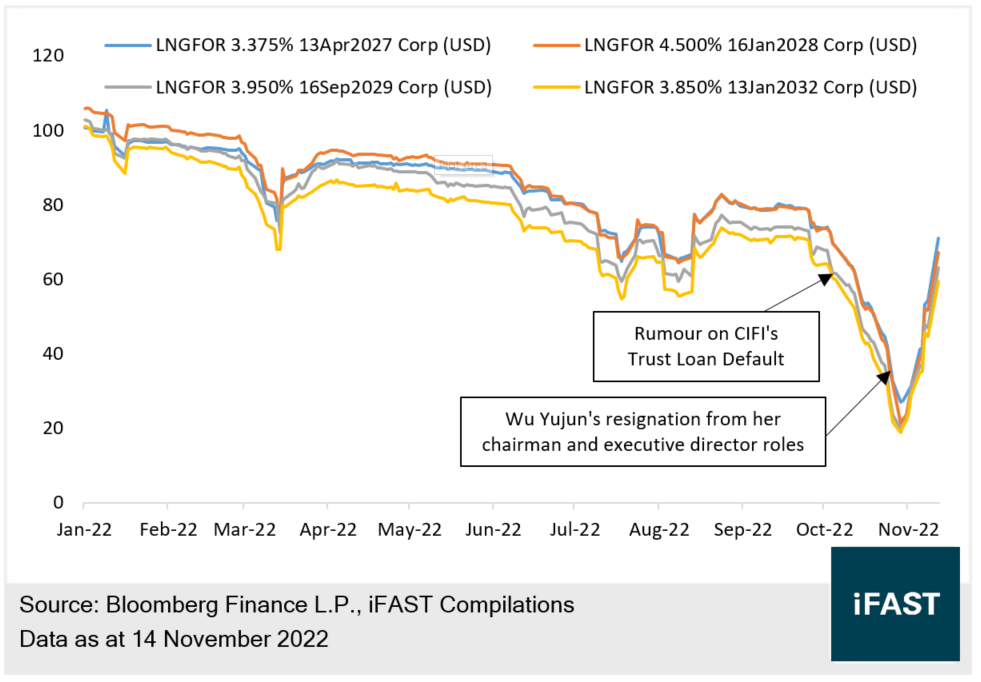
The reasons for a large decline in Longfor's bonds at that time included (1) CIFI Group’s unexpected default of trust and interest on bonds, which dragged down the overall performance of Longfor as both CIFI Group and Longfor are considered as “High-quality Developer”, (2) a stock market crash in China and Hong Kong markets which dragged down the real estate bonds and (3) the resignation of Wu Yajun, the founder of Longfor, from her chairman and executive director roles in the excuses of health reasons during the time between life and death in the industry (“the resignation event”). So, there were suspicions that the group has hidden issues or even liquidity problems.
Longfor is Superior to its Peers in terms of Different Aspects, with Higher Chance of Surviving in this Chinese Real Estate Crisis
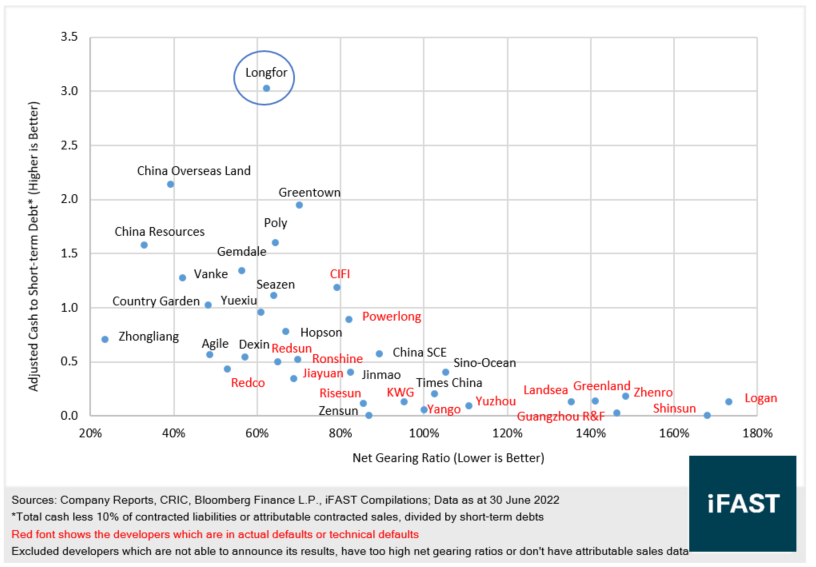
Longfor was once regarded as the best non-state-owned developer, mainly because of its sufficient cash on hand, with an adjusted cash to short term debt ratio of 3 times, the highest among the Chinese real estate developers in our coverage list (Chart 2), and a net gearing ratio of 60%, a manageable level.
Chart 2: Chinese Real Estate Developers’ Adjusted Cash To Short-term Debt and Net Gearing Ratio
Meanwhile, Longfor's short-term debt is only about 10% of its total debt. The debt maturity profile is very decent, with only about 10% to 15% of its total debt maturing each year. The average cost of borrowing is as low as 4%, far better than the peers’ average of around 7% to 8% levels.
The Group are still keeping land purchases since the beginning of the year, with cost of land acquisition to about RMB 28.8 billion (on attributable basis) in the first ten months, indicating its better-than-peers credit profile and liquidity.
In addition, Longfor's sales performance was more stable than its peers’, with cumulative attributable contracted sales for the first ten months only declining 33% YoY to RMB 106 billion. Its decline rate is much better than the average peers’ decline rate of around 50% level.
Meanwhile, the Group has massive investment properties to generate rental income. The cumulative rental revenues for the first ten months were RMB 9.8 billion. Other operating revenues (including property management, commercial operation etc.) were around RMB 9.3 billion. This diversified business model has an advantage over its peers who rely solely on property contracted sales.
In terms of financing, Longfor continued to issue onshore bonds since the beginning of the year, including issuing a number of corporate bonds amounted to RMB 5 billion and a medium-term note of RMB 1.5 billion. The medium-term note is fully guaranteed by China Bond Insurance Corporation, a state-owned enterprise.
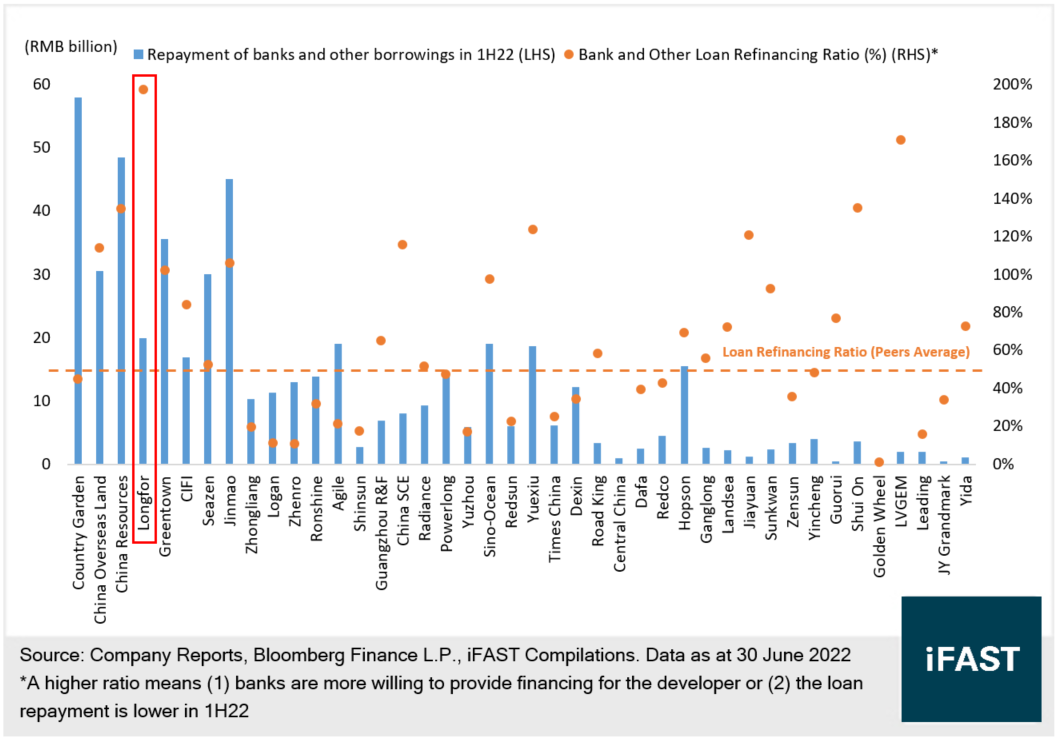
In addition, during the first half of the year, the Group's proceeds from banks and other borrowings were around RMB 39.2 billion, with a bank and other loan refinancing ratio (proceeds from banks and other borrowings / repayments of bank and other borrowings) reaching 197% (see Chart 3). The ratio is much higher than the average peers of around 50%. This shows that the Group's refinancing ability is much better than its peers and represents a certain degree of financial support from the government, banks and regulators.
Chart 3: Chinese Real Estate Developers’ Repayments of Bank and Other Borrowings and Bank and Other Loan Refinancing Ratio
Overall, Longfor is superior to the peers in terms of operation, sales, credit profile and financing. In theory, it has a higher chance of surviving in this Chinese real estate crisis. Its solvency remains good at the moment.
The Major Shareholder Bottom Fishing Stocks and Bonds, together with the Group’s Bond Repurchases
Since 31 October, Longfor's major shareholder, Charm Talent International Limited, (controlled by the family of former chairman and founder Wu Yajun) increased its positions in the Group's stocks and bonds (Table 1). We deduce that the major shareholder invested more than HKD 130 million in the stocks and bonds after the resignation event, which might reflect her continued confidence in the Group's prospects. We tend to believe that the resignation might not have much to do with the liquidity of the Group. Our view is not aligned with the market consensus.
It is emphasized that the large decline of the Group’s bond prices to $30 or below is not due to its own liquidity concern or any debt issue. It is very rare amongst the Chinese real estate bonds and is different from most of the past cases. This means that even if the Group's bond price fell to a level close to the default level, it still has a greater chance of recovery compared to other real estate developers who defaulted or are close to default. Indeed, thanks to the recent good news from all sides, the Group's bond price bounced back a lot from the bottom and outperformed its peers.
In addition, the Group also took the opportunity to repurchase USD bonds at a discount (Table 1). As of 8 Novembe, the Group has repurchased partial USD bonds, with a total principal amount of USD 9 million. According to our estimate, the repurchase price was around 25% to 45% of the bond par value, which helped to reduce the Group's debt repayment costs. This also demonstrated that it had better liquidity than its peers and still had more offshore funds available at the holding company level.
Table 1: The Records of Group’s Repurchase and Major Shareholder Purchase Bonds and Stocks
|
Date |
Purchases of Major Shareholder |
The Group’s Repurchases |
||
|
Stock (Shares amount) |
Average Purchase Price of Stocks |
Bond (Principal Amount in USD) |
Bond (Principal Amount in USD) |
|
|
10/31/2022 |
3 million |
9.53 |
5 million |
/ |
|
11/1/2022 |
3 million |
10.48 |
2.8 million |
/ |
|
11/2/2022 |
1 million |
11.27 |
5 million |
/ |
|
11/3/2022 |
/ |
/ |
5.2 million |
4 million |
|
11/7/2022 |
/ |
/ |
5 million |
3 million |
|
11/8/2022 |
/ |
/ |
3 million |
2 million |
|
Total |
7 million |
10.2 |
26 million |
9 million |
|
Sources: Company’s Announcements, iFAST compilations Data as of 8 November 2022 |
||||
In early November, in response to the concern about liquidity tightening, the Group chose to repay some of its debts early, including repaying a part of the syndicated loan of HKD 5.1 billion due in 2023 and redeeming USD 300 million bond due in April 2023 through a make-whole call, reflecting that the Group really has more funds on hand.
Short-term Default Risk is Low but Longer-term Bonds are Still Subject to Higher Risks
Unless there is a bigger black swan event (including the rumour about some developers’ delay to remit the funds, resulting in the failure to remit funds from the onshore to the offshore), Longfor is not expected to default on its offshore bonds in the short-term.
Given the sudden resignation of the former Chairman, Wu Yajun, from the Group's roles, investors feel panicked and sold off the bonds, which were once oversold. However, the Group repurchased bonds for a few times and the major shareholder continued to buy bonds. Moreover, a lot of market rescue measures are coming out, such as the second round financing of China Bond Insurance Corporation to non-state-owned developers, with a scale of around RMB 20 billion, PBoC’s “Second Arrow” which supports financing of non-state-owned enterprises, with a scale of up to RMB 250 billion and China’s “16-point Plan” to rescue the property sector. Therefore, the longer-term bonds have rebounded a lot.
However, the industry outlook is not yet clear. China has maintained a strict zero-COVID policy in battling against the virus. There is no signal of recovery in the property sales. More developers fell into credit crisis. These all mean that the recovery of Chinese property sector will take a longer time, maybe even years or more. This might lead to the gradual depletion of liquidity for those developers which have a better credit profile.
Therefore, we believe that investors should take a more conservative approach towards Chinese real estate bonds. Even though Longfor still has enough funds on hand, its longer-term bonds are still subject to higher credit risks. It might not be an appropriate time for investors to buy its bonds now and hold them until maturity.
Conclusion
Longfor’s longer-term bonds fell sharply. It reflected the market expected a higher chance of defaults for the bonds. However, Longfor is superior to the peers in terms of operation, sales, credit profile and financing. In theory, it has a higher chance of surviving in this Chinese real estate crisis.
Amongst the Chinese real estate bonds, the Group’s case is so rare that the large declines in the bond prices are not due to its own liquidity concern or any debt issue. It is different from most of the past cases. Additionally, the Group repurchased bonds for a few times and the major shareholder continued to buy bonds. Together with a lot of market rescue measures coming out, the longer-term bonds have rebounded a lot.
We do not expect Longfor to default on its offshore bonds in the short-term. However, the industry outlook is not yet clear. Those developers which have a better credit profile might gradually deplete their liquidity. Therefore, we believe that investors should take a more conservative approach towards Chinese real estate bonds. Even though Longfor still has enough funds on hand, its longer-term bonds are still subject to higher credit risks.
Declaration: For specific disclosure, at the time of publication of this report, IFPL (via its connected and associated entities) and the analyst who produced this report hold a NIL position in the abovementioned securities.
Our podcast series, Yield Hunters, is available on Spotify, iTunes Podcasts and Google Podcasts. We share our thoughts on new bond issues and hold discussions on
the fixed income space. Listen to our latest episode below and follow us!