Company Background
Matrix Concepts Holdings Berhad is a property developer that is best known for its flagship project, Bandar Sri Sendayan in Negeri Sembilan. Besides the Sendayan Developments (comprising of Bandar Sri Sendayan, Ara Sendayan and Tiara Sendayan), Matrix Concepts’ other major project is in Kluang, Johor namely the Bandar Seri Impian project. Collectively, Bandar Seri Sendayan and Bandar Seri Impian contribute ~75% of its total gross development value (“GDV”)[1].
Matrix Concepts is listed on the Kuala Lumpur Stock Exchange with a market capitalization of RM 1.58 billion as of 3 March 2020. Its major shareholder is Dato’ Lee Tian Hok, the founder and CEO of Matrix Concepts, who has a deemed interest of around 35% of the company. Other notable shareholders include the Employees Provident Fund Board (“EPF”) at 8.14%[2].
Financial Highlights
Matrix Concepts’ business has been consistent over the years, with property development making up the lion’s share of its revenue contribution (about 96% of total revenue). The company’s education and hospitality businesses make up the rest of its revenue.
In the past three financial years[3], Matrix Concepts has displayed strong profitability measures, both in terms of gross margins and operating margins. Its gross margin (gross profit over revenue) has consistently averaged about 50%, while its operating margin (EBIT over revenue) has consistently hovered above 30%. Matrix Concepts’ latest trailing-twelve-month (“TTM”) operating margin stood at 30.09% as of Q4CY2019. These profitability metrics indicate Matrix Concepts’ strength in managing costs, given the company’s focus on mid-range properties that do not normally command a premium.
Business analysis
Competitive advantage: low land cost
As previously mentioned, Matrix Concepts has had strong gross margins of above 50% across the past three financial years. Much of this can be attributed to the company’s competitive advantage of purchasing land at a bargain. According to a sell-side report by KAF, Matrix Concepts bought its Bandar Sri Sendayan site for approximately RM3 per square feet (“psf”) 10 years ago. While the opportunities to purchase land at such a low cost are unlikely to arise frequently and perpetually, our analysis on Matrix Concepts’ balance sheet suggests that the company still maintains a relatively low average land cost, with an average land bank cost of RM9.72 psf as of 31 March 2019.
Sufficient landbank
Matrix Concepts has been shoring up its landbank on a consistent basis. More recently, Matrix Concepts added landbanks across Negeri Sembilan, Johor, and Kuala Lumpur for an average value of RM 10.18 psf[4].
As of 31 December 2019, Matrix Concepts has a total of 1,979 acres of land with a combined potential GDV value of RM10.1 billion. Assuming RM1.2 billion worth of GDV is developed each year, Matrix Concepts’ existing landbank should be sufficient for the next eight years.
Low inventory of unsold completed property
The property sector continues to be plagued with an oversupply of houses as well as soft demand, which have proven to be a cause of concern for prospective investors. To that end, we have analyzed Matrix Concepts’ inventory levels to gauge the extent of Matrix Concepts’ exposure to the overhang problem.
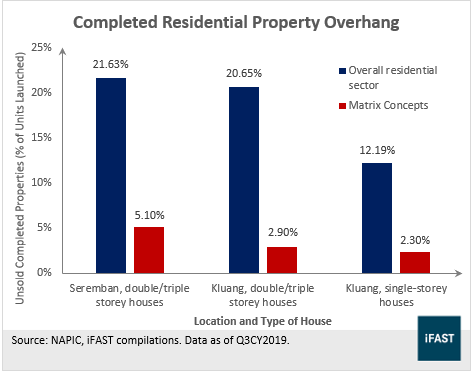
Based on our analysis, Matrix Concepts has little inventory buildup of completed properties. Notably, the company only has a maximum of 5.1% (minimum take-up rate of 94.9%) of unsold completed properties across Bandar Seri Sendayan and Bandar Seri Impian.
To provide context to the local property overhang problem, we have compared the percentage of unsold properties of Matrix Concepts versus the overhang percentage in Seremban and Kluang. For the broader residential sector in Seremban, we have looked at the overhang of double/triple story houses. For Kluang, we compared the overhang of both single-story houses and double/triple story houses to the percentage of completed unsold properties of Matrix Concepts.
Figure 1: Unsold completed property units across Seremban (double/triple story) and Kluang (single-story and double/triple-story)
We
are cognizant of the risk that ongoing projects yet to be completed may
subsequently face poorer sales. While sales of Matrix Concepts’ ongoing
projects are not moving as fast as the average take-up rate of completed projects,
we take comfort from the fact that projects that are to be completed in 2020
have an average take-up rate of 78%, well in line with the overall take-up rate
of the company. Only Ara Sendayan Phase 4 (Precinct 2A) registered an
abnormally low take-up rate of 29% as of Q4CY2019,
a situation that we suspect is due to the higher price point (average house
price of RM 783,607), which may have put off prospective homebuyers. Table 1
shows the take-up rates across the Bandar Seri Sendayan and Bandar Seri Impian projects
that are expected to be completed in 2020.
Table 1: Take-up rates across projects with expected completion in 2020.
| Project | Total Units | GDV (RM million) | Take-Up Rate | Launch Year |
|
Hijayu Resort Homes (Phase 4) | 232 | 181.5 | 94% | 2018 |
|
Ara Sendayan Phase 3 (Precinct 3B) | 168 | 119.9 | 95% | 2018 |
|
Ara Sendayan Phase 4 (Precinct 2A) | 244 | 191.2 | 29% | 2018 |
| Tiara Sendayan 1 | 404 | 151.5 | 100% | 2018 |
|
Tiara Sendayan 2 | 504 | 226.0 | 100% | 2018 |
|
Tiara Sendayan 3 (Precinct 4) | 363 | 158.6 | 99% | 2019 |
|
Impiana Square (Phase 1) | 113 | 110.2 | 46% | 2016 |
| Source: Company |
Growing international footprint: diversifying into Jakarta and Melbourne
Matrix Concepts marked its entry to Indonesia via a 30% stake in a JV company, PT Fin Centerindo Satu. The JV partners Matrix Concepts with leading corporates in Indonesia such as Salim Group, Agung Sendayu (one of Indonesia’s largest property developers), and Nikko Sekuritas, and will undertake the development of Menara Syariah Twin Towers in Pantai Indah Kapuk 2 as part of the plan to develop Jakarta’s Islamic Financial District. This project is touted to be Jakarta’s next financial hub. Targeted to be completed in 2021, the potential GDV to be reaped from this project is estimated at around USD 250 million.
In addition to its newly carved footprint in Jakarta, Matrix Concepts successfully delivered in 2018 its maiden project M.Carnegie in Melbourne, Australia, with a 100% take-up rate. Following M. Carnegie’s success, Matrix Concepts launched another project in 2019—M.Greenvale—with a projected GDV of AUD 27.8 million (around RM 79 million), which is expected to be completed in 2021.
Peer comparison
In order to put Matrix Concepts’ credit profile into perspective, we have benchmarked the company against Malaysia-listed property developers. We will refer to the median values of various credit metrics of the listed property developers as “industry average”. All financial numbers used henceforth are based on the latest available financial data as of 2 March 2020, which are the recently released Q4CY2019 financial results.
Profitability
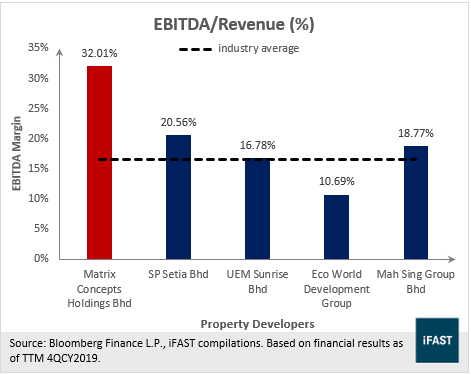
Matrix Concepts’ ability to procure land at low prices translates into its excellent profit margins, despite its mid-tier property strategy, as evidenced by its EBITDA margin. The company registered an EBITDA margin of 32.01% as of TTM Q4CY2019, significantly higher than the industry average of 16.54%. Additionally, the company’s TTM Q4CY2019 EBITDA margin is also the highest among the selected peers.
Figure 2: EBITDA margin (EBITDA/revenue) comparison across the property development sector
Gearing
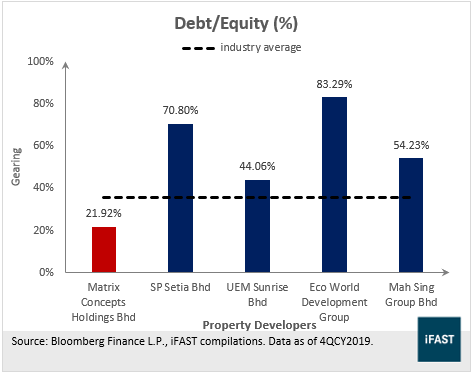
Using the debt-to-equity ratio as a yardstick for gearing, Matrix Concepts shows a strong balance-sheet discipline as the company has managed to keep its debt-to-equity ratio below 50% over the past eight years[5]. More recently, Matrix Concepts’ gearing ratio stood at 21.92% as of Q4CY2019, well below the industry average of 35.86%. Interestingly, Matrix Concepts gearing is also well below that of other notable listed property developers, which appear to be more aggressively geared.
Figure 3: Gearing (total debt/equity) comparison across the property development sector
Interest cover
The company’s financial discipline is also showcased via its ability to service interest expense. Using operating income (EBIT) over interest expense as a yardstick, Matrix Concepts has close to 13 times of operating income over interest expense, well above the industry average of 3.42 times. Suffice to say, Matrix Concepts has abundant headroom to take on more borrowings.
Figure 4:
Interest cover (EBIT/interest expense) comparison across the property
development sector
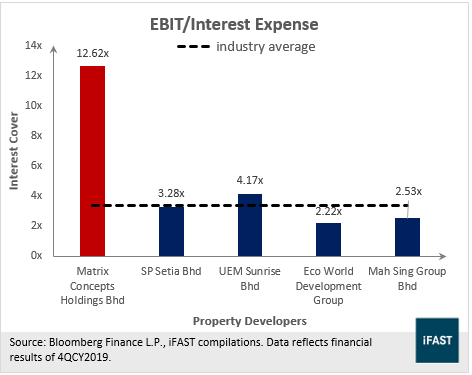
Figure 4: Interest cover (EBIT/interest expense) comparison across the property development sector
Refinancing risk
Over the past three financial years, Matrix Concepts has had, in general, a 50-50 ratio between its short-term and long-term borrowings. As of Q4CY2019, 52.64% of Matrix Concepts’ total borrowings were short-term borrowings.
That being said, with a cash position of RM 242.1
million, Matrix Concepts’ refinancing risk appears low. This is further
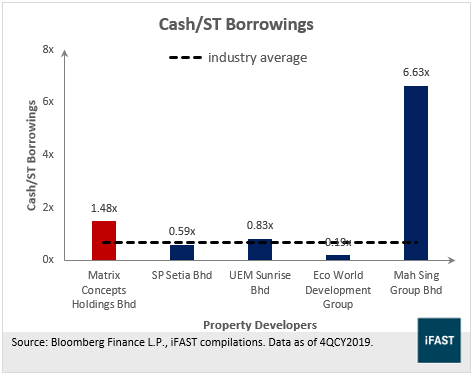
supported by its cash over short-term borrowings of 1.48 times, more than twice
the industry average.
Figure 5: Cash over short-term debt
comparison across the property development sector
Figure 5: Cash over short-term debt comparison across the property development sector
About the Matrix Concepts sukuk
Matrix Concepts is drawing down RM 50 million from its Islamic commercial papers and/or Islamic medium-term notes programme, which is based on the principle of Wakalah and has a programme limit of RM 250 million. The programme is unrated. The sukuk has a tenure of three years with a distribution rate of 5.5%, targeted to be issued on 6 March 2020.
The sukuk is ranked “secured” and at all times will rank at least paari paasu with all other present and future secured and unsubordinated obligations of the issuer. The sukuk is secured by the finance service reserve account (“FSRA”).
In addition to being secured, the sukuk is
subject to financial covenants such as the maintenance of finance to equity
(“F: E”) ratio of 0.85 times, and maintaining a finance service cover ratio
(“FSCR”) of 1.25 times throughout the tenure of the sukuk.
Valuation
At 5.5%, Matrix Concepts’ three-year notes provide a 289-basis point (“bps”) spread over the on-the-run 3Y MGII. Investors can look to the recently issued sukuk of Mah Sing as a pricing reference. On 25 February 2020, Mah Sing raised RM 600 million via an unrated Islamic medium-term notes programme under the principle of Murabahah. Mah Sing’s unrated bond due 2025 was priced at a profit rate of 4.35%.
Using the metrics we referred to in the peer comparison section as a yardstick, Matrix Concepts’ credit profile appear to be stronger as compared to Mah Sing. Matrix Concepts has a higher profit margin, lower gearing, and higher interest coverage. While we are cognizant of the material differences between the sukuk bonds of Matrix Concepts and Mah Sing, which include the issue size, issue structure, as well as the issuer’s frequency of bond issuance—all of which has an impact on market pricing—we like Matrix Concepts’ upcoming sukuk for the 115 bps yield pick-up.
Declaration: For specific disclosure, at the time of publication of this report, IFPL (via its connected and associated entities) holds a principal interest in the new issue Matrix Concepts bond. The analyst who produces this report own none of the above mentioned securities.