Receive first-hand news on the latest bond issues, credit updates and special events when you join us on our Telegram channel at https://t.me/bondsupermart!
Azalea Asset Management (“Azalea”), the sponsor of the popular Astrea Private Equity (“PE”) bonds, hosted their annual Astrea Investors Day on 21 Feb 23. The speakers consisted of Mr Chue En Yaw, Chief Investment Officer at Azalea and Mr Lim Jun Jie, Director of Investor Relations at Azalea.
Mr Chue kicked us off by introducing Azalea and provided a market update to PE while Mr Lim spoke on the resiliency of Astrea PE bonds and performance updates on each of the Astrea transactions. Here is a summary on the points mentioned on Astrea Investors Day 2023. For investors who are interested to view the full presentation may view the webcast on Azalea’s website here.
About Astrea PE bonds
Astrea PE bonds are issued by Azalea Asset Management. Azalea is a wholly-owned subsidiary of Seviora Holdings Pte. Ltd., and indirectly owned by Temasek Holdings (Private) Limited. Set up in 2015, Azalea has its own board and management team independent of Temasek. The company is focused on the development and creation of investment products to provide investors a wider access to PE.
PE Bonds are asset-backed securities, or bonds, backed by cash flows from PE funds. Cash flows generated by these PE bonds will be used to pay the interest payment and the principal of the bond. Azalea have been a frequent issuer in the retail bond market and the most recent issue, the Astrea 7 bond marks its 5th installment of its PE bonds on the Singapore retail bond market.
Macro risks to Private Equity in 2023
In the current macroeconomic environment, companies that the PE funds invest in (“investee companies”) are affected by higher inflation and tighter financial conditions. High inflation results in higher operating costs for investee companies. Cost for raw materials and labour have risen substantially over the past year. Also, key interest rates remain high as central banks around the world hiked their interest rates to combat inflation. This caused higher cost of borrowing for investee companies. Tighter financial conditions may affect the growth and refinancing for investee companies. Both of these factors result in lower profit margins as operating and financing costs become higher. Investee companies may potentially see a slowdown in growth and earnings especially if they cannot pass on the higher cost to its consumers.
As such, PE funds which invest in these investee companies will experience valuation markdowns in their investments. This causes longer exit horizons as PE fund managers are unable to hit their target growth level. PE funds may hold back on their exit through a sale or an IPO. Tighter and volatile financial markets also make IPO exits harder. Some PE funds may also exit at lower valuations. All of the factors mentioned results in uncertainty over the timing and amount of distributions that investors or PE funds may expect to receive.
However, comparing to broader market returns, PE showed resilience during times of economic downturns. Compared to total returns from S&P 500 index and MSCI World Index, PE outperformed both indices since the start of the pandemic. Comparing the Preqin PE Index to the S&P 500 Index and MSCI World Index, PE outperformed both the S&P500 and MSCI World indices during the onset of the COVID-19 pandemic. The Preqin PE Index declined 9% compared to declines of 20% and 21% from S&P 500 and MSCI World index respectively. The reason for PE’s resiliency was due to valuation multiples for PE. PE valuation multiples for are typically lower compared to publicly listed companies. Lower volatility is seen in PE as the companies are marked quarterly based on the fundamental valuations of the underlying companies and are not driven by share price movements.
Azalea’s strong alignment to bondholders
Azalea as the sponsor of the Astrea PE bond have shown strong alignment to its bondholders in all of its Astrea transactions. Structural safeguards like the reserves accounts, cap on its loan-to-value (“LTV”) ratio, sponsor sharing and credit facilities all help to protect the Astrea bondholders to mitigate downside risks in an event of a shortfall in cash flows.
In order to protect bondholders against valuation declines within its portfolio of PE funds, the LTV ratios for the Astrea bonds at issuance are between 40-45%. This provides some headroom for the portfolio value to decline before reaching the 50% cap on its LTV ratio. The cap on the maximum LTV ratio ensures that the portfolio value is always at least twice the values of the Astrea bonds.
The Astrea PE bond cash distribution structure also prioritises bondholders ahead of the sponsor. As per clauses 5-6 and 8–10 of its priority of payments, interest payments to bondholders are paid first then to its reserves accounts or the repayment of bond principal. The sponsor receives the cash flows after all the clauses are being paid. This ensures that bondholders receive their cash flows and full redemption of the bonds. Additionally, some Astrea bonds have structural safeguards like sponsor sharing embedded in the notes where the sponsor will provide 50% of cash flows receive to add into the reserves accounts upon reaching its performance threshold, thereby accelerating the build-up of its reserves account.
Performance Update of Astrea bonds
Chart 1: Astrea PE bonds saw several rating upgrades since issuance
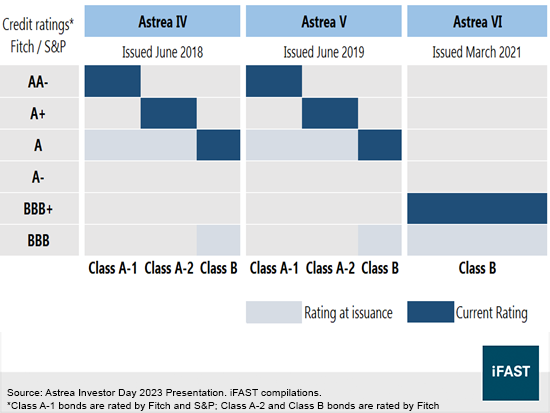
Most of the Astrea bonds saw credit ratings upgrades since issuance (Chart 1). Recently, Fitch upgraded its ratings of the Astrea V Class A-1 and Class B bonds. The Astrea V Class A-1 bond was upgraded to ‘AA-sf’ from ‘A+sf‘ while the Class B bond was upgraded to ‘Asf‘ from ‘A-sf’. The rationale for the upgrade of the Class A bond was because the bonds are fully reserved while the rationale for the upgrade of the Class B bonds was due to the decline in the bonds’ Loan-to-Value (“LTV”) ratio, net of Class A bonds reserves.
For the rest of the Astrea bonds that are still outstanding – Astrea IV, Astrea VI and Astrea 7, ratings on the bonds were affirmed by Fitch. It reflects Fitch’s view that Astrea IV Class A-1 and Class A-2 Bonds and Astrea V Class A-2 Bonds are now fully or almost fully reserved and that LTV ratios are able to withstand large declines in Net Asset Value (“NAV”).
Chart 2: Astrea IV NAV Movements (USD m)
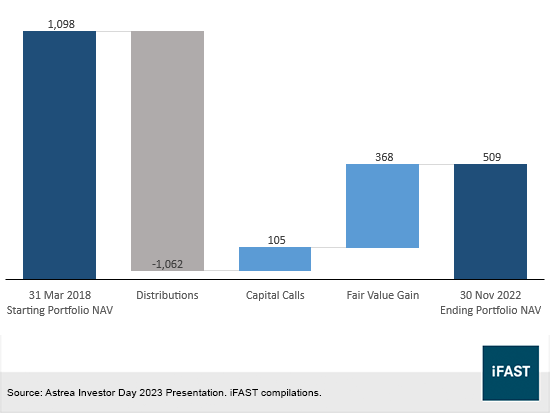
As of 30 Nov 2022, the Astrea IV portfolio had a total of USD 1.06b of distributions and fair value gain of USD 368m, resulting in an ending portfolio NAV of USD 509m.
Astrea IV Class A-1 bond was the first listed retail PE bond in Singapore. It has a call date on 14 Jun 2023 where it is mandatory for the issuer to redeem the Class A-1 bonds if the reserves account for the Class A bonds is sufficient to redeem the Class A bonds in full. As of December 2021, the Class A bonds have been fully reserved and the issuer will be redeeming the Class A bonds on the call date. On top of that, a bonus redemption premium of 0.5% will be given to Class A-1 bondholders as the Astrea IV portfolio achieved its performance threshold.
Chart 3: Astrea V NAV Movements (USD m)
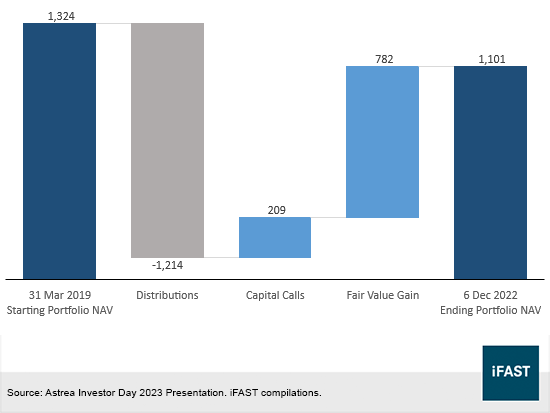
As of 6 Dec 2022, the Astrea V portfolio had a total of USD 1.21b of distributions and fair value gain of USD 782m, resulting in an ending portfolio NAV of USD 1.10b. The Astrea V class A bonds are 99% reserved while LTV ratio is at 13.3%.
Chart 4: Astrea VI NAV Movements (USD m)
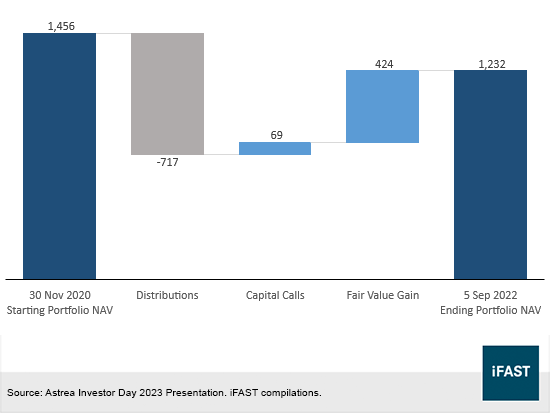
As of 5 Sep 2022, the Astrea VI portfolio had a total of USD 717m of distributions and fair value gain of USD 424m, resulting in an ending portfolio NAV of USD 1.23b. As of its last distribution date, the Astrea VI class A bonds are 34% reserved while LTV ratio was at 38.4%.
Chart 5: Astrea 7 NAV Movements (USD m)
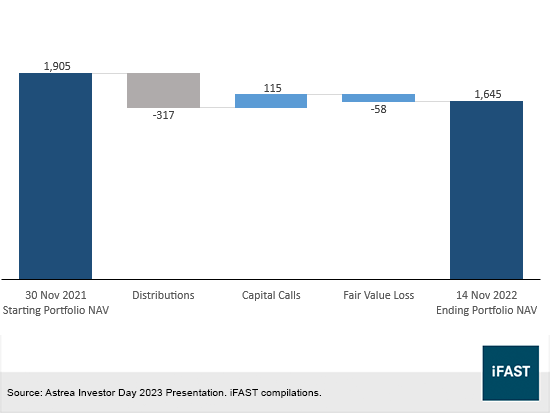
As of 14 Nov 2022, the Astrea 7 portfolio had a total of USD 317m of distributions resulting in an ending portfolio NAV of USD 1.65b. Astrea 7 being the latest PE bond by Azalea was affected by the boarder market downturn in 2022 and the portfolio saw fair value loss of USD 58m. Cash distributions from the Astrea 7 portfolio remained healthy as distributions made up 17% of its initial NAV. As of its latest distribution date, 10% of Astrea 7 class A bonds are reserved.
Summary
Overall, the event was insightful to understand the potential risks to PE funds during the current macroeconomic environment. The resiliency of Astrea’s PE portfolio can be seen from the recent performance of Astrea 7. The portfolio’s starting NAV as at 30 Nov 21 was USD 1.9b and only suffered USD 58m of fair value loss, which represents a 3% decline in NAV (excluding distributions and capital calls) from 30 Nov 21 to 14 Nov 22.
Table 1 highlights the outstanding Astrea bonds in the retail bond market. Among the Astrea bonds, we like the ASTLC 3.850% 20Jun2029 Corp (SGD) - Class A-1 bonds with an indicative yield to call of 4.48% for 1.32 years to its first call date. Its short tenor and high credit rating of AA- makes it a good alternative to fixed deposits and Singapore government securities.
Table 1: Outstanding Astrea PE retail bonds
|
Bond |
Issuer |
Currency |
Bond Price |
First call date |
Years to first call date |
Yield to call (%) |
| ASTLC 4.350% 14Jun2028 Corp (SGD) - Class A-1 - Retail | Astrea IV Pte Ltd |
SGD |
100.84 |
14-Jun-2023 |
0.31 |
1.53 |
| ASTLC 3.850% 20Jun2029 Corp (SGD) - Class A-1 - Retail | Astrea V Pte Ltd |
SGD |
99.20 |
20-Jun-2024 |
1.32 |
4.48 |
| ASTLC 3.000% 18Mar2031 Corp (SGD) - Class A-1 - Retail | Astrea VI Pte Ltd |
SGD |
94.90 |
18-Mar-2026 |
3.07 |
4.81 |
| ASTLC 4.125% 27May2032 Corp (SGD) - Class A-1 - Retail | Astrea 7 Pte Ltd |
SGD |
99.71 |
27-May-2027 |
4.26 |
4.20 |
| ASTLC 6.000% 27May2032 Corp (USD) - Class B - Retail | Astrea 7 Pte Ltd |
USD |
100.25 |
27-May-2028 |
5.26 |
5.94 |
|
Source: Bondsupermart. iFAST compilations. Data as of 22 Feb 2023. |
||||||
Declaration: For specific disclosure, at the time of publication of this report, IFPL (via its connected and associated entities) holds a position in ASTLC 3.250% 18Mar2031 Corp (USD) - Class A-2 Classified as SIP and the analyst who produced this report holds a NIL position in the abovementioned securities.
Our podcast series, Yield Hunters, is available on Spotify, iTunes Podcasts and Google Podcasts. We share our thoughts on new bond issues and hold discussions on the fixed income space. Listen to our latest episode below and follow us!