Oversea-Chinese Banking Corportion Limited (“OCBC”), the second largest financial services group in Southeast Asia, has announced a new Tier 2 USD bond offering at the initial price guidance (“IPG”) of 200 basis points above five-year US Treasury yields. The bond matures in September 2030 (first call: September 2025) and is rated A2/BBB+/A by Moody’s/S&P/Fitch.
OCBC currently has issuer ratings of Aa1/AA-/AA- by Moody’s/S&P/Fitch. As specified in the terms of the bond offering, the issuer has the option of redeeming the note in five years. In addition, a loss absorption event is triggered when the issuer is deemed to be non-viable and MAS notifies the bank that bondholders need to suffer a write-down or conversion to equity.
About OCBC
Founded in 1932, OCBC is the second largest bank in Singapore and ranked consistently among the World’s Top 50 Safest Banks by Global Finance. As one of Singapore’s largest publicly listed companies, the firm registered a market capitalization of approximately S$38 billion on 2 Sep 20. The lender has operations in 19 countries, with key markets in Singapore, Malaysia, Indonesia and Greater China.
Following its latest financials filing, Singapore accounted for nearly 41% of the bank’s loans to customers, while Malaysia, Indonesia and Greater China represented 59.2% of customer loans in aggregate. When classified by industries, building and construction constituted the biggest exposure of the loan portfolio, at 25.8% in June.
Besides providing an array of commercial banking services to individuals and institutions, OCBC has an 87.9% stake in the insurance company Great Eastern Holdings, which is listed on the Singapore Exchange with a market cap of S$9.00 billion. Lion Global Investors Limited, the asset management subsidiary of the bank, is 70% owned by Great Eastern Holdings and 30% owned by Orient Holdings Private Limited. Great Eastern Life Assurance Company Limited and Great Eastern General Insurance Limited, two of the main subsidiaries of Great Eastern Holdings, have been assigned AA- counterparty credit ratings by S&P since 2010.
Recent performance
In the six months ended 30 Jun 20 (“1H20”), total income dropped 3% to S$5.12 billion from S$5.29 billion in 1H19. Net interest income dropped 0.4% to S$3.11 billion, while non-interest income fell by 8% to S$2.01 billion. After factoring operating expenses, other charges and a loan allowance of S$1.41 billion, group profit decreased 41% year-on-year to S$1.49 billion.
The group saw a strong start to the year but the outbreak of COVID-19 led to business disruptions and a slowdown in customer activities. A contraction in the global economy led to a series of interest-rate cuts by central banks and increased fiscal spending by governments.
Towards the end of the second quarter, financial markets recovered from the March lows and there was a pick-up in activity in the bank’s key markets. However, weak business sentiment lingered and employment and economic growth remains low. OCBC has extended support to their customers through the provision of relief measures such as moratoriums on principal repayment, bridging loans and working capital lines.
OCBC is recognized as a domestic systemically important bank (“D-SIB”) in Singapore. The bank recorded S$510.00 billion of assets and S$264.39 billion of customer loans at the end of June. Deposits of non-bank customers increased from S$302.85 billion in 2019 to S$309.73 billion in 1H20 and total group equity rose from S$48.60 billion to S$49.34 billion during the same period. Non-bank deposits formed 73.6% of OCBC’s total funding requirements (total equity and total liabilities excluding life insurance fund liabilities), with current accounts and savings deposits comprising 56.7% of total non-bank deposits.
OCBC’s loans-to-customer deposit ratio was 85.4% on 30 Jun 20, and 12.4% of total assets (excluding life insurance fund investment assets) were made up of cash, central bank deposits, treasury bills and government securities. Furthermore, the lender may ride on its various debt programs – USD 10 billion Euro Commercial Paper Program (2012), USD 25 billion US Commercial Paper Program (2016) and USD 10 billion Global Covered Bond Program (2016) – for funding sources.
Meanwhile, CET1, Tier 1 and total capital adequacy ratios were 14.2%, 14.9% and 16.4% respectively, all of which comfortably exceeded the regulatory requirements of 6.5%, 8.0% and 10.0%. Because of the higher requirements set for domestic systemically important banks, OCBC registered average Singapore dollar and all currency liquidity coverage ratios of 284% and 127% respectively, well above the 100% minimum mandated by MAS.
Bond valuation
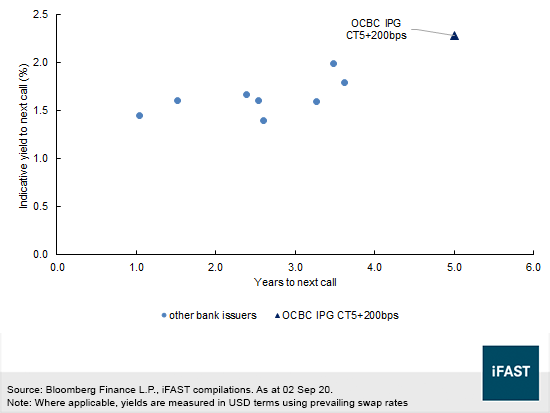
With the IPG of CT5 plus 200bps, we think OCBC’s new USD bond due September 2030 is attractively priced among Singapore bank Tier 2 notes (Figure 1). Based on prevailing US Treasury yields, the new OCBC T2 USD bond offers an indicative yield of ~2.28% – the highest yield in the sector.
Figure 1: Relative valuation among Singapore bank Tier 2 issues
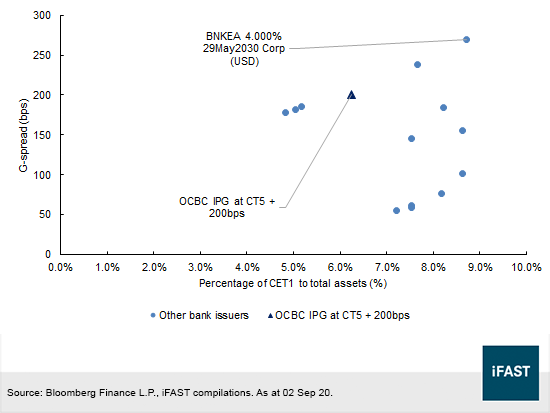
Extending the comparison to other bank Tier 2s, we think the new OCBC bond offers good value at its IPG. Investors may also consider the BNKEA 4.000% 29May2030 Corp (USD) of Bank of East Asia Ltd (“BNKEA”), for its higher credit spread (Figure 2). BNKEA is rated A3 by Moody’s and A- by S&P. Incorporated in Hong Kong in 1918, BNKEA offers banking services to customers mainly in Hong Kong and mainland China.
Figur 2: Relative valuation among Tier 2s of similar credit ratings and call dates
Declaration: For specific disclosure, at the time of publication of this report, IFPL (via its connected and associated entities) has a principal position in DBSSP 3.600% Perpetual Corp (USD). The analyst who produced this report holds a NIL position in the abovementioned securities.