U.S. Treasuries (USTs) are debt instruments issued by the U.S. Department of the Treasury to finance the federal government’s expenditures (Table 1). Widely regarded as the global benchmark for risk-free rates, USTs serve as a foundational reference for pricing a broad spectrum of financial instruments, including corporate bonds, sovereign debt, and derivatives. As of now, USTs carry long-term sovereign credit ratings of AA+ (stable outlook) from both Fitch and S&P, and Aaa (stable outlook) from Moody’s, reflecting the U.S. government's strong creditworthiness.
To view a comprehensive list of Government bonds & T-Bills, you can visit
here.
Key features of US treasuries
1) Safety: Backed by the full faith and credit of the U.S. government, USTs are widely regarded as one of the safest fixed-income instruments globally. Their high credit quality makes them a core holding for central banks, sovereign wealth funds, and institutional investors. USTs are also universally recognized as high-quality liquid assets (HQLA) under global regulatory frameworks, further reinforcing their role in financial system stability.
2) Liquidity: USTs represent the largest and most liquid sovereign bond market in the world. They are actively traded by both retail and institutional investors, with deep secondary markets across maturities. This allows investors to efficiently enter or exit positions, providing a high degree of liquidity, even in stressed market conditions.
3) Flexibility: Available across a wide range of maturities — from weeks (T-Bills) to decades (T-Bonds) — USTs offer investors the flexibility to match cash flow needs and investment horizons. This flexibility supports portfolio strategies such as laddering, which can help generate predictable income streams while managing interest rate risk over time.
Overall, USTs remain a core component of the fixed income universe, offering investors not only capital preservation and liquidity, but also the potential to enhance portfolio returns and support income objectives. In this article, we outline three UST-based strategies—ranging from hold-to-maturity approaches to active buy-and-sell tactics—designed to help investors align with their income and return targets across different market environments.
Table 1: Brief selection of available USTs across various tenors for investor consideration
1. Build a Treasury Ladder
What is a treasury ladder and how does it work
A treasury ladder is an investment strategy that involves building a diversified portfolio of USTs with staggered maturities. This strategy is designed to generate regular and predictable income, maintain investment flexibility as yields change, and reduce exposure to fluctuations in interest rates.
The ladder is constructed by purchasing multiple treasuries —such as T-Bills, T-Notes, or T-Bonds—that mature at evenly spaced intervals, ranging from months to years (e.g., every 6 or 12 months). As each UST matures, the principal can either be reinvested into a new UST to “extend” the ladder structure or redirected to meet cash flow needs.
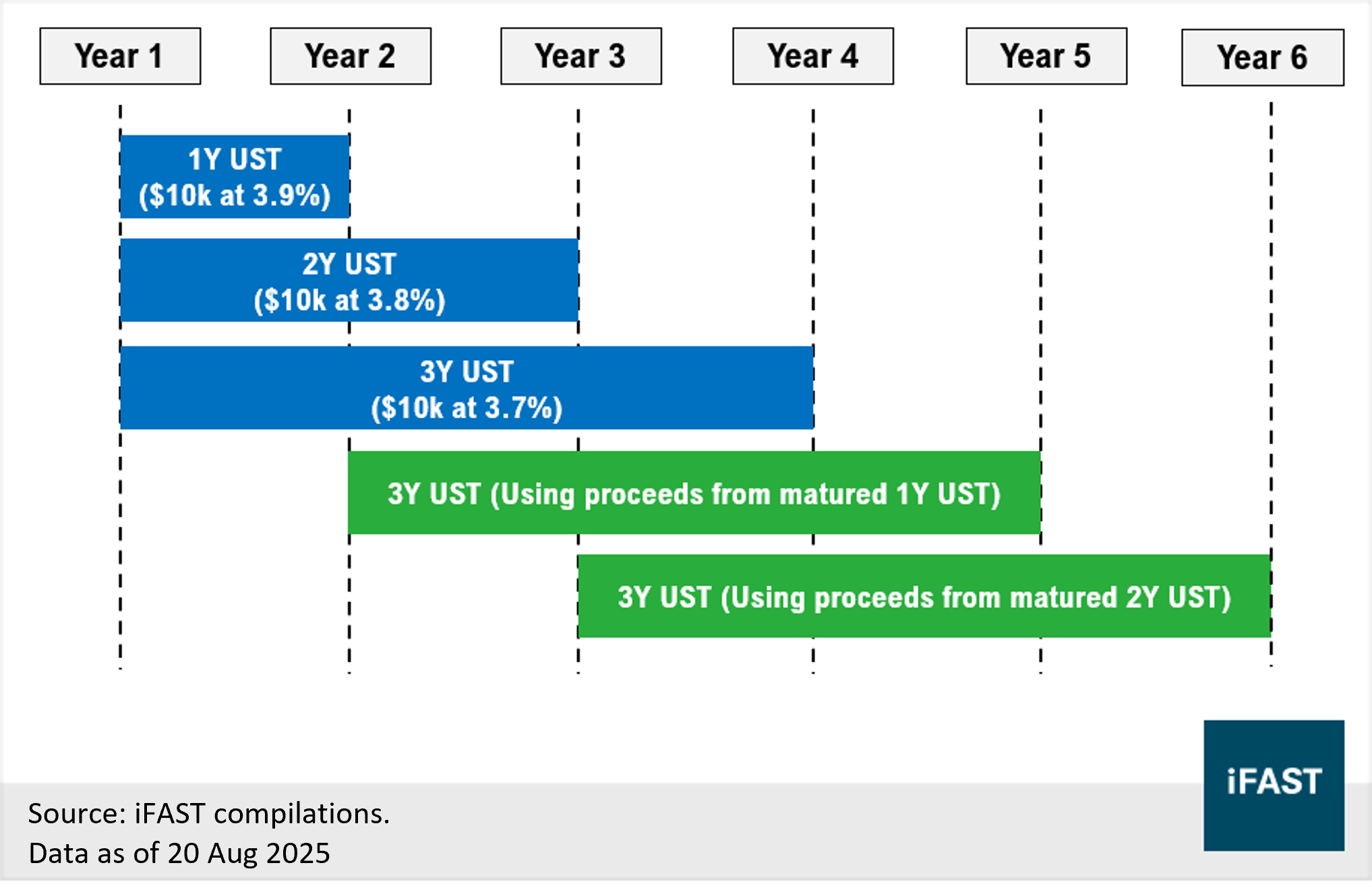
To demonstrate how a UST ladder works in practice, consider an investor with USD 30,000 in capital who wishes to implement a simple ladder strategy (Chart 1).
1. First, the investor decides how many USTs to include in the ladder. This will depend on both the total capital available and how much the investor is willing to “lock-in” for each treasury, at a specific yield. In this case, the investor divides the USD 30,000 equally across three USTs, allocating USD 10,000 per security.
2. Second, the investor selects the interval between maturities, which is influenced by their liquidity needs and income preferences. Shorter spacing allows for more frequent cash inflows but typically requires more active monitoring and reinvestment decisions. For this example, the investor chooses a 1-year spacing, resulting in a ladder consisting of a 1-year, 2-year, and 3-year UST. This structure ensures that one UST matures each year, providing a consistent annual cash inflow.
3. Third, as each UST matures, the investor must decide how to allocate the proceeds. This will depend on the investor’s personal financial needs and the prevailing interest rate environment. Continuing with the example above, the ladder structure ensures that one UST matures annually. When the 1-year UST (purchased at the inception of the ladder) matures after the first year, the investor can choose to either:
- Reinvest the proceeds into a new 3-year UST, thereby rolling the ladder forward and extending its structure, or
- Redeploy the funds (wholly or partly) for other purposes, such as expenses or reallocation to higher-yielding opportunities.
Chart 1: An example of a treasury ladder consisting of a 1-year, 2-year, and 3-year UST.
Benefits of a treasury ladder
|
Benefits of a treasury ladder
|
|
High-quality income
|
As bond
ladders are primarily designed to deliver steady and predictable income over
time, incorporating high-quality instruments such as USTs enhances the
reliability of this strategy.
Given the exceptional credit quality and
minimal default risk, USTs help ensure that the ladder's cash flows remain
uninterrupted and that proceeds are received in full and on time at each
maturity.
|
|
Manage interest rate risks
|
By staggering
the maturity dates of USTs, investors avoid being locked into a single
interest rate and instead gain diversified exposure across multiple tenors.
When treasury yields rise, proceeds from matured securities can be reinvested
at higher yields, enhancing income potential.
Conversely,
if yields decline, although reinvestment may occur at lower yields, the
longer-dated USTs in the ladder will continue to generate income at
previously locked-in higher rates. This staggered structure helps to smooth
out the impact of yield fluctuations, providing a more stable and predictable
income stream.
|
|
Create flexible cash flow
|
The spacing
of maturities in a treasury ladder can be tailored to match the investor’s
desired income frequency and cash flow needs, whether that be monthly,
semi-annually, or annually.
Additionally,
non-zero coupon USTs (such as Treasury notes and bonds) pay semi-annual
interest, providing a supplementary stream of smaller, but more frequent
income. Together, these features make the treasury ladder a versatile tool
for managing both short-term liquidity and long-term income goals.
|
|
Straightforward approach to navigating different
market conditions
|
By using an
all-UST ladder, bond investing can be simplified, as investors avoid the
complexity and risks associated with selecting potentially unsuitable or
lower-quality bonds.
By consistently
reinvesting proceeds from maturing securities and extending the ladder over
time, investors can maintain a steady income stream while navigating through
different market conditions — all without the need to actively time interest
rates or market cycles.
|
2. Capitalise on the fall in treasury yields
Understanding the price-yield relationship in US treasuries
Like all fixed income securities, the price of a UST is inversely related to its yield—the expected annual return an investor earns if the treasury is held to maturity. In simple terms, when yields rise, treasury prices fall, and when yields fall, treasury prices rise. This relationship holds as USTs offer a fixed coupon rate (coupon payments) to the investor over their term to maturity. Thus, when the price of USTs changes, the yield (expected return) will adjust accordingly.
To illustrate this relationship in the context of UST, assume two scenarios. First, when the Fed lowers interest rates, newly issued USTs will come with lower coupon rates and smaller coupon payments. This makes existing USTs with higher coupons more attractive, leading to increased demand in the secondary market. As demand rises, the prices of these older USTs increase, and their yields fall to reflect the higher price paid.
Second, when the Fed raises interest rates, new USTs will offer higher coupon rates, making them more attractive to investors. As a result, older USTs with lower coupons lose their appeal, and prices decline due to receding demand (shifting to newly issued USTs). This price decline compensates for the lower coupon rate, causing the yield on the older bonds to rise.
How can investors capitalise on a fall in UST yields?
While investing in USTs is often associated with conservative, hold-to-maturity strategies, they can also be actively traded to capture capital gains in response to changes in treasury yields. As prices move inversely to yields, investors can generate profits by purchasing USTs at lower prices when yields are higher and then selling them at higher prices when yields fall. The magnitude of price changes in response to yield movements will be affected by a bond's duration—a measure of a bond's price sensitivity to interest rate changes.
As a general rule, for every 1% change in yield, a bond’s price moves inversely by approximately 1% for each year of duration. Longer-duration bonds (typically with longer maturities and lower coupon rates) are more sensitive to changes in yields and demonstrate greater price movements, offering a more aggressive risk-return profile. On the other hand, shorter-duration bonds experience smaller price movements, providing a more defensive risk-return profile.
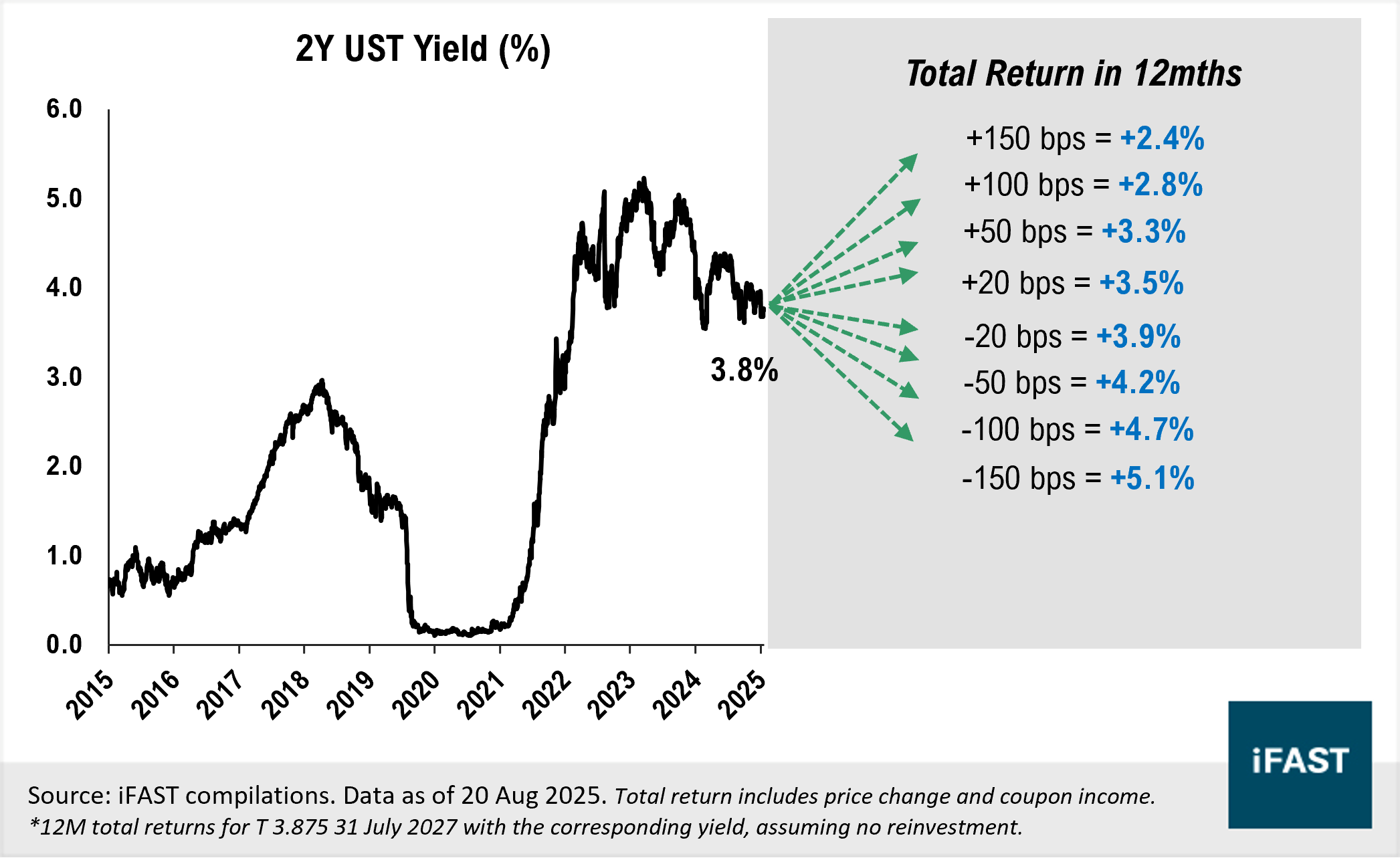
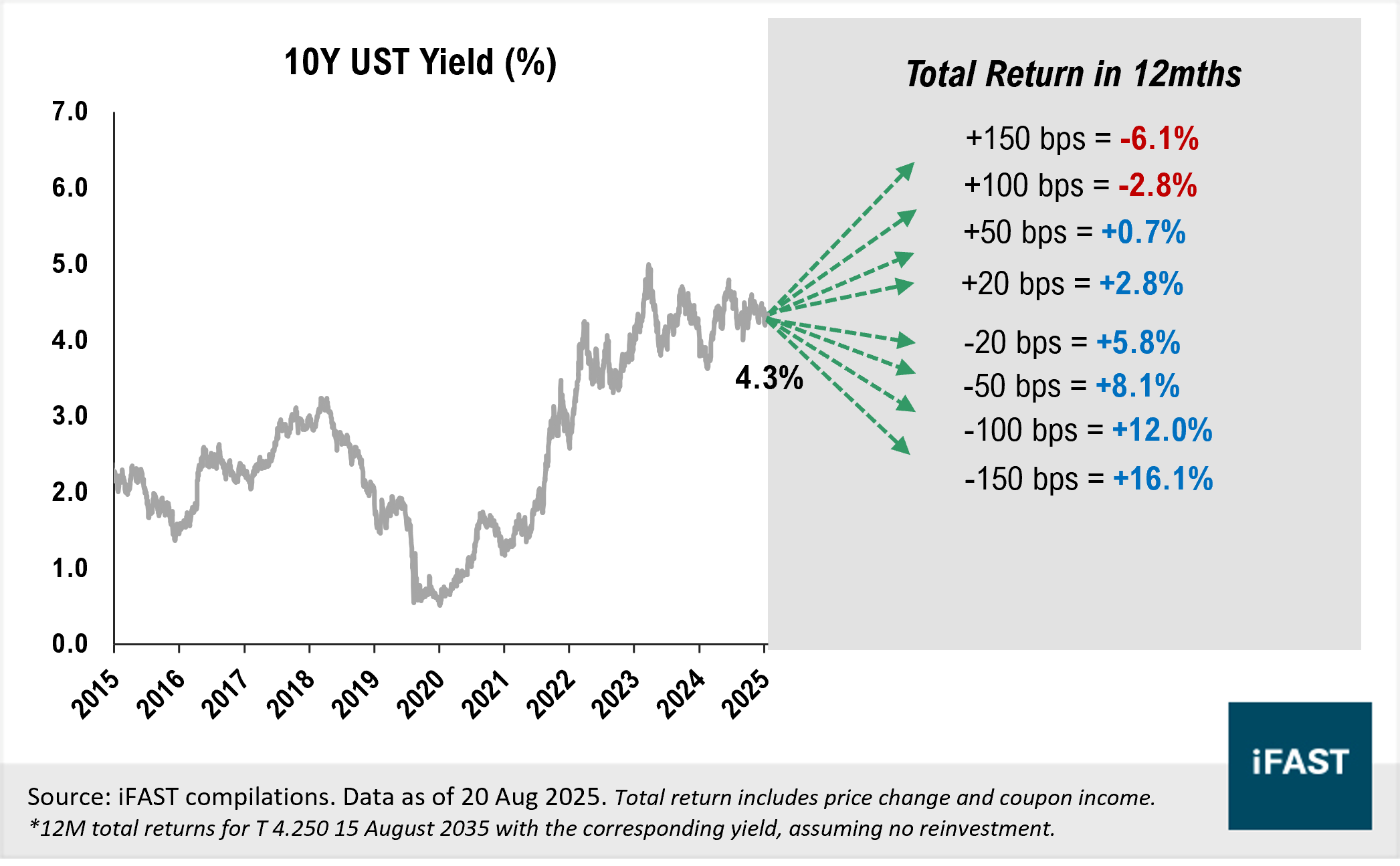
Charts 2 and 3 illustrate the impact of changes in treasury yields on the UST's total return (price change and coupon income) across different maturities over a 12-month horizon.
Using the most recently issued 10-year UST (yield: 4.3%) as an example,
- A rise in yields to 5.3% (+100bps) over the next 12 months results in a loss of -2.8%, and
a decline in yields to 3.3% (-100bps) leads to a gain of +12.0%.
In contrast, for the
most recently issued 2-year UST (yield: 3.8%),
- A rise in yields to 4.7% (+100bps) results in a gain of +2.8%, and a decline in yields to 2.7% (-100bps) leads to a larger gain of +4.7%.
This comparison demonstrates how longer-duration bonds are more sensitive to interest rate movements—offering greater upside in falling yield environments, but also higher downside risk when yields rise. Conversely, shorter-duration bonds provide more stable total returns across rate cycles.
Chart 2: Total return profile for a 2Y UST over 12 months
Chart 3: Total return profile for a 10Y UST over 12 months
Key Considerations for Investors
While trading UST offers opportunities for capital gains, especially in falling yield environments, there are important considerations investors should keep in mind:
1. Duration is a double-edged sword: Longer-duration USTs offer greater price sensitivity to changes in yields—this can amplify gains when yields fall but also magnify losses when yields rise. Investors should only take on duration exposure if it aligns with their risk tolerance and investment objectives.
2. Market timing risk: UST yields can be volatile at times and swings are not uncommon. Investors who actively trade Treasuries may need to incorporate market timing elements, which introduces additional risk. Poor timing—especially during periods of heightened yield volatility and uncertainty—can result in capital losses.
3. Macro factors can affect yield movements: UST yields are highly responsive to macroeconomic conditions and Federal Reserve policy. Factors such as inflation trends, employment data, and interest rate expectations can drive sharp movements in treasury yields which may impact returns.
3. Roll down the treasury curve
How does rolling down the yield curve work?
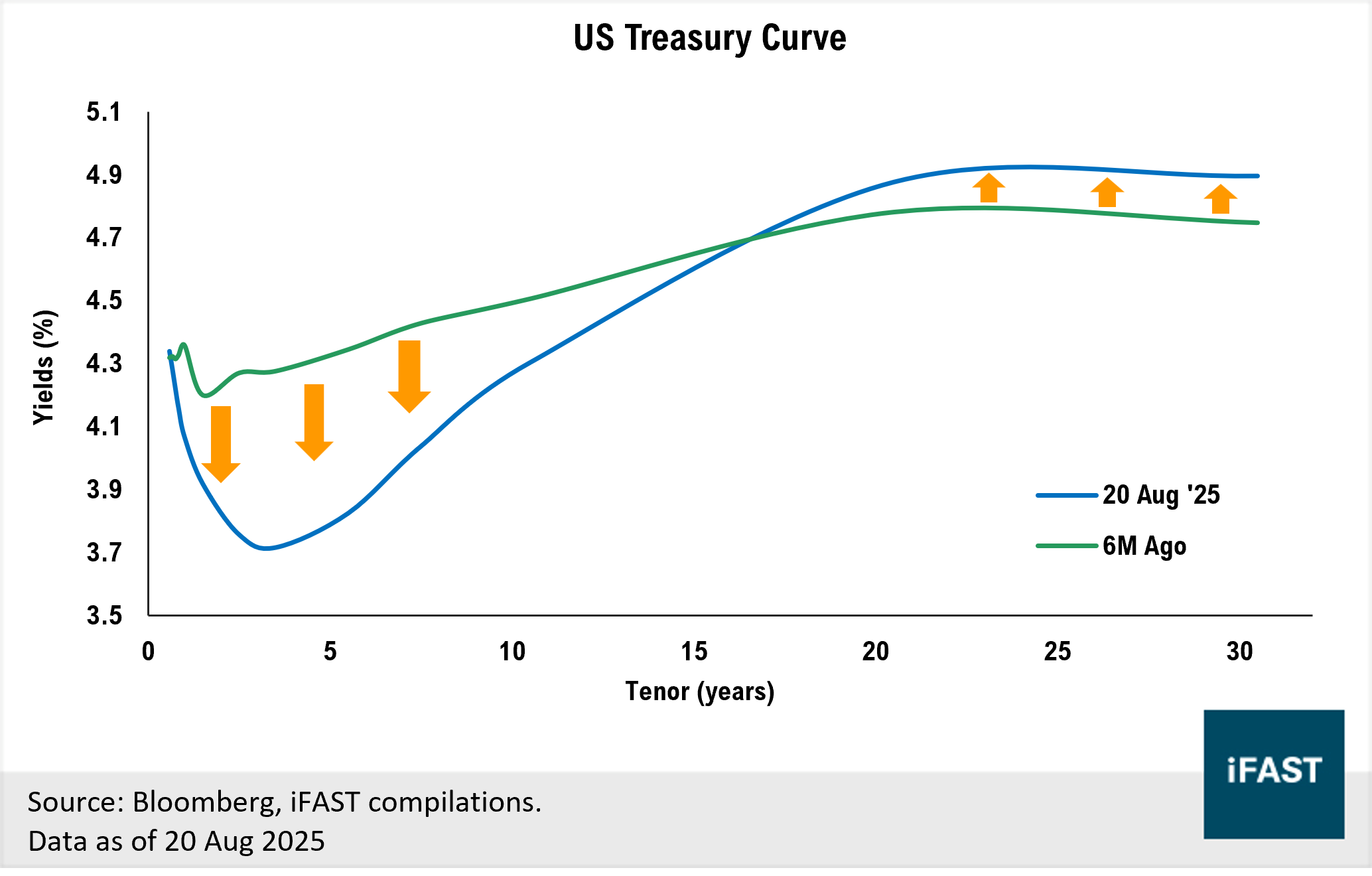
Rolling down the yield curve is a strategy that seeks to enhance total returns by capitalizing on the natural price appreciation that occurs as a bond “rolls down” the curve — that is, as it ages and moves closer to maturity. This approach is particularly effective in an environment where the yield curve is steep and upward sloping, meaning longer-dated bonds offer higher yields than shorter-dated ones.
This strategy involves buying bonds at a point on the curve where yields are relatively high—typically at the steeper parts of the yield curve (Chart 4) — and holding them until they move to a shorter maturity point where yields are lower. As the coupon of the bond is fixed, the price rises to adjust for the natural decline in yield (consistent with the curve’s slope). The bond can then be sold at a higher price, generating capital gains (“roll-down gains”), while also earning steady interest income throughout the holding period.
While the roll-down strategy can be implemented across a variety of fixed income instruments, it can be particularly effective when used with UST, as it offers the opportunity to capture roll-down gains while benefiting from the UST market's exceptional liquidity. The ability to exit positions efficiently enhances the strategy’s effectiveness.
USTs are also widely considered to be risk-free, so roll-down returns are primarily driven by movements in interest rates and the treasury curve shape. Fixed-income instruments like corporate bonds carry credit risk, which is reflected by a credit spread over USTs. These spreads can fluctuate based on issuer-specific or market/ industry conditions, potentially distorting the roll-down effect.
Chart 4: The UST curve has steepened significantly in 2025
Illustrating the roll-down strategy with US treasuries
To demonstrate the roll-down strategy in practice, consider an investor purchasing the most recently issued 7-Year U.S. Treasury (T 4.000 07/31/32) at a market ask price of 99.72, offering a yield of approximately 4.09%. The total investment outlay—including accrued interest—would be roughly USD 9,995 (assuming a USD 10,000 capital).
After holding the UST for two years and collecting semi-annual coupon payments of USD 200 (totalling USD 800 over the period), the UST will effectively become a 5-Year UST. Assuming the treasury curve remains stable, the yield of the original 7-Year UST will also “roll” towards the prevailing 5-Year yield of 3.82%. As coupons are fixed, the market price will adjust upward to approximately 100.96, reflecting the inverse relationship between bond yields and prices.
If the investor chooses to sell the treasury at this point, the total proceeds - including accrued interest - would amount to approximately USD 10,919. This translates to a total return of around 9.3% over the two-year holding period (ann. return of 4.5%), which can be decomposed into a 1.3% from capital appreciation, driven by the roll-down effect, and 8.0% from coupon income.
It is important to note that in order to realise roll-down gains, the investor must sell the UST before it matures. If held to maturity, the treasury will converge to par (100), and any price premium will gradually erode.
Benefits of rolling down the treasury curve
|
Benefits of rolling down the treasury curve
|
|
Getting
paid to wait
|
Investors can
continue to collect coupon payments from UST while waiting for yields to
decline and prices to rise, even amid periods of volatile yields. These
regular coupon payments not only provide a steady income but can also be
reinvested to further enhance the total return of the roll-down strategy over
the holding period.
|
|
Potentially higher returns than holding to maturity
|
If the yield
curve is sufficiently steep, a roll-down strategy can potentially generate
higher returns than simply holding a UST to maturity.
For example,
consider an investor purchasing the newly issued 2-Year UST (T 3.875 31 July
2027) at a market price of 100.03, offering a yield of approximately 3.79%.
By holding this UST until maturity, the investor would earn a total return of
around 7.3% over the two-year period (ann. return of 3.6%) — comprising a
-0.4% price loss (as the bond is redeemed at par) and a 7.7% gain from coupon
income.
In contrast,
an investor who buys a 7-Year UST and holds it for two years, allowing it to
“roll down” the curve, could achieve a higher total return of 9.3% over the
same period. The higher return reflects the “roll-down” gains.
|
|
Short holding period
|
The roll-down
strategy does not require investors to hold UST to maturity, thereby allowing
for a shorter holding period. This can be beneficial when investing in
longer-tenor USTs, which are more sensitive to yield changes.
While the
underlying duration remains unchanged, the roll-down strategy reduces the
investor’s exposure window to interest rate risk.
|
|
Compatible with other strategies
|
The roll-down
strategy can be effectively layered with other fixed income approaches - such
as bond laddering or the barbell strategy - offering additional roll-down
gains.
|
Key considerations when implementing a roll-down strategy
1. Effective only when the curve is steep: The roll-down strategy works on portions of the treasury curve that are steep and upward sloping as “rolling down” the UST to lower yields generate price gains. The strategy is most effective at the steepest portion of the treasury curve. Conversely, flatter or inverted portions of the curve can reduce or eliminate roll-down gains and may even result in losses.
2. Macro factors can influence treasury curve shape: The shape of the treasury curve is largely influenced by macroeconomic factors and the Federal Reserve’s policy stance. Changes in these factors can flatten or invert the curve (or portions of the curve), reducing the effectiveness of the roll-down strategy.
3. Holding period matters: Besides the shape of the treasury curve, investors must hold the UST just long enough to benefit from price appreciation as it “rolls down” the curve. Exiting too early or too late can reduce the total returns of this strategy.
4. Bond duration still impacts return: While the holding period for a roll-down strategy might be short, the UST remains exposed to interest rate risk during that time. A sudden spike in rates can offset expected roll-down gains.
Declaration: For specific disclosure, at the time of publication of this report, IFPL (via its connected and associated entities) holds a position in the abovementioned securities. The analyst who produced this report holds NIL position in the abovementioned securities.