- The Reserve Bank of Australia has raised the cash rate to 4.35% and could deliver one final hike, although rates now appear close to the terminal rate.
- March CPI rose to 4.6% yoy, largely due to fuel price spikes, reinforcing upside inflation risks stemming from ongoing global supply disruptions.
- Major companies have started passing through higher transport and input costs, pointing to broader and more persistent inflation.
- The RBA is widely expected to hold rates steady in June to assess lagged effects, with future moves hinging on inflation and wage data.
- We continue to favour a Barbell strategy, allocating exposure to both short-duration bonds (around the 1-year tenor) and longer-duration bonds (7 – 10-years) along the sovereign curve.
Back at 2024 peak cash rate (4.35%)
At its latest meeting, the Reserve Bank of Australia (RBA) raised the cash rate by 25 bps to 4.35%, marking the third consecutive increase. The decision was made by majority, with 8 members voted for 25bps hike and one member voted for hold.
This move fully unwinds the easing cycle conducted through 2025 and returns the cash rate to post-pandemic highs.
The decision was largely in line with expectations, as Australia’s annual inflation ratei accelerated to 4.6% yoy in March 2026 from 3.7% yoy in February 2026, the first reading after oil prices skyrocketed. Considering the uncertain developments around the Strait of Hormuz, the RBA signalled that inflation is expected to remain above its 2–3% target band for some time. With risks still leaning toward the upside, the central bank maintained that the most recent rate increase was necessary to manage these price pressures.
Chart 1: Australia’s inflation figures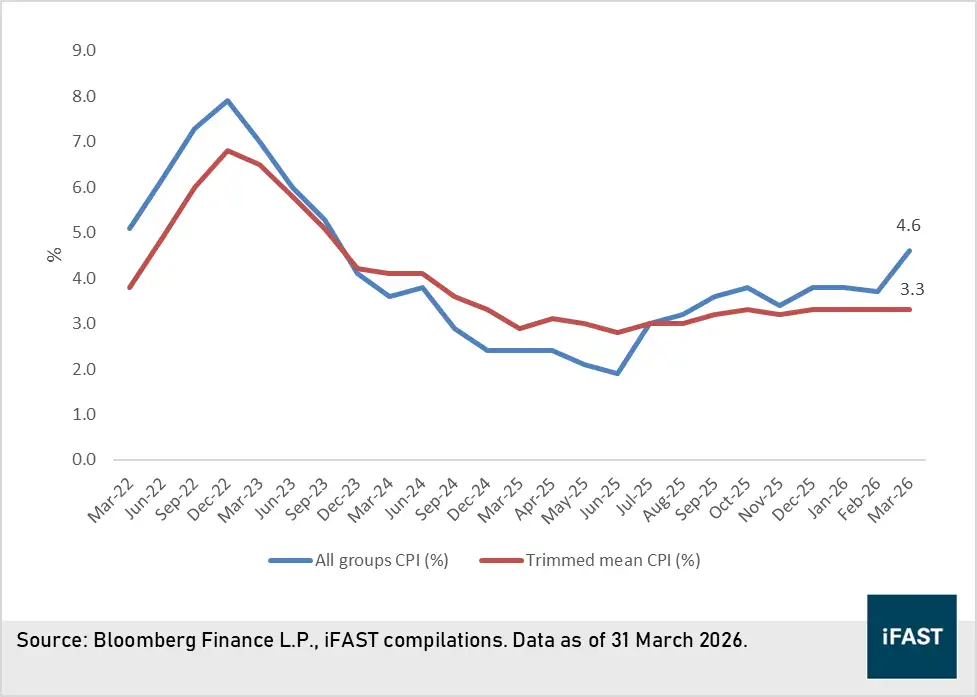
Current inflation may warrant one additional rate hike, but is close to terminal rate
At today’s level, Australia’s real rate (cash rate minus headline inflation) remains slightly negative, suggesting there is still room for further tightening (this indicates that monetary policy is still accommodative). At the same time, a potentially stronger Australian Dollar (AUD) supported by the upwards pressure of rate hike can also mitigate imported inflation to a certain extent.
We expect RBA to pause in June to assess the lagged effects of prior tightening, allowing the current rate level to “simmer.” In our view, an additional hike remains possible, but likely to be more back-loaded, possibly in 3Q, if inflation persist.
Rising inflation, and market is bracing for second-round effects
Australia’s inflation remains persistent as outlined above, driven primarily by a surge in fuel costs. As a net importer of fuel, the country has seen a notable increase across the different automotive fuel prices, reflecting the impact of the conflict in the Middle East on fuel prices (table 1).
Table 1: Changes in fuel price between February and March 2026
|
Percentage increase |
Average price per litre |
|
|
Regular unleaded petrol |
33% |
1.71 (Feb) -> 2.28 (Mar) |
|
Premium unleaded petrol |
30% |
1.92 (Feb) -> 2.50 (Mar) |
|
Diesel |
41% |
1.81 (Feb) -> 2.56 (Mar) |
|
Source: Australian Bureau of Statistics, iFAST compilations. Data as of 31 March 2026. |
||
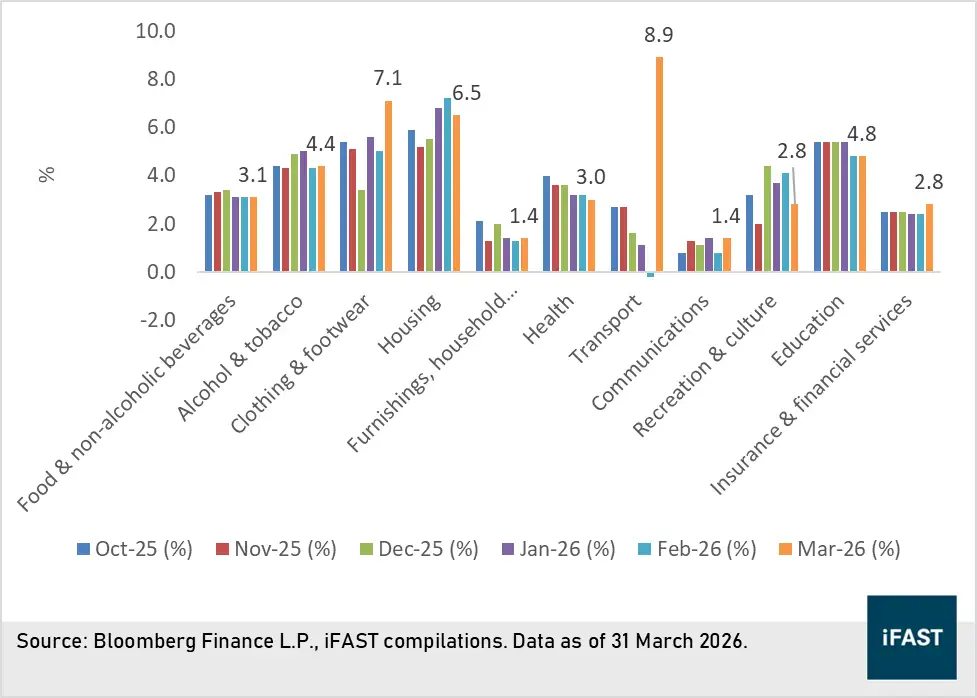
The increase was before the halving of the fuel excise announced by the government, which is effective from 1 April 2026 until 30 June 2026 - The fuel excise is a federal flat tax applied to every litre of petrol and diesel to fund transport infrastructure. By reducing the cost by 26.3 cents per litre, the government engineered a mechanical drop in retail fuel prices that will be reflected in April inflation figures. This is projected to shave off about 0.4%-0.5% from the CPI inflation numbers, barring any changes in other CPI components.
Despite the fuel excise, we believe headline inflation would persist stubbornly above the RBA’s inflation target, and this is before the second-round effects that is hanging over the horizon.
Recently, Wesfarmers, which is Australia’s largest retail conglomerate that operates major hardware and department store chains nationwide, has also warned that consumer prices will inevitably rise to offset mounting input costs. Management cited heavy fuel surcharges from international shipping and domestic transport providers, alongside surging costs for petrochemical-based goods like PVC pipes and building materials. This corporate pass-through confirms that second-round effects are indeed materialising, embedding inflation deeper into the economy.
At a broader level, we will also be watching the upcoming wage price index data to be released on 13 May. If ongoing union negotiations and cost-of-living adjustments lead to sticky wage growth, we expect this to exert upwards pressure on inflation.
Table 2: Some of Australia’s more pertinent economic calendars
|
Data |
|
|
12 May 2026 |
Westpac Consumer Confidence Index NAB Business Confidence |
|
13 May 2026 |
Wage Price Index |
|
19 May 2026 |
RBA Meeting Minutes |
|
16 June 2026 |
RBA Interest Rate Decision |
|
Source: Trading Economics, iFAST compilations. Data as of 6 May 2026. |
|
All eyes on next Tuesday’s Australia budget
Treasurer Jim Chalmers will be delivering 2026-2027 federal budget on 12 May, and we expect it to be a test of the government's resolve to balance inflation with the growing housing affordability crisis.
A major focal point will be the property sector, specifically whether the government introduces structural reforms to negative gearing or capital gains tax (CGT) discounts, policies widely viewed as catalysts for inflated investment property prices. Alongside housing, consumers and investors alike are closely monitoring the potential rollout of cost-of-living support, including the extension of the recent fuel excise cuts, targeted tax offsets for low-to-middle-income earners, and the reinstatement of energy bill rebates.
Any overly generous cash handouts or aggressive government spending risks artificially stimulating consumer demand, which may undermine RBA’s efforts to cool the economy.
What’s next for Australia
In our view, RBA is currently caught in a tug-of-war. On one hand, stubborn inflation suggests that interest rates will likely stay higher for a while. On the other hand, the broader economy appears to be losing momentum, with both corporate and consumer confidence weakening.
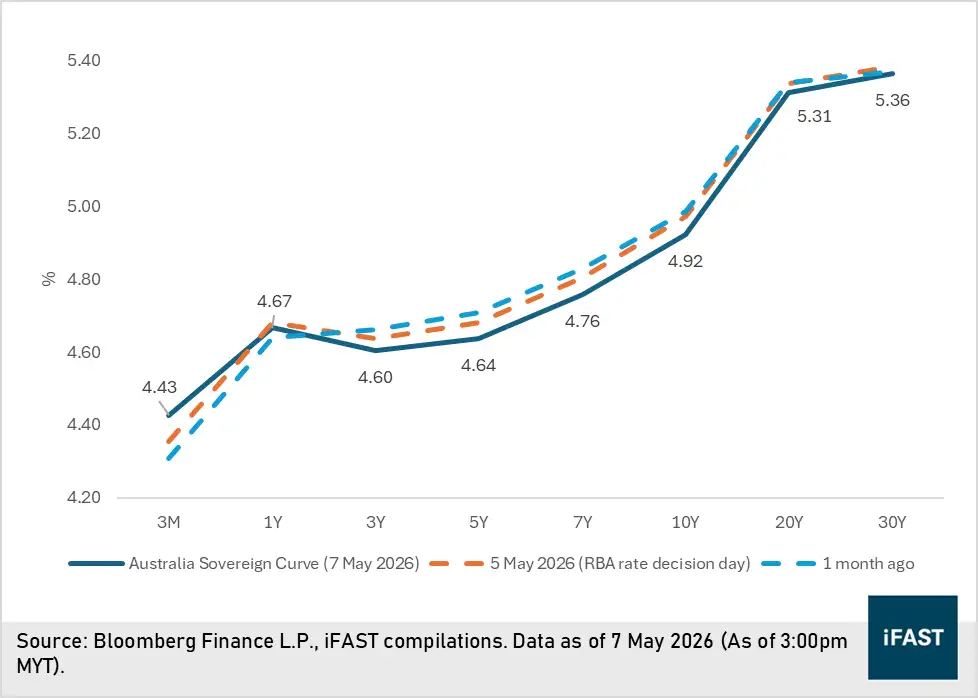
Given the current macroeconomic backdrop, we continue to favour a Barbell strategy, preferring both short (around 1-year) and longer tenors (7 to 10-years) of the yield curve.
At the short end, yields have repriced materially higher – close to 4.7%, in line with the RBA's tightening cycle. Positioning here allows investors to earn a competitive income given decent yields, bolstered by a strong AUD. At the longer end, the 7 to 10-year yields are currently nearer 5%, offering an attractive income and a meaningful carry. We also see roll-down potential in the 7-to-10-year segment, which captures the steepest portion of the sovereign curve. Investors who hold over a medium-term horizon stand to benefit from additional price appreciation as bonds “roll-down” to shorter maturities along the curve.
In the corporate credit space, we continue to favour high quality, investment grade corporate bonds, particularly names like Australian major banks, as well as regulated or essential services issuers that offer the defensive characteristics.
Table 3: Recommended bonds (within the long ends)
|
Bond |
Issuer |
Bond credit rating (S&P/Fitch) |
Years to next call/maturity |
Bond price |
Yield to next call/Yield to maturity |
Min/Sub investment amount |
|
Banks |
|
|
|
|
|
|
|
National Australia Bank (NAB) |
- / A- |
8Y1M/ 13Y1M |
100.50 |
6.2%/6.3% |
10k/1k |
|
|
Westpac Banking Corporation (WBC) |
- / A- |
9Y1M/ 14Y1M |
96.45 |
6.3%/6.3% |
10k/10k |
|
|
Australia and New Zealand Banking Group (ANZ) |
- / A- |
6Y9M/ 11Y9M |
103.33 |
6.1%/6.4% |
10k/1k |
|
|
Commonwealth Bank of Australia (CBA) |
- / A- |
8Y7M/13Y7M |
99.32 |
6.2%/6.2% |
200k/10k |
|
|
Emirates NBD Bank PJSC |
- / A+ |
-/9Y1M |
97.55 |
-/6.2% |
10k/10k |
|
|
BPCE SA |
- / BBB+ |
9Y1M/14Y1M |
99.42 |
6.6%/6.7% |
5k/5k |
|
|
Supermarket chains |
|
|
|
|
|
|
|
Coles Group Treasury Pty Ltd |
- / - |
6Y2M/6Y5M |
98.57 |
5.8%/5.8% |
10k/10k |
|
|
Woolworths Group Limited |
- / - |
8Y4M/8Y7M |
99.19 |
6.0%/6.0% |
10k/10k |
|
|
Regulated business |
|
|
|
|
|
|
|
AusNet Services Holdings Pty Ltd |
- / - |
6Y11M/ 7Y1M |
101.42 |
5.8%/5.8% |
10k/10k |
|
|
Ausgrid Finance Pty Ltd |
- / - |
9Y4M/9Y7M |
98.09 |
6.2%/6.2% |
10k/10k |
|
|
EnBW International Finance B.V. |
-/- |
9Y10M |
96.60 |
-/6.2% |
200k/10k |
|
|
Source: Bondsupermart, iFAST compilations. Data as of 6 May 2026. |
||||||