Note: This is an edited version of an article published earlier by our affiliates on 3 Jul 20.
Highlights
- The growth rate of contracted sales in 2019 was above the average of tier-one Chinese property developers. Rental revenue surged by 92.3% to RMB 4.1 billion.
- Leverage ratio dropped significantly due to asset disposal in 2H19, and the overall credit profile is sound.
- The group’s bonds are reasonably priced; short-term bonds are more attractive.
Since the listing of FUTLAN 6.150% 15Apr2023 Corp, issued by Seazen Group Limited, on Bond Express, the bond has been popular among investors. There are actually a number of other Seazen Group bonds available in the market. In this article, we are going to provide insights into Seazen Group's latest operating results and credit profile, and identify the bonds that are worth considering.
Recent highlights
The growth rate of contracted sales in 2019 was above the average of tier-one Chinese property developers
2019 was a tough year for Seazen Group. After the arrest of the group’s founder and former chairman, Wang Zhenhua, banks suspended their lending and Seazen Group had to sell off a number of subsidiaries to its peers for cash flows. Fortunately, the scandal did not cause much impact on its operation, and the group was able to deliver decent annual results.
Contracted sales amounted to RMB 270.8 billion, up 22.5% YoY, and the growth rate was above the average of tier-one Chinese property developers (around 20%). The sales amount ranked eighth among all Chinese property developers, which was the same as last year.
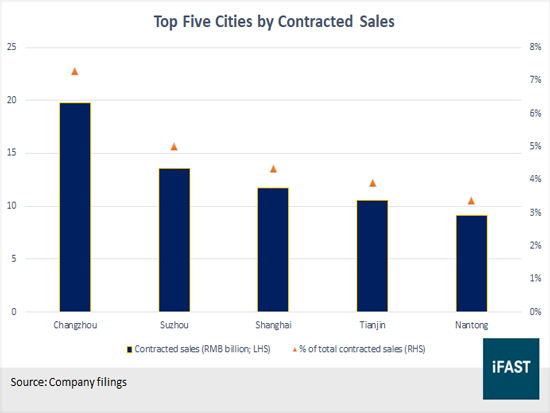
In terms of contracted sales breakdown by cities, most of its property development business is in tier-two and tier-three cities in Yangtze River Delta. Chart 1 depicts that the top five cities in terms of contracted sales are all located in this region except Tianjin. As a large-sized property developer, Seazen Group's property projects are well diversified nationwide. At the end of 2019, the business covered 102 cities across China. This diversified project geographical distribution could help the company hedge its concentration risk to a certain extent.
Chart 1: Top five cities by 2019 contracted sales
Sales recovering from the pandemic; management adjusting to a lower sales target
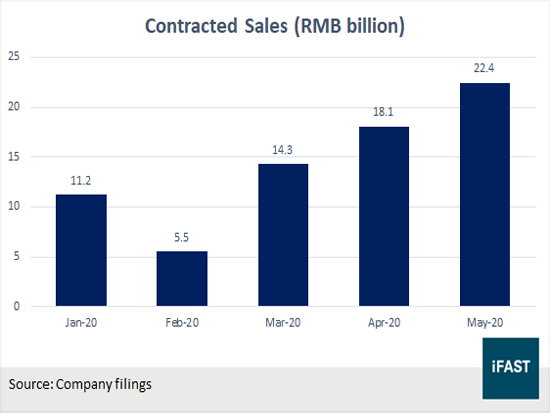
The pandemic has served a blow to the sales of Seazen Group, with contracted sales declining by 23.1% to RMB 71.5 billion for the first five months of this year. However, sales have been recovering since February (see Chart 2). In particular, May’s contracted sales moved up 24.1% MoM to RMB 22.4 billion, showing that sales growth had returned to pre-virus levels.
Chart 2: Monthly contracted sales in 2020
On the other hand, saleable resources this year are relatively lower due to asset disposals in 2H19. As stated by the senior management in a results briefing, saleable resources for 2020 were approximately RMB 400 billion, lower than the RMB 500 billion in 2019. The management thus lowered their annual sales target to RMB 250 billion, based on last year’s 54% sell-through rate.
It is worth noting that the property market in Yangtze River Delta is leading the sector’s recovery compared to other regions. For example, Jiangsu province's growth rate for commercial housing sold in the first four months had turned positive, reaching 0.4%, while the same nationwide measure was -18.6%. We believe Seazen Group should benefit from the favourable local property market, and retain an excellent sales performance to accomplish the annual target.
Shifting focus to tier-one and tier-two cities
The land banking policy of Seazen Group has seen some changes in 2019. Firstly, the group cut its land acquisition spending to reduce cash outflow after the scandal of Wang Zhenhua. Consequently, the spending on land acquisition totalled RMB 49.3 billion, ranking 13th among Chinese property developers. The group's spending was close to RMB 67.3 billion in 2018, ranking eighth in the Chinese real estate market.
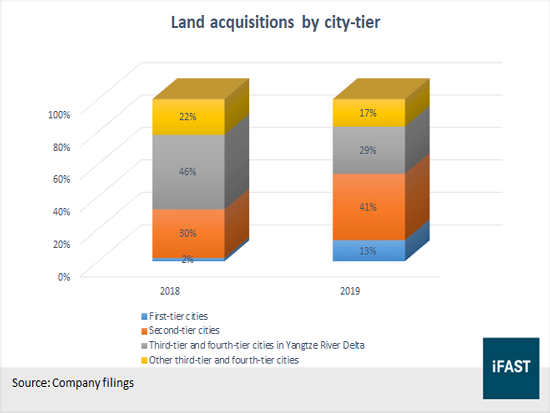
Secondly, Seazen Group switched its focus from tier-three and tier-four cities in Yangtze River Delta to allocating more spending to land acquisitions in tier-one and tier-two cities since 2019. As a result, the proportion of land spending in tier-one and tier-two cities has climbed from 32% in 2018 to approximately 54% in 2019 (see Chart 3), indicating that the business focus will shift to tier-one and tier-two cities in the future. In that case, the company will likely maintain a decent sales performance. The total gross floor area (“GFA”) of Seazen Group’s land bank was about 124 million square metres as at 31 Dec 19, more than five times the aggregated sales area in 2019, indicating a rich land bank.
Chart 3: Land acquisitions by city-tier
Expansion of Wuyue Plazas peaking
The number of Wuyue Plazas, the commercial property business of Seazen Group, has been snowballing for the past few years, with approximately 20 new Wuyue Plazas opening every year. In 2019, 21 Wuyue Plazas were opened, and the total number of plazas amounted to 63 (see Chart 4), with the overall occupancy rate at over 99%. If we include plazas under construction, the number of Wuyue Plazas owned by Seazen Group reached 124 as at end-March 2020.
Rental revenue also grew alongside with the number of plazas. The group's rental revenue in the past three years were RMB 1.0 billion, RMB 2.1 billion and RMB 4.1 billion respectively, translating to a three-year CAGR of 58.6%.
Chart 4: Growth in commercial property business
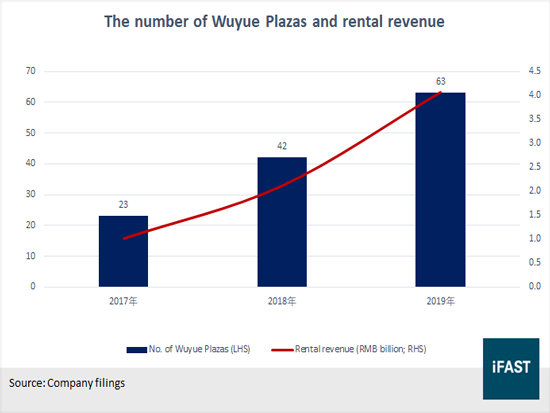
The group is speeding up the pace of expansion for Wuyue Plaza. In 2020, there will be another 30 plazas coming into operation and the rental revenue is correspondingly expected to grow at a high rate.
Credit profile
Abundant cash balance with healthy cash collection
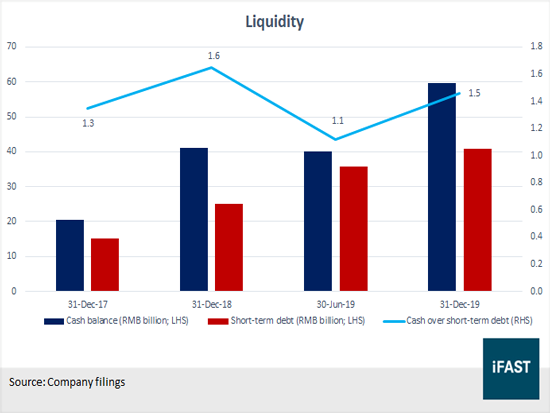
Total interest-bearing debt of Seazen Group increased 5.1% YoY to RMB 87.9 billion as at end-2019. Looking at the group’s debt maturity profile, short-term debt takes up a larger proportion of debt, reaching RMB 40.9 billion. Meanwhile, cash balance soared by 37.6% to RMB 65.6 billion, thanks to asset disposals. Excluding restricted cash, cash and cash equivalents spiked to RMB 59.7 billion, translating to a 1.5x ratio of cash to short-term debt (see Chart 5), which is line with the average of BB-rated developers.
Chart 5: Cash over short-term debt
Seazen Group also saw an improvement in its cash collection, as the cash collection rate increased 20 bps YoY to 80% in 2019. We estimated that there would be over RMB 57.2 billion of cash inflow from sales in the first five months of 2020, based on the favourable cash collection rate of 80%. Also, due to the conservative land banking policy, the land spending in the first five months was RMB 25.6 billion, only 55.6% of the same period last year.
We believe Seazen Group’s cash balance will continue to improve. The credit lines assigned by banks totalled RMB 93.9 billion as of end-2019, and unused credit lines were close to RMB 73.5 billion. Weighing the factors listed above, the group’s liquidity looks good from the cash balance perspective and the pressure from debt repayment is manageable.
Leverage ratio plunged
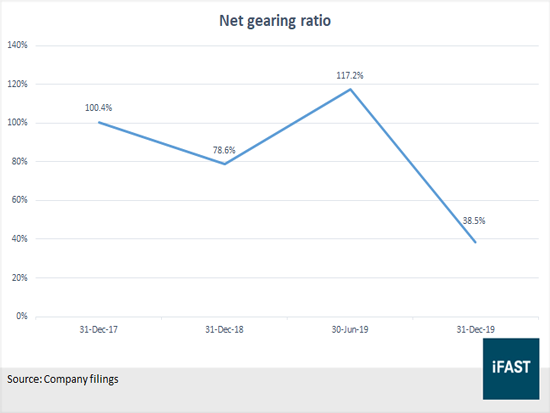
As mentioned earlier, saleable resources for this year decreased due to asset disposals. On the other hand, the group’s debt ratios were also moving down. From Chart 6, we see that the net gearing ratio plunged in 2019 by 40.1 and 78.7 percentage points compared to end-2018 and mid-2019.
Chart 6: Net gearing ratio
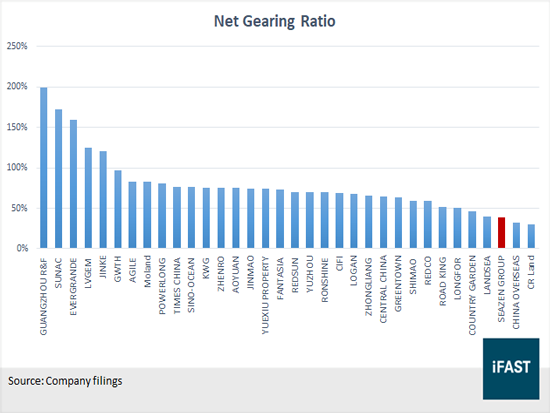
Seazen Group's net gearing ratio is on low-end of the spectrum among Chinese property developers (see Chart 7). In fact, only China Overseas Land and Investment and China Resources Land had lower gearing ratios, suggesting that the group has an excellent credit profile.
Chart 7: Net gearing ratio of Chinese developers (as of end-2019)
Bond investments
There are quite a number of bonds outstanding issued by Seazen Group and Seazen Holdings, most of which are issued by Seazen Holdings, with the investment horizon ranging from 0.8 to 3.1 years. Details of some of these bonds are listed in Table 1.
| Bond | Issuer/Guarantor | Years to Maturity | Ask Price | Ask YTM |
|---|---|---|---|---|
| FTLNHD 6.500% 23APR2021 CORP (USD) | Seazen Holdings | 0.8 | 100.76 | 5.51% |
| FTLNHD 7.500% 16DEC2021 CORP (USD) | Seazen Holdings | 1.5 | 102.07 | 5.97% |
| FTLNHD 7.500% 20MAR2022 CORP (USD) | Seazen Holdings | 1.7 | 102.17 | 6.14% |
| FTLNHD 6.500% 20MAY2022 CORP (USD) | Seazen Holdings | 1.9 | 100.85 | 6.01% |
| FUTLAN 6.450% 11Jun2022 Corp (USD) | Seazen Group | 1.9 | 101.01 | 5.89% |
| FTLNHD 5.000% 08AUG2022 CORP (USD) | Seazen Holdings | 2.1 | 97.66 | 6.20% |
| FUTLAN 6.150% 15APR2023 CORP (USD) | Seazen Group | 2.8 | 99.33 | 6.41% |
| FTLNHD 6.800% 05AUG2023 CORP (USD) | Seazen Holdings | 3.1 | 101.31 | 6.33% |
Source : Bondsupermart; data as at 2 Jul 20 |
||||
As shown in Table 1, the yield curve of Seazen Group/ Seazen Holdings is rather flat, indicating narrow term spreads between the group’s short-term bonds and long-term bonds. In other words, investing in the shorter term Seazen bonds seems to be preferable and investors may consider the bonds with less than two years to maturity. Notably, the bond due March 2022 is embedded with a call option and has a relatively high coupon rate, and the issuer probably will redeem this bond given the current low interest rate environment. If so, investors might face a price loss as the bond is currently trading at a premium above the call price, and hence should first consider investing in other bonds.
Corporate Risks
Investors should be aware of the following risks. First, Seazen Group is facing operational risks. Since the arrest of Wang Zhenhua, his son took over the company. Although overall the senior management team did not go through an overhaul, we noticed that some key men of the group resigned, like the group’s former vice president Chen Deli. The reduced stability in management might affect the group’s operations.
Apart from operational risks, investors should not ignore foreign exchange risk. As at 31 Dec 19, a big portion of Seazen Group’s debt (27.9%) were denominated in non-RMB currencies. The group’s debt burden would increase if RMB depreciates.
Lastly, the debt maturity profile of Seazen Group is not ideal due to the group’s high dependence on short-term debt funding. Year-to-date, the group issued four onshore “super & short-term commercial papers”, with tenures ranging from 180 days to 270 days. The short-term debt balance is thus expanded, leading to tighter liquidity.
Conclusion
Seazen Group's overall operating results in 2019 were decent, and both the property development and commercial property segments saw good performance. Due to having fewer saleable resources, contracted sales this year are expected to slip. But in the long run, the group's outlook remains positive.
The group’s cash balance has jumped and debt ratio plunged due to asset disposals in the second half of last year, and the overall credit profile is superior among BB-rated peers. Investors may consider its short-term bonds due to the flat yield curve.
Declaration:
For specific disclosure, at the time of publication of this report, IFPL (via its connected and associated entities) has a principal position in FUTLAN 6.150% 15Apr2023 Corp (USD). The analyst who produced this report holds a NIL position in the abovementioned securities.