- Yields on the Singapore T-bills had fell slightly despite continued rate hikes by the Feds in the first half of 2023.
- SGD issuances had fallen in 1H23, primarily led by the banks.
- We expect SGS yields to stabilise in the second half of 2023.
- We should see more SGD issuances from different issuers in 2H23, and more options for investors to choose from.
Looking back at the first half of 2023
Chart 1
US
Fed Funds Rate versus SGD 6-months, 1-year T-bills yields since 2022
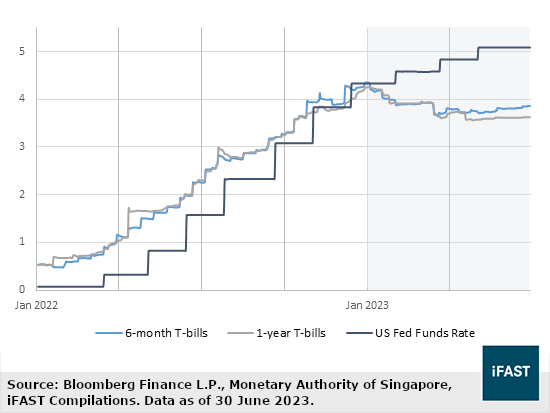
For many local investors, the first thing that comes to mind would likely be Singapore Treasury Bills. Across 2022, the popularity of the Singapore T-bills jumped as interest rates rose – especially when it hit a peak cut-off yield of 4.4% in late 2022 (Chart 1) - and has drawn a frenzied crowd of interest since then.
However, coming into 2023, we began to see a divergence between the US Fed Funds Rate and Singapore T-bill yields. Even as the US Federal Reserve continued to increase policy rates in the first half of 2023, yields on the Singapore T-bills had been gradually coming down.
We see this happening despite the significant rise in US Treasury yields across recent months. This jump in the US Treasury yields was due to an upwards adjustment of rate expectations after policymaker’s hawkish comments alongside another rate hike. This happened after volatile yield movements during March’s banking crisis, and more recently, May’s debt ceiling concerns.
Ultimately, the situation we see in Singapore remains within our expectations. Singapore’s monetary environment has been stable as a result of the stringent regulations imposed by the Monetary Authority of Singapore (“MAS”). This was further reinforced during the banking crisis where the strength and stability of Singapore’s monetary environment stood out.
In short, we believe Singapore’s stable monetary environment is likely the underlying reason for the divergence of the yields on Singapore T-bills against the US Fed Funds rate.
Chart 2
Market
issuance size by financials & non-financials in 1H for past years
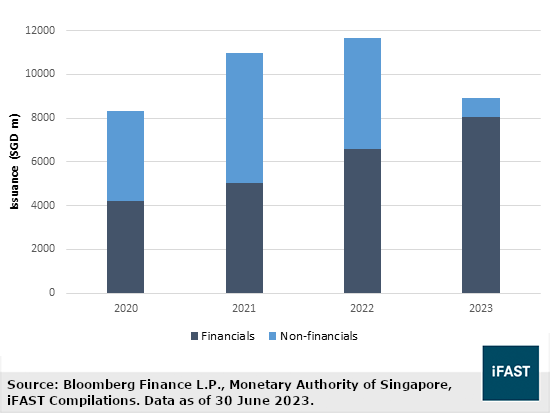
Chart 3
Market
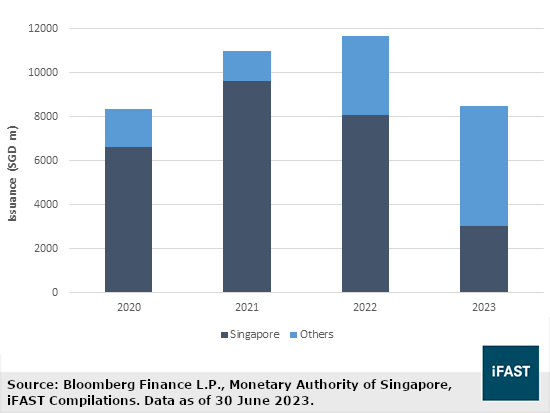
issuance size by Singapore & other countries in 1H for past years
As yields of Singapore T-bills adjusted downwards in 1H23, issuances in the Singapore corporate bonds market were limited by the high interest rates environment. As shown by Chart 2, SGD issuances in 1H23 had decreased from 1H21 and 1H22, coming close to the levels seen during the pandemic in 1H20. In addition, the majority of the issuances in 1H23 came from the financial sector, while issuances from other sectors fell off significantly.
Year to date, the majority of new issuers within the financial sector were banks, which was not surprising as banks are incentivised to borrow more to increase lending. The elevated interest rates environment is expected to stay for the rest of the year, allowing the banks to benefit from high net interest margins.
Similarly, by geography (Chart 3), more issuances were coming from overseas – a majority of the issuers in 1H23 were foreign banks, especially from Europe. Issuances coming from Singapore fell to 35.5% (of the total notional issuance value) in 1H23, much lower than the 69.3% in 1H22 and 87.8% in 1H21. In addition, unlike previous years, we have yet to see any quasi-sovereign SGD issuances in 2023, despite being major contributors to overall issuances in the past years.
Considering the sky-high interest rate environment, borrowing has been difficult for corporates in Singapore. As such, most corporates will likely consider obtaining short-term, temporary loans from banks, rather than to issue new, longer fixed-rate bonds that would require them to pay more over a longer time period.
Reaching the destination soon
Looking ahead to 2H23, we believe that local rates will continue to stabilize. In the previous two rate hike cycles (2006 to 2008 and 2018 to 2020) (Chart 4), yields on the Singapore Government Securities (“SGS”) started to fall off or plateaued before the Feds came to a pause.
Chart 4
Historical
Fed Funds Rate versus 1-year T-bills and 10Y SGS
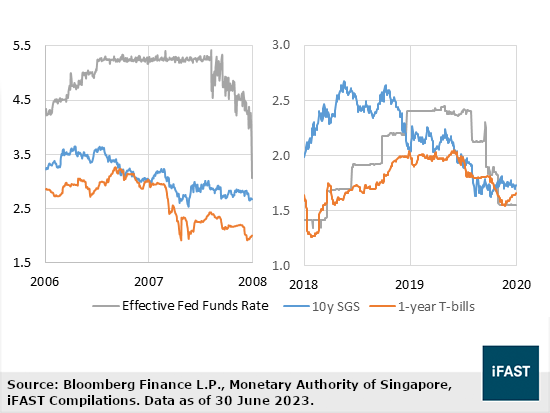
Chart 5
US
Fed Funds Rate versus Yields of SGS at various tenors
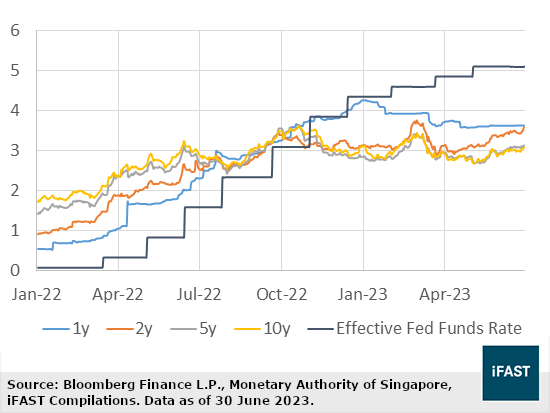
Coming into 2023, such a trend might have already begun as we see most SGS yields reaching a plateau since the start of the year. Even though the Fed continues to hint at another rate hike in late-July, the recent pause in June and moderation of headline inflation (to 3% YoY) suggests that we might soon reach the end of the hiking cycle.
Although the yields on the SGS had spiked during the US debt ceiling discussions, this appear to be one-off event which may not have a longer-term impact. In sum, we see a decent likelihood of Singapore interest rates stabilising from here, given a potential Fed rate pause that is looming on the horizon.
Will the yields blow past the previous peaks?
Chart 6
US
Fed Funds Rate, 10Y SGD SGS and US Inflation
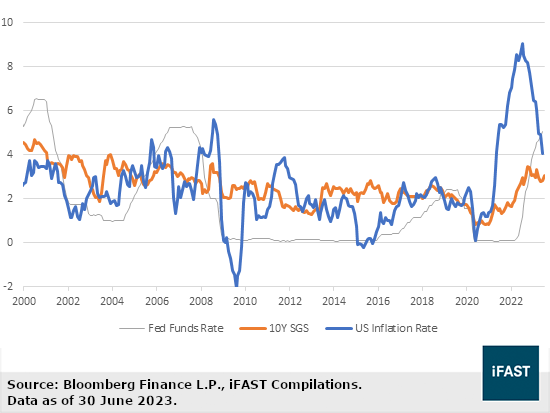
For Singapore, MAS manages the monetary policy through the currency strength, instead of controlling interest rates – more commonly seen in other countries. As a result, Singapore is mostly an interest rate taker, where our rates environment is mostly dictated by external factors – with a strong correlation to US Fed Funds Rate.
For SGS yields to break past their previous peak, US inflation will likely need to blow past previous peak. We believe it is unlikely that US headline CPI will exceed previous peak of 9.1% (June 2022) in the near-term. We may see bounces in inflation, but a sustain rise beyond prior peak is unlikely given a comparatively (to June 2022) more challenging macro backdrop, base effect and tighter monetary conditions. That said, inflation will likely remain elevated and interest rates are likely to stay higher for longer.
Outlook for 2H23
With milder expectations that interest rates would rise moving ahead, the environment should become more favourable for Singapore corporates in terms of debt issuances. As we enter 2H23, we expect to see more SGD corporate issuances from different issuers in Singapore, giving investors more options to choose from.
Given the current economic outlook where growth continues to slow, we still prefer investment-grade issuers over high-yield issuers. In addition, the prospect of higher-for-longer rates and nominal short-end yields also means that shorter duration bonds remain attractive.
That said, as rates begin to stabilise and the yield curve potentially flattens, investors may consider adding duration to their portfolio. However, we caution to be selective – look for an attractive yield pickup (over short duration bonds) that comes with decent credit quality and without significant trade off in tenor.
Declaration: For specific disclosure, at the time of publication of this report, IFPL (via its connected and associated entities) holds a position in BS23105W; SITB ZERO 19Sep2023 Govt (SGD), BS23107V; SITB ZERO 17Oct2023 Govt (SGD), BS23109E; SITB ZERO 14Nov2023 Govt (SGD), BS23111W; SITB ZERO 12Dec2023 Govt (SGD), BS23112N; SITB ZERO 26Dec2023 Govt (SGD), BS23114A; SITB ZERO 23Jan2024 Govt (SGD), BY23101W; SITB ZERO 23Apr2024 Govt (SGD), NX15100Z; SIGB 2.375% 01Jun2025 Govt (SGD) and the analyst who produced this report holds a NIL position in the abovementioned securities.
Our podcast series, Yield Hunters, is available on Spotify, iTunes Podcasts and Google Podcasts. We share our thoughts on new bond issues and hold discussions on the fixed income space. Listen to our latest episode below and follow us!