Libor, the London Interbank Offer Rate will be discontinued and this affects the calculation of the SGD Swap Offer Rate (“SOR”). The SOR will eventually be replaced by the Singapore Overnight Rate Average (“SORA”).
Existing cash products will use the fallback rate (SOR) after the switch which may have a small difference between it and the SOR.
SORA is currently trading at a lower rate than SOR but an expected rise in interest rates may compensate for the difference in the future.
SORA also has lower volatility which may be beneficial for the bond market.
In March this year, the Financial Conduct Authority announced that certain Libor quotes will not be provided after 31 Dec 2021, and this is applicable for all GBP, EUR, CHF and JPY tenor settings, as well as the 1-week and 2-month US dollar settings. All other Libor references will cease after 30 Jun 2023.
The proposed discontinuation of Libor directly affects SGD Swap Offer Rate as the SOR relies on Libor in its computation. SOR is widely used to price SGD bonds, compute floating coupon rates and determine part of the reset rate for SGD perpetual securities. As stated in its calculation methodology, the SOR is a function of the (i) USDSGD spot rate, (ii) volume of SGD FX swaps, (iii) USD Libor, and (iv) SIBOR rate (if the USD Libor rate is not available, or if there are no available SGD FX swap transactions).
Thus on 31 Mar 2021, the Steering Committee for SOR & SIBOR Transition to SORA (“SC-STS”) announced that all financial institutions and customers should cease to reference SOR for new derivatives contracts, and to stop using the Singapore Interbank Offered Rate (“SIBOR”) in new contracts by the end of September 2021.
Why does Libor need to be replaced?
Libor was administered by the British Bankers’ Association (“BBA”) from 1986 to 2014. As the name implies, the Libor rate is a reflection of the cost of borrowing between banks. This borrowing rate was computed as the interquartile trimmed mean of all submissions, and these submissions were collected from the banks every morning.
According to a paper by the Bank for International Settlements, Libor was arguably a design flaw as it was developed from a set of non-binding quotes rather than actual transactions and this gave the contributing banks an opportunity to manipulate the interbank rate. After investigating the Libor misconducts, the UK’s Financial Conduct Authority was given the responsibility of regulating Libor. Subsequently, the Intercontinental Exchange Benchmark Administration Limited started to administer ICE Libor with effect from February 2014.
There is a need to replace Libor as benchmark rates should not be easily manipulated by market participants. Following the author’s recommendations in the BIS paper, an ideal reference rate has to be a robust and accurate representation of interest rates in money markets, as well as serve as a benchmark for financial contracts outside money markets. Furthermore, the benchmark must be easily used by financial intermediaries (i.e. banks) for funding and lending purposes.
Introducing SORA
The Association of Banks in Singapore and Singapore Foreign Exchange Market Committee have identified the Singapore Overnight Rate Average (“SORA”) as the alternative risk-free rate to replace SOR. To oversee the migration from SOR to SORA, the Monetary Authority of Singapore (“MAS”) has assigned the SC-STS to drive the initiative and raise awareness about the new SGD interest rate benchmark.
SORA will be administered by MAS and is a volume weighted average borrowing rate of unsecured overnight interbank SGD transactions in Singapore. A daily auction is being conducted to support the price discovery of the SORA Overnight Indexed Swap rate. In addition to this overnight rate, MAS will publish the compounded 1-month, 3-month and 6-month SORA rates and SORA Index. Investors may refer here for more details on the computation of the compounded SORA.
The SORA rate is based on the previous day’s transactions and published at 9am every day. In the process of calculating SORA, there should be at least 10 eligible transactions of minimum SGD 1m from at least 5 reporting banks, with a combined minimum volume of SGD 500m. If these conditions are not met, MAS will apply the Contingency SORA rate, which has a floor value of zero.
As an interbank rate, the SORA is a reflection of the banking system’s credit risk. The credit profiles of the counterparties will be a contributing factor to SORA and a marked deterioration in credit quality of a bank will lead to a higher borrowing rate. But because it is a volume weighted measure, the SORA will likely be driven by transactions of the largest banks.
Similar to the Secured Overnight Financing Rate (“SOFR”), which is the presumed replacement for Libor, the SORA is computed based on overnight transactions. This would help to mitigate liquidity risk as volumes for overnight rates tend to be higher than longer tenors.
However, unlike the SOFR, SORA is derived from unsecured transactions, whereas the SOFR is a measure of the cost of borrowing cash overnight collateralized by Treasury securities. Additionally, SOFR has a bigger pool of contributors as it extends to submissions from non-bank wholesale counterparties.
SORA vs SOR
Unlike the SOR, which is a synthetic forward rate based on currency swaps, the SORA is a historical interbank borrowing rate based on unsecured SGD transactions. The SORA, by design, is likely to trade in a less volatile fashion than the SOR as it is derived from the average of cash transactions.
As an illustration in Figure 1, the 6m compounded SORA rate is comparatively less volatile than the 6m SOR. Therefore, we will probably see less fluctuation in SORA derived financial contracts as compared to contracts that have SOR references moving forward.
Figure 1: 6m compounded SORA and SOR rates
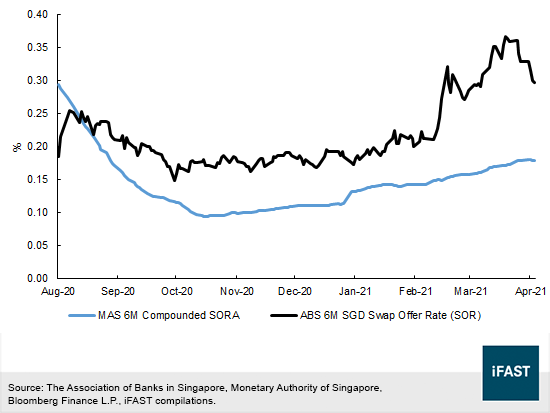
From Figure 1, the interest rate movements for both SORA and SOR appear to move in the same direction. The 6-month compounded SORA fell to as low as 9.5 basis points (“bps”) in October last year but has since recovered to 17.9bps. The 6-month Swap Offer Rate traded in a similar manner but rose to as high as 36.7bps in March 2021.
Fallback rate
To address the possibility of contractual disputes or settlement issues, the ABS Benchmarks Administration Co. Pte Ltd published the Fallback Rate (SOR), which will form the backup reference should the SOR be discontinued. The current intention, according to our understanding, is that the Fallback Rate (SOR) will form the backup benchmark for existing financial cash products including fixed rate bonds. However, the Fallback Rate (SOR) is not applicable to floating rate bonds as they will switch to SORA-based rates.
The calculation of the Fallback Rate (SOR) is similar to the SOR, with the exception of using the SOFR and the compounded SORA as part of the inputs. Unlike SORA, the Fallback Rate (SOR) is a backward-looking interest rate. Further details of the methodology for the Fallback Rate (SOR) may be found in this document.
Figure 2: ABS 1-month SOR vs ABS 1-month Fallback Rate (SOR)
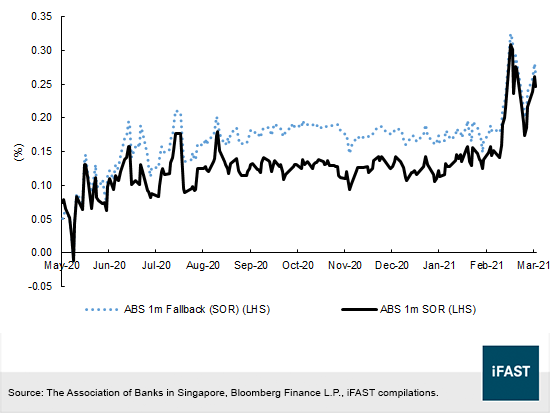
Referring to Figure 2, the ABS 1-month Fallback Rate (SOR) and ABS 1-month SOR have moved in tandem with each other, albeit the former has a slightly higher value than the latter. There is a small rate difference between the two benchmarks, so we think that there is little impact to outstanding fixed income securities that have SOR references. This is, of course, assuming that the 6m Fallback Rate (SOR) trades higher than, or close to the 6m SOR.
According to the media release by the SC-STS on 31 Mar 2021, the Fallback Rate (SOR) will be published until the end of 2024. And with this in mind, the switch to the Fallback Rate (SOR) will have little impact on SGD perps that are callable before end-2024, because we expect the Fallback Rate (SOR) to trade at an equal, if not higher level than the SOR.
On the other hand, SGD perps that are callable after 2024 may be resetting against a new SORA-derived benchmark. As of this writing, the SORA is trading at a lower rate than the SOR and one may argue there is a higher non-call probability for these perps. However, we believe that this will be offset by higher interest rates in 2025 as it is the central bank’s current expectation that inflation and general economic conditions would have improved by 2025.
Recent SORA issuance
New bond issues moving forward, will be priced according to the SORA rate. On 8 Jan 21, United Overseas Bank priced the first security that is resettable against SORA at 2.25%. The pricing of the UOB 2.250% Perpetual Corp (SGD) was lower than fair value given that the ask yield to call (“YTC”) for the UOBSP 3.875% Perpetual Corp (USD), which is redeemable at a much earlier date on 19 Oct 2023, was trading at 2.48% (~SGD 2.30% on 8 Jan 2021).
If not called on 15 Jan 2026, the coupon on the UOB 2.250% Perpetual Corp (SGD), a five-year Additional Tier-1 note (“AT1”) will reset to the 5-year SORA-OIS rate + 181bps. This is different from most other AT1s that usually have a reset rate based on the Swap Offer Rate interest rate swap (“SOR IRS”).
The UOBSP 3.580% Perpetual Corp (SGD), for instance, is resettable on 17 Jul 2026 with a reset rate equivalent to the prevailing 7-year Swap Offer Rate interest rate swap (“7-year SOR IRS”) + 179.5bps. Comparing the characteristics of the UOBSP 3.580% Perpetual Corp (SGD) and the UOB 2.250% Perpetual Corp (SGD), we observed that the credit ratings for both notes are identical.
For example, the UOBSP 3.58% perp is rated Baa1 / BBB- / BBB+ by Moody’s / S&P / Fitch respectively, whereas the UOB 2.250% Perpetual Corp (SGD) is rated Baa1 by Moody’s. However, UOB 2.250% Perpetual Corp (SGD) has an outstanding amount of SGD 150m, and this is lower than the UOBSP 3.58% perp.
Figure 3: Recent prices of the UOBSP SGD perpetual securities
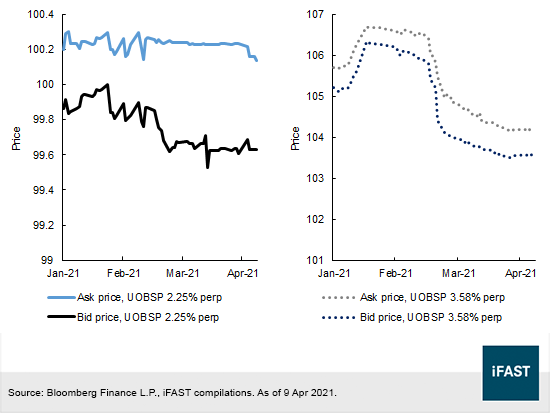
As seen in Figure 3, the price movements for both the UOBSP 2.25% perp and the UOBSP 3.58% perp were generally in the same direction. Bid prices for the notes were higher in February but staged a gradual decline in March and April. This suggest that the market is not assigning any price discount to a SORA-based security and may be a positive development for future SORA bonds.
To conclude, we do not believe that the transition to SORA will pose substantial disruptions for SGD bondholders. The SC-STS is proceeding gradually to allow the SOR to exit the system with little impact. The SORA is less volatile compared to the SOR and may serve as a better benchmark in the pricing of fixed income securities. There may be certain operational hiccups along the way and perhaps, a certain period of time may be required before market participants become more familiar with SORA, but we think that the overall risks will be manageable.
Declaration:
For specific disclosure, at the time of publication of this report, IFPL (via its connected and associated entities) and the analyst who produced this report hold a NIL position in the abovementioned securities.
Our podcast series, Yield Hunters, is available on Spotify and iTunes Podcasts and Google Podcasts. We share our thoughts on new bond issues and hold discussions on the fixed income space. Listen to our latest episode below and follow us!