Following the issuance of the AGSP 3.150% 16Jan2025 Corp (SGD) by Allgreen Properties Ltd earlier this month, another company within the Kuok Group, Shangri-La Asia Limited (“Shangri-La”), has announced a new SGD ten-year bond at the initial price guidance (“IPG”) of 3.70%. The senior issue is guaranteed by Shangri-La and issued by Shangri-La Hotel Limited, a wholly-owned subsidiary of the publicly listed hotel group. Similar to the SLHSP 4.500% 12Nov2025 Corp (SGD), the new bond is issued under the existing USD4.0 billion Euro Medium Term Note Program.
About Shangri-La Asia Limited
Shangri-La owns and manages the Shangri-La brand of hotels worldwide, operating 101 hotels in 27 countries across five different brands (see Table 1 for a list of the hotel brands). Additionally, the portfolio will include 15 hotels that are under development in Melbourne, Bahrain, China, Phnom Penh, Kota Kinabalu, Saudi Arabia and Bali.
Each hotel brand targets a specific group of customers. The group’s flagship hotels — Shangri-La Hotels and Resorts — are five-star luxury accommodations in major global cities. The Kerry hotels are also five-star establishments, but located only within China and Hong Kong. Hotel Jen, on the other hand, are mid-range hotels situated in Asian cities such as Singapore and Malaysia. Business travelers may consider staying at Shangri-La’s Traders Hotel, which are located in the business hubs of Asia and the Middle East.
Table 1: Hotel brands
|
|
No. of owned / leased hotels |
No. of managed hotels |
Total |
|
Shangri-La Hotels and Resorts |
71 |
15 |
86 |
|
Kerry Hotels |
3 |
- |
3 |
|
Hotel Jen |
7 |
2 |
9 |
|
Traders Hotels |
- |
3 |
3 |
|
Others (Portman Ritz-Carlton Hotel, Shanghai) |
1 |
- |
1 |
|
Source: Company |
|||
The group’s revenue is recognized through four main principal activities, namely 1) the development, ownership and operation of hotel properties; 2) the servicing and management of the group-owned hotels and third-party hotels; 3) development, ownership and operation of investment properties consisting of offices, commercial real estate and serviced apartments; and 4) the sale of development properties.
Ms Kuok Hui Kwong, daughter of Robert Kuok, Malaysia’s richest man, is the Executive Director and Chairman of Shangri-La. Ms Kuok is also a substantial shareholder of Kerry Group Limited, which owns a 51% interest in Shangri-La. Other major shareholders include the Kuok Brothers Sdn Berhad and Kuok (Singapore) Limited with stakes of 8.7% and 6.2% respectively.
The Kuok Group is involved in a number of businesses including properties, logistics, media, maritime and commodities. Other establishments within the Kuok conglomerate include Allgreen Properties, the real estate arm in Singapore, Shang Properties, a property developer listed on the Philippine Stock Exchange and Wilmar International, a leading agribusiness firm in Asia.
Top-line and operating profit discussion
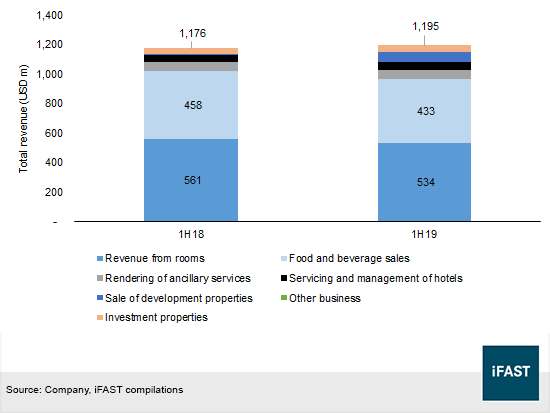
As seen in Figure 1, consolidated revenue in 1H19 was modestly higher from a year ago, driven by a recognition of USD66m in revenue from the sale of the remaining pre-sold units at the One Galle Face development in Colombo, Sri Lanka. However, hotel business revenue, specifically those from room bookings and food and beverages were 5% and 6% lower respectively. Food and beverage sales dropped to USD433m from USD458m in 1H19, while revenue from rooms declined to USD534m from USD561m. Those declines, according to management, were largely attributed to geopolitical and local-specific events, as well as a stronger US dollar against its operating currencies.
Figure 1: Revenue breakdown
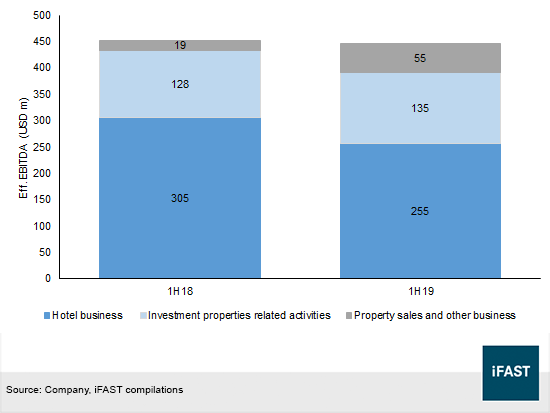
In contrast to a modest gain in revenue, Shangri-La’s operating income decreased in the six months till June 2019 from the corresponding period a year earlier. The group’s profitability remained healthy albeit there was near-term pressure on its hotel business. In this instance, we define operating income as the company’s aggregate effective share of EBITDA (“Eff. EBITDA”), because earnings from associate companies form a significant constituent of Shangri-La’s net income. Eff. EBITDA is determined as the aggregate total of the company’s EBITDA and the group’s share of the EBITDA of subsidiaries and associates based on the percentage of equity interests. Shangri-La’s operating margins, calculated as Eff. EBITDA over revenue, dropped slightly from 32% in 1H18 to 29% in 1H19.
Taking reference from the company’s guidance, operating income within the hotel properties segment dropped 23.2% to USD247m in 1H19 dragged by hotels in Hong Kong, China and Singapore, with percentage declines of 11.7%, 19.2% and 20.0% respectively. In contrast to the drop in operating income from hotel properties, Eff. EBITDA from investment properties and property sales both improved in 1H19. Eff. EBITDA from property development sales expanded to USD55m due to gains from the Colombo project mentioned earlier, while Eff. EBITDA from investment properties increased 5% YoY to USD135m, because of positive contributions from its associated firm in Beijing and investment properties in Mongolia.
Figure 2: Aggregate effective share of EBITDA
Credit highlights
In keeping with the trend of lower Eff. EBITDA, Shangri-La’s reported interest coverage ratio (EBITDA over interest expense, calculated in accordance with the former accounting standard HKAS 17) dropped from 3.7x in 2018 to 3.2x for the twelve months ended 30 Jun 19. In general, the group’s interest coverage ability was weighed down by decreased EBITDA and higher interest costs. If we included an additional USD16m of interest costs related to lease liabilities (under the new accounting standard), interest costs would have expanded 43% from USD76m in 1H18 to USD109m in 1H19.
Overall, Shangri-La’s credit profile was somewhat weaker in 1H19, as its reported net debt over effective share of EBITDA rose to 4.7x at the end of June from 4.2x at the end of 2018, while the reported net borrowings (total bank loans and fixed rate bonds less cash and bank balances and short-term fund placements) over total equity increased to 66.1% in 1H19 from 61% at the end of 2018. The increase in Shangri-La’s net gearing ratio was mainly driven by the increase of borrowings over the six-month period (from USD5.13 billion to USD5.24 billion) and the decrease of total equity due to the adoption of new accounting standards related to leases.
Shangri-La’s free cash flow may be hampered by capital expenditures, which are likely to increase over the foreseeable future given the increased commitments for capex in 1H19 to USD498m (31 Dec 18: USD440m). Nonetheless, we think the firm can still raise capital by pledging its investment properties as collateral for loans to offset its capex requirements, and the company should be able to at least maintain a decent liquidity profile moving forward.
At our meeting with management during a roadshow last year, the group disclosed that it was comfortable with its current leverage level, while a 50% debt-to-asset ratio (all-in including attributable debt at the level of associated companies) should cap the upper limit of the firm’s gearing. However, management was not satisfied with the weighted average debt maturity of 3.64 years as of end-June, and would be planning to extend the debt maturity profile. We understand that they were looking to achieve a debt distribution profile of around USD500m maturing in each year for ten years.
Shangri-La has ample liquidity to address its near-term debt obligations. As at 1H19, the group’s cash and bank balance approximated USD831m (2018: USD970m). The cash position covers its short-term borrowings of USD490m, short-term lease liabilities of USD52m and USD11m of amounts due to non-controlling shareholders. So far, the company has not encountered any difficulty in drawing loans from its banking facilities. Committed and undrawn facilities added to USD903m as of 30 Jun 19, although USD296m and USD559m of banking facilities will mature in 1H20 and 2H20 respectively.
The group’s gearing ratio, defined as total debt over total assets, dropped slightly from 39% in 2018 to 38% in 1H19. Taking the level of lease liabilities into account, the gearing ratio would have reached 43%. In 1H19, the adoption of HKFRS 16 led to the recognition of USD1.4 billion of right-of-use assets and USD638m of lease liabilities on the balance sheet.
Hotel operations
In the short term, Shangri-La’s exposure to Hong Kong poses the largest downside risk to its credit profile. The management acknowledged that the unrest in the territory had affected the firm’s performance, although the situation had been partly mitigated by traffic flows to Singapore.
Revenue from Hong Kong accounted for 15% of Shangri-La’s overall hotel property revenue. Hotel occupancy in the city dropped to 82% for the six months ended 30 Jun 19, down from 83% in 1H18. Revenue per available room (“RevPAR”) was USD237 in 1H19, nearly unchanged from USD238 in 1H18. Aggregate hotel revenue in Hong Kong decreased just 1.5% YoY to USD175.0m, but operators may cut room rates going forward in view of the recent drop in tourist arrivals.
Also, hotel revenue from China were lower as many business meetings did not materialize due to the US-China trade tensions. RevPAR and occupancy dropped 8% YoY and one percentage point to USD79 and 64% respectively in 1H19. Looking forward, management shared that hotel rates in Tier 1 cities had been holding up much better than those in Tier 2 and Tier 3 cities, coinciding with a pick-up in sales during July and August 2019.
In view of a possible outbreak of the Wuhan coronavirus and ongoing social unrest in Hong Kong, the outlook for hotel bookings seems uncertain. The drag on hotel revenue may persist into the first half of 2020 but we do not think it will significantly impair the liquidity profile of the company.
Bond valuation
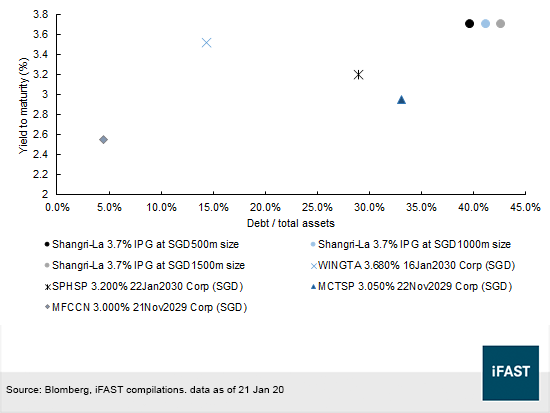
We think that the new Shangri-La bond is fairly priced at its initial price guidance (“IPG”) of 3.7%. The IPG is priced above the yield to maturity (”YTM”) of WINGTA 3.680% 16Jan2030 Corp (SGD), a senior unsecured note by Wing Tai Holdings Limited (“Wing Tai”).
Although Wing Tai has a lower gearing than Shangri-La, the property developer has a smaller recurring revenue base and would be more exposed to property prices. Shangri-La also has a more diversified revenue profile as it operates in 27 countries. The YTMs of some other long duration SGD notes provided in Figure 3, such as the SPHSP 3.200% 22Jan2030 Corp (SGD), MCTSP 3.050% 22Nov2029 Corp (SGD) and MFCCN 3.000% 21Nov2029 Corp (SGD), are comparatively less attractive in our view.
Figure 3: Relative valuation
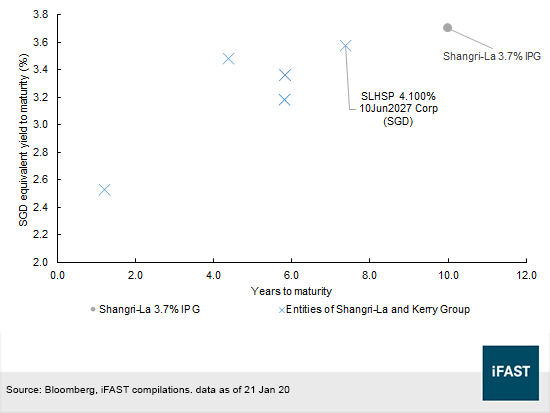
When compared to the SLHSP and other credits within the Kerry Group (Figure 4), we think that the 3.7% IPG is priced on the tight end of the curve. For instance, the SLHSP 4.1% notes due 2027 were quoted at around 3.6% ask YTM as of this writing, and we think the pickup of approximately 10 basis points is meager for the 2.5-year long tenure of the new SLHSP notes. The 2027 bond is also ranked senior unsecured and has an issue size of SGD165m.
Figure 4: Yield comparison of the Shangri-La bonds and other Kerry Group credits
Declaration:
For specific disclosure, at the time of publication of this report, IFPL (via its connected and associated entities) has a principal position in MFCCN 3.850% 25May2026 Corp (SGD). The analyst(s) who produced this report holds a NIL position in the abovementioned securities.