Highlights:
The rate hike cycle may arrive earlier. The Fed has started tapering and we believe the 10-year Treasury yield will continue its upward trend. Despite the recent rise in investment grade corporate bond yields, it is not the best time for long-term investment grade bonds investments, unless investors want to hold them to maturity.
For high yield bonds, the yield spreads of European and American markets remain unattractive. Comparatively, the investment value of Asian bonds in some regions and sectors is better, including diversified choices such as gaming, utilities, natural resources, energy and financial leasing companies.
Regulations governing the Chinese real estate sector are gradually loosening, paving the way for recovery in supply and demand. Nonetheless, sales next year is expected to decline slightly. We believe investors should keep a look out for sudden but short-lived opportunities that may arise for bonds with BB-rated or above. However, investors should be prepared to embrace the price volatility
Investment Grade Bond Market Outlook
Fed Has Started Tapering
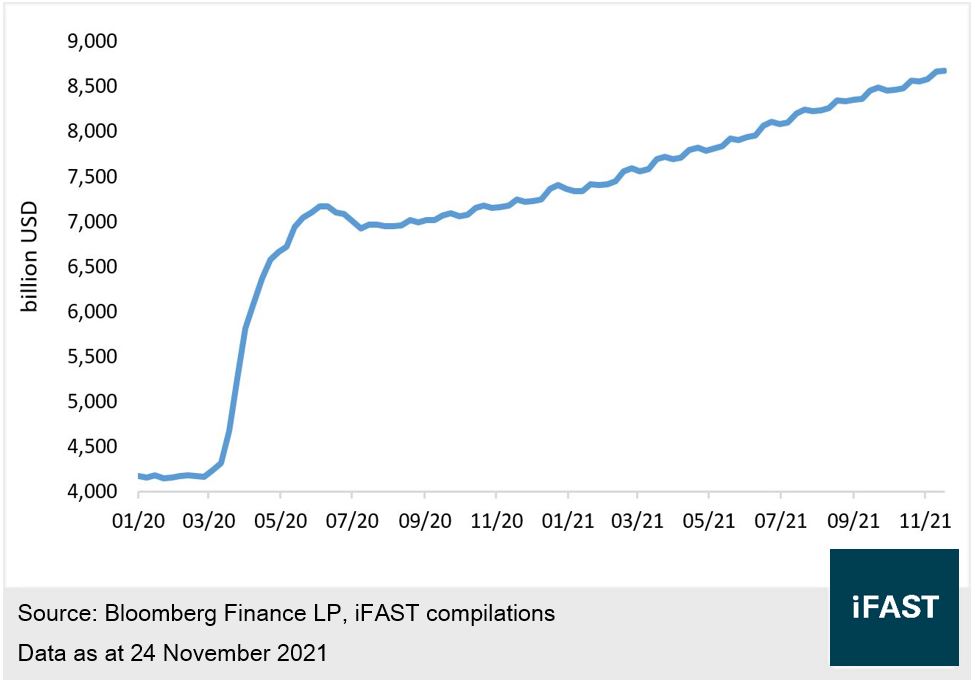
After the FOMC meeting in early November, Fed Chairman Jerome Powell announced that the Fed would start tapering asset buys by USD15 billion per month (including USD10 billion Treasury securities and USD5 billion mortgage-backed securities), and could be done by mid-2022. In other words, the Fed has officially put an end to its USD120 billion monthly asset-buying program which began last July (see Chart 1).
Chart 1: The Size of Fed’s Balance Sheet
Markets did not react drastically as the meeting result was exactly what has been anticipated, and the tapering speed was within expectations as well. Meanwhile, investors have already shifted their focus to whether the Fed will end its bond-buying program earlier and are predicting the timing of future rate hikes. Similar to what we mentioned before, the first step of Fed’s taper will be the reduction of bond buying, followed by a rate hike.
Given that the first step has already taken place, are we far from the second step?
Rate Hike Cycle May Arrive Earlier
With modern monetary theory becoming the key economic trend nowadays, the out-of-control inflation is the main reason for the increase in interest rates across the globe. This year, we saw successive rate hikes from emerging market countries such as Brazil and Russia. Developed countries such as South Korea, Norway and New Zealand have raised their interest rates due to domestic inflation problems.
Since April this year, US CPI has remained high and even reached 6.2% in October. Although Powell has repeatedly told the public that inflation is ‘transitory’, his stance has changed – inflation could last until next year due to supply-side limitations, especially since both CPI and PPI show no signs of slowing down.
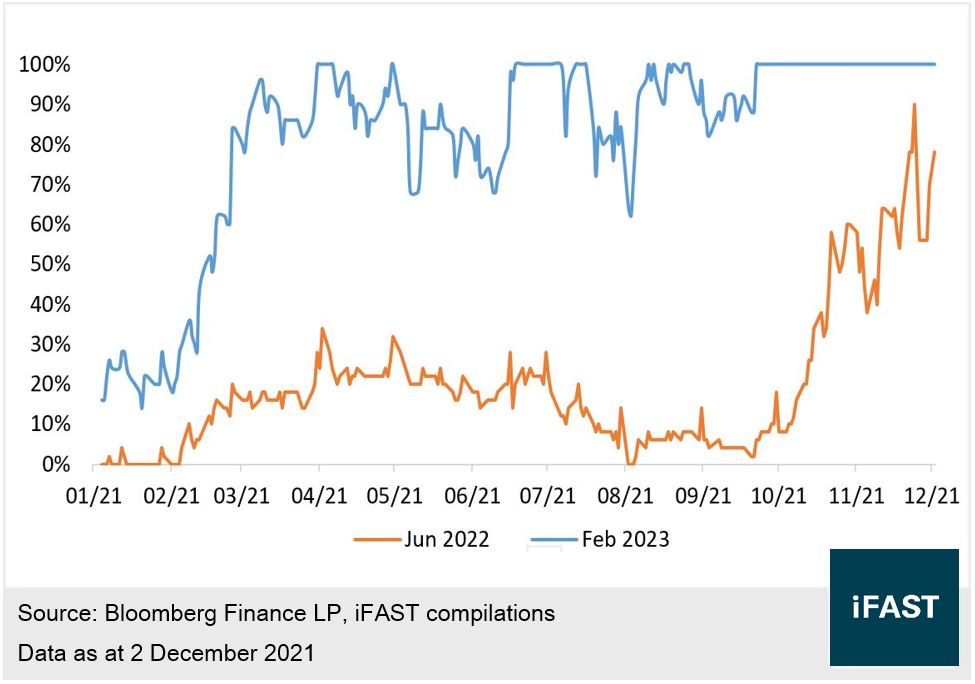
Against this macro backdrop, the dot-plot following the FOMC meeting in September revealed that half the Fed officials are anticipating at least one rate hike in 2022. Markets are also expecting an earlier rate hike in the Fed funds futures, and implied probabilities for a 25-bps rate hike in June 2022 and February 2023 have reached 70% and 100% respectively (see Chart 2).
Chart 2: Fed Funds Futures Implied Probability (25-bps Hike)
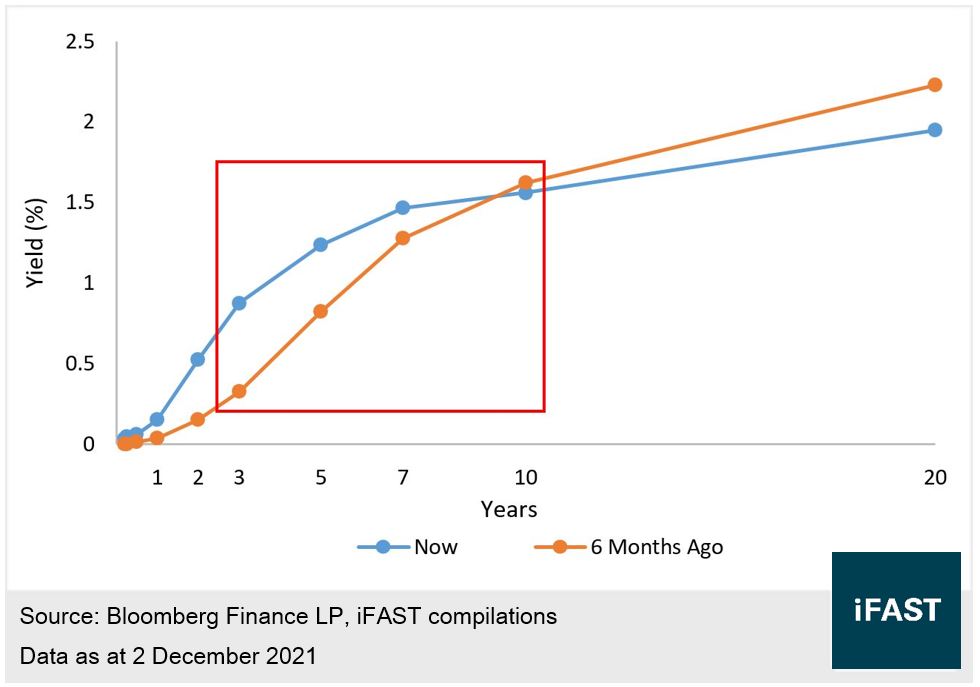
The short-and-medium-term Treasuries have responded quickly as they are highly sensitive to interest rates. 5-year Treasury yield increased sharply from 0.78% to 1.2% in just three months, leading to a flattened yield curve (see Chart 3) and putting upward pressure on longer-term bond yields.
Chart 3: US Treasury Yield Curve
Treasury Yield Will Continue
Its Upward Trend; Should Avoid Long-term Investment Grade Bonds
In 2013, because of the Fed’s announcement of plans to gradually exit from its quantitative easing program, the 10-year real yield jumped by over 100-bps from its historical low within six months; that period was named ‘Taper Tantrum’.
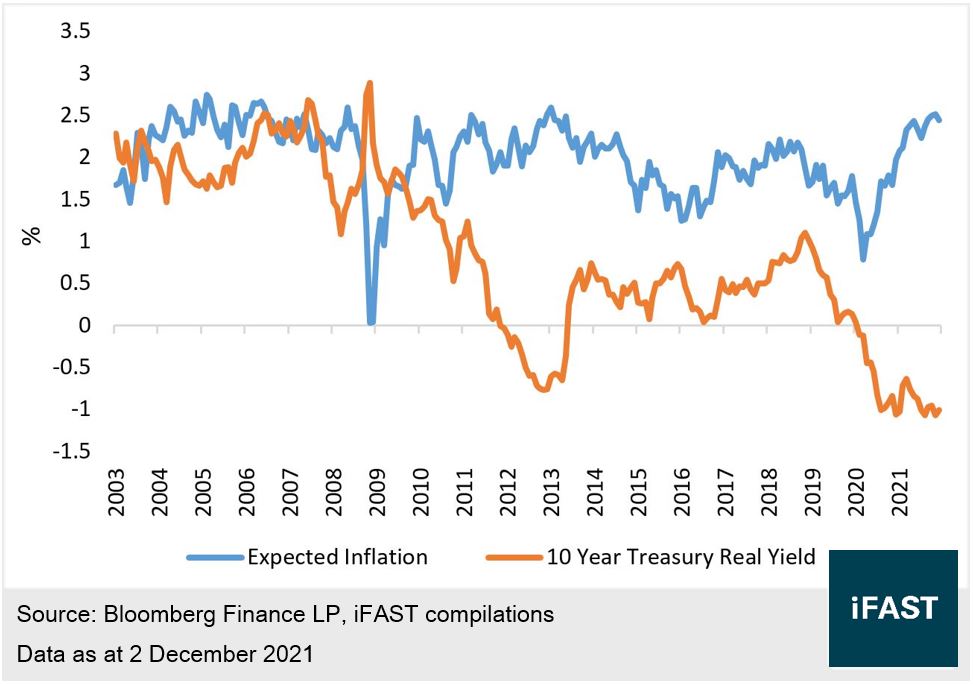
Although Powell wants to avoid any form of a Taper Tantrum again - since the real yield is now sitting at a historical low of -1.1% (see Chart 4), we believe that the nominal yield will continue to rise even if inflation expectations slow down, as the real yield will become the key contributor in the long run.
In last year’s outlook, we mentioned that long-term investment grade bonds would carry a higher interest rate risk. Despite a growth of 60-bps in Treasury yield over the past year and a recent rise in investment grade corporate bond yield, it is still not the best timing to invest into long-term investment grade bonds, unless investors intend to hold them to maturity.
Chart 4: 10-year Treasury Real Yield vs. Expected Inflation
High Yield Bond Market Outlook
European and American Markets Remains Unattractive
Since June, the Asian high yield bond market, led by Chinese Real Estate (CRE) bonds, have suffered a big loss, with yield spreads once widening over 600-bps. Meanwhile, other markets remained quite stable as the high yield bond spreads for emerging markets and European & American markets increased by around 150-bps and 50-bps respectively (see Chart 5).
Chart 5: High Yield Bond Spreads by Geographical Locations
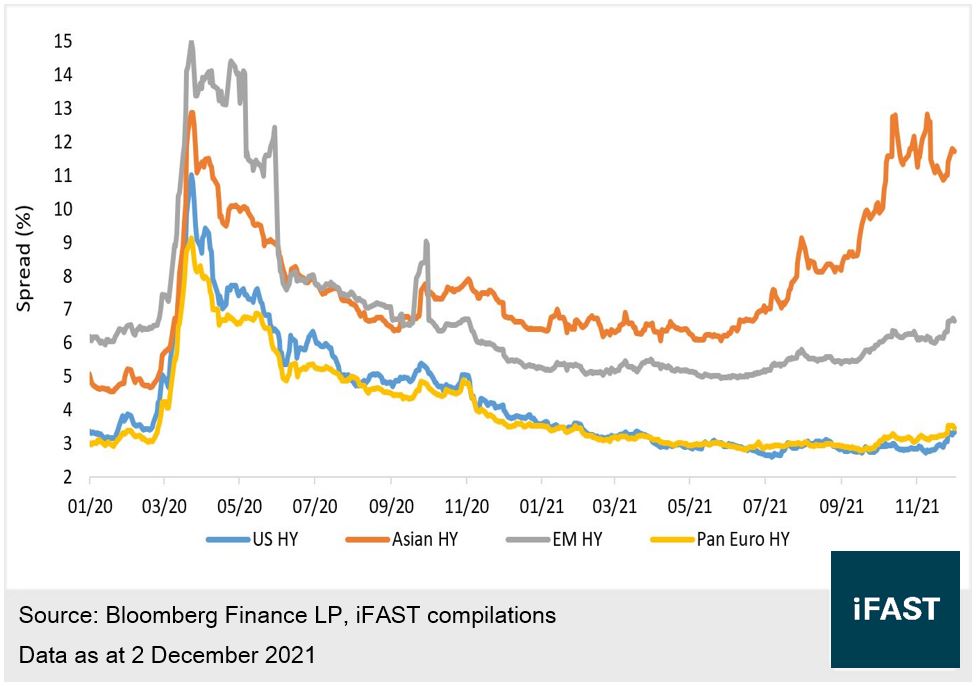
Although high yield bonds usually have shorter duration and lower sensitivity to interest rates, European and American bonds may be more affected by the global rate hike cycle given that their yield spreads are now at approximately 330-bps to 340-bps, a level much lower than the historical mean. We believe these bonds are less attractive in terms of relative value, while more analysis based on their specific locations and sectors are needed from credit perspective.
Asian Bonds in Some Regions and Sectors Are Worth Considering
On the other hand, with China accounting for nearly half of its weightage, Asian high yield bond spreads have returned to the same level in March 2020. The Chinese Government’s intervention in different industries and continuous credit events in the real estate sector have caused significant capital outflow, and some non-property bonds took a hit as well.
Looking forward, we still think China offers good investment value, and the recent crash in the property sector will not trigger a systematic risk. Aside from real estate bonds, the market still offers various choices including utilities, natural resources, energy and financial leasing companies. The yields of these bonds have generally risen 150-bps recently, making them even more attractive.
If investors wish to invest in other markets, the Asian high yield market also includes countries such as India, Indonesia and Japan. Apart from Mainland China, the bonds issued by casinos in Macau and the mid-size developers in Hong Kong can also provide appealing returns.
We still hold a conservative stance towards the bonds issued by local government financing vehicles (LGFV). These corporates generally have a huge amount of debt and lack transparency in financial information (usually unlisted), and their credit ratings are commonly bumped up by 6 to 7 notches against the standalone credit profile simply because of their local government background. Referencing the Tewoo Group, Yongcheng Coal and Chongqing Energy, we think investors have to be more prudent before investing in LGFV bonds, and the key consideration is the financial condition of each issuer’s local government.
Lastly, although perpetual bonds and contingent convertible (CoCo) bonds can offer higher yields, it usually requires a case-by-case analysis because of their complicated terms. It is important to understand their features before making any investments in them.
Chinese Real Estate Bond Market Outlook
The Intensity of Selloff is Unprecedented
Despite the sharp decline in market value, CRE bonds remain as the key member of the Asian high yield market and contributes to over 30% in the JP Morgan Asia Credit Non-Investment Grade Index weighting.
According to Moody’s, defaults in Chinese offshore bonds over the first nine months this year amounted to around USD7.8 billion. This increased by 28% YoY and has already surpassed the total size in 2020. In the last quarter, we saw more credit events happening, including but not limited to Sinic, Fantasia, Yango, Kaisa and Aoyuan – an indication that the defaults might increase further.
The intensity in which CRE bonds have been sold off this time is unprecedented. During the 2009 global financial crisis, CRE USD bonds were not that popular, with just a couple of developers issuing those bonds. In 2020, the liquidity crash caused by COVID-19 did not trigger this huge a correction in the CRE bonds as well. According to our tracked CRE USD Bond Yield Index, the average yield of B and BB-rated issuers once surpassed 60% and 20% respectively (see Chart 6).
Chart 6: BSM Chinese Real Estate USD Bond Yield Index
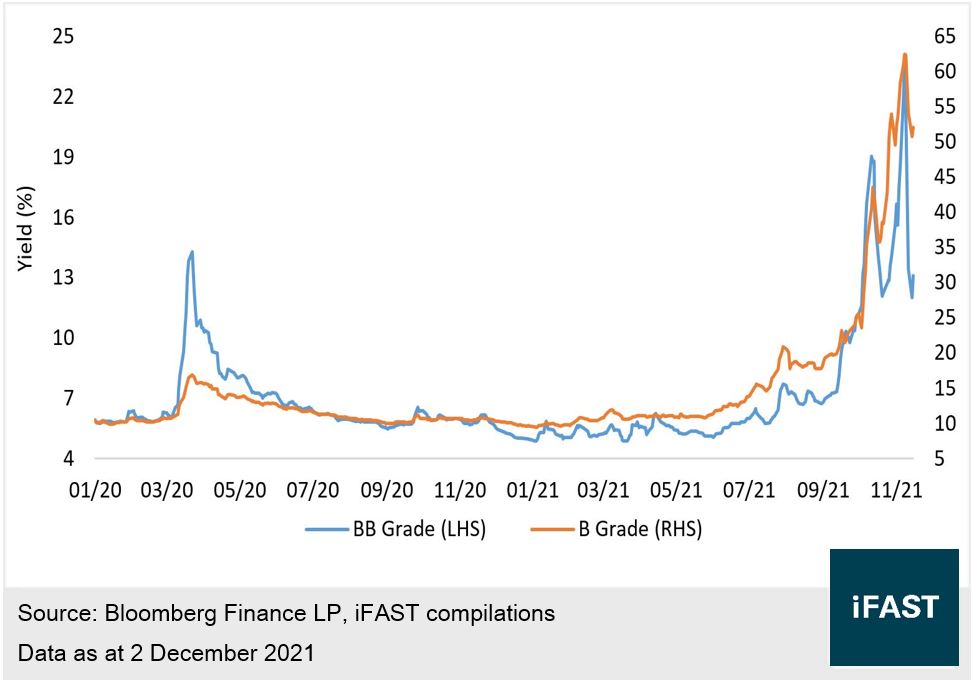
Given the skyrocketing bond yields, high yield issuers find it almost impossible to access their bond financing channels. According to KE Research, the offshore CRE bond issue size in Jan-Oct dropped by 37% YoY, while the new issue market has gone completely silent, especially in the second half of the year. It was reported that the three major credit rating agencies have downgraded the developers’ outlook and ratings over 130 times from June to mid-November. This in turn resulted in bond prices dropping further, leading to another downgrade due to the weakened financing channels, thereby creating a vicious cycle.
Regulations are Gradually Loosening; Both Demand and Supply Could Recover
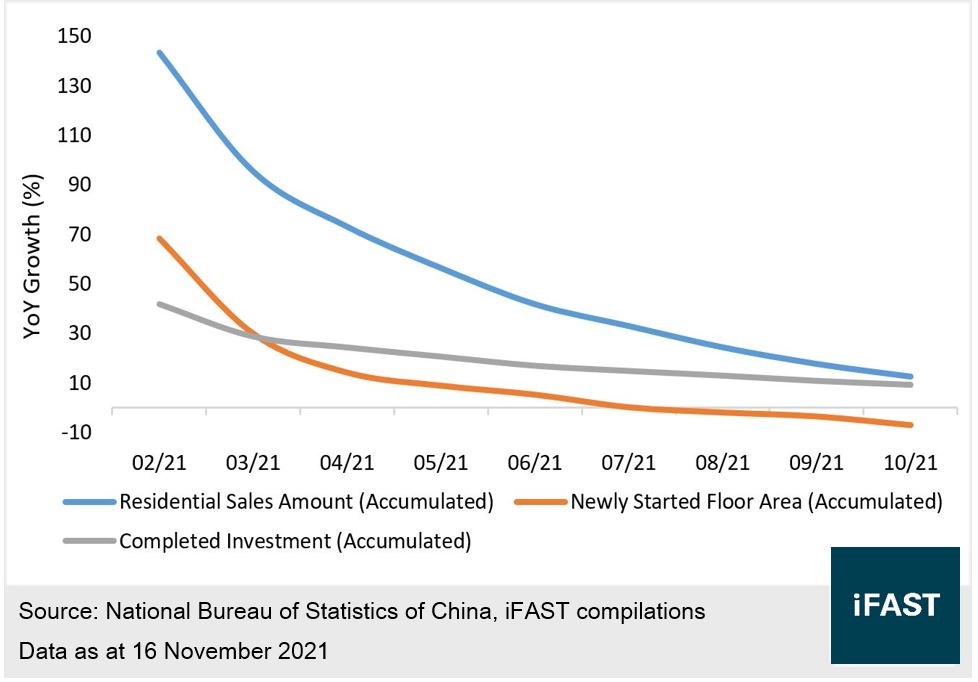
The Chinese real estate sector has been facing a downturn since June this year. We saw weakened fundamentals as the growth in residential sales, newly started floor area and completed investment amounts have shrunk significantly (see Chart 7). The situation is quite similar to the market downturn back in 2013-2014.
Chart 7: National Residential Development, Investment and Sales Data
Looking back to 2014, the property sector remained its weak trend since previous year-end, housing prices fell and the national sales of commodity housing declined by 9% YoY from Jan-Aug then. Afterwards, the Chinese Government tried to stabilize the property market and livelihood of the people by loosening regulations and limitations on purchasing property and obtaining mortgages. They announced the ‘930 new policy’ in September 2014, and then implemented another ‘330 new policy’ in 2015, which significantly boosted confidence of market demand and led to a sectorial rebound.
Since the start of 2021, the Chinese Government continued to observe the debt woes of different developers from the sidelines without interfering. However, the fundamental factors like supply-demand, housing price and homebuyers’ confidence were severely impaired after many developers fought for survival by cutting sales prices, ceasing land buying programs and halting construction works. With stabilisation as the top priority, the Government has finally garnered sufficient grounds to take actions.
Although the liquidity injection from its monetary policy may not be feasible given the inflation pressure, the Government has enough tools to loosen controls at the industry level. Recently, we saw many positive signals of market stabilisation such as speeding up mortgage approval, lowering mortgage rates and allowing developers to issue notes in the interbank market. In addition, the controversial property tax law has changed from legislative precedence to a 5-year experiment, and the number of trial cities have been reduced.
With a strong growth in the first half of the year, the robust demand for housing in China is unlikely to disappear. Therefore, if regulators continue to loosen the regulatory measures, we believe both supply and demand could recover. Under this direction, we estimate that the 2022 national residential sales will decline slightly, with a magnitude less than 10%.
Short-term Bond Price to Remain Volatile; Could Focus on Bonds that are BB-rated or above Next Year
In fact, the property sector’s debt crisis has yet to be abated. Even with the relaxed measures, it takes time to deliver them and may not provide immediate relief for the developers facing a liquidity crunch. Therefore, it is likely that more default events are to come in the next 3 to 6 months.
In mid-November, the negative rumors surrounding Shimao Group spread to the marginal investment grade issuers like Country Garden and Seazen Group. Although these companies are all facing the risk of a credit downgrade, their credit profiles have a comparative advantage over their peers, which offer certain investment value.
Looking ahead into 2022, we believe investors should keep a look out for sudden but short-lived opportunities that may arise for bonds with BB-rated or above. However, investors should be prepared to embrace the price volatility. For conservative investors, one strategy is to adopt a wait-and-see approach and make your decisions after observing if the industry sales situation picks up in the next few months.
Conclusion
The rate hike cycle may arrive earlier as the Fed has started tapering and we believe the 10-year Treasury yield will continue its upward trend. Despite the recent rise in investment grade corporate bond yield, it is still not the right time to invest into long-term investment grade bonds, unless investors intend to hold them to maturity.
For high yield bonds, the yield spreads of European and American markets remain unattractive. Comparatively, the investment value of Asian bonds in some regions and sectors is better, including diversified choices such as gaming, utilities, natural resources, energy and financial leasing companies.
Regulations governing the Chinese real estate sector are gradually loosening, paving the way for recovery in supply and demand. Nonetheless, sales next year is expected to decline slightly. We believe investors should keep a look out for sudden but short-lived opportunities that may arise for bonds with BB-rated or above. However, investors should be prepared to embrace the price volatility.