STT GDC Pte Ltd (“STT GDC”) is tapping the SGD market with a 5-year senior unsecured bond, riding on its S$1.5 billion debt program. We met with management of the private company at a recent roadshow, and highlight here a few points investors should know about STT GDC and the bond issue.
About STT GDC
STT GDC offers co-location, managed hosting and cloud services. It is a wholly-owned subsidiary of STT Communications Ltd (“STT Comms”), which is in turn a direct wholly-owned subsidiary of Singapore Technologies Telemedia Pte Ltd (“ST Telemedia”). Being a part of the ST Telemedia group, STT GDC is also able to leverage on ST Telemedia to broaden its customer reach.
The ultimate parent is Temasek Holdings (Private) Limited (“Temasek”), which has a 100% stake in ST Telemedia (see Figure 1). Temasek is entirely owned by the Government of Singapore and is currently rated triple-A (with a stable outlook) by both Moody’s Investors Service and S&P Global Ratings.
Figure 1: Company structure
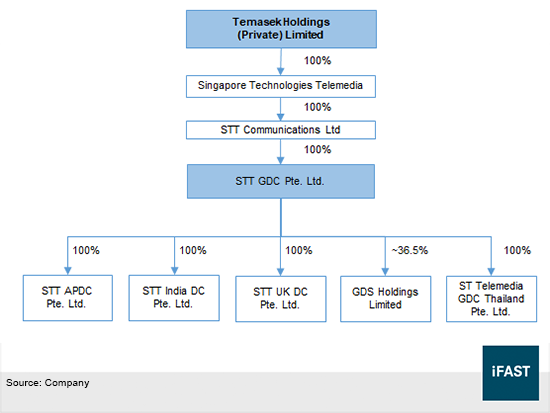
As of the end of 1H19, STT GDC owns a portfolio of over 90 data centres, out of which 72 data centres are in service. STT GDC’s geographical reach stretches across a number of countries including Singapore, India and the United Kingdom through various subsidiaries. In addition, STT GDC has a 36.5% interest in NASDAQ-listed GDS Holdings Limited (“GDS”), which is a leading developer and operator of high-performance data centres in China. GDS has a market cap of US$6.3 billion as of 13 Sep.
Corporate developments since 2014
STT GDC was incepted in Singapore in 2014. The firm made its first venture into China after acquiring an approximately 42% stake in GDS. A year later, STT GDC announced plans to build a high quality data centre in Defu Lane, Singapore.
In June 2015, the company took ~26% interest in STT Virtus Holdco Limited, which in turn held an effective interest of 98.6% in Virtus, one of the UK’s fastest-growing data centre providers. A month later, Starhub partnered with STT GDC to build STT MediaHub, a telecommunications, media and data centre at one-north, Singapore.
In May 2016, STT GDC acquired a 74% interest in Tata Communications’ India data centre through a partnership with Tata Communications. The company then acquired Tata Communications’ data centre business in Singapore nine months later, by taking a 74% stake in STT Tai Seng Pte Ltd.
In September 2017, STT GDC started construction on another data centre next to Defu Lane. Concurrently, Virtus became a wholly-owned subsidiary of STT GDC with its acquisition of the remaining minority stake. In April last year, a joint venture partnership with Frasers Property Thailand paved the way for STT GDC to develop and operate data centres in Thailand.
As recently as January this year, Virtus announced the construction of five additional data centres across London. At the end of June, STT Tai Seng became a wholly-owned subsidiary of the firm.
What are data centres?
Data centres are facilities with specially built systems and equipment to store, process and distribute data. Put simply, they are the essential connectivity hubs that are a crucial component in our digitalization age.
Due to the unceasing nature of data consumption, there is a need to keep data centres up and operational on a continuous basis. That emphasizes the requirement for physical security of the facility, as well as the continuous monitoring of heat and power consumption. In addition to having high performance computers and large storage servers, there is an increasing need for data centres to connect with various telecommunication and internet service providers in order to improve network latency and reduce distance related delays for end users.
End users either operate data centres on their own, or adopt a colocation data centre. In a colocation data centre, customers are often assigned a designated area, where they install equipment that is not accessible by the facility provider. There are three groups of colocation end users — retail, wholesale and hyperscale.
Retail users use less than 240 kilowatt (“kW”) of power, often sharing network and IT equipment with multiple tenants that starts from a single rack of servers. They are billed at a flat rate for their power consumption and contracts with the data centre provider usually last between 1 to 3 years.
Corporate or wholesale customers use colocation as a model to outsource their acquisition or management of IT assets, and tend to occupy a larger area within the data centre. Depending on the circumstances, they may also lease the entire facility for their operation. Unlike retail users, wholesale customers require 240kW to 2 megawatt (“MW”) of power and enter into contract agreements that last between 5 and 15 years.
The last group of end customers is hyperscale users, or companies that consume power at the 2MW-and-above level. Hyperscale users occupy the entire data centre, and floor spaces can range between 1,393 to 11,148 square meters (“sqm”). Companies in this category would include large cloud service providers such as Amazon Web Services, Microsoft and Google. The tenant agreements usually last 3 to 15 years.
Industry projections
The independent research firm, Structure Research, projects worldwide colocation revenue to expand to USD69.8 billion by 2024, growing at a compound annual growth rate (“CAGR”) of 9.9%. Retail colocation sales could grow at a CAGR of 6.3% to reach USD39.2 billion in 2024, while wholesale colocation revenues could expand at a CAGR of 15.7% to USD30.6 billion in 2024.
The strong growth will be driven by increased use of mobile devices, cloud data traffic and growing number of hyperscale cloud service providers. Moreover, the number of IPv6-capable devices could grow at a CAGR of 18% between 2017 and 2022, and global mobile data traffic could grow at a CAGR of 46%. IPv6 is the latest version of the Internet Protocol that allows more efficient network routing, among other benefits.
An overview of STT GDC’s properties and business operations
Table 1: STT GDC’s global footprint
|
Data centres in operation |
|||||
|
Country |
Singapore |
India |
the UK |
China |
Thailand |
|
Number of data centres |
6 |
14 |
5 |
47 |
|
|
Net floor area (sqm) |
27,355 |
39,855 |
32,842 |
180,441 |
|
|
Data centres under construction |
|||||
|
Country |
Singapore |
India |
United Kingdom |
China |
Thailand |
|
Number of data centres |
1 |
1 |
5 |
11 |
1 |
|
Net floor area (sqm) |
11,288 |
6,502 |
34,021 |
78,373 |
16,000 |
|
Committed net floor area |
91.5% |
79.0% |
87.8% |
93.7% |
|
|
Source: Company |
|||||
Referring to Table 1, STT GDC presently has seven centres in Singapore. STT Loyang, a 30MW data centre, is expected to be completed by 2020. Within Singapore, the group faces strong competition from a number of players.
Digital Realty Trust (“DRT”), one of the world’s largest data centre companies, is said to be building its third facility — a 50MW building on Loyang Drive — expected to be launched by 2020. Equinix, the world’s largest colocation provider, will compete with STT GDC with its SG4 data center. AirTrunk, a startup focusing on hyperscale data centres, has also announced the launch of a 60MW facility in Singapore.
After the partnership with Tata Communications, STT GDC is currently the market leader in India with 15 facilities across 8 cities. Customers in India range from IT firms, multinational corporations, telecommunication carriers and e-commerce firms. Nearly 80% of the floor area is operational. The 14 data centres cover a floor area of nearly 40,000 sqm, while 6,502 sqm are under construction.
Growing to a capacity of over 29,000 sqm in a span of three years, the group’s London unit — Virtus — is one of the UK’s fastest-growing data centre providers. Virtus operates five data centres and plans to add five more centres. That will bring its portfolio floor area to nearly 70,000 sqm. With the three new data centres built near Stockley Park, Virtus will become London’s largest data facility campus. As of 1H19, 87.8% of the facility space is contracted to cloud service firms, IT service companies, financial institutions and local businesses.
STT GDC’s exposure to China is held through its 36.5% interest in NASDAQ-listed GDS Holdings, a leading carrier-neutral data centre operator and developer with an 18-year track record. In its 2Q19 results filing, GDS reported a 54.3% YoY increase in total committed area to 220,818 sqm, resulting in a 54.5% YoY gain in total revenue. Adjusted EBITDA climbed 84.5% YoY and EBITDA margin was 43.5% as of the quarter ended June. Recently, Singapore’s sovereign wealth fund GIC partnered with GDS to build data centres outside tier 1 cities in China.
STT GDC’s end users are mainly investment-grade companies. In the first six months of this year, the top 10 customers contributed 66% of total revenue. Two of the group’s largest customers accounted for 44% of total revenue, which indicates revenue concentration risk given that STT GDC would be highly dependent on these international cloud service providers.
Discussion of financials
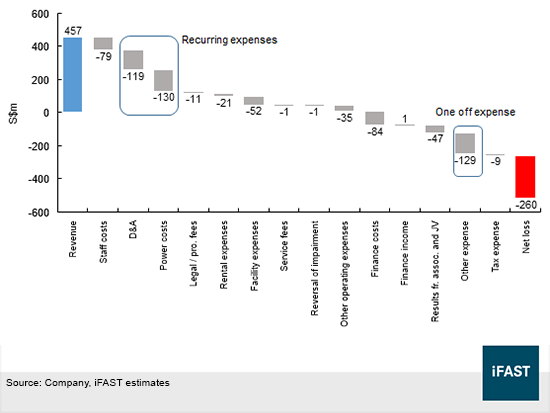
In the trailing twelve months (“TTM”) ended June, revenue increased to S$457m, up 14% from S$401m in 2018. However, the group reported a net loss of S$260m in TTM 2Q19 (see Figure 2), partly due to recurring expenses such as depreciation and amortization (S$119) and power costs (S$130). A one-off expense of S$129 incurred in 2018 also detracted from earnings, which was related to the impairment on goodwill and intangible assets from a previous acquisition. The loss in TTM 2Q19 exceeded that of 2018 (-S$254m) and 2017 (-S$64m)
Figure 2: TTM 2Q19 income statement breakdown
Compared to its publicly listed peers, STT GDC is more geared and has a lower profitability margin. With a debt-to-EBITDA multiple of 13.6x in TTM June, STT GDC’s financial leverage is meaningfully higher than other firms. We believe that this is because the company has borrowed considerably to expand its presence in a number of countries including Thailand and the United Kingdom (where it is constructing five more data centres).
While STT GDC competes directly with Digital Realty Trust, Interxion Holding NV (“Interxion”) and Equinix, we also included telecommunication service providers in our comparison in Table 2 as they were mentioned as competitors in the offering circular of the company’s debt program. STT GDC’s EBITDA margin of 28% in TTM June trailed competitors. Nonetheless, EBITDA margin in 1H19 increased to 35% from 24% in 1H18, which indicated that the firm’s operating profitability has improved from a year ago, and management has guided that EBITDA margin should increase to between 40% and 45% moving forward, in line with industry peers.
Table 2: STT GDC vs peers (TTM June 2019 estimates)
|
|
TTM revenue (S$ m) |
TTM EBITDA (S$ m) |
TTM EBITDA margin |
Debt (S$ m) |
TTM Debt / EBITDA |
|
China Mobile Ltd |
146,926 |
56,271 |
38% |
15,800 |
0.3x |
|
Equinix Inc |
7,293 |
3,357 |
46% |
16,606 |
4.9x |
|
Singapore Telecommunications |
17,351 |
4,726 |
27% |
12,766 |
2.7x |
|
China Unicom Hong Kong Ltd |
57,360 |
17,759 |
31% |
5,337 |
0.3x |
|
Digital Realty Trust Inc |
4,317 |
1,941 |
45% |
15,643 |
8.1x |
|
Interxion Holding NV |
933 |
421 |
45% |
2,657 |
6.3x |
|
STT GDC |
457 |
127 |
28% |
1,731 |
13.6x |
|
Source: Bloomberg, Company, iFAST estimates |
|||||
Bond valuation
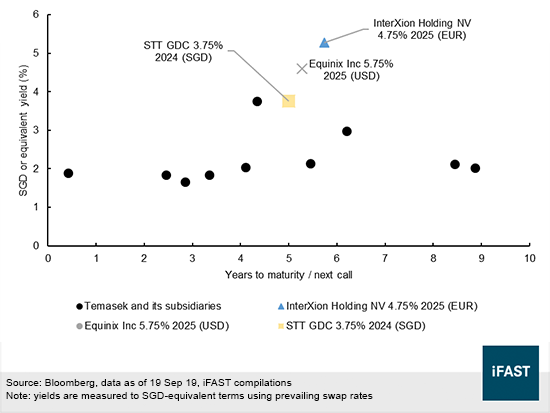
We think that the new STT GDC 5-year SGD bond is fairly priced at its initial price guidance (“IPG”) of 3.75%. The IPG falls between the yields of bonds issued by Temasek and its subsidiaries, and the 2025 notes of InterXion and Equinix. While it is reflecting a reasonable credit spread above Temasek’s bond yields, the IPG is set below the notes of STT GDC’s competitors.
In fact, the IPG is close to the yield to next call of 3.76% (as of 18 Sep) on the SINTEC 5.000% Perpetual Corp (SGD). The S$350m SINTEC 5% perpetual bond was issued by ST Telemedia (parent of STT GDC) in January this year. The note is first callable on 17 Jan 24, and has dividend stopper and pusher features.
Figure 3: Relative valuation
Declaration:
For specific disclosure, at the time of publication of this report, IFPL (via its connected and associated entities) and the analyst who produced this report hold a NIL position in the abovementioned securities.