After registering a steep drop in revenue in 2020, Vertex Venture Holdings Ltd (“Vertex”), a wholly-owned subsidiary of Temasek Holdings (Private) Limited has announced a 2028 bond offering to raise capital for general working capital and other corporate purposes.
About the senior unsecured bonds
Bond proceeds may also be used to fund investments, refinance existing borrowings and redeem preference shares. The notes will be listed on the Singapore Exchange and will be available for investments in denominations of SGD 250,000. Terms and conditions of the offering were in accordance to the issuer’s USD 2 billion multicurrency debt issuance program dated 12 July 2021. The notes pay a coupon rate of 3.3%, which tightened from the initial price guidance of 3.5%.
As long as the bonds remain outstanding, the issuer is subject to negative pledge and financial covenants. In particular, the consolidated borrowings (which include redeemable preference shares) to consolidated net worth should not exceed more than 150%.
About the bond issuer
Vertex is a venture capital company that provides funding and support to a global network of venture capital funds. Having started with USD 0.2 billion in 2008, it now oversees more than USD 4.5 billion of assets under management ("AUM"), nearly half of which was funded by Temasek.
As mandated by its constitution, the company is required to distribute at least 50% of its profit every year. Its parent, Temasek Holdings received USD 71.5m in dividends in 2020.
Figure 1: AUM breakdown by geography
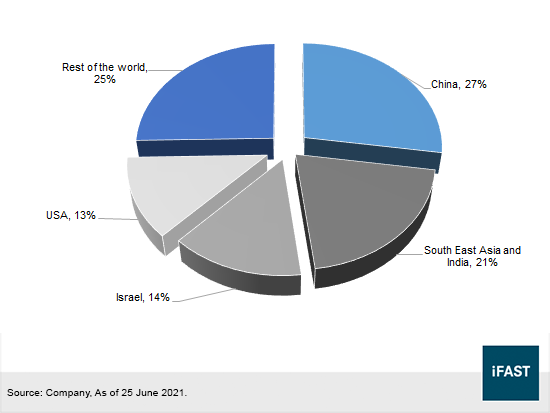
Assets under management are invested globally with China, South East Asia and India accounting for 48% of the portfolio in June. Funds may be classified according to three categories – network funds, captive funds and master funds.
Network funds and captive funds invest in startup companies while master funds help to channel funding into the network and captive funds. There are 15 network funds and 10 captive funds.
Network funds are structured as a limited partnership with Vertex providing 30% to 50% of the committed capital of each fund. Network funds have an investment capital of between USD 150m and USD 305m. Vertex does not manage network funds as they are run by third party general partners who form the investment committee of the funds.
On the other hand, captive funds are managed by Vertex members and these funds are wholly-owned by the company. Captive funds are fully funded by Vertex.
As a fund manager, Vertex collects investment management fees from its captive funds. They also receive a platform fee and service fee from network funds for the provision of middle and back room functions.
Vertex raises money from institutional investors, including financial institutions, pension funds, corporate and family offices. With more than 200 active companies in its portfolio, the group is headed by Mr. Chua Kee Lock, who has been the company’s CEO since 2008. Mr. Chua is also the Managing Partner of Vertex Ventures Southeast Asia & India, and Chairman of Vertex Growth Fund. Some of the notable portfolio companies include Grab Holdings Inc. (which was fully divested with a 9x return at exit), Nium, Binance and Patsnap.
Financial performance
Last year, the group made a loss of USD 32.6m driven by a steep drop in revenue. Profits soared from USD 85.9m in 2018 to USD 188.3m in 2019, but swung to a loss of USD 32.6m in 2020.
Figure 2: Revenue and net profit since 2018
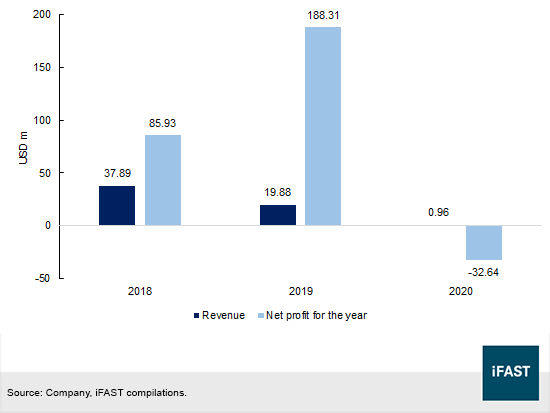
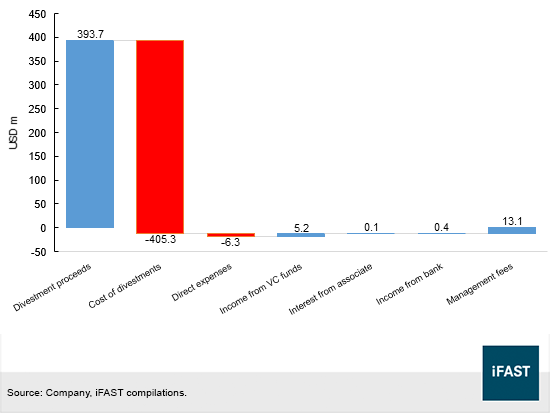
To explain the drop in revenue in 2020, Vertex recognized USD 393.7m of divestment proceeds, USD 6.3m of direct expenses and USD 405.3m of divestment costs. This resulted in a net loss of USD 17.9m on its divestments, and a significant decrease in its top-line (Figure 3).
Figure 3: A breakdown of revenue in 2020
Coinciding with the net loss of USD 32.6m in 2020, Vertex recorded an operating loss before working capital changes of USD 28.4m and net cash operating outflow of USD 141.9m (2019: -USD 113.3m).
On a more positive note, group equity had been increasing for the last three years, rising from USD 1,131m in 2018 to USD 1,440m in 2020 (Figure 4). The aggregate carrying value of its associates rose from USD 298m in 2018 to USD 739m in 2020. Among its associates, the group’s interest in the Vertex IV (C.I.) fund L.P. nearly doubled from USD 56.3m to USD 109.3m while its interest in the Vertex Ventures China III, L.P. fell from USD 154.0m to USD 136.5m.
Figure 4: Total assets and equity since 2018
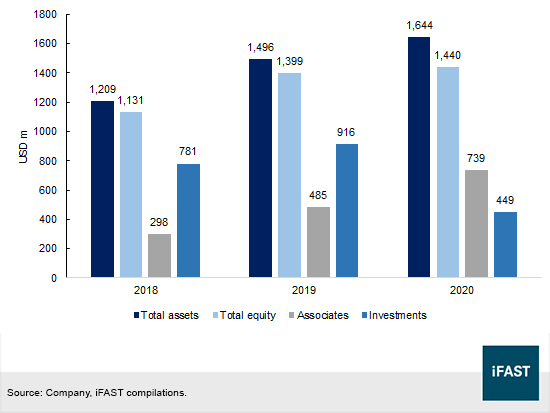
Investments, made up of quoted as well as unquoted equity securities, unquoted debt securities and venture funds, dropped from USD 916m in 2019 to USD 449m last year. This was partly because of a USD 398.9m decline in unquoted equity securities.
These fund investments are generally illiquid and there is no public market for them. Disposal of illiquid securities require a long period of time. In addition, a premature exit from these funds may not be possible and may be subject to the consent of the General Partner.
Adequate capital position
Vertex has a comfortable liquidity profile with USD 128.6m of cash (of which USD 24.0m are fixed deposits) and USD 99m of current borrowings as at 31 December 2020. Maturing this year, the USD short-term bank loans have an interest rate of between 1.44% and 2.10%.
That aside, the venture capital firm may access USD 115m of unutilised committed and uncommitted credit facilities for capital requirements.
Redeemable preference shares
As a subsidiary of Temasek, Vertex is able to issue up to USD 472m of Class A redeemable preference shares (“RPS”) and up to USD 106.76m of Class B redeemable preference shares to its parent to obtain funding in supporting its role as an investor in its venture capital funds.
As of July 2021, the firm is able to draw down on its undrawn USD 188m of Class A RPS and USD 51.06m of Class B RPS from Temasek.
Investors should note that in the occurrence of a winding up event, Class A and Class B RPS holders have the right to receive all their invested capital and remaining assets of the company.
Every half-year, Vertex has to use any cash in excess of USD 100m to redeem its Class A RPS. There are USD 176.2m of outstanding SGD denominated Class A RPS, USD 91.4m of USD denominated Class A RPS and USD 55.7m of Class B RPS. Unlike Class A shares, these Class B redeemable preference shares are marked as financial liabilities on the balance sheet as they have a specific redemption date with mandatory dividend payments.
Gearing, measured as borrowings and Class B redeemable preference shares over total assets was low at 8.5% as at December. If we treat Class A RPS as debt, the estimated gearing ratio would increase to ~25.7%. According to the company, total debt/total equity was 10% in 2020, up from 2% in the prior year. Taking into account the SGD 450m raised from the VRTVEN 3.300% 28Jul2028 Corp (SGD), gearing may have risen to about 30%.
Relative valuation
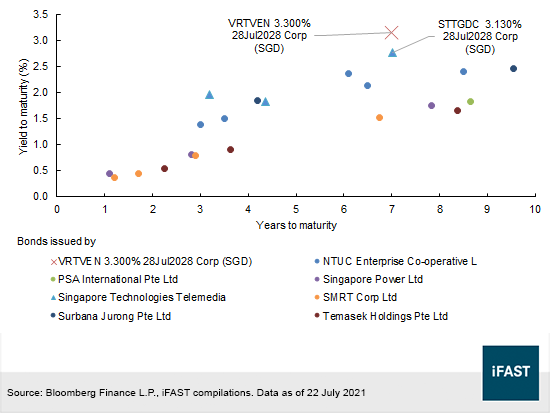
Investors who are keen on Vertex bonds ought to bear in mind that they are a private issuer with delayed financial reporting. However, with an ask price of 100.9 and an indicative yield to maturity (“YTM”) of 3.15%, we think that the VRTVEN 3.3% 2028’s is the most attractive among comparable credits as it provide the highest bond yield. The STTGDC 3.130% 28Jul2028 Corp (SGD), which has the exact maturity date and issued by another Temasek subsidiary, has a YTM of 2.77% on 22 July 2021. The VRTVEN 3.3% 2028’s also have a higher credit spread (I-spread: 208.7 basis points) over the STTGDC 3.13% 2028’s with an I-spread of 179 basis points.
Figure 5: Relative valuation using YTM
Declaration: For or specific disclosure, at the time of publication of this report, IFPL (via its connected and associated entities) holds a NIL position and the analyst who produced this report holds a NIL position in the abovementioned securities.
Our podcast series, Yield Hunters, is available on Spotify and iTunes Podcasts and Google Podcasts. We share our thoughts on new bond issues and hold discussions on the fixed income space. Listen to our latest episode below and follow us!