- In the last week, the hot topic was shifted from the default of Chinese property developers to a Hong Kong developer, New World Development (NWD). There were sell-offs on the NWD bonds, mainly due to some unverified rumours, including:
- An allegation was made on a social media platform that a large real estate developer used three commercial projects as collaterals to raise funds in the form of “disguised equity financing” with the cost of debts up to 11% to 12%. The value of these projects amounted to HKD 20 billion. It implied that the developer’s liquidity was quite tight.
- Based on our understanding, the three commercial projects are D-park Shopping Mall, the 888 Lai Chi Kok Road office project and the Wing Hong Street office project (Table 1). Below are our commentaries:
Table 1: Analyzing the Possibility of "Disguised Equity Financing"
|
Project Name |
Possibility of “Disguised Equity Financing” |
Analysis |
|
D-Park |
Normal |
In the middle of last year, there was news that the Group planned to sell D-Park at HKD 6 billion. But the market response at that time was not good. The Group still holds the asset at the moment. The asset is only about HKD 6 billion in size. Even if the Group does raise funds through this project, it could not bring in much new funds. During the results announcement in March, the group already indicated that it would sell more non-core assets (around HKD 20 billion). So this could just be an old news repackaged as a new version of a rumor. |
|
The 888 Lai Chi Kok Road Office Project |
Almost Impossible |
Around 80% of the units in the office building in 888 Lai Chi Kok were already sold. It is impossible to pledge the office building again if the Group does not have most of their ownership. |
|
The Wing Hong Street Office Project |
Low |
The Group sold 51% equity stake of the project to Ares Management, a Global Private Equity manager in September 2022 (the Group still holds 49% stake). The project is being developed under partnership. In theory, Ares Management will monitor the project ownership. It is less likely (or more difficult) for NWD to finance the JV ownership through “disguised equity financing”. |
|
Sources: Internet Resources, Company’s Reply, iFAST compilations |
||
- Investors might concern about the withdrawal of the Group’s credit lines, weakening its repayment ability. We believe that on the basis of these rumors alone, it is unlikely that the banks would suddenly withdraw the credit lines of the Group. In general, banks do not suddenly withdraw the credit lines and require the Group to repay the loans, as this is equal to forcing the Group to default on its loans and undermine the confidence of other developers in the banks.
- In addition, taking reference to the case of Country Garden, which was still able to refinance offshore loans up to around HKD 6.6 billion in July 2023, we think NWD should be still able to refinance its term loans with banks.
- Based on what we understand about the business models of banks, at the moment, they should only review NWD’s loan exposures instead of completely withdrawing NWD’s credit lines. Therefore, NWD bondholders do not have to worry much about the refinancing risk.
- Surely, we cannot rule out the possibility of some banks withdrawing its NWD’s credit line. If it is really the case, then NWD might fall into confidence and liquidity crisis.
- Whether or not the reasons for the decline are justified, a sell-off of its bonds has happened due to the lack of market confidence. Indeed, this had an impact on NWD’s liquidity. The most obvious reason is the tightening of refinancing channels. It leads to difficulty in issuing bonds in the public market. The Group cannot repay the incoming matured debts by bond refinancing.
- Taking reference to the bond maturity profile (Chart 1), from September 2023 to the end of 2025, the Group has to repay around HKD 8.5 billion principal amount. Compared to the cash balance (At the end-2022: HKD 56.7 billion, or HKD 41.4 billion after deducting the bond repayment issued by FT Life), the Group still has sufficient liquidity to repay the bonds matured in the next two years. The default risk of the short-term bonds is still low.
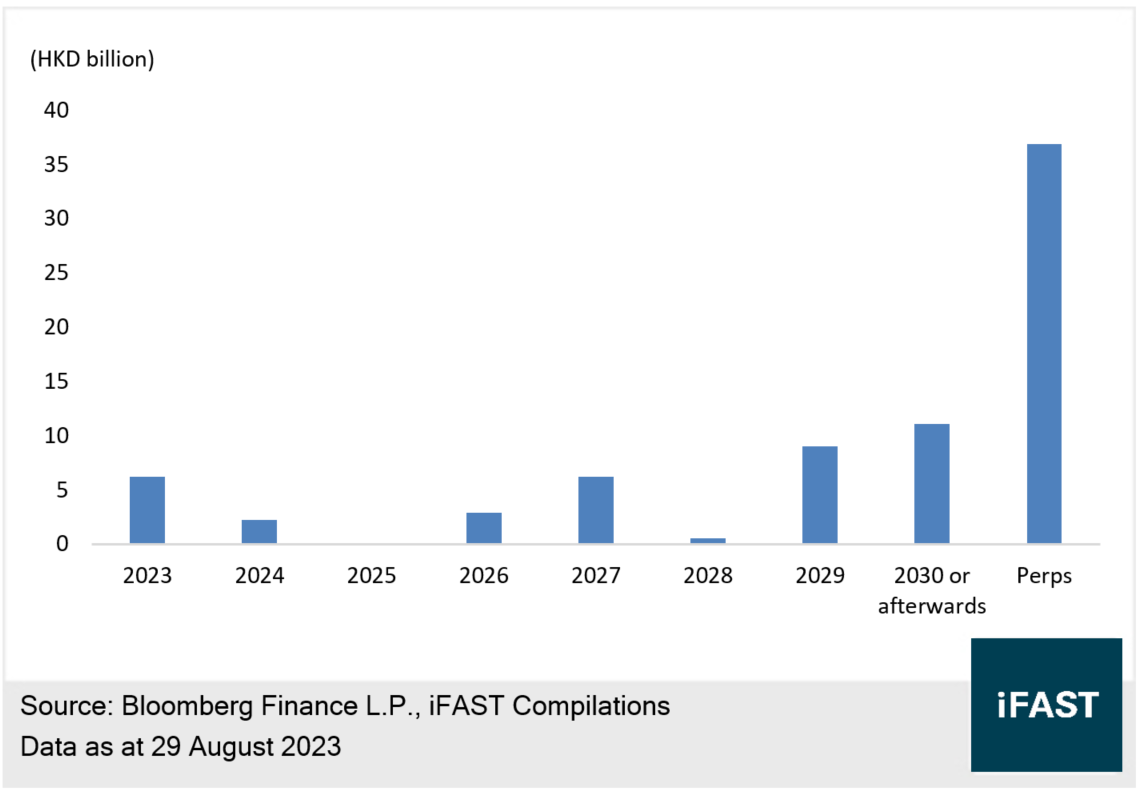
- The credit risk of NWD is higher really now, due to a higher refinancing risk. The bond yields surged to around 12% to 15%. We believe that the bond market is already priced in the negative factors and risks.
- Despite this, we believe that the Group’s default risk is still under control. Over the medium- to long-term, the Group has a number of ways to replenish the liquidity, such as the disposal of non-core assets, a dividend cut or dividend suspension, giving up the insistence on no rights issue and/or securitization or spit-offs of K11 investment properties. The last two opinions (rights issue and spit-off) allow the Group to get the funds over ten billion.
- Investors who are more aggressive can consider the bonds with different tenors to take advantage of the extremely high yield opportunities due to the sell-off. Amongst these, the bond, NWDEVL 5.875% 16Jun2027 Corp (USD), is currently yielding at around 15%, which has a high investment attractiveness. Conservative investors should take a wait-and-see attitude and wait for bond prices to be stabilized before taking further action.
- Last but not least, the perps are riskier than the normal bonds. Even the perps are senior unsecured, which is as same as the normal bonds in terms of seniority. In terms of clauses, the perps have “Deferral Interest Payment” clauses, which means the Group could suspend and delay the perps coupon, which does not result in a bond default.
Related Articles:
Idea of the Week: New World Development—Could They Hold On Without a Rights Issue?
Can New World Development Benefit from Tender Offer of NWS Holdings?
For specific disclosure, at the time of publication of this report, IFPL (via its connected and associated entities) and the analyst who produced this report hold a NIL position in the abovementioned securities.
Our podcast series, Yield Hunters, is available on Spotify, iTunes Podcasts and Google Podcasts. We share our thoughts on new bond issues and hold discussions on the fixed income space. Listen to our latest episode below and follow us!