-
eCommerce acceleration will continue to cushion the structural decline in mail revenues for its post & parcel segment, while its logistics segment will likely benefit following the acquisition of FMH.
-
Property segment remains resilient and provides stable earnings and diversification benefits amidst the gradual recovery of its international post & parcel segment.
-
SingPost maintains strong credit metrics with a net cash position as at the end of 2021, while liquidity remains healthy following the refinancing of its perpetual bond.
-
The Group has sufficient debt headroom to fully acquire FMH in the next few years due to its manageable debt and leverage levels.
-
We prefer its 2027 bond over the 2030 notes in terms of relative valuation. Investors with higher risk appetite may consider the subordinated SPOST 4.350% Perpetual Corp (SGD).
Founded in 1819, Singapore Post Limited (“SingPost”) has been Singapore’s leading postal service provider for over 160 years with an extensive global footprint. It is located in 17 markets with 56 post offices worldwide as of last year.
The Group has a well-established infrastructure and nationwide network that provides customers with a one-stop mail, logistics and retail distribution solution in Singapore. It has long maintained its market dominance with approximately 95% of domestic mail market share. It is the sole public postal licensee with direct access to all letterboxes in public housing buildings, sole rights to issue national stamps and the rights to maintain the national postal code system.
Financial Highlights
For the six months ended 30 September 2021 (“1H FY21/22”), SingPost’s revenue grew 3.3% year-on-year (“YoY”) from SGD 707.8m to SGD 731.4m. Its operating profit also posted a strong growth of 28.4% from SGD 39.8m to SGD 51.1m, largely driven by a significant improvement in its logistics and property segments, as well as a notable decline in its impairment loss on trade and other receivables. However, its post & parcel segment continues to worsen mainly due to the absence of government grants such as property tax rebates and Job Support Scheme (“JSS”), falling 52.6% from a year ago.
Figure 1: Total Operating Profit Breakdown
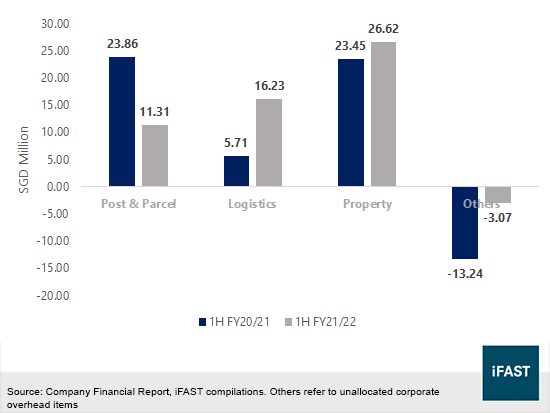
Despite a sharp decline in the operating profit of its post & parcel segment, SingPost’s domestic post & parcel (“DPP”) business saw an eCommerce revenue growth of 32% YoY in 1H FY21/22, which was able to cushion the continued double-digit decline in mail revenue. eCommerce takes up 40% of DPP revenue for 1H FY21/22, up from 32% a year ago. Meanwhile, its international post & parcel (“IPP”) business was largely impacted due to the low flight capacities and cross border restrictions, causing revenue to fall by 26.6% from a year ago.
On the other hand, SingPost’s logistics segment posted a 184.4% YoY increase in operating profit on the back of higher revenues that grew 29.6% from a year ago. This was largely driven by a strong growth among its subsidiaries, namely Famous Holdings and CouriersPlease. Total volume of consignments at CouriersPlease grew 11% YoY due to the acceleration of eCommerce adoption, while Famous Holdings also enjoyed higher sea freight volumes and rates amidst the global supply chain disruptions.
Its property segment operating profit grew 13.5% YoY on the back of higher receipts from carpark and lower rental rebates provided for eligible tenants. Footfall and tenant sales for Singpost Centre (“SPC”) Mall increased 11% and 33% respectively. However, total committed occupancy across all properties fell slightly from 96.1% in March 2021 to 94.9% in September 2021, mainly due to the exit of its sole external tenant in its property industrial segment.
Outlook
eCommerce remains as a bright spot for Post & Parcel segment amidst the structural decline in letter volumes
Technological advancements over the years have replaced the need for physical letters and printed papers, which is detrimental to the Group’s post & parcel segment. Revenues for its letters & printed papers segment fell by 15% YoY for 1H FY21/22 on the back of lower delivery volumes. Notably, this segment still takes up a substantial portion of its DPP revenues (~44%) for 1H FY21/22 (1H FY20/21: ~53%).
Looking ahead, we expect the structural decline in letters & printed papers to persist as more companies shift towards online substitutes. Fortunately, the pandemic has accelerated the growth of eCommerce delivery volumes. SingPost managed to increase its domestic market share in eCommerce deliveries to over 50% during the pandemic, which helped to offset the decline in letters & printed papers delivery revenue. Going forward, SingPost will continue to capture new eCommerce growth opportunities within Asia-Pacific through its subsidiaries and developing new infrastructure to improve post & parcel operations and productivity.
As for its IPP business, we expect a gradual recovery ahead as international air freight continues to normalize. Margins for this business are projected to remain tight due to the high air conveyance costs and spike in fuel prices. In order to improve its margins, SingPost aims to optimize routes and partner selection to manage costs and diversify trade lanes beyond Singapore so as to develop new income streams for its IPP business.
Logistics segment to benefit from FMH acquisition
SingPost increased its stake in Freight Management Holdings Pty. Ltd. (“FMH”), a 4th party logistics service company based in Australia, from 28% to 51% last October. Following the agreement, the Group will consolidate FMH’s financials as its subsidiary. The agreement also provided SingPost an opportunity to fully acquire FMH by granting existing shareholders with put options that are exercisable from 30 June 2022. EBITDA of FMH and its subsidiaries for the FY2021 was approximately AUD 29.4m, and the transaction will be immediately accretive to SingPost’s earnings going forward.
FMH has performed well ahead of expectations for FY2021 due to the acceleration of eCommerce growth. Its current prospects are still favorable as Australia’s logistics market remains attractive and structurally profitable due to greater investments in the country’s logistics infrastructure. Based on SingPost’s latest business update, consignment volume in Australia grew 7% YoY for the quarter ended 31 December 2021, partly due to the addition of FMH’s volume in December. Looking ahead, the Group expects to capitalize on Australia’s growing eCommerce segment through FMH to scale its B2B and B2C logistics capabilities, and we expect FMH to remain accretive to SingPost’s earnings by sustaining its strong growth rate.
Property segment remains resilient for FY22/23, but could face challenges in FY23/24
As at 31 December 2021, SingPost’s property segment maintained a relatively high occupancy of 94.0%. FY21/22 renewal rates for all of its properties came in at ~85%, where 64 out of 75 expiring leases were renewed. Looking at its current lease expiry profile, we think that its property segment will remain resilient for the upcoming fiscal year due to a manageable percentage of expiring leases for its SPC Mall (7%) and SPC Office/Enrichment (17%).
Even though 46% of its smaller properties such as shophouses (classified as “Others”) will expire in FY22/23, we remain confident that SingPost will be able to renew or replace its expiring leases within this category as the Group managed to renew all 15 of its expired leases in the current fiscal year for this category. However, we should be mindful of the bulk of SPC leases that will be expiring in FY23/24, where 45% of SPC Mall and 62% of SPC Office/Enrichment leases will mature in the fiscal year. SingPost will have to address the expiring leases by renewing the leases or securing new tenants in order to preserve the stability of its property segment earnings.
Credit Discussion
Table 1: Credit metrics comparison as at 31 December 2021
|
Postal Service Provider |
Current Ratio |
Net Gearing |
LTM EBITDA Coverage |
Total Debt/Total Asset |
Net Debt/LTM EBITDA |
|
SingPost* |
1.35 |
-0.10 |
11.40 |
11.62% |
-1.11 |
|
Royal Mail PLC* |
1.30 |
-0.14 |
36.24 |
8.82% |
-0.42 |
|
PostNL |
1.44 |
-0.34 |
21.95 |
28.22% |
-0.32 |
|
Deutsche Post |
1.09 |
0.66 |
16.84 |
30.49% |
1.23 |
|
Source: Company Financial Reports, iFAST estimates *As at 30 September 2021 |
|||||
SingPost has a strong credit profile that is comparable to some of the world’s largest postal service providers as shown in Table 1. We have selected Royal Mail PLC, PostNL N.V. and Deutsche Post DHL Group for its peer comparison because these companies have a public ownership as compared to other postal service providers that are majority owned (>50%) by the government or privately held. As of 2021, Temasek Holdings owns ~22% deemed interest in SingPost through Singtel, while Alibaba Group Holdings holds ~15% of direct interest.
As at 30 September 2021, SingPost’s cash and cash equivalents amount to SGD 480.5m, which is more than sufficient to cover its total borrowings of SGD 314.8m (net cash of ~SGD 166m). However, following the accelerated investment in FMH in October 2021, the Group’s net cash position has declined to SGD 111m as at the end of last year, as a result of higher borrowings due to the consolidation of FMH.
SingPost recently called back its SGD 350m of 4.250% perpetual securities (“perp”) on 2 March 2022. Following the redemption, SingPost decided to refinance its perp by issuing 2 new securities: 1) SGD 100m of 3.230% senior unsecured fixed rate notes due 2027 and 2) SGD 250m 4.350% subordinated perpetual bond that is callable in 2027. The fixed rate notes and perp will be classified as debt and equity respectively based on accounting standards.
After the new issuances, we expect its net cash position decline further to ~SGD 11m, while total equity is projected to decline to ~SGD 1.63b due to the lower notional amount of the newly issued perp. As a result, net gearing ratio is estimated to be approximately -0.01x, while total debt-to-asset ratio is projected to increase to around 16.72%.
Going forward, SingPost will likely have to raise more capital to fund the potential acquisition of the remaining interest in FMH. If existing FMH shareholders opt to exercise their put options, SingPost will obligated to purchase the remaining FMH shares from them. As such, we expect the Group’s leverage to increase further as a result of this deferred cash obligation, unless it decides to fund the potential acquisition through asset divestments and capital recycling. Nonetheless, we think that SingPost has sufficient debt headroom to acquire additional stake in FMH due to its low debt-to-asset ratio and negative gearing.
SingPost Bonds
Existing SPOST bonds. Figures as at 21 April 2022
|
Bond |
Issue Date |
Maturity Date/Next Call Date |
Remaining Years to Maturity/Call |
Ask YTM/YTC |
|
SPOST 2.530% 19Nov2030 Corp (SGD) |
19 Nov 20 |
19 Nov 30 |
8.6 |
3.44% |
|
SPOST 3.230% 29Mar2027 Corp (SGD) |
29 Mar 22 |
29 Mar 27 |
4.9 |
3.14% |
|
SPOST 4.350% Perpetual Corp (SGD) |
06 Apr 22 |
06 Apr 27 |
4.9 |
4.06% |
|
Source: Bloomberg Finance L.P., iFAST compilations. |
||||
Between the 2 senior unsecured bonds, we prefer the shorter dated March 2027 bond over the November 2030 bond, considering that the 2030 bond only offers a 30 basis points (“bps”) yield pick-up over the 2027 bond for a 3.7-year difference in remaining time to maturity. Investors with a higher risk appetite may consider the subordinated SPOST 4.350% Perpetual Corp (SGD), which is first callable from 6 April 2027 until its first reset date on 6 July 2027. If the perp is not redeemed by 6 July 2027, the coupon will be reset based on the prevailing 5Y SORA OIS + initial spread of 218.3 bps + 25 bps of step-up margin.
The perp has an issue rating of BBB- by S&P. Distributions of the perp are deferrable but cumulative, and the perp also contains dividend stopper and pusher clauses which incentivizes the issuer not to skip distributions unless they are unable to support payments. Looking at its interest coverage ratio, even if we treat the perp distributions as interest expenses, we estimate EBITDA/interest expense to be ~5.48x, which is still more than sufficient to cover its total finance costs and distributions. As such, we strongly believe that SingPost will be able to support distribution payments of its perp. However, investors should be mindful of the potential non-call risks for the perp, given that the step-up margin is only 25 bps and it may not have a meaningful impact to its reset rate.
Conclusion
In conclusion, we think that SingPost’s status as the only public postal service provider in Singapore continues to uphold its market dominance. The Group’s ongoing efforts to tap into eCommerce will help to cushion the decline in letters & printed papers revenue, while earnings from its logistics segment have shown strong growth through its subsidiaries and the FMH acquisition. It has strong credit metrics in terms of its liquidity, leverage and interest servicing ability, and it still has sufficient debt headroom to fully acquire FMH in the future to scale its logistics business. As such, investors who are looking for stable income options may consider its shorter dated senior bond, while investors with greater risk tolerance may consider the SPOST 4.350% Perpetual Corp (SGD).
Declaration: For specific disclosure, at the time of publication of this report, IFPL (via its connected and associated entities) holds positions in SPOST 4.350% Perpetual Corp (SGD), and the analyst who produced this report holds a NIL position in the abovementioned securities.
Our podcast series, Yield Hunters, is available on Spotify, iTunes Podcasts and Google Podcasts. We share our thoughts on new bond issues and hold discussions on the fixed income space. Listen to our latest episode below and follow us!