About Singapore Post
Singapore Post Limited (“SingPost”) is the national postal service provider and has been around for more than 160 years. The Group has expanded beyond providing postal and parcel delivery, diversifying into the logistics and property business. As of the recent FY2022/2023 earnings report, the logistics business has become the Group’s largest revenue contributor. At the same time, Singpost has also ventured into overseas markets, with Australia (45.8%) being the largest revenue contributor, followed by Singapore (31.8%).
SingPost was listed on the mainboard of SGX since 2003 and sported a market cap of SGD 1,046m. The firm’s largest shareholder is Temasek Holdings, which holds about 22% stake in SingPost. Alibaba Group came in as the second largest shareholder since May 2014, when the Chinese e-commerce giant acquired a 10% stake in SingPost for ~SGD 500m. The Group holds a stake of 14.6%.
Singpost downgraded to ‘BBB’, perpetual bonds downgrade to ‘BB+‘
In late May, S&P Global Ratings downgraded the long-term issuer credit rating on SingPost 'BBB' from 'BBB+' and issue rating on the SGD$250M senior perpetual securities to 'BB+' from 'BBB-'. This effectively lowers the company’s perpetual securities from investment grade to high-yield status. The rating agency cited that the downgrade is due to SingPost’s pivot towards the more competitive Australia-focused logistics business while the traditional post and parcel business is facing a structural decline. Consequently, this has weighed on the company’s financials and its credit profile.
Financial highlights
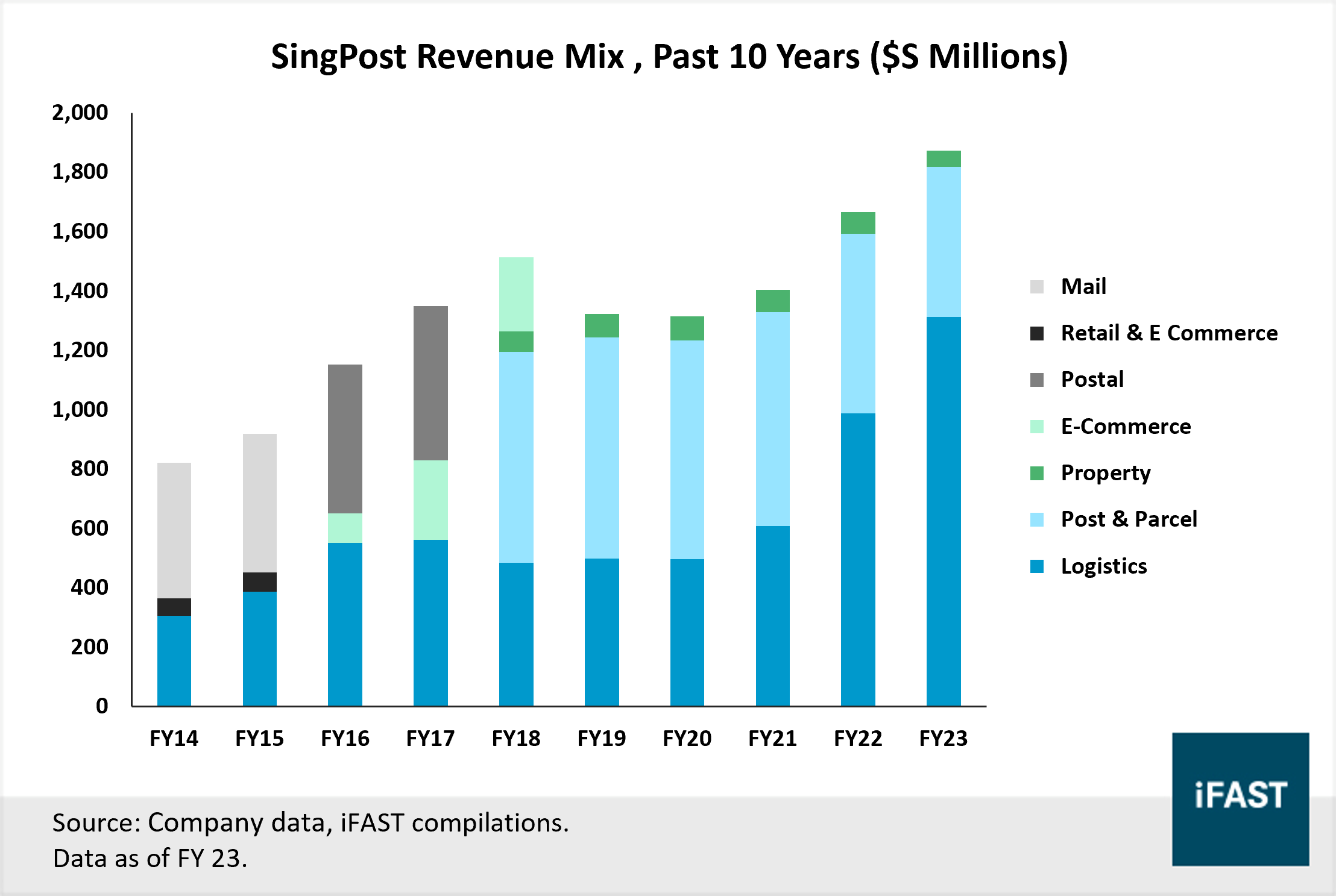
Starting with the positives, SingPost’s revenue grew 12.4% year-on-year (“YoY”) to SGD 1,872M for FY23 (ended 31 March 2023). The logistics segment was the main revenue driver for SingPost (Chart 1), contributing around SGD 1,313m of the firm’s revenue (70.1% of total revenue). Revenue for the segment grew 32.8% YoY due to stronger performances from the freight forwarding business and Australia businesses. SingPost owns an 88% stake (as of 31 March) in Freight Management Holdings (FMH), which is one of the leading 4th party logistics (4PL) service providers in Australia. FMH has been a key revenue contributor for the fiscal year, as sales nearly doubled due to increased customer volume, acquisitions, and consolidation.
Moving on to the negatives, the post and parcel segment - a once major revenue driver of the Group – continues to deteriorate. Revenue fell -16.4% YoY to SGD 505.5m (contribution of total revenue fell to 27%) as both international and domestic services were hit by a double whammy of higher operating expenses (conveyance, labor, utility costs) and falling delivery volume due to COVID disruptions. SingPost’s e-commerce segment, which contributed around SGD 53.7m of the firm’s revenue (2.9% of total revenue), also saw revenue decline by 26% YoY. However, this was largely due to the sale of self-storage business, General Storage Company, in Dec 2021. That said, occupancy across all properties increased from 95.8% (FY22) to 98.2% (FY23).
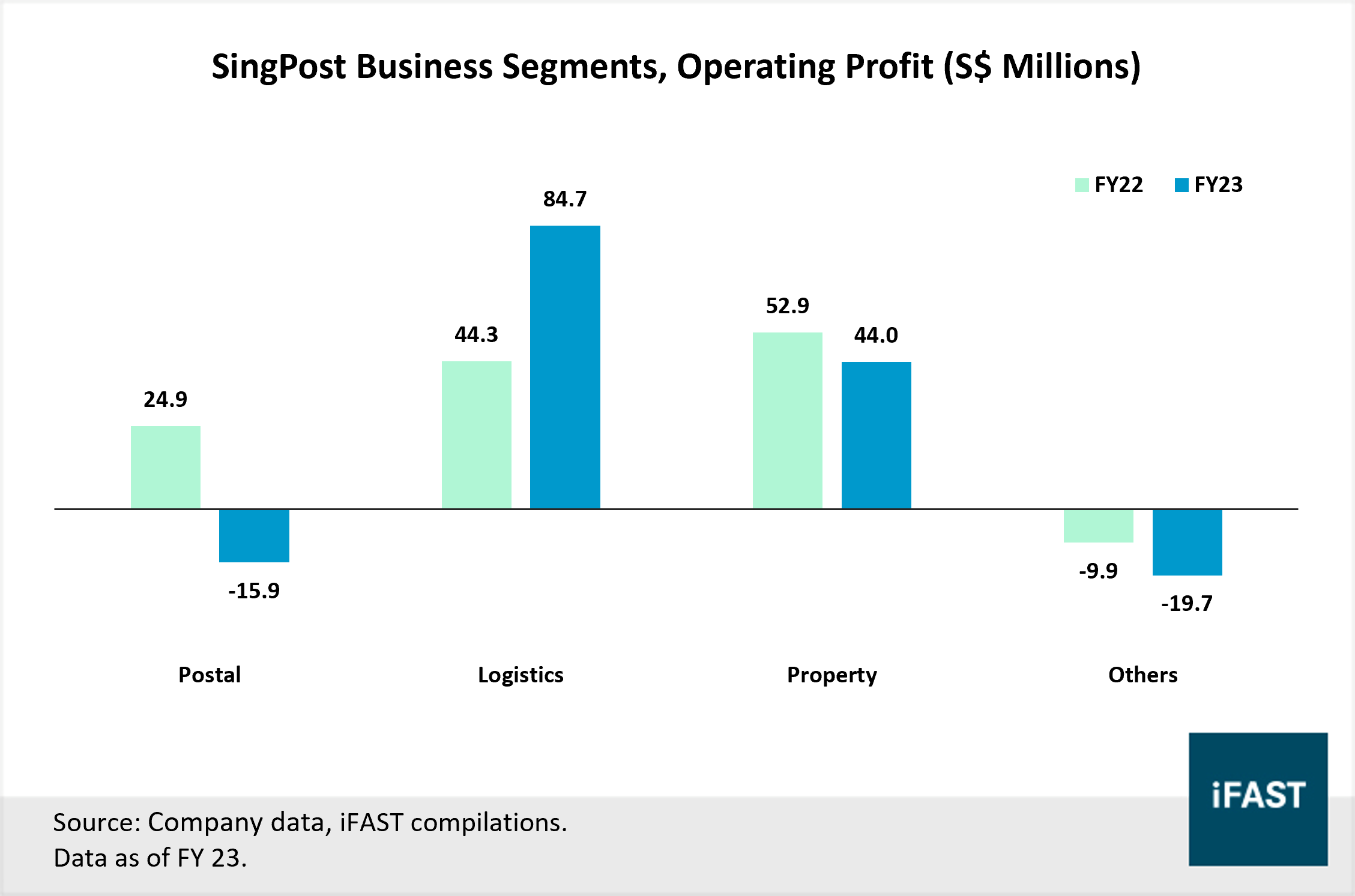
While revenue for SingPost grew, operating profit fell by -16.9% YoY to SGD 93.2M in the same period due to a deterioration in the post & parcel business (Chart 2) as well as a notable jump in selling-related expenses. Higher interest expenses on borrowings further ate into pre-tax profit, which fell 36.7% YoY to SGD 68.0M.
Chart 1: SingPost’s revenue mix has changed significantly over the past decade
Business Outlook
In our view, the earnings outlook for SingPost will likely remain challenged in FY24. We expect an eventual earnings stabilisation, likely in the back half of FY24, and potentially rebound thereafter. This is based on our expectation that:
- The logistics segment is expected to remain profitable, underpinned by strong Australian e-commerce spending trend. However, strong competition within the highly fragmented Australian logistic market should limit volume growth and drive cost-cutting, at least until the Group’s businesses (FMH, CouriersPlease, Famous Pacific Shipping) acquire sufficient market share.
- The post and parcel segment will likely see weaker operating profit moving forward, weighed down by the structural decline in letter mail and global inflationary pressure. The Group expects this segment to remain unprofitable for FY24.
- The property segment should see stable operating profit growth moving forward, in line with history, with a high occupancy rate and an expected stability in demand.
Chart 2: Operating profit contribution by SingPost’s business segments
Credit highlights
Total debt, including lease liabilities, for Singpost grew by 17.3% YoY from SGD 600.5m (FY22) to SGD 704.1m (FY23). This was largely driven by an increase in long-term borrowings from a secured bank loan of nearly SGD 40m and an unsecured loan of AUD 264.4M (approximately SGD 235.2m) from 5-year term loan facilities. As a result of higher debt and lower operating profit, the Group’s leverage ratios have worsened.
We estimated SingPost’s debt over EBITDA at 4.0x (FY23), increasing from 3.2x (FY22). Treating the perpetual securities (“perps”) as debt, SingPost’s adjusted debt over EBITDA rises to 5.4x (FY23). At first glance, the net gearing ratio appears to have fallen as cash position increased notably - we estimate the ratio to be 15% (FY23), falling from 28.0% (FY22). However, accounting for the perps, the adjusted net gearing ratio rises to 41.0% (FY23). Both ratios are above the industry average (Table 1).
With SingPost looking to grow the Australian business, we foresee larger investment in the region over the coming years and thus, greater need for financing which should weigh on the Group’s debt profile. As such, we believe debt ratios may not see a material improvement until late FY24, when earnings demonstrate a stronger rebound (based on our expectation) and funding rates decline.
Table 1: Ratio comparison between SingPost and global industry peers with similar market cap
|
Issuer
|
Market
Cap. (SGD Millions)
|
Gross
Debt to EBITDA (X)
|
Net
Gearing (%)
|
Gross
Debt to Asset (%)
|
EBITDA
Interest Coverage (X)
|
CFO
Interest Coverage (X)
|
|
Singapore Post
|
1,046
|
5.4
|
41.0
|
33.7
|
6.3
|
5.6
|
|
Freightways Group
|
1,522
|
2.6
|
129.6
|
44.7
|
9.6
|
6.4
|
|
Jetpak Top Holding
|
1,209
|
1.3
|
3.9
|
16.4
|
13.7
|
12.3
|
|
GDEX
|
1,025
|
3.6
|
-21.7
|
18.1
|
7.5
|
19.4
|
|
Bpost
|
834
|
2.7
|
41.1
|
34.2
|
33.3
|
31.1
|
|
PostNL
|
800
|
2.2
|
274.9
|
47.2
|
-94.6
|
20.3
|
|
Speedy
|
602
|
1.2
|
31.5
|
33.4
|
31.4
|
30.7
|
|
Average
|
-
|
2.7
|
37.6
|
32.5
|
17.0
|
18.0
|
|
Source:
Bloomberg L.P., iFAST Compilations. Data as of 26 June 2023.
*Calculation
of average excludes figures that are larger than 2 standard deviation of
their respective category.
|
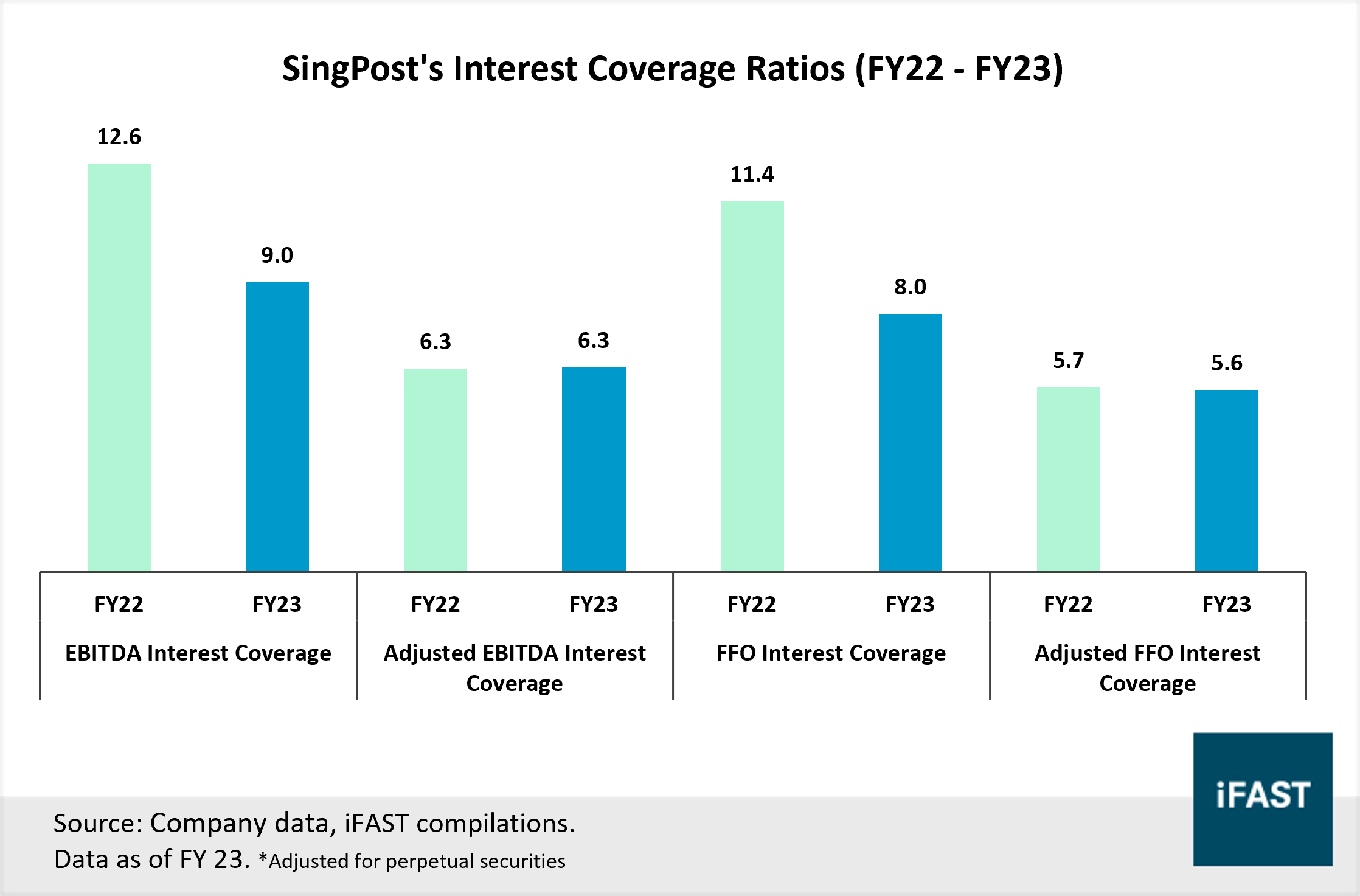
On a positive note, while debt levels have risen, we believe that SingPost will have no issue meeting its debt obligations in the short-term. Accounting for the distribution to perps, we estimate SingPost’s EBITDA interest coverage and fund from operations (FFO) interest coverage ratio to be 6.3x and 5.6x respectively for the full fiscal year (Chart 3). While these ratios have fallen and are below the industry average (Table 1), both EBITDA and funds from operation remain sufficient to comfortably cover debt-related expenses.
Management also continues to exhibit prudence in managing capital. First, the Group has managed to reduce short-term borrowings to SGD 1.37m (FY23) after repaying a short-term loan of SGD 50.0 million. Second, management has also highlighted that over 99% of the borrowings are medium to long term, with around 93% locked in at fixed rates, which immunises against further interest rate hikes.
SingPost managed to strengthen its liquidity position by growing cash and cash equivalents from SGD 280.4m to SGD 495.7m, a 77% increase. We find comfort in knowing that approximately 1% of the Group’s borrowings mature within a year’s time and cash position remains strong and sufficient to cover this short-term borrowings of SGD 1.37m. The Group’s stronger liquidity position was driven by larger cashflows from financing and operations.
Overall, we believe the credit profile for SingPost has deteriorated given a higher degree of leverage and weaker earnings. That said, liquidity and cashflow remains robust and suggests that the company should be able to meet debt obligations in the short-term.
Chart 3: Interest coverage has fallen
Recommendations
SingPost now has three outstanding bonds - the SPOST 4.350% Perpetual Corp (SGD), SPOST 2.530% 19Nov2030 Corp (SGD), and the SPOST 3.230% Mar2027 Corp (SGD) (Table 1). Between the two senior unsecured bonds, we prefer the shorter-dated March 2027 bond over the November 2030 bond, considering that the 2030 bond only offers a 4 basis points (“bps”) yield pick-up over the 2027 bond for a 3.65-year difference in remaining time to maturity.
Comparing the perps, we prefer the ESRCAY 5.650% Perpetual Corp (SGD) over SPOST 4.350% Perpetual Corp (SGD). We like the former as the issuer has a healthier credit profile and a positive business outlook. The perp also have a higher initial spread and a larger step up margin of 200 bps. The high step-up margin strongly incentivises the issuer to call the perps on its reset date or incur higher financing cost. Lastly, the ESRCAY 5.650% Perpetual Corp (SGD) also has a higher YTM with shorter remaining years to call.
Table 1: Issuances from SingPost
Table 2: Comparing SingPost and ESR Group’s perps
|
Bond
|
Ask Price
|
Next Call /Reset Date
|
Remaining Years to Call
(Years)
|
Current Yield
(%)
|
Yield to Call
(%)
|
Reset Rate
|
|
SPOST 4.350% Perpetual Corp (SGD)
|
96.10
|
6 Apr 27
|
3.78
|
4.53
|
5.48
|
Prevailing 5Y SORA OIS +
Initial Spread (2.183%) + Applicable Step-Up Margin [25bps from year 5.25;
additional 75bps from year 25.25 (cumulative 100bps)]
|
|
ESRCAY 5.650% Perpetual Corp (SGD)
|
97.87
|
2 Mar 26
|
2.68
|
5.77
|
6.52
|
Prevailing 5-year SOR +
Initial Spread (4.73%) + Step Up Margin (200 bps from 2-Mar-26)
|
|
Source: Bondsupermart, Bloomberg Finance L.P., iFAST compilations. Data as of 26 Jun 23
|
Declaration: For specific disclosure, at the time of publication of this report, IFPL (via its connected and associated entities) holds a position in SPOST 4.350% Perpetual Corp (SGD), ESRCAY 5.650% Perpetual Corp (SGD) and the analyst who produced this report holds a NIL position in the abovementioned securities.