- Rising inflation and interest rates have dominated the headlines in the first half of 2022, and we expect the hawkish rhetoric to persist in the second half of this year as central banks look to combat inflation.
- Despite rising interest rates, SGD issuance volume in 1H2022 is higher compared to a year ago, but we could potentially see a slowdown in issuance volume as benchmark rates have risen significantly since the start of this year.
- Year-to-date, banks have taken the spotlight with the highest volume of issuance, mostly comprising of AT1s and T2s as they look to refinance their existing bank capital instruments. Non-bank corporate issues on the other hand have slowed down notably in May and June.
- SGD bonds have been rather resilient despite higher inflation and interest rates, but we could potentially see some repricing of existing secondary market bonds going forward with more attractive new issuances in 2H2022.
The first half of 2022 was rather tumultuous for bond investors, as markets were reeling from the impact of higher macroeconomic volatility, while many countries suffered the brunt of rising inflationary pressures. Annual inflation rate in the US accelerated to 8.6% for the month of May, surpassing market expectations and reaching its highest level since December 1981. Meanwhile, prices in the eurozone continued to soar higher in May, hitting a record high of 8.1% due to rising food and energy prices. Inflationary pressures were further exacerbated by the Russia-Ukraine conflict as export bans and reduced commodity supplies have worsened the global supply chain issues.
Following the sharp increase in prices, global central banks were left with no choice but to start tightening their monetary policies in hopes of bringing down demand. Notably, the Federal Reserve started raising rates in March by 25 basis points (“bps”), but soon realized that a more aggressive rate hiking cycle is required to tame the rising cost pressure that is spiralling out of control. As such, the central bank decided to raise interest rates by 75 bps in the June FOMC meeting, which sent US Treasury (“UST”) yields across the curve significantly higher.
Figure 1: Performance Comparison Across Different Bond Maturities
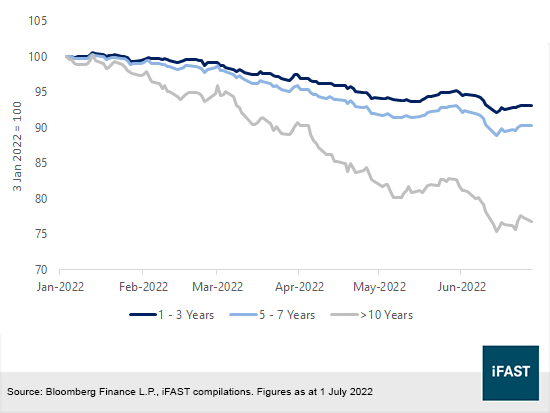
With rising interest rates, global bonds have seen year-to-date (“YTD”) losses since prices are inversely correlated to interest rates. Particularly, the longer-dated bonds (>10 years) have been impacted the most (-23.2% YTD) due to a higher duration, which measures the sensitivity of interest rates to bond prices. Meanwhile, the short (1 - 3 years) and medium (5 – 7 years) tenor bonds have been rather resilient for the first half of 2022, seeing losses of 6.8% and 9.7% respectively.
Going forward, global central banks will continue to raise interest rates to fight inflation. The Fed will look to increase 50 – 75 bps at subsequent FOMC meetings, while the ECB will also hike rates by 25 bps in July, followed by another round of tightening in September with a possibility of a larger rate increment. As such, we think that investors should continue to position their portfolios with shorter duration bonds that are less sensitive to rate movements, as global central banks continue to step-up their efforts in tightening their monetary policies to lower inflation.
1H2022 SGD issuance volume higher year-on-year despite rising interest rates
Figure 2: Year-to-date SGD Bond Issuance Across Months
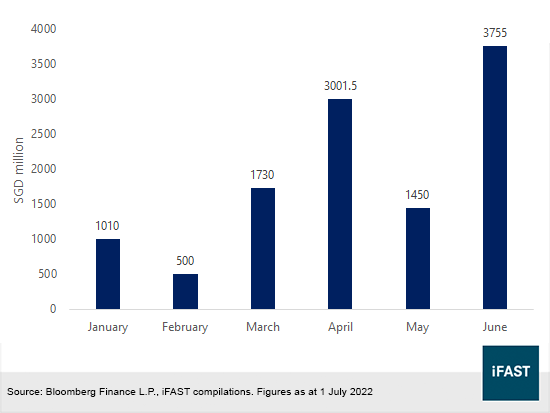
For the first half of 2022, total new SGD issuance was approximately SGD 11.5b, 6.5% higher compared to a year ago at SGD 10.8b. The first 2 months of this year were relatively quiet, likely due to the Chinese New Year holidays in February. March saw a pickup in activity with notable issuances from SingPost pricing both a senior and subordinated perpetual bond, as well as First REIT issuing a social bond (rated “AA” by S&P) guaranteed by the Credit Guarantee and Investment Facility (“CGIF”), which is a trust fund of the Asian Development Bank.
April posted the second highest volume of issuance this year, and we believe that the spike in new issuances was due to corporations rushing to raise new funds after the Fed turned hawkish and announced its first rate hike since 2018 back in March. In May, the SGD bond issuance market took a breather after the US central bank raised its Fed funds target rate by another 50 bps, leaving corporations to reconsider their financing options following the rise in cost of borrowing.
Figure 3: Year-to-date SGD Bond Issuance Across Sectors
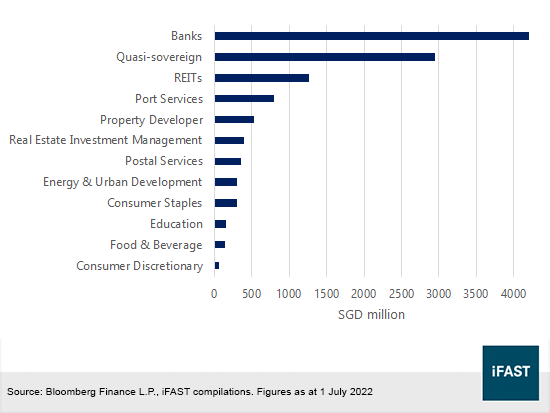
Among sectors, we see that banks take up the largest portion of issuance (36.7%), followed by quasi-sovereigns (25.8%) and REITs (11.0%). Most of the bank issuances come from AT1 and T2 notes with a total size of SGD 3.6b, as financial institutions look to refinance their existing bank capital instruments. Meanwhile, the quasi-sovereign space is largely dominated by the Housing and Development Board (“HDB”), of which the statutory board tapped the capital markets 3 times separately this year in January, March and May. Notably, the HDB issuances became more attractive over the months with rising interest rates, starting off with 7-year issue at 1.971% in January, followed by a 5-year issue at 1.845% in March, and ended off with a 3-year issue at 2.627% in May.
Figure 4: Year-to-date SGD Bond Issuance Across Tenors
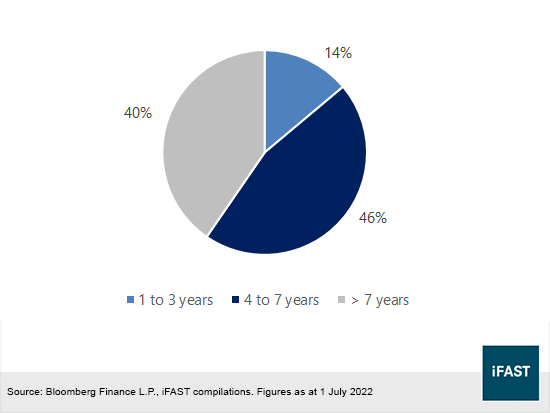
In terms of the breakdown by tenor, we see that most the issuance volume is still largely contained within the mid-to-longer end of the curve. A majority of bonds that have >7 years of maturity are either AT1 or T2 bank papers that are perpetual by nature or have a legal maturity of more than 10 years. Meanwhile, most non-bank corporations issued bonds with 4 – 7 years to maturity, while there are only a handful of bonds with less than 3 years to maturity, largely dominated by HDB’s 3-year issuance of SGD 900m.
A potential slowdown in primary market issuance in 2H2022?
As major central banks look to frontload rate hikes in the near future, we think that the cost of borrowing within the bond issuance market will be higher for corporations, making it more expensive for them to tap the capital markets going forward. Even though June saw a significant increase in issuance volume relative to the previous month, we note that there was only one non-bank corporate issue from ESR-logos REIT. Most of the new issues in June were either AT1 or T2 notes, of which banks use these capital instruments to supplement their total capital ratios which are important metrics to assess their liquidity and solvency profiles.
As such, we have seen a slowdown of new primary market issuances from non-bank corporations, and we think that this trend will likely continue as companies will have to reassess their financing options going forward since the debt capital markets have become more expensive for them to raise funds. Companies will have to look for alternative means of raising capital, or price bonds with a smaller issue size to manage their interest expenses.
SGD bonds have been rather resilient despite higher interest rates
Despite the interest rate hikes, SGD bonds have generally been resilient this year, as we have not seen a significant decline in prices other than some of the longer-dated bonds and perps. Firstly, we think that this is because SGD bonds are generally issued by stable corporations with healthy credit metrics even though most of them are unrated. Year-to-date, SGD corporates have outperformed the rest of the benchmarks such as the Asian IG & HY indices as well as the Global Aggregate Bond Index (Figure 5). As such, investors are comfortable holding these SGD names that can act as a defensive play in times of rising market volatility.
Figure 5: Year-to-date Performance of SGD Corporate Bonds Relative to Benchmark
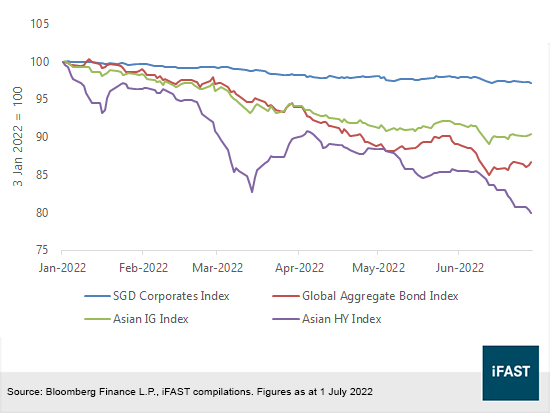
Secondly, we think that another driving factor of bond prices is due to the issuance of new bonds within the market. So far, a majority of new issuances are priced at more attractive levels as compared to their existing secondary market bonds, and this is mainly due to higher benchmark rates amid the quantitative tightening by major central banks. Following which, the new issuances have also led to the repricing of some secondary market bonds as investors switch to these attractive alternatives.
For instance, UOB announced a 4.250% PerpNC5.25 on 27 June 2022, and following which, some of its existing SGD perpetual bonds saw some selling activity which sent yields higher. The UOBSP 2.550% Perpetual Corp (SGD) saw an increase of ~15 bps to 3.97% yield-to-worst (“YTW”), while the UOB 2.250% Perpetual Corp (SGD) also traded lower with YTW rising to 3.62%. Credit Suisse also recently issued a USD perpetual bond at 9.750%, which led to a significant repricing of its 5.625% SGD perpetual bond where the YTW shot up by ~126 bps to 7.19%, reaching its highest level since inception.
Despite some of the repricing, the SGD bond market historically has a lower volume of new issuances as compared to other markets (e.g., Asia Ex-Japan and US IG & HY markets). The lack of new supply could imply that investors have fewer SGD alternatives to turn to, which is also one of the main reasons why SGD bonds have been rather resilient this year.
More repricing ahead in the SGD market?
With benchmark rates significantly higher since the start of this year, we see that new issuances have inevitably resulted in the repricing of some secondary market bonds. Going forward, we think that this trend will likely continue, given that most of the secondary market bond spreads have declined from their issue date as benchmark rates got higher, but their yields were not commensurate to the increase in benchmark rates (some examples seen from Table 1).
Table 1: Spread Comparison for SGD Issues in 2022
|
Bond |
Issue Date |
Estimated Spread at Issue Date |
Current Ask Yield to Maturity |
Estimated Current Spread |
|
CLIVSG 3.330% 12Apr2027 Corp (SGD) |
12Apr2022 |
63 bps |
3.44% |
53 bps |
|
AREIT 3.468% 19Apr2029 Corp (SGD) |
19Apr2029 |
82 bps |
3.57% |
62 bps |
|
ARTSP 3.630% 20Apr2027 Corp (SGD) |
20Apr2022 |
102 bps |
3.61% |
70 bps |
|
SCISP 3.735% 20Apr2029 Corp (SGD) |
20Apr2022 |
109 bps |
3.85% |
89 bps |
|
Source: Bloomberg Finance L.P., iFAST Compilations. Figures as at 1 July 2022 |
||||
As mentioned earlier, we think that one of the main reasons for the observation is due to a lack of new supply and SGD alternatives for investors. Going forward, we think that new SGD issuances will continue to be priced more attractively compared to secondary market bonds, which might result in a repricing of secondary market issues. Furthermore, a slowdown of issuance in 2H2022 could leave investors hungrier than before for new issues that are priced more attractively due to the rising benchmark rates.
Conclusion
In conclusion, for the first half of 2022, banks took the spotlight with the largest issuance volume across all sectors, mainly comprising of AT1s and T2s. Non-bank corporate issuances have slowed down in May and June, and we believe that with rising interest rates, we could potentially see a slower primary market activity in the second half of this year. Nonetheless, investors should still keep a lookout for new issuances, given that they are priced at more attractive levels relative to existing secondary market bonds due to higher benchmark rates as a result of quantitative tightening. That being said, we could also see a potential repricing of secondary market bonds as investors switch to more attractive alternatives.
Declaration: For specific disclosure, at the time of publication of this report, IFPL (via its connected and associated entities) holds positions in CLIVSG 3.300% 12Apr2027 Corp (SGD), ARTSP 3.070% Perpetual Corp (SGD), CS 5.625% Perpetual Corp (SGD), UOB 2.550% Perpetual Corp (SGD) and UOB 4.250% Perpetual Corp (SGD), and the analyst who produced this report holds a NIL position in the abovementioned securities.