Introduction
Press Metal is Southeast Asia's largest integrated aluminium producer by smelting capacity (1.08 million tonnes/year). As of 5 October 2026, the group is listed on the Main Market of Bursa Malaysia with a market capitalisation of RM59.1 billion.
Raw materials: what is alumina, and what does Press Metal need to make aluminium?
Aluminium production starts several steps upstream of the smelter, and understanding the chain helps explain why vertical integration matters so much to Press Metal's cost position:
Bauxite is the raw ore mined from the ground, a reddish-brown rock rich in aluminium oxide.
Alumina (aluminium oxide, Al₂O₃) is the refined white powder extracted from bauxite via the Bayer process. It's is the direct feedstock for smelting, and is Press Metal's single largest input cost, typically representing somewhere in the 10–20% range of the aluminium selling price, depending on where alumina and LME aluminium prices sit relative to each other (the "alumina-to-aluminium ratio" that management track closely).
Smelting (electrolysis) then converts alumina into primary (metallic) aluminium via the Hall-Héroult process, which passes a strong electric current through molten alumina in carbon-lined cells. This step is extremely energy-intensive, with electricity typically accounting for 28–30% of global aluminium production costs, which is why reliable, low-cost power is as critical an input as the alumina itself.
Carbon anodes are consumed in the electrolysis process and need to be continually replaced, making them a recurring raw material requirement alongside alumina and electricity.
Chart 1: From bauxite to aluminium
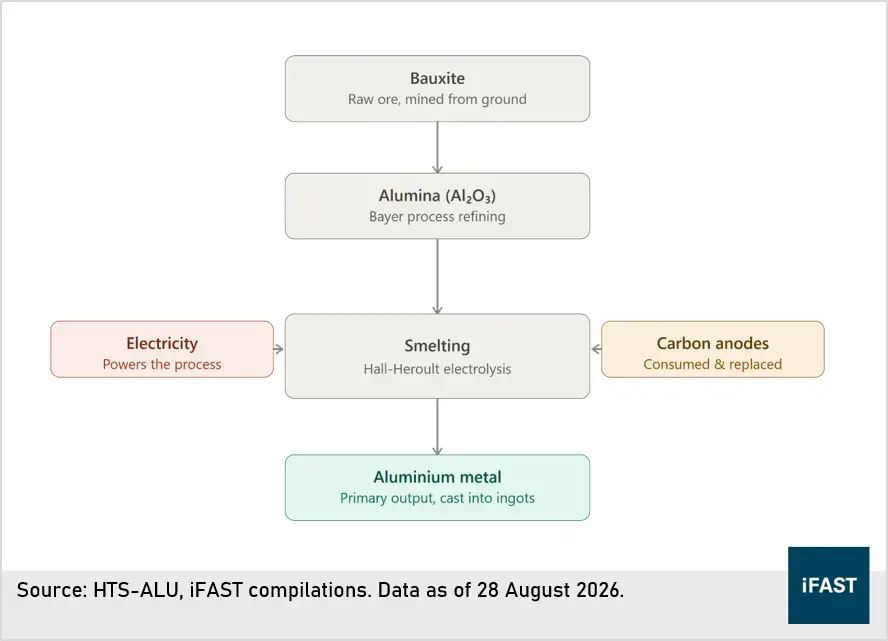
In short, Press Metal's three core raw materials are: alumina (feedstock), electricity (process energy), and carbon anodes (consumables), and its business model is built around securing all three as directly and cost-effectively as possible rather than buying them at spot prices.
Table 1: Typical production cost in aluminium production (not derived from Press Metal’s reports)
|
Share of total production cost |
|
|
Alumina |
38-39% |
|
Electricity |
30-33% |
|
Carbon anodes |
15% |
|
Source: HTS-ALU, iFAST compilations. Data as of 3 February 2026. |
|
Business model and vertical integration
Press Metal is Southeast Asia's largest integrated aluminium producer by smelting capacity (1.08 million tonnes/year), with a business model structured across three tiers that map directly onto the raw-material chain above:
Upstream (raw material security): Press Metal's alumina exposure comes through several structures, via its stakes in different companies.
One of it is via the indirect stakes in PT Bintan Alumina Indonesia (PT BAI) via a 20.62% stake in Hong Kong-listed Nanshan Aluminium International Holdings Ltd (NAIHL) which controls approx. 97.7% of PT BAI.
Separately, Press Metal holds a 50% stake in Japan Alumina Associates (Australia) Pty Ltd (JAA) which in turn holds a 10% interest in the Worsley Alumina Unincorporated Joint Venture in Australia.
The group also holds an 80% equity interest in PT Kalimantan Alumina Nusantara (PT KAN), a new alumina refinery under construction and planned to have an initial capacity of 1 million tonnes per annum, with first commissioning expected in 2027. Per other sources, the management estimates the refinery could supply about 40% of Press Metal's alumina requirements.
On the carbon anode side, Press Metal holds a 20% stake (with an option to increase to 40% after three years) in Shandong Sunstone & PMB Carbon Ltd Co (SSPC) in China.
All these exhibits management’s continuous effort to make Press Metal self sufficiency in raw materials.
Midstream (smelting): Smelting is carried out through 80%-owned subsidiaries Press Metal Sarawak and Press Metal Bintulu, operating in Mukah and Samalaju Industrial Park, Sarawak, with combined capacity of 1.08 million tonnes per annum. Located within the Sarawak Corridor of Renewable Energy, these smelters benefit from long-term power purchase agreements with Sarawak Energy, giving Press Metal cost stability.
Downstream: Extrusion operations in Klang and Foshan with roughly 230,000 tonnes of value-added capacity per annum, turning primary metal into higher-margin finished and semi-finished products (car bumpers, EV battery trays etc).
End products
Press Metal's output spans three broad product tiers, each serving different end markets:
Primary aluminium ingots (P1020) - certified and traded on the London Metal Exchange (LME) as High-Grade Primary Aluminium.
Extrusion profiles - serve the building, construction, infrastructure, consumer goods, and transportation sectors. They are also increasingly used for solar panel frames.
Higher-value components and casings - manufacture EV/automotive components, specifically car bumpers, battery casings/trays, and rocker beams. In the solar sector, they supply solar module frames.
Revenue breakdown (FY2025)
By business segment (external revenue), smelting is by far the dominant contributor.
Table 2: Revenue by business segment
|
RM |
% of total revenue |
|
|
Smelting |
13.4 bil |
83% |
|
Extrusion |
2.4 bil |
15% |
|
Alumina products (refinery) & others |
384.3 mil |
2% |
|
Source: Press Metal, iFAST compilations. Data as of 31 December 2025. |
||
By geography, revenue is more internationally diversified than the segment mix might suggest.
Table 3: Revenue by geography
|
% of total revenue |
|
|
Asia ex- Malaysia region |
51% |
|
Europe region |
30% |
|
Malaysia |
11% |
|
Other countries |
8% |
|
Source: Press Metal, iFAST compilations. Data as of 31 December 2025. |
|
Financial highlights
1H26 net profit rose 50.8% yoy to RM1.43 billion, on revenue of RM8.79 billion (+8.7% yoy). Excluding a one-off RM115.4 million gain from the dilution of its stake in an associate, 1H26 net profit rose approximately 38.6% yoy to RM1.31 billion.
This is due to stronger realised aluminium prices and lower alumina input costs driving the improvement, notwithstanding softer profit contribution from associates.
Credit metrics
In terms of credit metrics, the group remains in a robust position, with debt-to-EBIT at just 1.20 times. This implies that the group could theoretically repay its debt obligations through EBIT within 1.2 years. The debt-to-equity ratio also remained stable at 0.35 times, which we view as relatively low given its business model and relatively high capex requirements. Meanwhile, free cash flow declined slightly to RM0.99 billion, mainly due to higher capex and investments in associates, but remained at a healthy level overall.
Table 4: Key credit ratios
|
|
FY25 |
1H25 |
1H26 |
|
Debt/EBIT |
1.44 |
2.01 |
1.20 |
|
Debt/equity |
0.37 |
0.37 |
0.35 |
|
Free cash flow (MYR billion) |
1.56 |
1.05 |
0.99 |
|
Source: Press Metal, iFAST compilations. Data as of 30 June 2026. |
|||
Our view
Press Metal continues to be in a position of credit strength: AA1 rating and an integrated business model that dampens raw-material and price volatility relative to non-integrated smelters.
Overall, we view Press Metal as one of the stronger corporate credits in the Malaysian market, supported by its cost leadership, growing vertical integration and conservative leverage. We remain comfortable with the group's credit profile and see its bonds as a suitable option for investors seeking exposure to high-quality MYR corporate credit, with around 40-50 bps pickup relative to Malaysia sovereign bonds.
Table 5: Press Metal’s bond on platform (subject to liquidity)
|
|
Outstanding bond |
Years to maturity |
|
Bond price |
Yield to worst |
|
250 mil |
1Y2M |
Senior unsecured |
101.2 |
3.65% |
|
|
350 mil |
2Y2M |
Senior unsecured |
102.0 |
3.83% |
|
|
250 mil |
3Y0M |
Senior unsecured |
100.9 |
3.96% |
|
|
Source: Bondsupermart, iFAST compilations. Data as of 5 October 2026. |
|||||