Highlights:
- Looking ahead to 2024, we believe that bond yields and interest rate will remain elevated for a longer period. The Fed may not consider a rate cut within the year because (1) inflation is unlikely to come down to 2%, (2) fading recessionary expectations, and (3) the potential imbalance between supply and demand for US Treasuries.
- We think the long-term bond yields can go up further, so it is yet the time to buy long-term bonds. Meanwhile, we remain positive about short-term US Treasuries of which the yields are at their highest level since 2007.
- High investment-grade (A-rated or above) corporate bonds offer higher investment value and are suitable for investors who seek additional returns.
- While we do not expect an imminent recession, credit risk and overall default rates should still rise under the high interest rate environment. Therefore, the current spreads for global high yield bond market do not look attractive enough.
Bond Yields and Interest Rate will Remain Elevated for A Longer Period
In line with our prediction, the Fed is not going to cut interest rate in 2023. Still, it is undeniable that this rate hike cycle is approaching the end. The Fed has raised interest rate by a total of 525 bps over the past two years, and both interest rate and bond yields are at their highest levels since 2007.
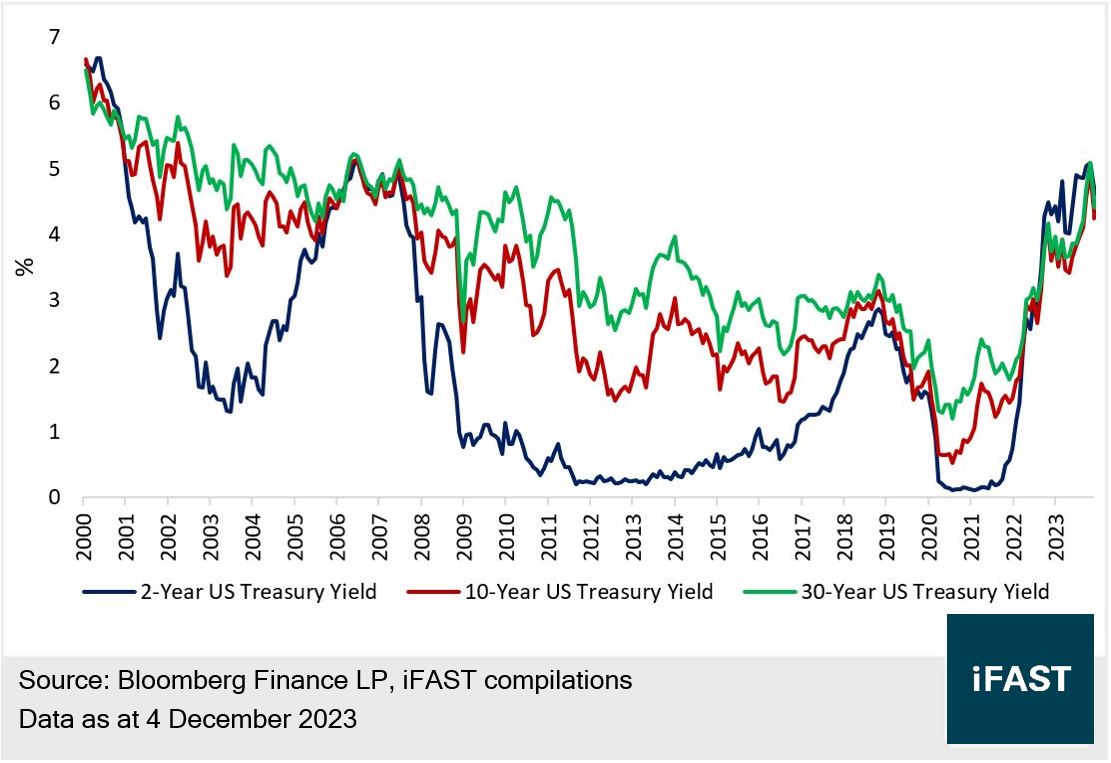
In recent months, long-term bond yields have fluctuated significantly again. The 10-year and 30-year Treasury yields once exceeded 5% in mid-October, before retreating to the 4.2% to 4.4% level (see Chart 1). One of the factors is the returning expectations of rate cuts next year, as the interest rate futures are now suggesting that the market generally expects five rate cuts by the end of 2024.
Chart 1: 2-year, 10-year and 30-year US Treasury Yields
However, looking ahead to 2024, we believe that bond yields and interest rate will remain elevated for a longer period, and the Fed may not consider a rate cut within the year. We have summarized three main justifications for this view: (1) inflation is unlikely to come down to 2%, (2) fading recessionary expectations, and (3) the imbalance between supply and demand for US Treasuries.
1. Inflation is Unlikely to Come Down to 2%
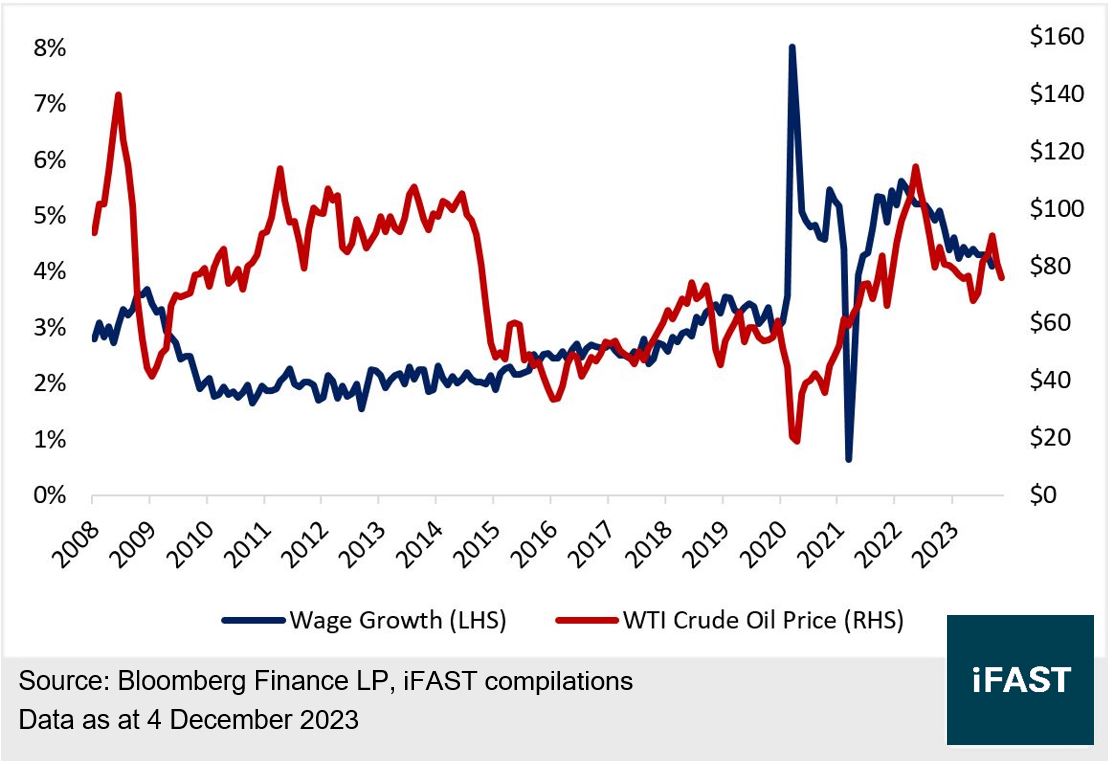
As mentioned in our 2023 outlook, the sticky inflation this time is a result of past excessive quantitative easing, rising commodity prices, higher labour wages, combined with supply-side pressure brought by de-globalization. These structural inflationary factors still exist today, as labor wages continues to grow at a rate of over 4% (see Chart 2), while the shelter, transportation, medical care and apparel costs are showing no sign of significant cooldown. These, coupled with the lingering upward pressure on energy prices, make it difficult to improve the high inflation situation in the near term.
Chart 2: Labour Wage Growth and WTI Oil Price
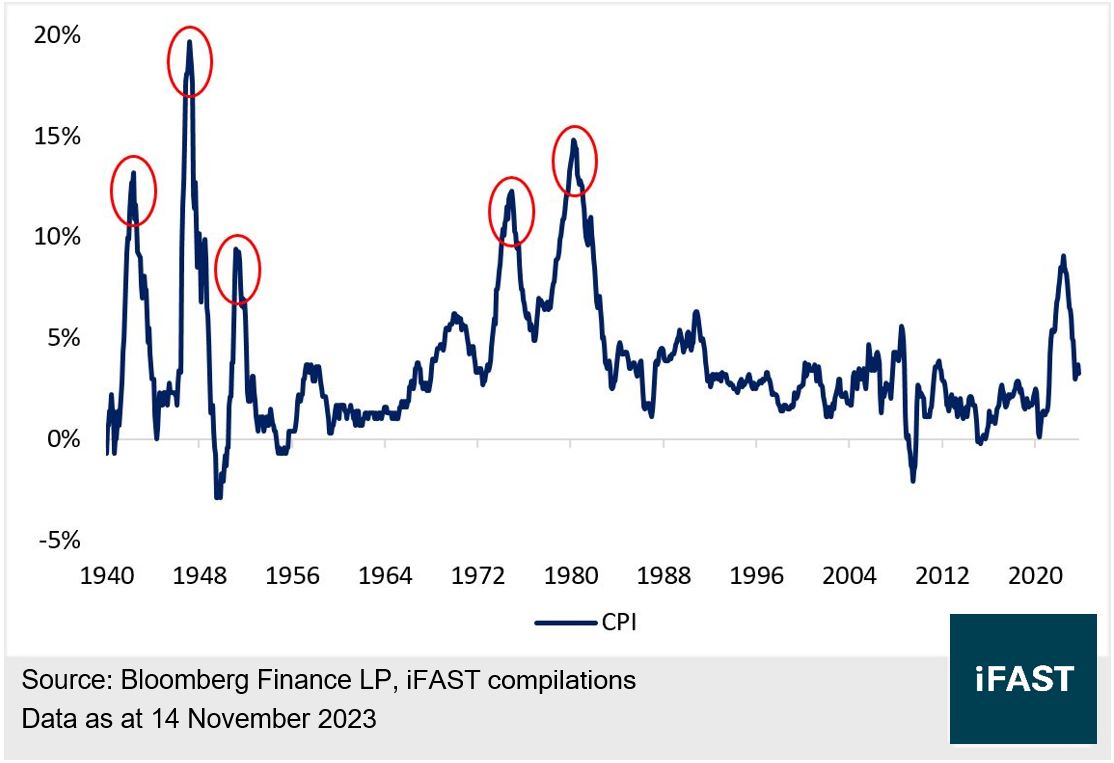
In fact, not only the core CPI has persistently stayed above 4% over the months, the headline CPI has also rebounded after dropping to 3% in June (see Chart 3). With reference to previous high inflation cycles, there was a rebound in inflation in both cases (see Chart 4). Therefore, it will not be an easy task for the Fed to bring inflation back down to the 2% target.
Chart 3: Headline CPI and Core CPI
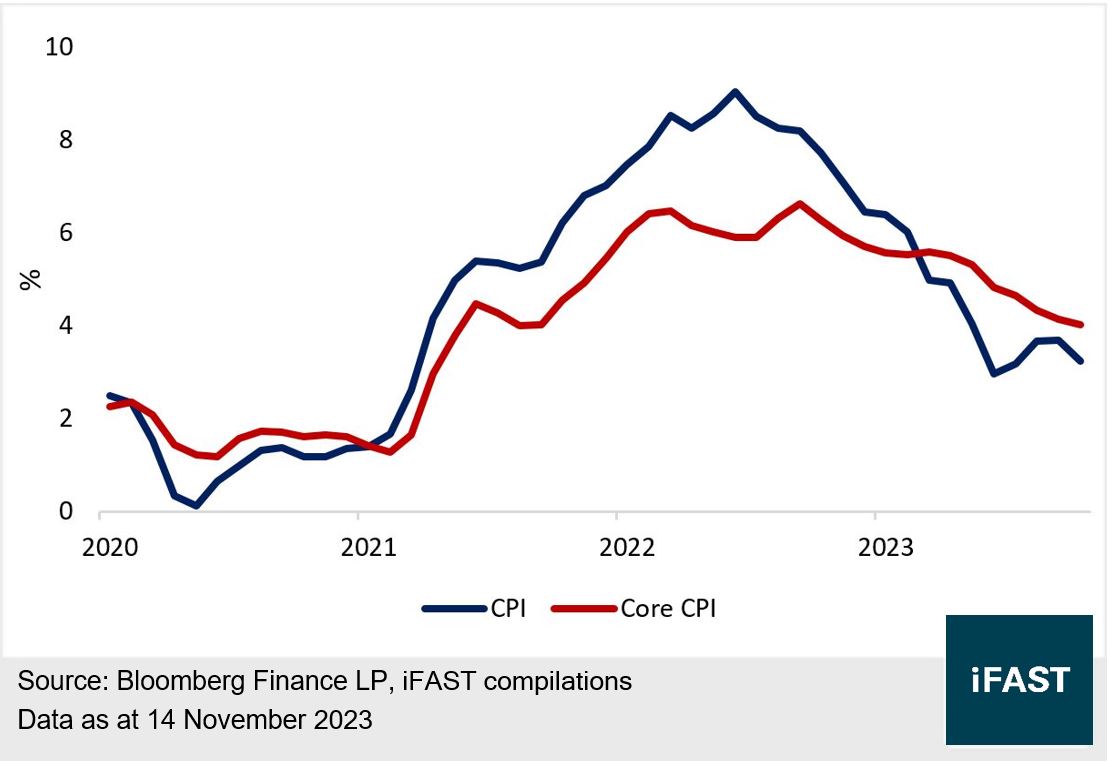
Chart 4: Historical CPI
2. Fading Recessionary Expectations
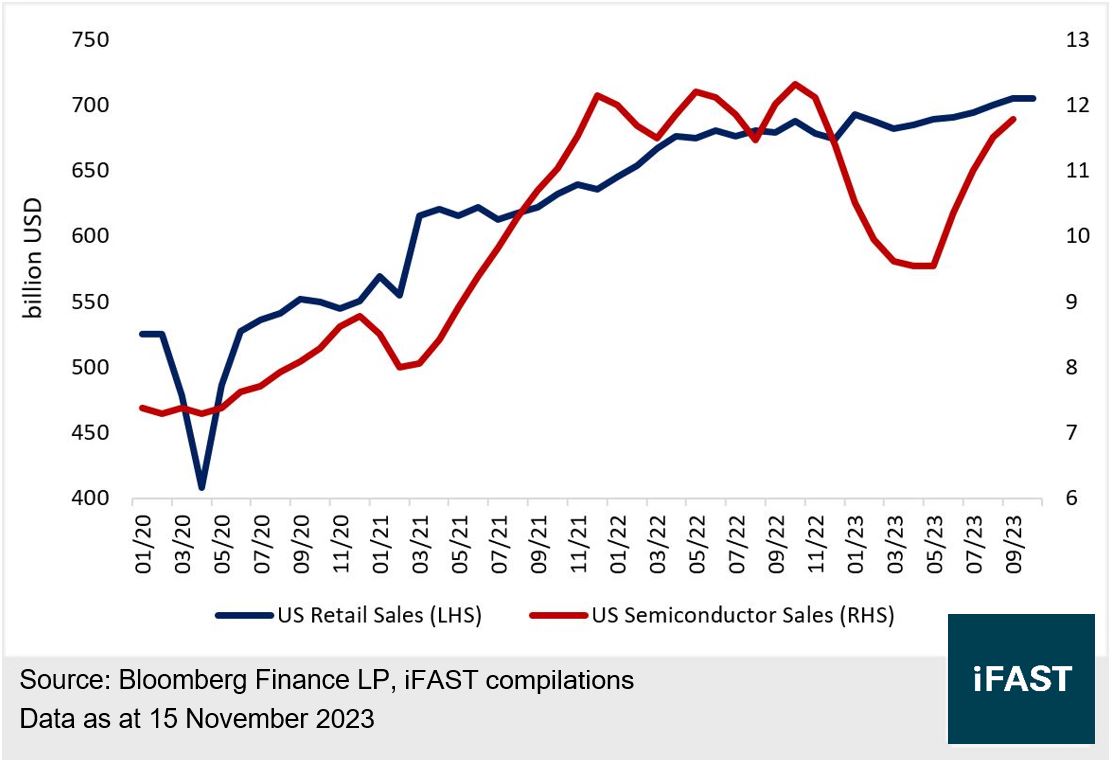
Apart from inflation, we also think that the possibility of a ‘hard landing’ in US is diminishing. Key metrics such as corporate earnings, semiconductor sales and retail sales both saw a strong rebound after a brief downturn in 2Q23 (see Chart 5 and 6).
Chart 5: US Corporate Earnings
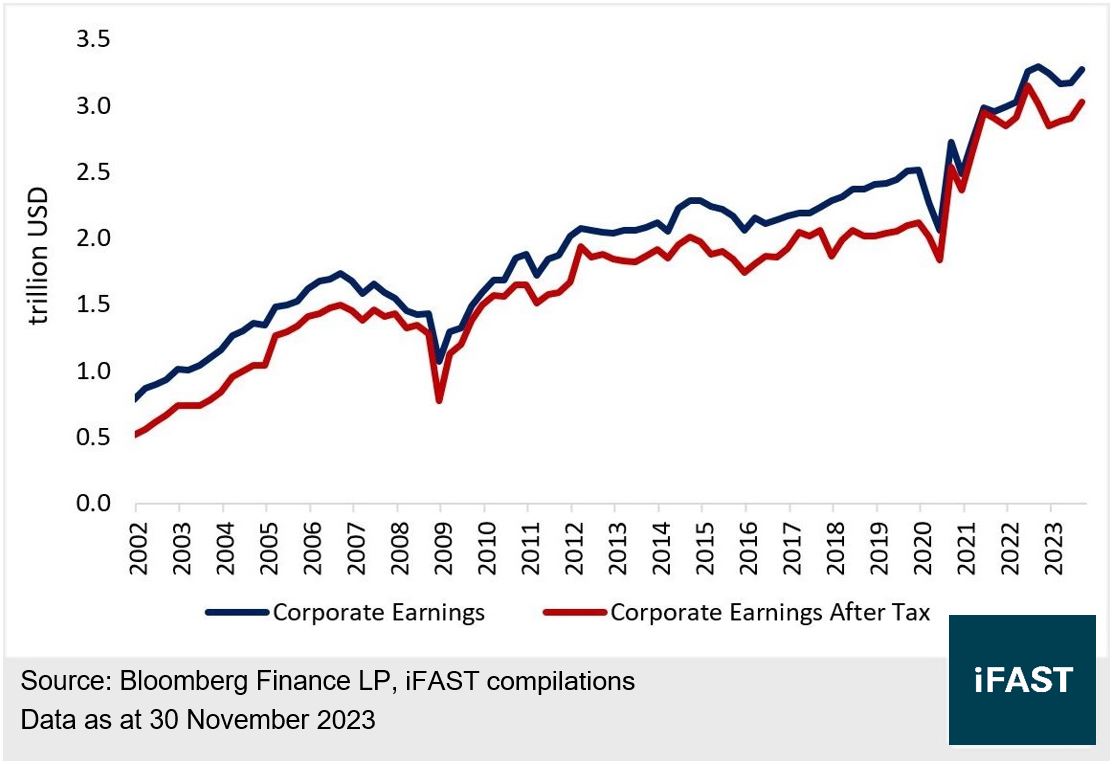
Chart 6: US Semiconductor Sales and Retail Sales
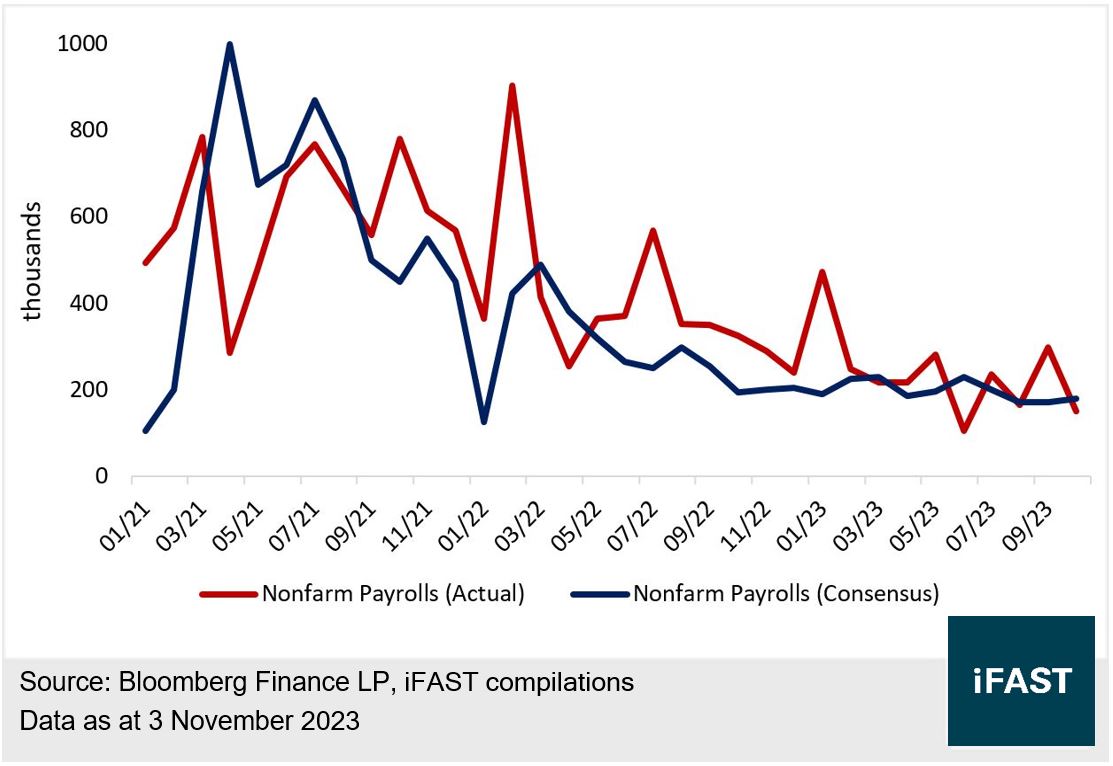
On the other hand, as Biden administration has significantly increased fiscal spending (see Chart 7), government-related job creations will continue to support the overall employment figures. Whilst we saw layoffs in many big technology and financial companies, and the non-farm payrolls look softened in recent months, the number still grew by more than 200,000 on monthly average (see Chart 8), which is higher than the 10-year average before the COVID period. This reflects that the employment condition is resilient and consistent with the ‘soft landing’ theme. We therefore do not expect a recession to arrive in 2024.
Chart 7: Federal Government Budget Deficit
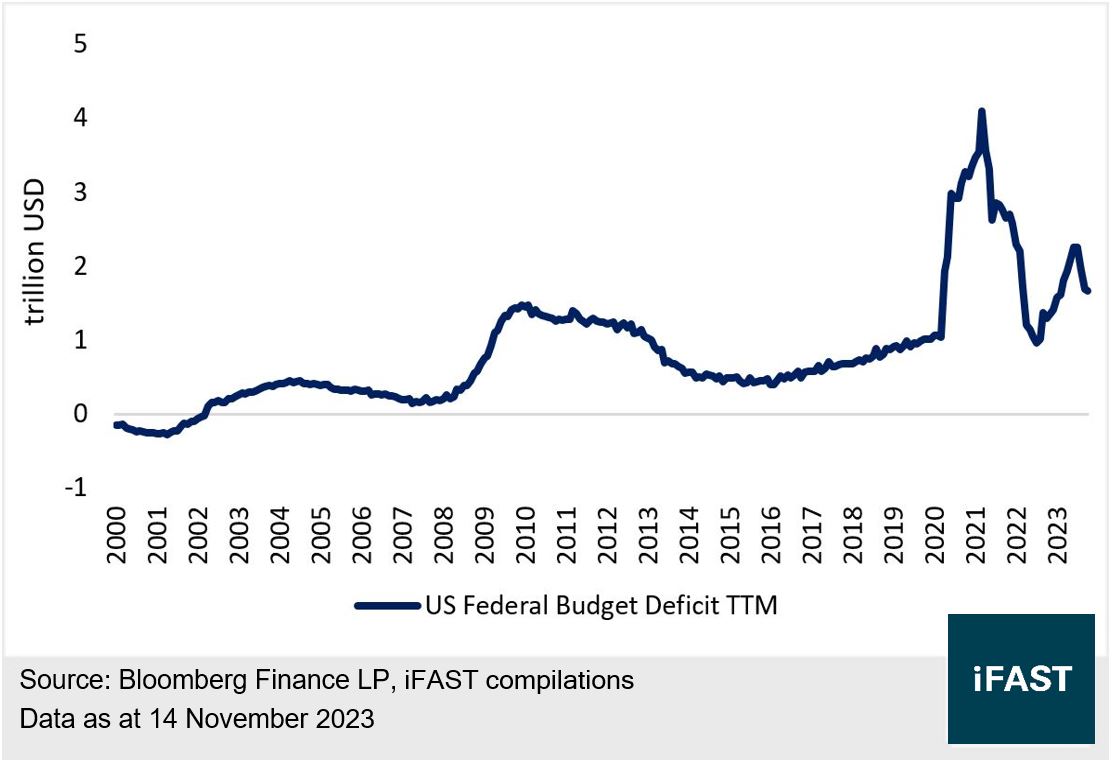
Chart 8: Change in Non-Farm Payrolls (Actual vs. Consensus)
3. Potential Imbalance between Supply and Demand for US Treasuries
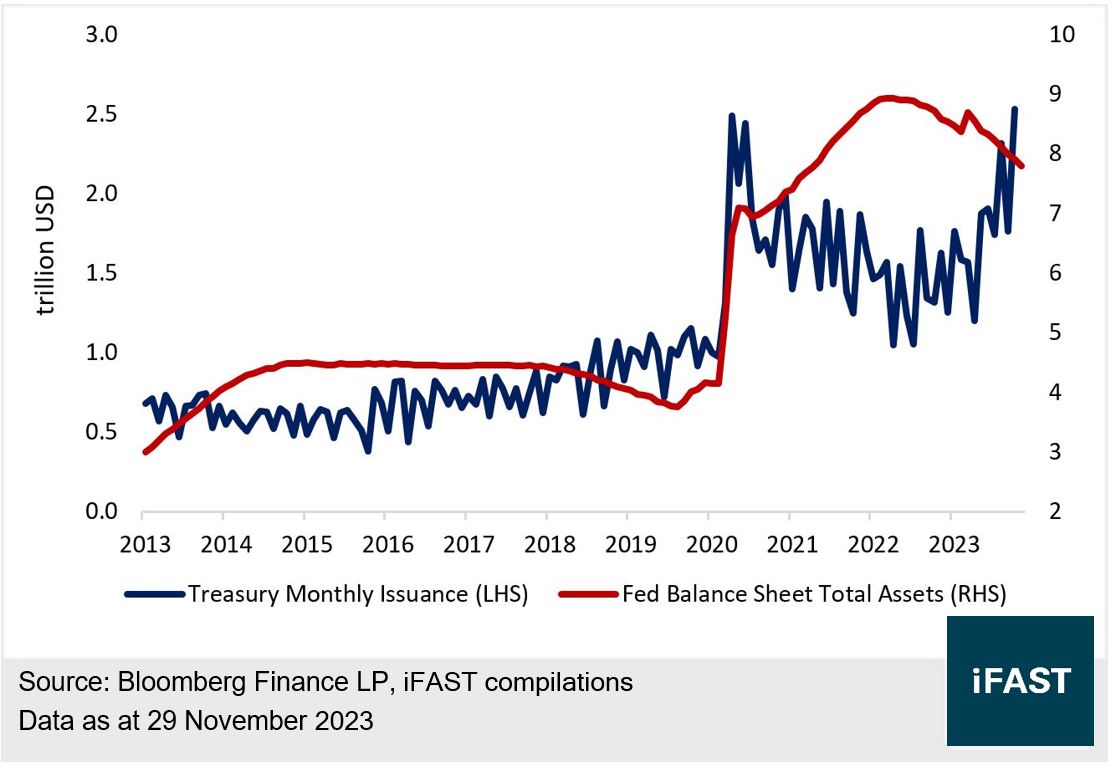
After the Democrats and Republicans reached a bipartisan deal to suspend debt ceiling in June, the Treasury Department has further increased the size of debt issuance. The total issuance over the last few months has even returned to the peak during the COVID period in 2020.
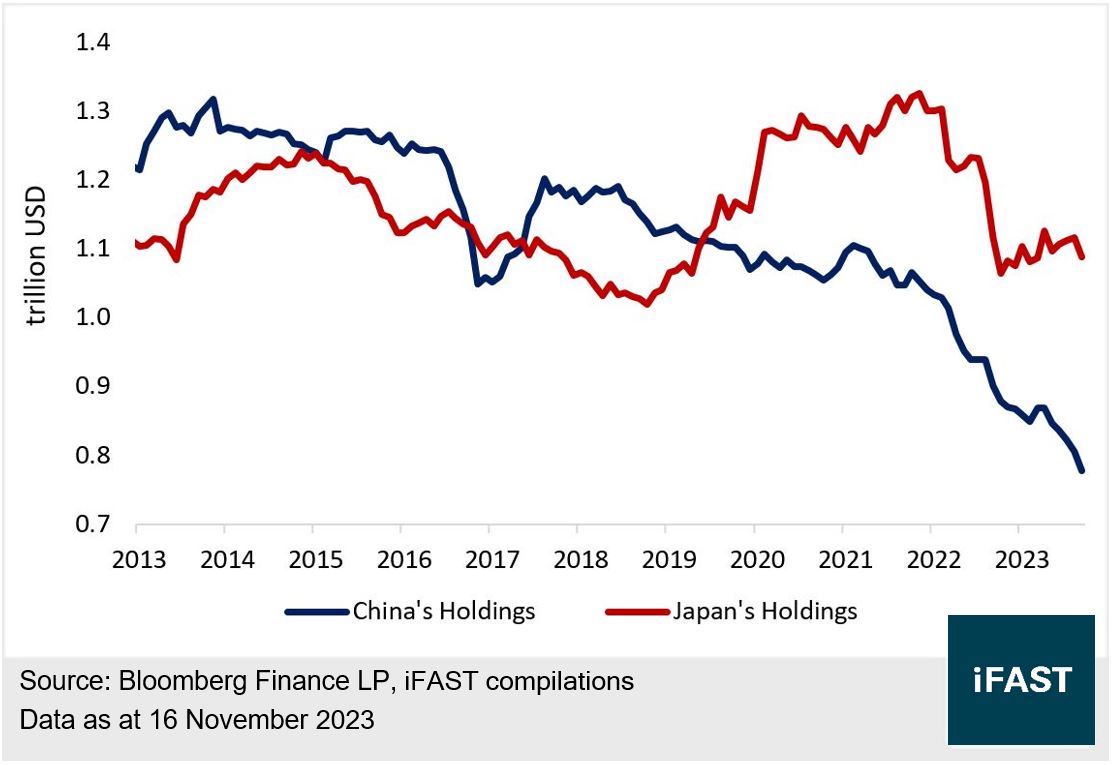
In the next few years, it is predictable that the Government will continue to issue sizeable new debts to finance its widening budget deficit. However, this time is different compared to the pandemic period, as the Fed is now shrinking its balance sheet (see Chart 9). Meanwhile, the largest foreign holders of US Treasuries, such as China and Japan, are reducing their holdings as well (see Chart 10). These factors may lead to a pressure on bond prices, and further push up the real yields.
Chart 9: Monthly Treasury Securities Issuance and Fed Balance Sheet Total Assets
Chart 10: China and Japan’s Holdings of US Treasury Securities
Long-term Bond Yields Can Still Rise; Remain Positive on Short-term US Treasuries
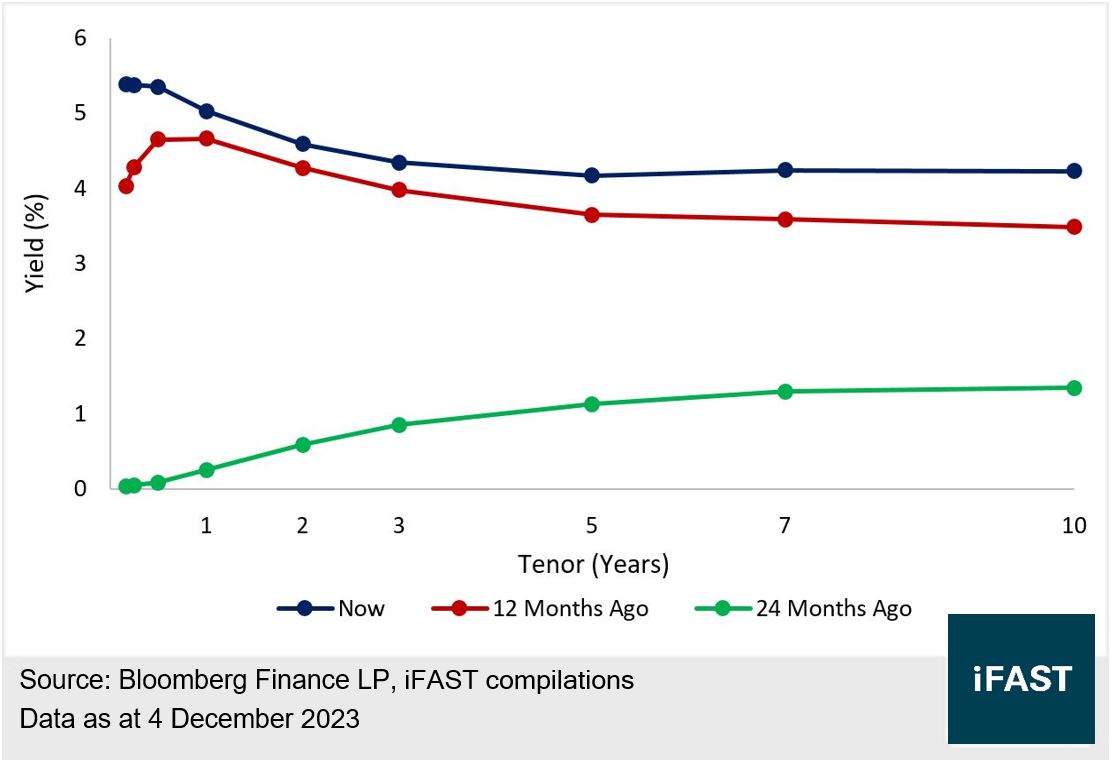
Currently, the yield curve has shifted upward compared to 12 months ago, but the magnitude of inversion remains severe (see Chart 11). Despite the Treasury is switching new issuance towards shorter tenors recently, we still believe that the next phase in yield curve normalization will be driven by a further increase in long-term bond yields.
Chart 11: US Treasury Yield Curve
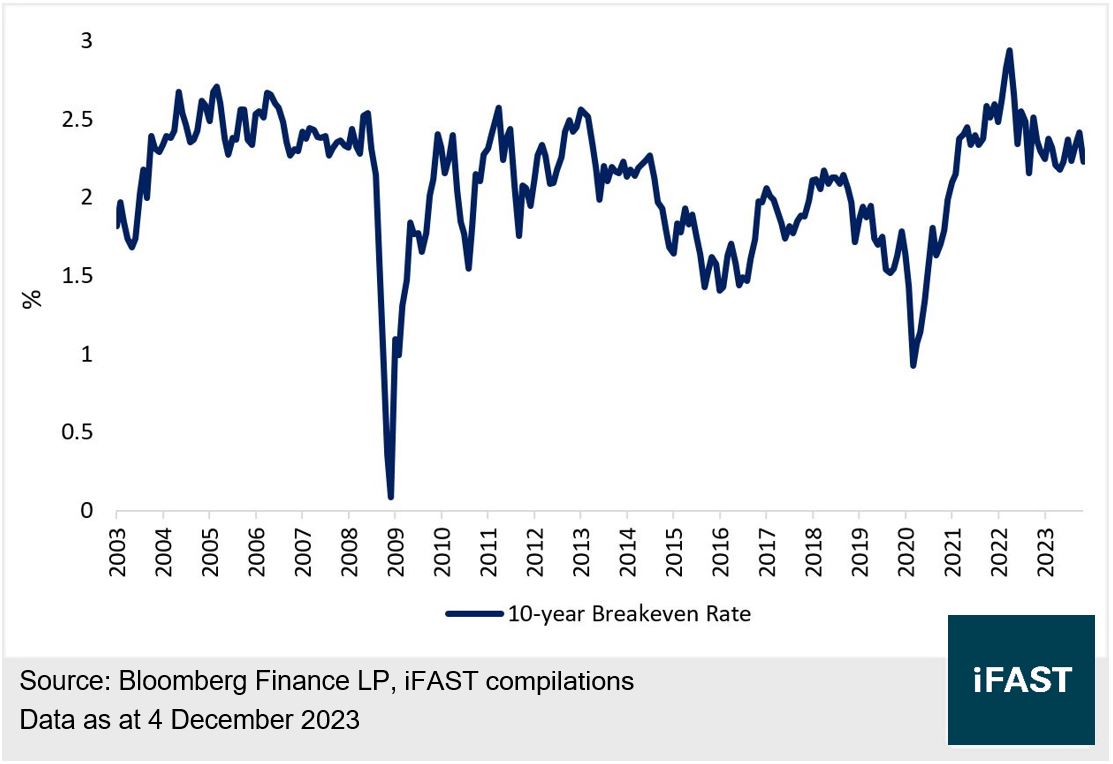
In fact, although the 10-year Treasury yield has reached 5% in October, the breakeven rate (nominal yield minus real yield) has been staying below 2.5% (see Chart 12). If the market starts to realize that higher inflation is going to stay for longer period, the breakeven rate will climb rapidly under this narrative change.
Chart 12: 10-year Breakeven Rate
Based on a higher inflation expectation, plus neutral rate and term premium, the 10-year Treasury yield is reasonable to go up at higher than 5%, and it could even reach 6%. In view of this, it is yet the time to buy long-term bonds now.
On the contrary, we remain positive on short-term US Treasuries that have a tenor of 0 to 2 years. They generally offer yields above 5% and are suitable for investor who seek stable and decent returns (see Table 1).
Table 1: US Treasury Yields
Tenor Yield to Maturity 6-month 5.4% 1-year 5.0% 2-year 4.6% 3-year 4.3% 5-year 4.2% 7-year 4.2% 10-year 4.2% Source: Bloomberg Finance LP
Data as of 5 December 2023
Corporate Bond Spreads Remain Low; High Investment Grade Bonds Are More Attractive
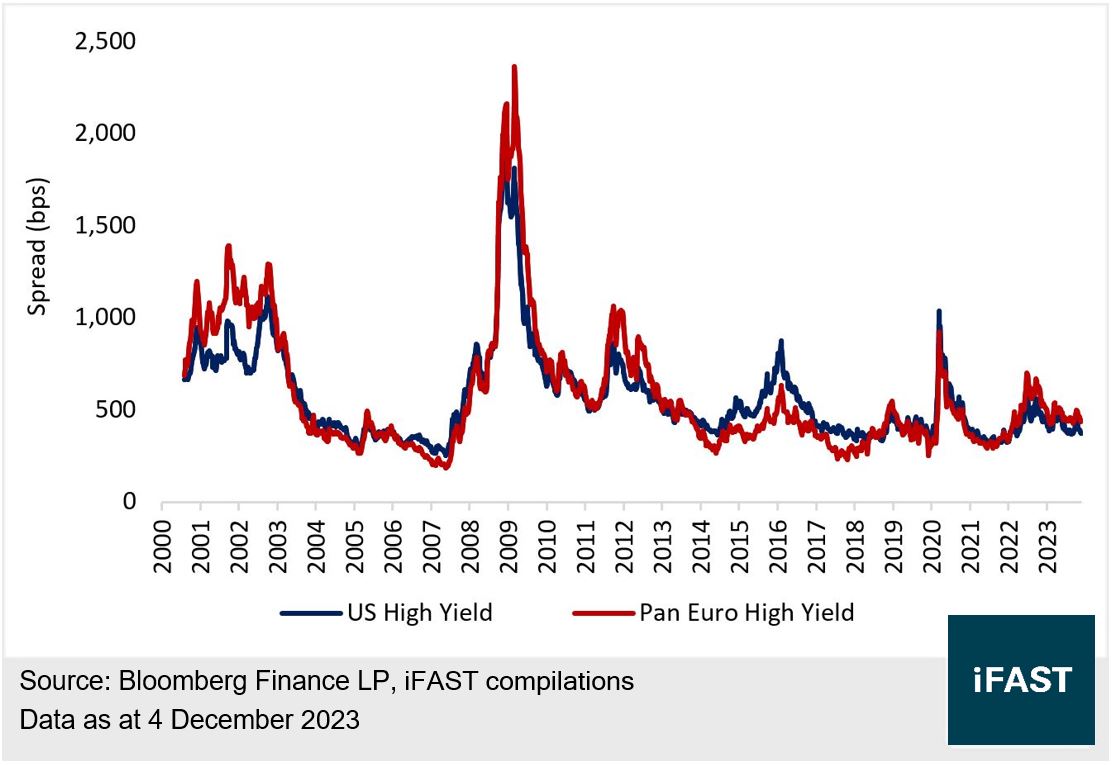
As we do not expect a recession to come soon, there may not be a wave of defaults. However, the average cost of bond issuance for US high yield issuers has already risen to around 8% in recent months, implying that these companies will need to further improve their profitability to cover the interest burden. It means a heightened credit risk and overall default rate is very likely to happen. Thus, the US and European high yield bond spreads do not look attractive enough now (see Chart 13).
Chart 13: US and European High Yield Bond Spreads
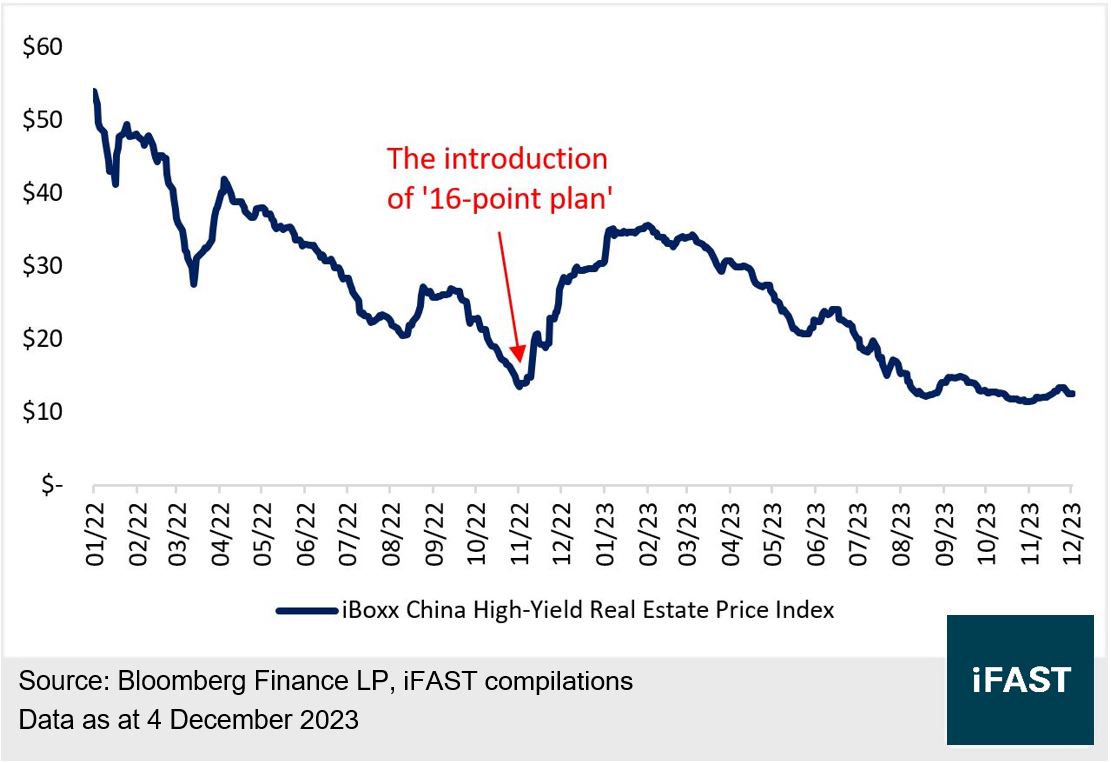
As for the Asian high yield bonds, they are still limited by the debt crisis across different industries in China. Even if the new set of guidelines announced by the Mainland regulators recently could lead to a short-term recovery in the Chinese real estate bonds, similar to what happened last year with the introduction of ‘16-point plan' (see Chart 14), we still believe the overall uncertainty remains elevated. These bonds are therefore not suitable for investors who are looking for income.
Chart 14: iBoxx Chinese Real Estate High Yield USD Bond Price
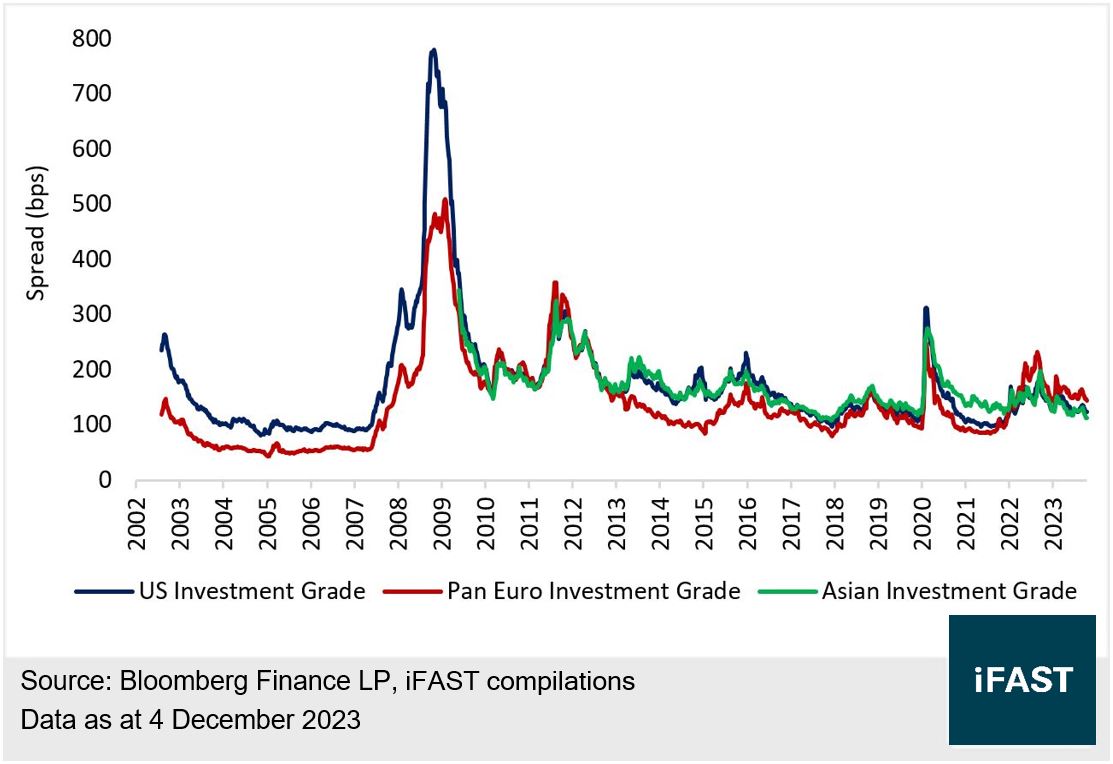
For investment grade bonds, the current spreads of US, European and Asian investment grade corporate bonds range from 150 to 160 bps, which are still tight compared to historical levels (see Chart 15). However, given the yields have reached the highest point since 2008, some instruments carrying even lower credit risks such as high investment grade bonds (A-rated or above) and certificates of deposit could be decent choices for investors looking for extra yield pickup above US Treasuries.
Chart 15: Global Investment Grade Bond Spreads
Conclusion
Looking ahead to 2024, we believe that bond yields and interest rate will remain elevated for a longer period. The Fed may not consider a rate cut within the year because (1) inflation is unlikely to come down to 2%, (2) fading recessionary expectations, and (3) the potential imbalance between supply and demand for US Treasuries.
We think the long-term bond yields can go up further, so it is yet the time to buy long-term bonds. Meanwhile, we remain positive about short-term US Treasuries of which the yields are at their highest level since 2007.
For corporate bonds, high investment-grade (A-rated or above) bonds offer higher investment value and are suitable for investors who seek additional returns. While we do not expect an imminent recession, credit risk and overall default rates should still rise under the high interest rate environment. Therefore, the current spreads for global high yield bond market do not look attractive enough.
You can also refer to our '2024 Global Fixed Income Outlook' to grasp the investment ideas across different fixed income markets around the world.
Our podcast series, Yield Hunters, is available on Spotify, iTunes Podcasts and Google Podcasts. We share our thoughts on new bond issues and hold discussions on the fixed income space. Listen to our latest episode below and follow us!