Receive first-hand news on the latest bond issues, credit updates and special events when you join us on our Telegram channel at https://t.me/bondsupermart!
Highlights:
- China's regulators have recently issued a new round of real estate bailout measures, including "Three No-lowers principles “and allowing banks to provide uncollateralized loans to real estate developers. The overall efforts are stronger than those of the "16-points Plan" of the same period last year, and we believe that these policies will have a positive impact on the liquidity of developers in the short term.
- China's real estate market is plagued by a lack of confidence among homebuyers under the pressure of the economic downturn and a lack of investment nature in the real estate market. We believe that the improvement in the liquidity of developers alone will not be able to address the depressed market sentiment.
- The new round of bailout policies will, to a certain extent, shift the risk to the financial system, and the asset quality of state-owned banks is expected to be weighed down, while other impacts remain to be seen by the market.
New Round of Bailout Policies
In a meeting held by regulators including PBOC and attended by state-owned banks on 17 Nov, regulators announced the new policies for real estate developers, with the core elements of the "Three No-lowers principles ", as detailed below:
- The growth rate of real estate loans of the bank is not lower than the industry average
- The growth rate of loans to non-state-owned developers is not lower than the growth rate of the bank’s average real estate loan
- The growth rate of residential mortgage loans of non-state-owned developers' properties is not lower than the growth rate of a bank's average mortgage loan
Regulators are drafting a white list that covers around 50 property developers, and shortlisted developers will receive support from banks, including bank loans, and debt and equity refinancing. In particular, regulators allow banks to provide collateral-free loans to developers. Though no official white list has been announced yet, there are reports that the list will be screened based on contracted sales rankings and also include defaulted developers, like Country Garden and CIFI.
Short Commentary
In our view, the "Three No-lowers principles “will be helpful in improving the liquidity of developers in the near term, and may help financial institutions restore their confidence in developers, led in particular by the role model of large state-owned banks. Previously, bank loans were principally lent to SOE developers, whereas non-SOE developers, which make up the majority of the industry, found it difficult to get support. The new policies reshape the credit structure and are more in favour of non-SOE developers, which are expected to be the major beneficiaries.
In comparison to the "16-points Plan" announced last November, which was considered to be the strongest bailout policy in history, we believe this round of new policies is more powerful and practical. From the table below, we can see that the biggest difference between the two round of policies lie in the coverage of property developers and the way they are implemented by the financial institutions involved.
"16-points Plan" benefited the high-quality real estate developers, mostly SOEs, while the new policies would cover a larger number of non-SOE developers if the white list is screened by contracted sales ranking. Furthermore, despite the large number of policies involved, the "16-points Plan" is more like a policy framework which consists of some guidelines, such as encouraging commercial banks to support the reasonable refinancing needs of developers. Given that loans lent to non-SOE developers will be exposed to larger credit risk, banks have less incentive to fulfill these guidelines. However, the "Three No-lowers Principles "is quite different, as it is a regulatory requirement just like “Three Red Line”, and PBOC may incorporate it into the MPA (Macro Prudential Assessment) of commercial banks, giving us the impression that the new round of bailout policies is much stronger than the "16-points Plan". Financial institutions respond quickly to the new policies, and state-owned banks including the Bank of Communication and China Construction Bank have already organised seminars with developers to discuss solutions to support the financing needs.
Table 1: Policies Comparison
|
New Policies |
16-points Plan |
|
|
Release Date |
November 2023 |
November 2022 |
|
Key Points |
"Three No-lowers principles “and allowing banks to provide uncollateralized loans to real estate developers. |
Stabilization of real estate development loans, and issuance of bonds guaranteed by CBICL |
|
Coverage |
White List that covers around 50 developers |
High-quality real estate developer, mostly SOEs |
|
Financial Institutions Involved |
State-owned Banks |
Commercial banks and trust companies, etc. |
|
Execution Approach |
Regulatory Requirement |
Guideline |
|
Source: China Government, iFAST Compilations Data as of 28 November 2023 |
||
Real Estate Fundamentals Remain Bleak and Recovery Has a Long Way to Go
Even though the new policies could be somewhat helpful in improving developers' liquidity, we don't think it is still enough to drive the real estate market out of the doldrums. From our point of view, the the depressed real estate market is not due to the credit issue of developers, but rather to the lack of confidence of buyers and the lack of investment nature of the properties.
Until 2022, the main cause of concern for homebuyers is the uncertainty of house handover derived from developers' tight liquidity, but the demand for home purchase and investment remains. Currently, with the increasing downward pressure on the economy and falling property prices, households are not confident to consider real estate as a good investment underlying asset and would rather put their money in the banks, which led to a significant increase in deposits and a decrease in demand for consumption and investment. (For more details, please refer to our research article " Will the Ongoing Depression in Chinese Real Estate Trigger Balance Sheet Recession? "). We thus believe that the fundamentals of Chinese real estate will remain bleak before restoring the investment nature of properties, and it is too early to conclude that the market is recovering.
State-owned Banks Are Expected to be Risk Takers with Weakened Asset Quality
From the angle of property developers, the collateral-free loans proposed in the new policies are undoubtedly desirable options, but they would weigh on the asset quality of banks as a result. Generally speaking, most loans lent to property developers are secured with collateral, which could be liquidated to offset the potential credit loss in case of credit events. This is why Chinese banks’ credit impairment loss remains low in the case of high exposure to property developers.
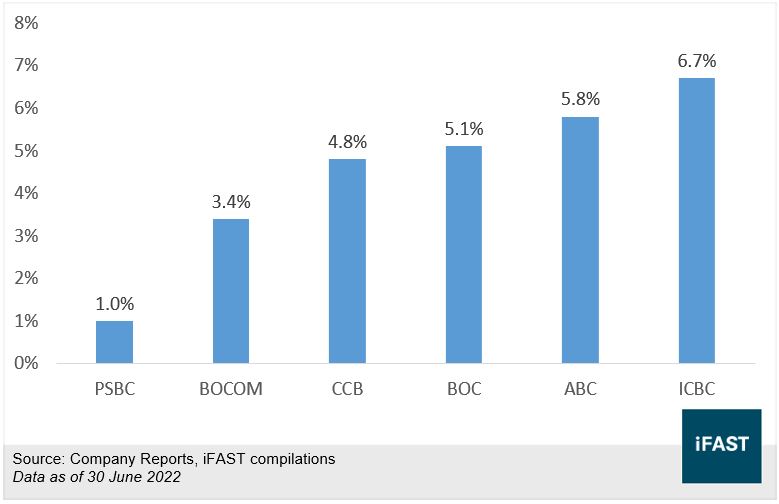
State-owned banks are the major operators of new policies, and although it is not clear which banks will be involved, the market usually considers state-owned banks to be the Big Four banks together with the Bank of Communications (BoCom) and the Postal Savings Bank of China (PSBC). We find that the Non-Performing Loan (NPL) ratio in 1H2023 for state-owned banks to the real estate sector is at a very high level, except for PSBC, even as high as 6.7% for ICBC. Therefore, if the collateral-free loans are implemented on a large scale, the NPL ratio would further uplift, coupled with the fact that Chinese regulators recently required large commercial banks to have "loan-for-bond swaps" for LGFVs to alleviate the debt repayment pressure, we thus believe state-owned banks become the credit risk taker, and the likelihood of systemic risk of financial institutions is increasing if PBOC does not take any action
Chart 1: NPL Ratio for State-owned Banks to Real Estate Sector
Impacts on Investment
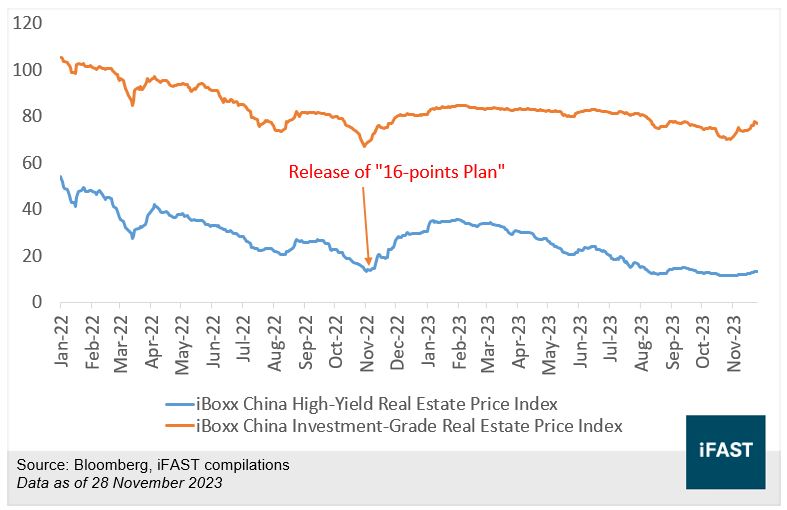
Even though the new policies will be unlikely to turn around the sluggish market sentiment of Chinese property, the improved liquidity is supposed to have positive impacts on the bond price of Chinese property developers. Referring to the "16-points Plan", the USD bond prices of Chinese property developers saw remarkable rebounding after the release of the policies, with the price index of high-yield property bonds rallying by more than 100% from November last year to February this year. It is noteworthy that the price index of high-yield bonds has rebounded by around 10% after the new round of policy announcements, and there is still room for further rebound.
Chart 2: Price Movement of Chinese Property Bond
 Looking at the individual bond investment, we believe the bond
price of property developers that are included in the "white list"
will rise a bit more, particularly those that have already defaulted but may
still be shortlisted, such as Country Garden and CIFI. Bondholders can pay
attention to the changes in bond prices in the near future, so as to make
investment decisions that suit their needs.
Looking at the individual bond investment, we believe the bond
price of property developers that are included in the "white list"
will rise a bit more, particularly those that have already defaulted but may
still be shortlisted, such as Country Garden and CIFI. Bondholders can pay
attention to the changes in bond prices in the near future, so as to make
investment decisions that suit their needs.
Conclusion
China's regulators have recently issued a new round of real estate bailout measures, including "Three No-lowers principles “and allowing banks to provide uncollateralized loans to real estate developers. The overall efforts are stronger than those of the "16-points Plan" of the same period last year, and we believe that these policies will have a positive impact on the liquidity of developers in the short term.
China's real estate market is plagued by a lack of confidence among homebuyers under the pressure of the economic downturn and a lack of investment nature in the real estate market. We believe that the improvement in the liquidity of developers alone will not be able to address the depressed market sentiment.
The new round of bailout policies will, to a
certain extent, shift the risk to the financial system, and the asset quality
of state-owned banks is expected to be weighed down, while other impacts remain
to be seen by the market.