1. Asian high yield offers one of the highest yields anywhere in the bond market today
Table 1: Bond segment yields
| Bond Segment | Yield-to-worst (%) |
| Asian High Yield Bonds | 8.82 |
| Global High Yield Bonds | 4.44 |
| US Corporate High Yield Bonds | 4.02 |
| Europe Corporate High Yield Bonds | 3.04 |
| Asian Investment Grade Bonds | 2.16 |
| Global Investment Grade Bonds | 0.98 |
Source: Bloomberg Finance L.P., iFAST compilations; data as of 5 August 2021
With interest rates still near historical lows, investors have been hard-pressed to find yield within the fixed income space. This insatiable appetite for yield has driven yields on higher-yielding bond segments like US high yield to some of the lowest levels on record – the yield on the Barclays US Corporate High Yield Index recently fell to a new historical low of just 3.53% in early July, before rising marginally to 4.02% as of 5 August 2021.
In contrast, yields on the Asian high yield segment have risen precipitously since the start of the year, with the yield on the Barclays USD Asia High Yield index currently at 8.82%, up from the 6.74% at the end of 2020, making it one of the highest yielding fixed income segments anywhere in the bond market today.
2. Valuations are attractive historically, and also relative to peers
This sharp rise in yields has made the sector much more attractive when compared against its own history, as well as on a relative basis versus other higher-yielding fixed income segments.
On an absolute yield basis, Asian high yield now offers a yield-to-worst of 8.8%, a level seen only in past crises (the depths of Covid-19 pandemic in 2020, and the heightened trade war tensions between China and the US in 2018; see Chart 1).
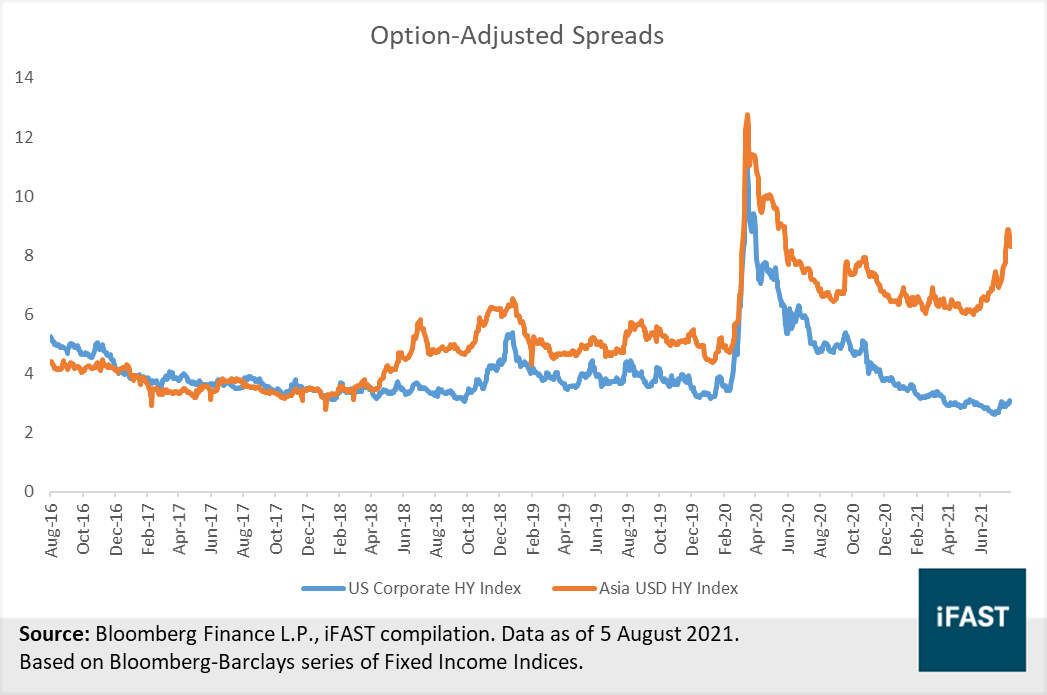
With lower risk-free rates today, Asian high yield looks even more attractive on a spread basis (see Chart 2), with spread levels on the sector approaching some of the wider levels seen in the depths of the Covid-19 pandemic. Relative to US high yield, Asian high yield also offers a significant level of value, with the current spread difference (525bps) representing one of the widest levels on record, suggesting that Asian high yield is much cheaper relative to its US counterpart.
Chart 1: Asian high yield (yield-to-worst)
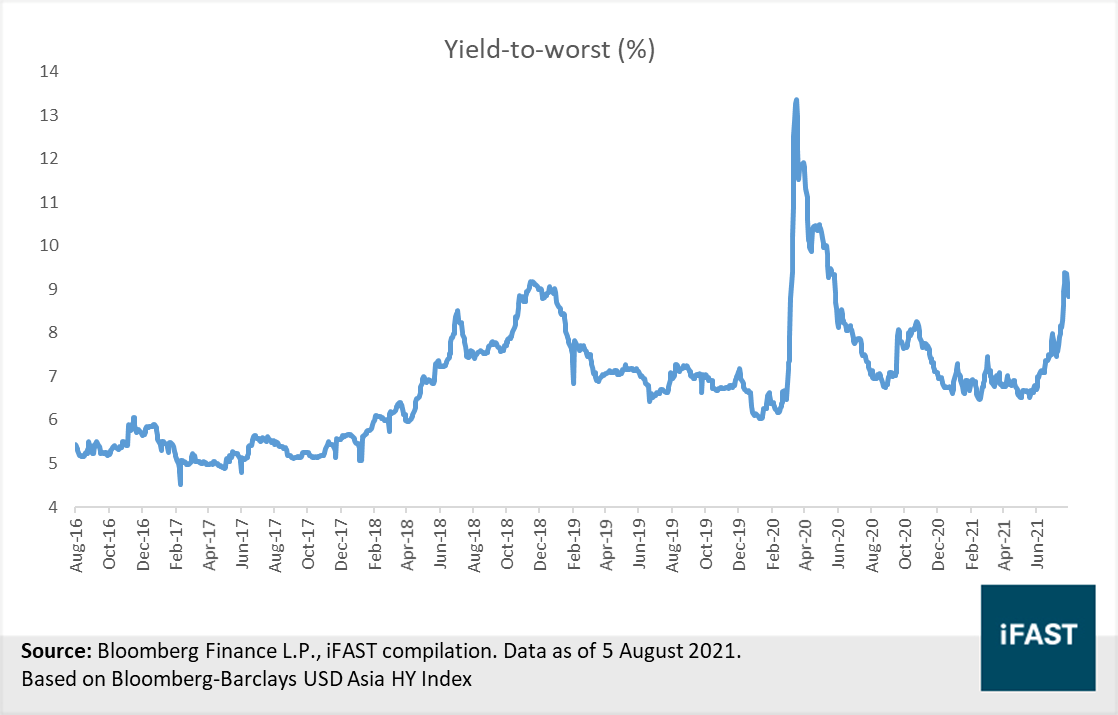
Chart 2: Spreads between Asian and US High Yield Bonds
3. A proxy to a potential recovery in one of the hardest-hit segments
Investors should be aware that the improved valuations (due to the sharp sell-off in Asian high yield bonds) has come on the back of a fair amount of headline risk related to China’s recent crackdown on various sectors and industries. Within the Asian high yield universe, China is the largest component, and amongst the China issuers, the real estate segment has the largest representation.
In recent times, China has introduced measures to cool the real estate sector, including the much-debated “3 red lines” to reduce leverage in the sector, which has had a direct impact on some of the more levered China real estate developers. Recent woes surrounding China Evergrande (one of the largest issuers in most Asian high yield strategies) has also spilled over to the rest of the China real estate sector - a quick check on the year-to-date performance of Asian high yield bond components shows that the bonds from China Evergrande, Fantasia, Yuzhou Properties, Central China Real Estate and China Aoyuan Group are some of the worst-performing, having declined between -15% to -39% so far in 2021 (as of 5 August 2021).
While we have little visibility on how the ongoing China real estate sector crackdown will play out, it is likely that deleveraging will hurt the near-term profitability of China real estate developers, as they place a greater emphasis on liquidity. That being said, we don’t expect crackdown measures to permanently impair the business viability of the entire sector, but rather, serve as a wake-up call to real estate companies to focus on debt reduction rather than chasing profitability. Investors can logically expect to see a China real estate sector with a much healthier credit profile emerge post-crackdown, which would be poised for more sustainable long term growth.
For investors who remain positive on the long-term China growth story and expect current crackdown measures to abate at some juncture, the China-heavy Asian high yield bond segment offers a proxy to the recovery of the beleaguered China real estate sector, which has been one of the key targets of government measures.