In March 2020, the government of Singapore announced new safe-distancing regulations to minimize the spread of the coronavirus. These measures included mandatory physical distancing between individuals and the closure of entertainment venues such as concerts, bars and cinemas.
In Malaysia, the government enforced the Movement Control Order to prohibit the mass gathering and movement of people. Tourists and foreign visitors were barred from entering the country and all businesses with the exception of supermarkets, groceries and convenience stores were closed. To adhere to government guidelines about social distancing and the size restrictions of gatherings, all cinemas have shut their operations in both countries.
With the drop in foot traffic to cinemas and concert events, combined with the ongoing need to pay certain fixed expenses and debt-servicing costs, the credit profiles of entertainment content providers and cinema operators will invariably weaken. Notwithstanding the shutdown and business closures, we think that mm2 Asia Ltd (“mm2”) should still have sufficient liquidity to cover its cash burn. Once the ban is lifted, theatres will likely offer promotions to attract concert and movie customers in conjunction with its competitors. Assuming that mm2 is able to reopen its cinemas by May and a return to normalcy by the end of the year, we think the pent-up demand could mitigate losses.
About mm2 Asia
mm2 is an entertainment group that mainly operates as a media and content producer for film and television, with a significant presence in Malaysia and Singapore. Listed on the Singapore exchange in 2017, the group has expanded its geographical footprint through various investments in Hong Kong, Taiwan, China and the US. The company’s principal activities are divided into four principal areas – 1) content production, distribution and sponsorship (“CPDS”); 2) post-production and content production; 3) cinema operations; and 4) event production and concert promotions.
Content production, distribution and sponsorship
The group’s core business lies in film, TV and online content production, distribution and sponsorship. Production income is made through consultancy fees, government subsidies, script writing, photography and other pre-production events.
Distribution income is obtained through the delivery of content across various platforms including cinemas, pay TV, online streams and airlines. More specifically, mm2 receives a percentage of payment for films distributed through the platforms as well as licensing fees for sequel rights. Lastly, sponsorship income comes from advertisers who use the content channels for marketing.
Post-production and content production
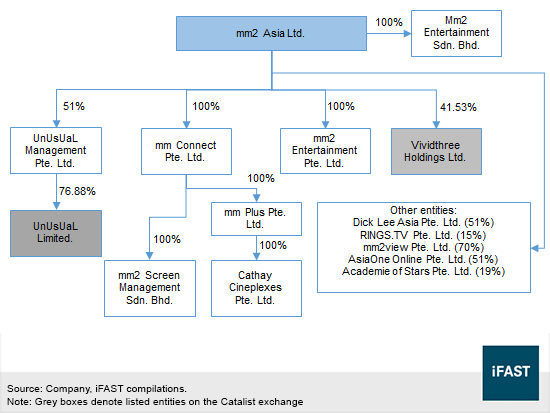
mm2 produces post-production content and immersive experiences through Vividthree Holdings Ltd. ("Vividthree"), an award-winning visual effects, computer-generated imagery and virtual reality studio in Singapore. Vividthree is a 41.53%-owned subsidiary of mm2 and is listed on the Catalist Board of the Singapore Exchange.
Segmental revenue was S$6.3m in the year ending 31 Mar 18 (“FY18”) and S$9.3m in FY19. Vividthree recorded S$3.4m of revenue in the first half ended 30 Sep 19 (“1HFY20”), meaning the subsidiary’s top-line performance declined from 2HFY19 to 1HFY20. The company is presently working on a few projects such as developing a Doraemon virtual reality show with Animation International Ltd and collaborating with the Malaysia Institute of Economic Research and Science Discoveries Sdn Bhd to build immersive experience projects.
Vividthree registered a market capitalization of S$16.7m as at 1 Apr 19. The subsidiary recently issued new shares to raise S$2m to finance the acquisition of intellectual property rights owned by DarkBox Studios Pte Ltd.
Cinema operations
In May 2017, mm2 expanded its cinema portfolio by acquiring Lotus Fivestar Cinemas (M) Sdn Bhd (“Lotus Cinemas”) for S$37.8m. The cinema chain was rebranded as mmCineplexes following the acquisition.
On 2 Nov 17, the company made a major investment by acquiring the entire share capital of Cathay Cineplexes Pte Ltd (“Cathay”) for S$230m. This came after mm2 failed to acquire 50% of the Golden Village cinema chain in Singapore.
Fast forward to now, the group collectively operates 133 screens across 18 locations in Malaysia, and 64 screens across eight locations in Singapore. According to the Infocomm Media Development Authority (“IMDA”), Cathay held a 27% local market share in terms of its seating capacity as a percentage of industry total (Table 1).
Table 1: Singapore cinema statistics
|
|
Screens |
Seating capacity |
|
Shaw |
86 |
8,230 |
|
Golden Village |
112 |
16,486 |
|
Cathay |
64 |
11,364 |
|
Filmgarde |
20 |
3,182 |
|
WECinemas |
10 |
746 |
|
Carnival Cinemas |
5 |
1,943 |
|
Source: IMDA, iFAST compilations |
||
As the group expands its distribution platform overseas and grows its downstream cinema exposure, mm2 is likely to increase recurring income and achieve higher cost efficiencies. Once the pandemic simmers down, mm2 will be able to reap the benefits of economies of scale from its expanded regional presence, coupled with better bargaining power with suppliers and international production studios for film screening and rentals.
Cinema patronage in Singapore and Malaysia
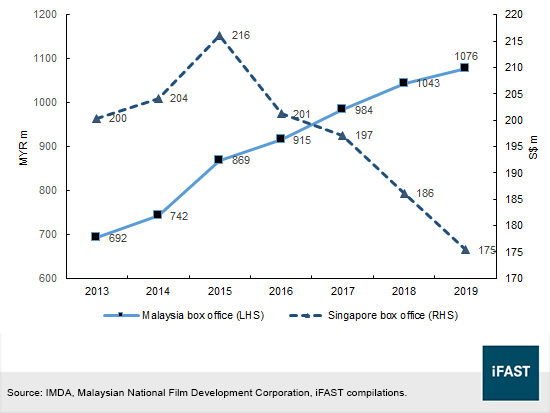
Industry statistics in Figure 1 show that movie audiences in Malaysia and Singapore displayed different consumption trends in the last few years. While box office receipts continue to increase in Malaysia, audiences in Singapore have been less keen to go to cinemas as home entertainment options became more appealing.
For instance, box office sales in Singapore declined to S$175m in 2019 from S$186m a year earlier, despite the launch of a few Disney crowd favorites like Marvel Studios’ Avengers: Endgame and Spiderman: Far from Home. Unsurprisingly, the decline in local box office revenue coincided with the worldwide expansion of the Netflix service since 2016.
Ticket sales at Malaysian cinemas, however, continued to register consecutive years of gains. Box office receipts exceeded MYR 1 billion during 2019 and do not appear to be tapering off. The upward trend in box office receipts reflect the fact that watching movies in theatres remains a popular pastime for many Malaysians.
Figure 1: Box office receipts in Singapore and Malaysia
Event production and concert promotion
mm2’s concert promotion and event production division is operated by UnUsUaL Limited (“UnUsUaL”), a 39.21%-owned subsidiary of mm2 listed on the Catalist Board. UnUsUaL specializes in the production and promotion of large-scale live events and concerts. In the third quarter ended 31 Dec 19 (“3QFY20”), UnUsUaL posted a 66.7% increase in revenue. Gross profit improved 36% YoY to S$5m and net profit margin climbed to 19.5%.
UnUsUaL attributed the strong quarterly result to a recent focus on family entertainment shows. The subsidiary intends to continue securing the events pipeline for FY2021 by targeting new geographical markets and working with established artistes.
With the above business segments in mind, a presentation of the group’s corporate structure is displayed in Figure 2.
Figure 2: mm2’s corporate structure
Coronavirus impact
In a filing to the exchange in March, UnUsUaL highlighted that a number of concerts and events had been postponed and the company has implemented a few measures to mitigate the financial impact of COVID-19. To reduce operation costs and improve the bottom line, UnUsUaL will cut labor expenses by 10-20%, lower discretionary spending and negotiate revised payment terms on existing commitments.
In a separate filing, mm2 announced that the group would be tapping on government support packages to tide over the virus outbreak. The group may also obtain rental reliefs for its cinema halls in Singapore.
Singapore will soon pass the COVID-19 (Temporary Measures) Bill, giving temporary relief from some contractual obligations. The relief will only apply to contracts entered into or renewed before 25 Mar 20, and for obligations to be performed on or after 1 Feb 20.
Under the new Solidarity Budget announced in April, 75% of wages will be subsidized for the month of April and a 25% subsidy will apply until December. These wage subsidies will apply to the first S$4,600 of wages per employee.
In Malaysia, companies including cinema operators may claim some form of cash-flow relief, as they would be exempted from contributions to the mandatory Human Resources Development Fund for six months. Employers may defer contributions to the Employees Provident Fund. Altogether, these relief packages will serve to alleviate the group’s cash outflows.
Financial estimates
Our assessment of mm2’s financial and credit profile hinges on our EBITDA forecasts, which encompass two scenarios. In both our baseline and optimistic scenarios, we assume cinemas will reopen in May with a gradual pick-up in moviegoers towards 4QFY21. Concerts, on the other hand, are projected to return to normal from September this year.
Furthermore, we adopted a 30% EBITDA margin and 11% labor cost margin in our estimates. We also factored a 15% wage expense cut and 18% government wage subsidy in both scenarios.
With respect to mm2’s content production business, we foresee a stable CPDS revenue stream in FY20 and a mild decline in FY21. We think mm2 had a healthy order book in its CPDS segment prior to the virus outbreak, as mm2 recorded S$86.2m in other current assets, up from S$66.2m at the end of March 2019. Other current assets, as revealed by the company, are connected to expenses in fulfilling a contract with a customer, which would be recognized only if they are related directly to a contract or to an anticipated contract that is identifiable.
In the context of projecting future cinema sales, we made reference to the group’s market share in Singapore and the country’s box office receipts. Our projections also took into account the group’s revenue disclosures from Lotus Cinemas of S$8.1m between 1 Oct 17 and 31 Mar 18, and Malaysia’s box office ticket sales of MYR 1,076m in 2019.
Table 2: Selected financials and EBITDA projections
|
|
FY18 |
FY19 |
FY20F |
FY21F (baseline) |
FY21F (optimistic) |
|
Total Revenue |
192,035 |
266,187 |
228,075 |
166,213 |
265,509 |
|
Core business |
93,622 |
98,201 |
98,201 |
82,489 |
92,800 |
|
Post and content production |
6,317 |
9,258 |
7,072 |
7,264 |
9,258 |
|
Cinema operations |
45,038 |
100,746 |
71,292 |
40,738 |
99,655 |
|
Concert and event |
46,442 |
56,207 |
60,417 |
33,947 |
62,021 |
|
Others |
616 |
1,775 |
1,775 |
1,775 |
1,775 |
|
Forecasted EBITDA |
57,611 |
79,856 |
68,422 |
56,223 |
93,064 |
|
Source: Company filings, iFAST estimates. Figures in S$’000 unless indicated otherwise. |
|||||
Financial discussion
In the quarter ended 30 Sep 19 (“2QFY20”), mm2 increased revenue by 5.4% YoY to S$68.4m. Cost of sales expanded by 8.3%, resulting in a gross profit of S$28.0m. Administrative expenses were higher by 16.8%, while finance charges remained flat at S$5.5m. Net profit for 2QFY20 was nearly flat YoY at S$5.3m.
Within the balance sheet, total assets increased from S$665m in FY19 to S$789m in 2QFY20. Total liabilities were S$510m at the end of September, leaving S$279m of total equity. Intangible assets and goodwill were included in equity and made up S$295m of total assets. After mm2 acquired Cathay in 2017, the group allocated S$198m of goodwill connected to the acquisition. Notably, net assets would have been negative had we excluded the S$295m of intangibles and goodwill from total assets.
Total debt added to S$260.9m as at 2QFY20, or S$350.9m if we included operating lease liabilities. Short-term borrowings, made up entirely of secured bank loans, added to S$68.9m. These loans are secured by corporate guarantees from subsidiaries, shares of a certain subsidiary and a leasehold property. Including the S$10.5m of current operating lease liabilities, the value of short-term borrowings would amount to S$79.4m. In the longer time period, the group’s non-current borrowings include the S$50m MMASIA 7.000% 27Apr2021 Corp (SGD) due April 2021 and S$5m loan notes (issued by UnUsUaL) due 29 Jan 21.
To address the abovementioned S$134.4m of financial obligations up till April 2021, the company may access internal liquidity sources such as its S$18.6m cash position, sell its cinema business in Singapore, or dispose its 39.21% interest in UnUsUaL (market cap: S$139m as at 8 Apr 20). mm2 could also seek to refinance the S$68.9m short-term secured bank loan or rely on operating cash flows to shore up liquidity. In the previous section, our projections estimated an EBITDA of ~S$68.4m in FY20 and ~S$56.2-93.1m in FY21.
Management will announce the company’s FY20 results before the end of May and we will update our views accordingly. Depending on its financial performance in the most recent financial year, we may downgrade our view on the company if there is a large deviation from our EBITDA estimates. In the next twelve months, we are expecting a material capital injection from its stakeholders, the establishment of an additional credit line from its lenders, or some form of asset sales, the lack of which would impair our credit outlook on the firm.
Credit discussion
Along with a lower revenue and EBITDA prediction for FY21, mm2’s leverage, or total debt (including operating lease liabilities) over EBITDA is anticipated to increase from 4.3x in trailing-twelve-month 2QFY20 to 6.2x in our baseline scenario. In our earlier assumptions, we foresee cinemas to reopen in May with EBITDA improving as moviegoers return to theatres, and strong box office sales towards the second half of FY21. Through this period of low cinema patronage activity, we think free cash flow generation will be negative in FY21 as net operating cash flows were marginally positive at S$1.3m in 2QFY20 and S$1.7m in 1HFY20.
The group’s ability to cover interest expenses, defined as earnings before interest and taxes over interest expense, is projected to fall from 2.8x in 2QFY20 to 1.7x in our baseline scenario. At this juncture, we think that mm2’s leverage and interest coverage are indicative of a manageable credit profile with some buffers against insolvency.
Outstanding Bond
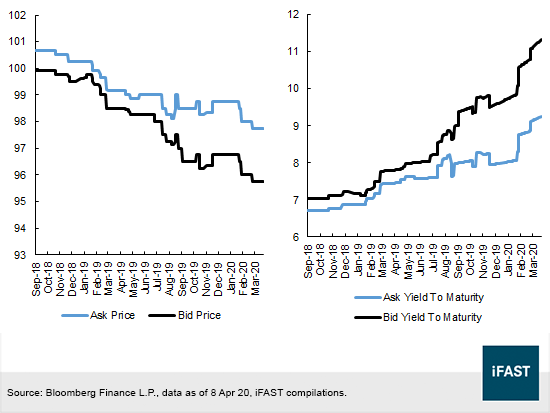
The MMASIA 7.000% 27Apr2021 Corp (SGD) is first callable at 103.5 on 27 Apr 20, but the issuer is unlikely to redeem the bond as bid prices have dropped substantially below par (Figure 3). The bond’s market value has declined in tandem with the drop in the issuer’s credit quality. Indicative ask yields have risen beyond 11% as credit spreads widened in line with the broader risk-off sentiment.
Figure 3: Price and yield to maturity of the MMASIA 7% ‘21s
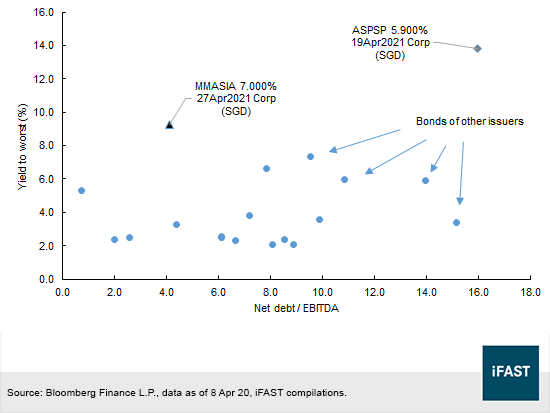
The ask yield to maturity on the MMASIA 7.000% 27Apr2021 Corp (SGD) ranks among the highest within peer credits of similar maturities. We think the valuation of the bond is more attractive compared to other issues, although trading the note in the secondary market may be difficult due to the small issue size. This is because potential buyers would pay a liquidity premium to buy the bond, while existing noteholders looking to sell might have to do so at depressed prices, given wide bid-ask spreads.
Figure 4 demonstrates that bondholders are decently compensated in relation to mm2’s net debt over EBITDA of 4.1x. In contrast, we are bearish on the ASPSP 5.900% 19Apr2021 Corp (SGD). Our article “Aspial Corp: Credit Update 20 Jan 2020” explains the rationale for our less sanguine outlook on Aspial Corporation Ltd.
Figure 4: Relative valuation among SGD senior unsecured bonds of similar maturity dates
In view of the recently implemented fiscal measures and the central bank’s initiative to loosen banking capital rules (which should encourage banks to support credit requirements by local companies), we think that mm2 has an increased chance to refinance its bank loans or obtain additional borrowings from local lenders. The primary downside risk to our credit assessment would be a prolonged outbreak in Malaysia and Singapore, causing the governments to extend their lockdown measures beyond June. There is also a risk that mm2 exhausts all existing sources of liquidity and fails to cover its cash burn for the remaining half of the year, but this scenario is less likely in our view.
Declaration:
For specific disclosure, at the time of publication of this report, IFPL (via its connected and associated entities) holds a principal interest in the MMASIA 7.000% 27Apr2021 Corp (SGD). The analyst who produces this report owns none of the abovementioned securities.