- Stable Inflation: Inflation expected to remain below 2%, supported by targeted fiscal measures and a strengthening ringgit.
- Moderate Growth: GDP growth likely to moderate, with domestic consumption remaining resilient.
- Yield Stability: Fiscal consolidation and moderate net issuance expected to keep MGS yields stable despite peak debt maturities.
- Rate Cut Still on the Table: A potential rate cut remains possible if GDP growth softens further or export performance weakens.
- Investment Preference: Medium-term 5–7 years attractive; A-rated corporate bonds preferred for wider spreads.
- MYR Fixed Income Outlook: The market remained stable and delivered positive returns in 2025, and this trend is expected to continue in 2026.
As we approach 2026, investors may be wondering how Malaysia’s fixed income market will perform, especially as major economies like the US and Europe have already begun easing rates. In 2025, Bank Negara Malaysia (BNM) cut the Overnight Policy Rate (OPR) once, by 25 basis points (bps) to 2.75% in July, while maintaining a cautious stance for the rest of the year.
Recap of 2025 - Closing the Year with Resilient Results
Despite a challenging backdrop of shifting rate expectations, uneven global growth, and market volatility, global fixed income markets delivered resilient returns in 2025. Performance was largely driven by strong returns in emerging markets (EM), supported by a softening US dollar and a series of global rate cuts. The Federal Reserve eased rates gradually during the year, while investor demand for higher-yielding opportunities further bolstered EM and high-yield bond performance.
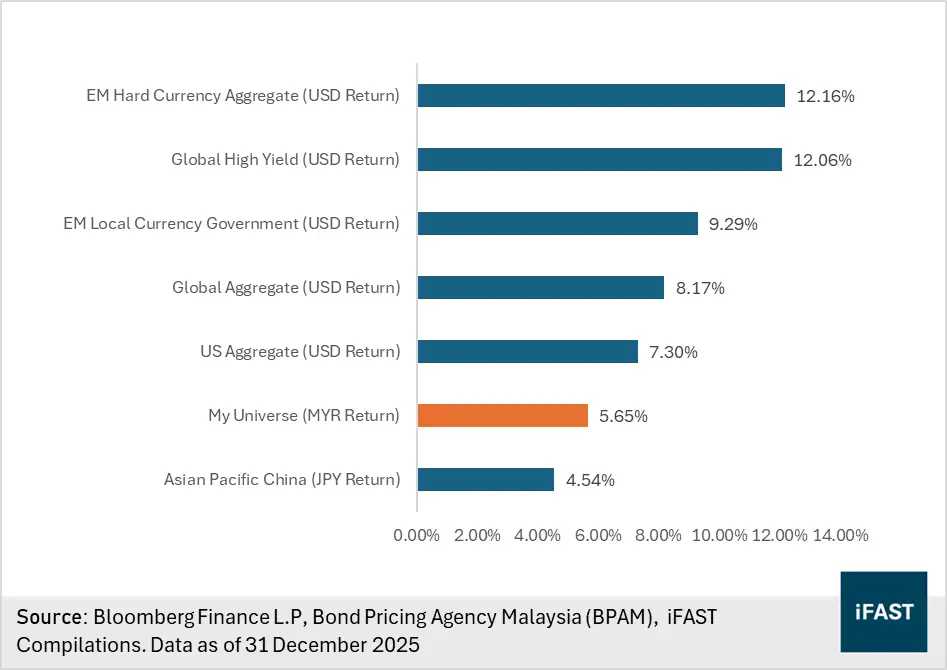
As shown in Chart 1, the Malaysian fixed income market continued its positive momentum, delivering a year-to-date (YTD) return of 5.65%. By comparison, EM Hard Currency Aggregate bonds returned (12.16%), Global High Yield bonds (12.06%), and EM Local Currency Government bonds (9.29%). Meanwhile, Global Aggregate and US Aggregate bonds posted solid returns of 8.17% and 7.30%, respectively.
Chart 1: Major Fixed Income Market Return (as of end December 2025)
A Safe Haven for Investors Seeking Resilient Returns
While other bond markets, such as EM Currency and Global High Yield, delivered stronger returns in 2025, the MYR bond space remains attractive due to its stability and resilience. The market is supported by a stable macroeconomic backdrop, manageable inflation, and consistent performance across economic cycles.
Since November 2022, when Anwar Ibrahim became Malaysia’s Prime Minister, his administration has been implementing the MADANI Economy framework, which was officially launched in July 2023. The framework aims to transform Malaysia’s economy by prioritising high-growth, high-value sectors, pursuing fiscal reform, and improving livelihoods. Key supporting initiatives, such as the National Energy Transition Roadmap (NETR) and the New Industrial Master Plan 2030 (NIMP 2030), further reinforce this agenda. Collectively, these reforms have strengthened policy direction and enhanced Malaysia’s long-term economic resilience.
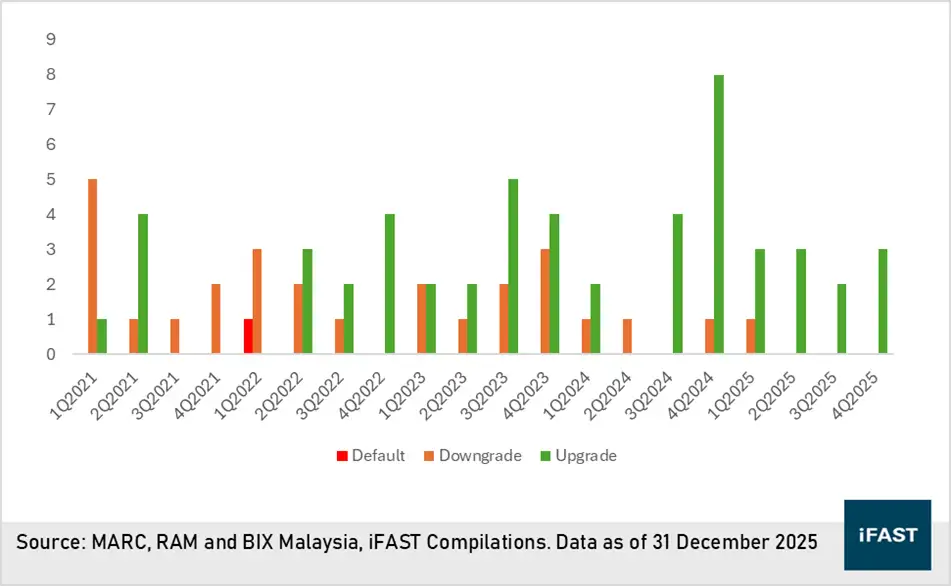
Looking ahead, we remain constructive on the Malaysian fixed income outlook. Political stability, structural reforms under the MADANI framework, and stable funding costs are expected to support economic growth and corporate credit fundamentals in 2026. Recent quarters have also seen credit rating upgrades among Malaysian corporates, reflecting improving business conditions and stronger balance sheets as show in chart 2.
Improving credit quality, historically low default rates, and a stable economic backdrop underscore the robustness of Malaysia’s financial system. Overall, we view the MYR fixed income market as well-positioned to deliver stable, consistent returns for investors in 2026.
Chart 2: Rating outlook in MYR fixed income market
Malaysia's Leading Sukuk Market with High Foreign Participation
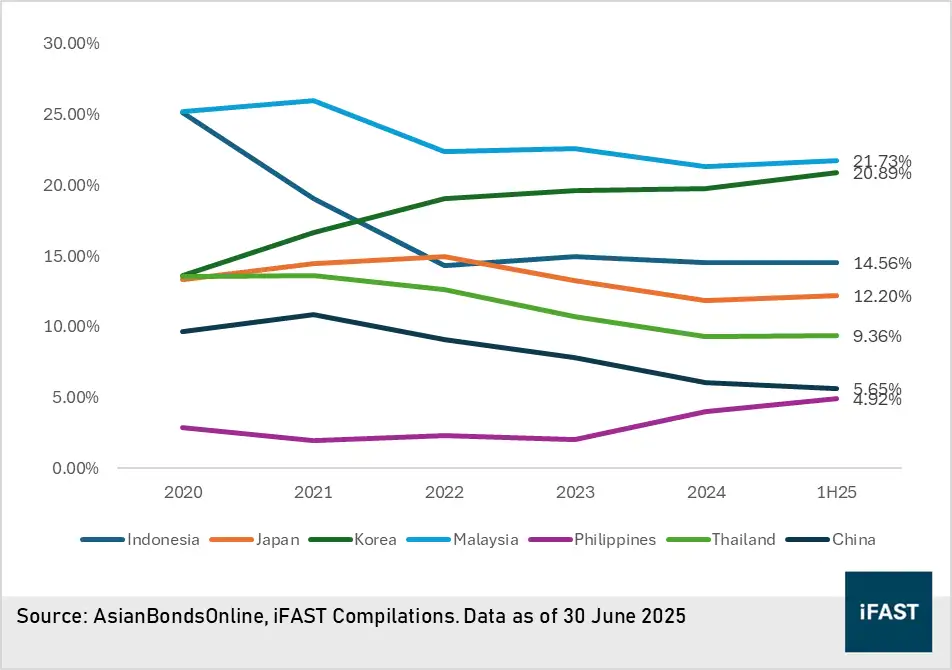
As shown in Table 1, the domestic fixed income market is largely dominated by local investors, who hold 77.1% of government debt, while foreign investors account for the remaining 22.9%. Chart 3 illustrates that Malaysia has one of the highest foreign investor participation rates in Asia, at 21.7%, surpassing markets such as Korea, China, and Japan. This is partly because Malaysia is one of the largest sukuk markets globally. According to Islamic Corporation for the Insurance of Investment and Export Credit (ICIEC) Insight, Malaysia accounted for 35% of outstanding sukuk at the end of 1Q2025 (March 25), ahead of Saudi Arabia (29%), Indonesia (13%), and the UAE (7%).
Table 1: Resident and foreign holdings in outstanding Malaysia Government Securities
|
Component |
2024 |
1H25 (June 25) |
|
Resident |
77.3% |
77.1% |
|
Employees Provident Fund |
27.5% |
27.2% |
|
Retirement Fund (Incorporated) |
2.6% |
2.4% |
|
Insurance companies |
5.4% |
5.5% |
|
Bank Negara Malaysia |
5.1% |
3.8% |
|
Banking institutions |
28.6% |
29.4% |
|
Development financial institutions |
2.2% |
2.2% |
|
Others |
5.9% |
6.6% |
|
Non-resident |
22.7% |
22.9% |
|
Source: MOF, iFAST Compilations. Data as of 30 June 2025 |
||
Chart 3: Foreign Participation Rate (% of total) in Asian Government Bond
Stable and manageable Inflation and Solid Labour Market in 2026
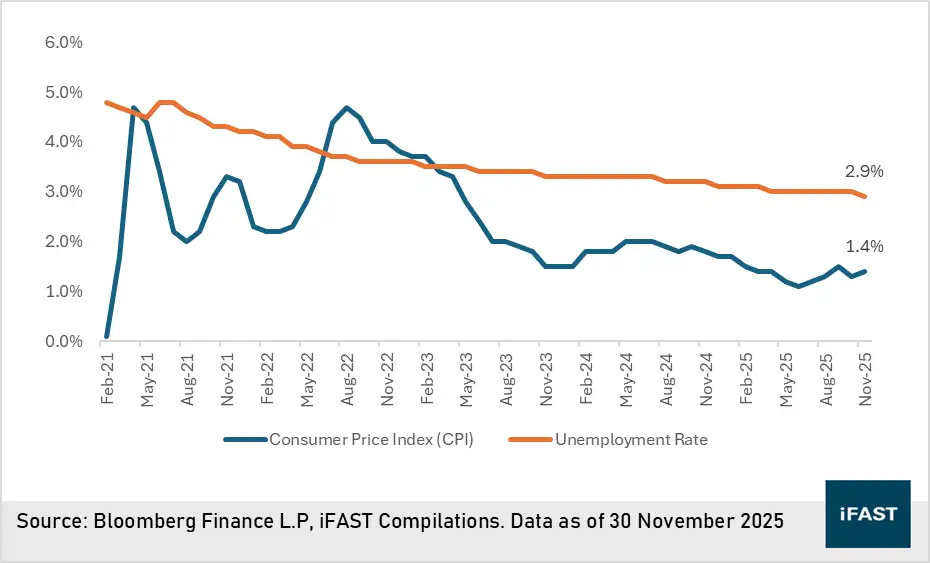
Despite several fiscal consolidation measures, such as electricity tariff adjustments and SST expansion in July 2025, inflationary pressures remained milder than expected. The Consumer Price Index (CPI) rose to 1.4% in November 2025, lower than 1.8% a year earlier and only slightly above 1.3% in October 2025 mainly driven by alcoholic beverages & tobacco, education, and transport costs.
The labour market remained robust. In November 2025, Malaysia’s unemployment rate declined to 2.9% from 3.0% in October 2025, marking its lowest level in 11 years. This reflects strong job creation and stable labour demand across key sectors. These stable labour market conditions are expected to continue supporting household purchasing power. With fewer new taxes announced in Budget 2026, a gradual and targeted approach to fiscal measures, and a strengthening ringgit helping to contain imported inflation, a significant spike in inflation is unlikely.
Overall, we view inflation as stable and manageable, remaining below the 2% target rate in 2026.
Chart 4: Unemployment Rate and CPI
Slower Growth in 2026
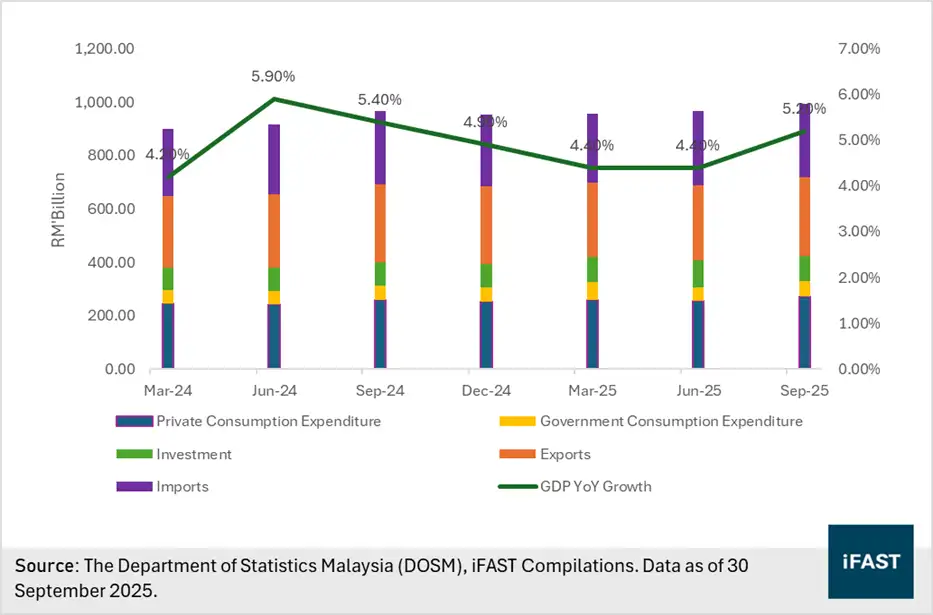
As shown in Chart 5, Malaysia’s GDP grew 5.2% in 3Q25, up from 4.4% in 2Q25, supported by resilient domestic demand and higher net exports amid a gradual recovery in external trade. This was underpinned by expansion in the construction, mining & quarrying, services, and manufacturing sectors.
Household spending remained robust, supported by favourable labour market conditions, targeted income policies, and cash assistance programmes such as Sumbangan Tunai Rahmah (STR) and Sumbangan Asas Rahmah (SARA). Tourism-related activity also strengthened ahead of Visit Malaysia 2026, providing additional momentum to the services sector, while contained inflation helped maintain real purchasing power.
Although overall exports softened, the Electrical & Electronics (E&E) sector is expected to remain a bright spot, benefiting from the global semiconductor upcycle driven by AI and digitalisation, which reinforces Malaysia’s role in the global supply chain.
Despite these downside risk to export growth remains, with potential slowdown arising from sector-specific tariffs and lingering geopolitical tensions. Looking into 2026, GDP growth is expected to moderate amid a softer external environment.
Chart 5: Malaysia’s GDP
Fiscal Consolidation Limits Yield Pressures
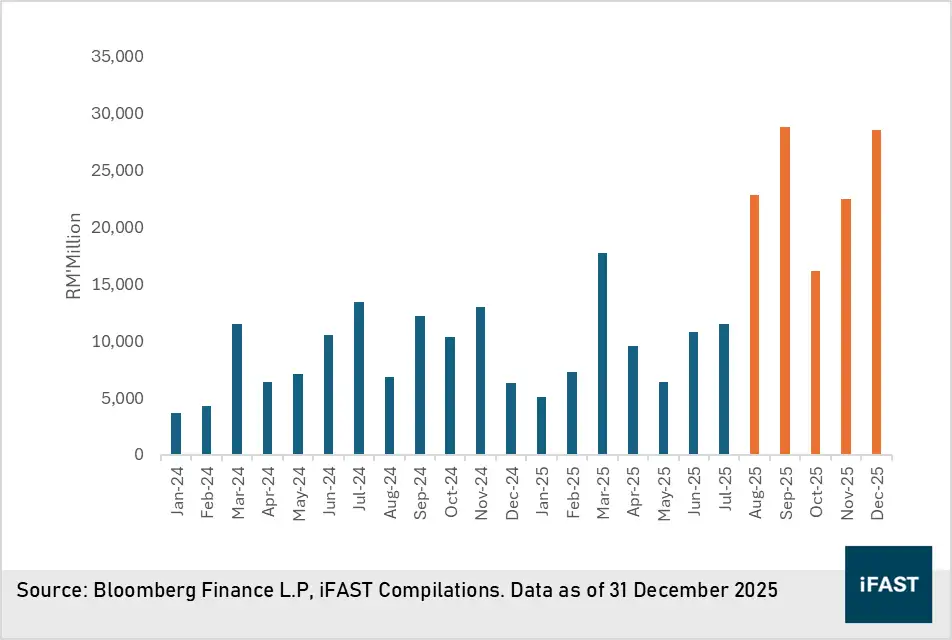
As shown in Chart 6, the average bid-to-cover (BTC) ratio softened to 1.96 times in October 2025 and 1.92 times in December 2025, slightly below the average level of 2. This decline was largely driven by the sharp drop in the 30-year bid-to-cover ratio, which fell to 1.38 times in October 2025 from 2.00 times in July 2025. The softer auction outcomes appear to reflect a lack of catalysts amid fading rate-cut expectations, compounded by a surge in corporate bond issuance from August 2025 to December 2025, as illustrated in Chart 7.
In contrast, the BTC ratio rebounded to 2.27 times in November 2025, largely due to the absence of a private placement (PP). Without a PP, all demand was directed to the main auction, naturally pushing the BTC ratio higher.
Chart 6: Monthly average bid-to-cover of MGS and GII
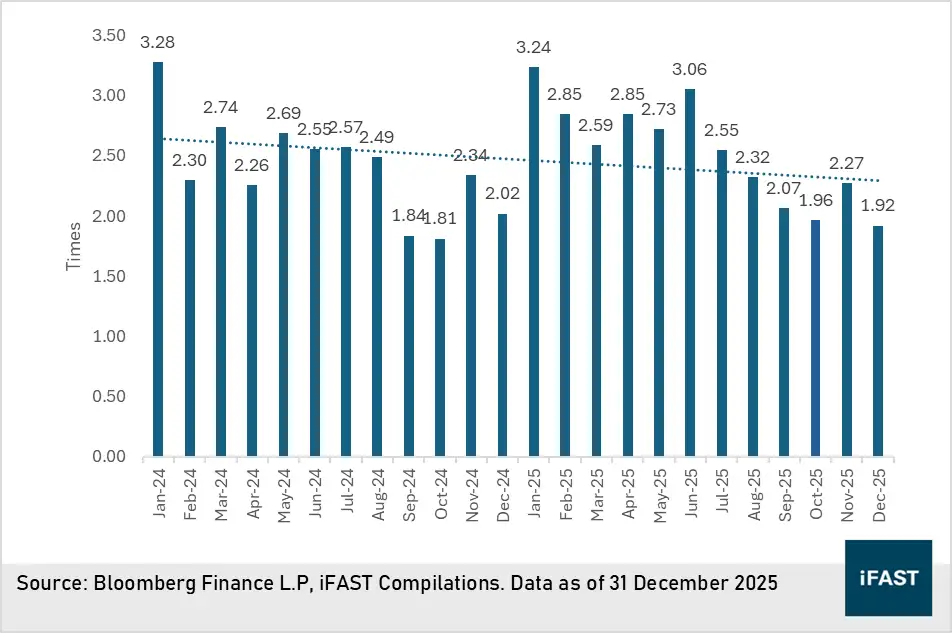
Chart 7: Monthly Corporate Bond Issuance
The government faces significant refinancing needs, with RM506 billion of debt maturing over 2026–2030. In 2026, government and corporate maturities peak at RM119 billion and RM108 billion, respectively as shown in Chart 8. With most corporate maturities concentrated in 2026, refinancing activities are expected to drive a pickup in corporate issuance, potentially prompting investors to rebalance away from government bonds and causing moderate near-term upward pressure on yields. We expect this could result in a slight 10–20 bps increases initially.
Despite this, the Ministry of Finance (MOF) projects a lower fiscal balance of RM74.6 billion in 2026. The fiscal deficit is expected to narrow further from 3.8% in 2025 to 3.5% in 2026, with a medium-term target of 3% and a Debt-to-GDP ratio maintained below 60% by 2030. This is supported by recent trends, as fiscal deficit has gradually declined over the past few years as show in Table 2.
Malaysia Government Securities (MGS) and Malaysia Government Investment Issue (MGII) maturities are expected to rise sharply to RM108.7 billion in 2026, (2025: RM83.5 billion), contributing to a 7.4% YoY increase in debt service charges to RM58.3 billion, as reflected in Table 2. Taking these factors into account, we estimate gross bond issuance at RM185–188 billion in 2026. However, net issuance is projected lower at RM77–79 billion, reflecting ongoing fiscal consolidation that limits the need for additional borrowing beyond refinancing requirements.
Following an initial near-term adjustment, any potential rate cut in 2026 is likely to be offset, with yields stabilising, supported by continued fiscal consolidation. Overall, the MGS yield curve is expected to remain relatively stable throughout 2026.
Chart 8: Debt Maturity Profile of Government and Corporate
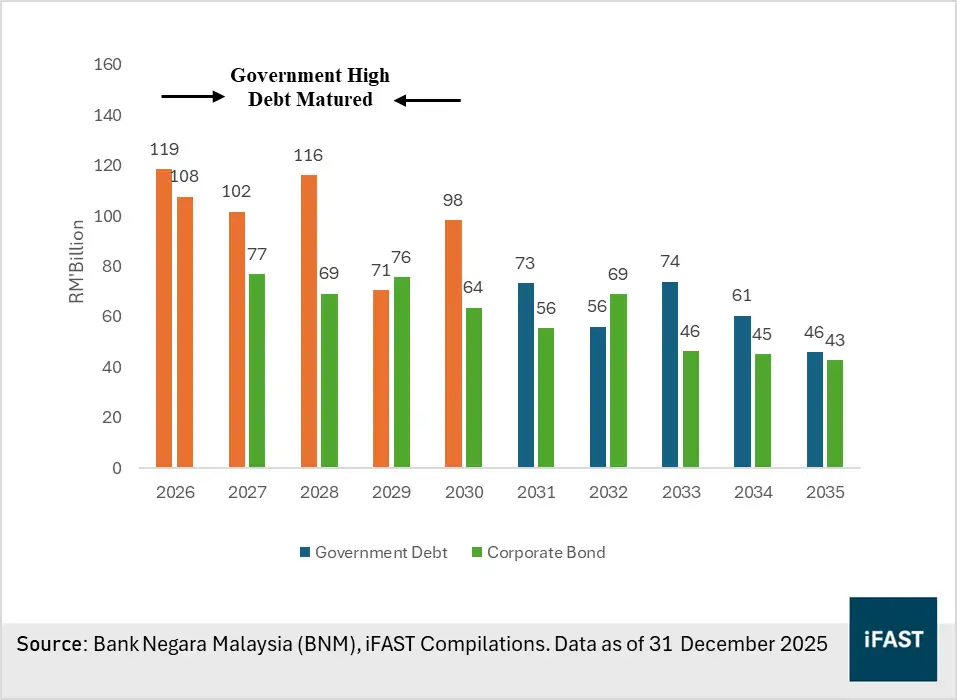
Table 2: Malaysia Fiscal and Debt Indicators (2023–2026F)
|
|
2023 |
2024 |
2025 |
2026F |
|
Fiscal balance (RM Billion) |
-91.4 |
-79.2 |
-76.7 |
-74.6 |
|
Debt Maturity (RM Billion) |
81 |
93 |
83.5 |
108.7 |
|
Debt Service Charges (RM Billion) |
46.3 |
50.5 |
54.3 |
58.3 |
|
Gross Issuance (RM Billion)** |
186 |
175 |
168.5 |
185-188* |
|
Net Issuance (RM Billion) |
105 |
82 |
85 |
77-79* |
|
Fiscal deficit to GDP (%) |
5.00% |
4.10% |
3.80% |
3.50% |
|
Debt to GDP Ratio (%) |
64.30% |
64.60% |
64.00% |
65.80% |
|
*iFAST Forecast ** Gross Issuance on MGS and MGII only. Source: Ministry of Finance (MOF), Bank Negara Malaysia (BNM), iFAST Compilations. Data as of 31 December 2025 |
||||
Rate Cut Remain on The Table
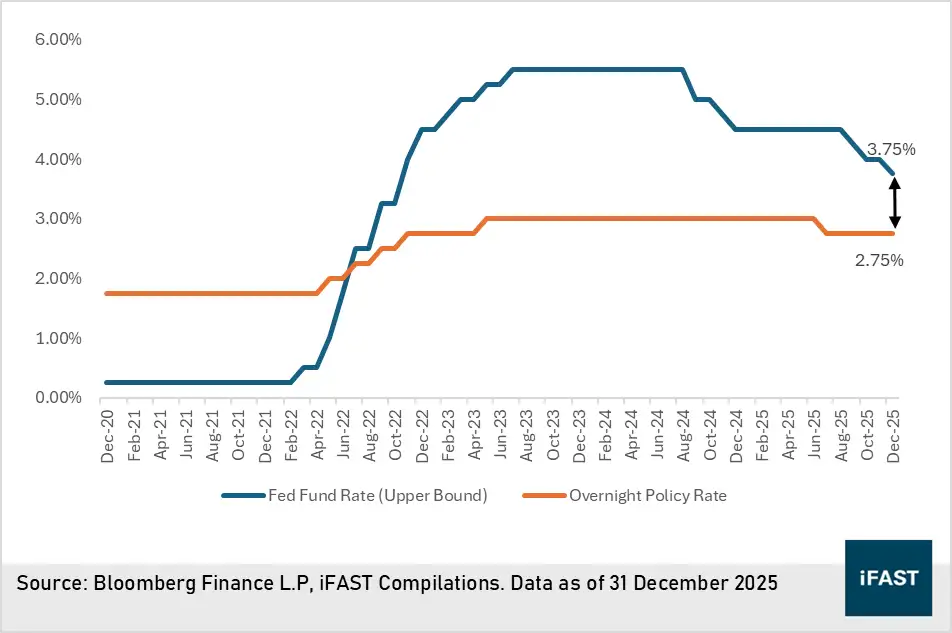
Compared with other major economies, Malaysia adopted a measured monetary stance in 2025, with Bank Negara Malaysia (BNM) implementing a pre-emptive 25 bps cut to the Overnight Policy Rate (OPR) in July, bringing it to 2.75% and maintaining it throughout the year. This reflects resilient domestic demand, contained inflation, and a stable labour market. Meanwhile, global central banks, including the U.S. Federal Reserve and European Central Bank, delivered cumulative rate cuts of 100–175 basis points in 2024–2025 to support growth amid moderating inflation, with most Asian economies following suit, as show in Table 3.
As shown in Chart 8, the interest rate differential between the OPR and the Fed Funds Rate has continued to narrow (2.75% vs. 3.75%). As of 31 December 2025, the Malaysian ringgit (MYR) has appreciated by 9.4% against the U.S. dollar (USD). We expect the MYR to see modest gains in 2026, although a repeat of the strong appreciation experienced in 2025 is unlikely. The anticipated scale of rate cuts in the US is larger than that of the OPR, which would further narrow the interest rate differential and provide modest support for the MYR.
Looking ahead to 2026, we expect BNM to maintain a measured policy stance, with the potential for rate cut if GDP growth slows below 4% YoY or if export performance weakens. In addition, several factors highlighted above including low and manageable inflation, low unemployment rate, strengthen MYR, and narrowing interest rate differentials with the US will provide BNM with sufficient room to implement a rate cut. Our base case assumes one rate cut in 2026.
Table 3: Changes in Monetary Stances in Major Advanced Economies and Select Emerging East Asian Markets

Chart 8: OPR and Fed Fund Rate
MGS Yield Curve Remains Upward Sloping; Medium-Term (5–7 Years) Favoured
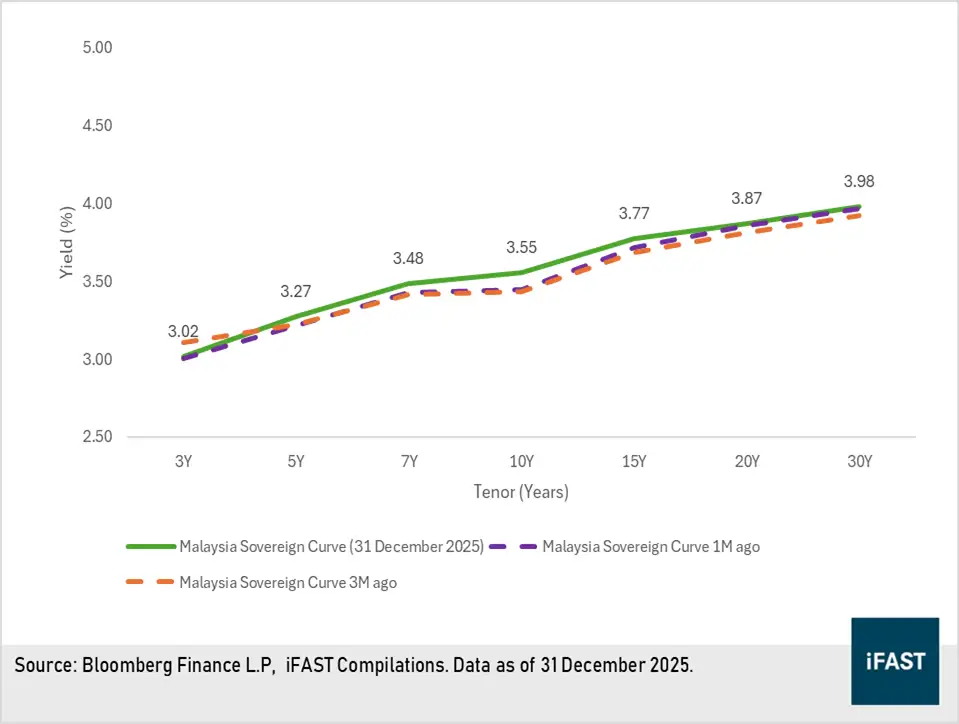
The Malaysian Government Securities (MGS) yield curve remains upward sloping. Compared to one month ago, yields have increased across all tenors. Over the past three months, the short-term 3Y yield declined modestly by 9 bps, while most other tenors recorded gradual increases. Notably, the 10Y and 15Y yields rose by 12 bps and 9 bps, respectively, as shown in Chart 9, reflecting a steady upward trend. This movement was primarily driven by a combination of factors, including a lack of market catalysts, fading expectations of rate cuts, and a surge in corporate bond issuance, as highlighted above.
Malaysia's yield curve has maintained an upward slope for the past decade. We view the medium-term segment (5–7 years) as the sweet spot, showing the steepest gradient on the curve. As illustrated in Chart 9. The 5-7 years tenor also provide relatively attractive absolute yields. Additionally, with yields likely to fall further due to potential rate cuts, the 5–7-year tenure also provides capital gain potential, although we view it to be minimal.
Chart 9: Yield Curve and Credit Spread
Tightening credit spread; Prefer A-rated bonds given the wider spread
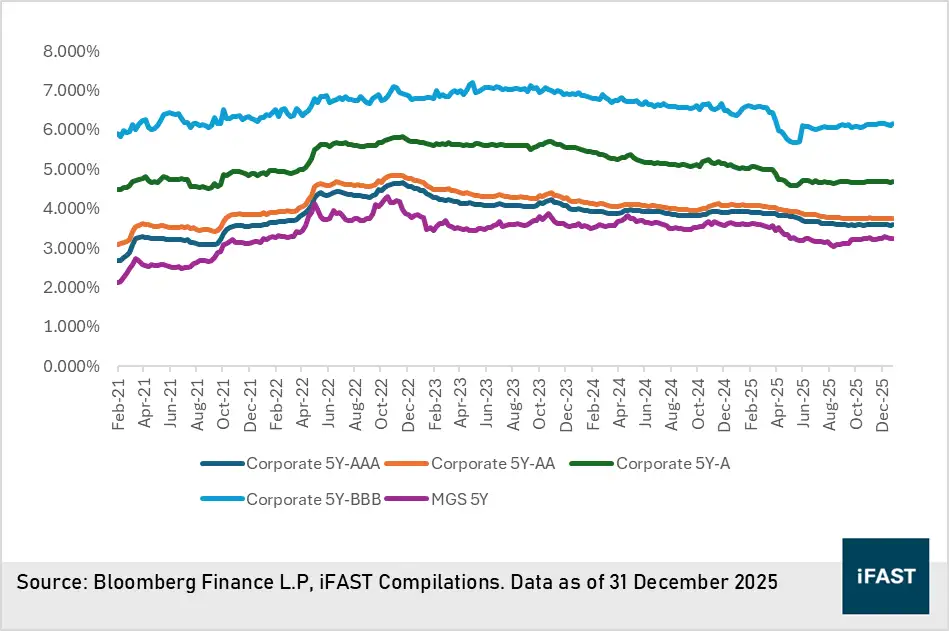
The tightening credit spread makes us to continue favour the A-rated bonds, given their relatively wider spread against MGS. Among all credit ratings, BBB-grade bonds exhibit the widest spread. While higher yield bonds are generally associated with higher risk, this does not necessarily imply a higher likelihood of default. Depending on investor’s risk appetite, if high-yielder bonds sufficiently compensate for the additional risk, they may still be worth considering on a selective basis.
Chart 11: Credit Spread of each rating VS MGS
All In One
Overall, the MYR fixed income market is expected to remain resilient in 2026. With manageable inflation, a solid labour market, and a strengthening ringgit, BNM is likely to maintain a measured stance, with the possibility of rate cut if growth slows or exports weaken.
We continue to see medium-term 5–7 years as sweet spot, allowing investors to benefit from the higher yields offered at longer tenures. For corporate bonds, we would recommend A-rated bonds.
We have compiled a recommended list of government bonds of both MGS and MGII, as shown in Table 4. MGS are conventional government bonds, featuring fixed coupons (interest), with the coupon paid semi-annually and maturities ranging from 3 to 30 years. MGII, on the other hand, are the equivalent of MGS but based on Islamic principles.
Together, MGS and MGII are known as Malaysian Government Bonds. Investing in these instruments essentially means lending to the government in exchange for fixed coupon payments until maturity, making them among the safest investment options in the Malaysian market, as they are backed by the government.
In addition, we have compiled a list of A-rated corporate bonds in Table 5 below, which are subject to market conditions and liquidity.
Table 4: MGS and MGII Bond
|
|
Bonds |
Years to Maturity |
Yield to Maturity |
Min / Sub investment |
|
Malaysian Government Securities (MGS)
|
5Y 3M |
3.27% |
RM1,000/1,000 |
|
|
6Y 3M |
3.35% |
RM1,000/1,000 |
||
|
7Y 3M |
3.42% |
RM1,000/1,000 |
||
|
Malaysian Government Investment Issues (MGII) |
5Y 9M |
3.28% |
RM1,000/1,000 |
|
|
6Y 9M |
3.36% |
RM1,000/1,000 |
||
|
7Y 5M |
3.45% |
RM1,000/1,000 |
||
|
Source: FSMONE, iFAST Compilations. Data as of 16 January 2025 |
||||
Table 5: A-rated Bonds
|
Isser |
Bond |
Years to Maturity/Years to next call |
Yield to Maturity/Yield to Next Call |
Min / Sub investment |
|
JB Cocoa Sdn Bhd |
1Y 2M/- |
4.89%/- |
MYR 5,000/5,000 |
|
|
1Y 10M/- |
5.04%/- |
MYR 5,000/5,000 |
||
|
3Y 10M/- |
5.31%/- |
MYR 5,000/5,000 |
||
|
Yinson Holdings Berhad |
4Y 11M/- |
4.72%/- |
MYR 250,000/250,000 |
|
|
-/1Y 10M |
-/5.02% |
MYR 250,000/250,000 |
||
|
-/1Y 11M |
-/5.04% |
MYR 250,000/250,000 |
||
|
-/3Y 11M |
-/5.36% |
MYR 250,000/250,000 |
||
|
Tropicana Corporation Berhad |
2Y 3M/- |
5.32%/- |
MYR 5,000/5,000 |
|
|
2Y 10M/- |
5.50%/- |
MYR 5,000/5,000 |
||
|
2Y 10M/- |
5.50%/- |
MYR 5,000/5,000 |
||
|
Source: Bondsupermart, iFAST Compilations. Data as of 16 January 2026 |
||||
Declaration: For specific disclosure, at the time of publication of this report, IFPL (via its connected and associated entities) holds position in MGS 4.127% 15Apr2032 Govt (MYR), MGII 4.724% 15Jun2033 Govt (MYR), JBCOCO 5.800% 12Nov2027 Corp (MYR) and YNSMK 5.000% 12Dec2030 Corp (MYR) and the analyst who produced this report hold a NIL position in the abovementioned securities.