Highlights:
- New World’s sales performance was robust, but the operating performance was fair. The Group is determined to deleverage and launched a series of deleveraging plans, such as capital expenditure optimisation, disposal of non-core assets, dividend reset, treasury management and corporate actions.
- The Group’s financial position was solid. Overall, the credit risk was manageable. The short- to medium-term default risk remained low. Even without a rights issue, the Group could still hold on.
- Investors could consider its 2027 USD bond, with the yield to maturity at around 6.2%.
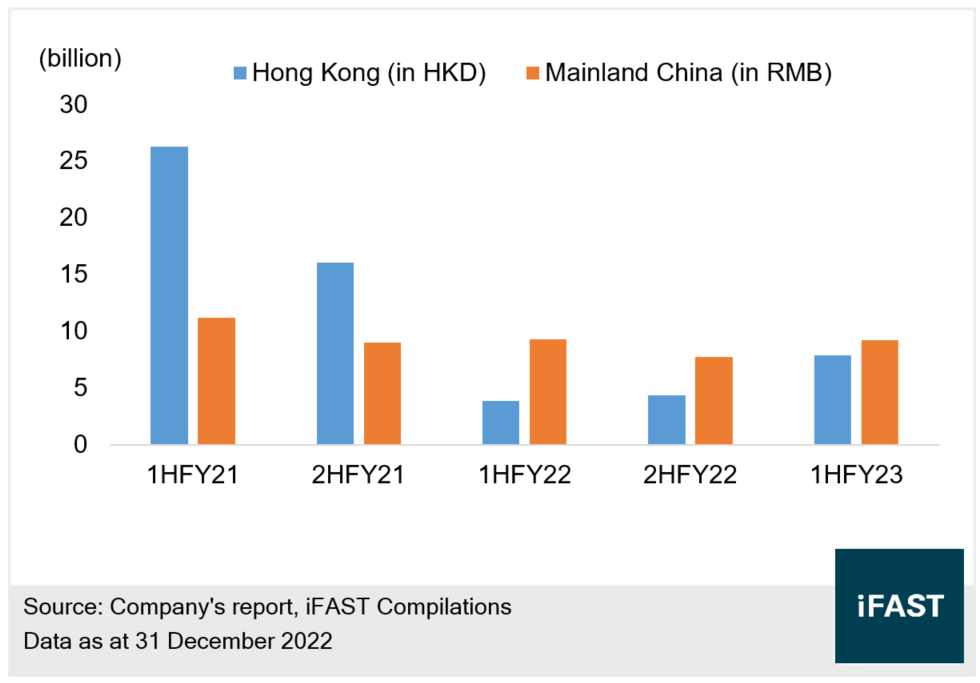
The Group's property sales in the Mainland was not affected by the poor sentiment of the property market. For example, the Group's core project in Hangzhou, New World Hangzhou Arts Centre, reached up to RMB 11 billion in cumulative sales last year.
In addition, according to the sales ranking by CRIC, the Group's total contracted sales amount reached RMB3.3 billion during January and February this year. Its ranking even jumped from outside the top 100 to the 65th.
Perhaps due to homebuyers’ concern about suspended projects, they instead seek out the pre-sale projects developed by state-owned enterprises and Hong Kong developers who have higher capital strength and lower risk of properties being abandoned. The Group is one of the beneficiaries of this trend.
In terms of segment results, as shown in Figure 2, the Group's main profit is still derived from property sales (which accounted for 56% of its operating profit in the first half of FY2023). Due to the absence of major projects in Hong Kong being recorded in the period, the operating profit of property sales fell to HKD 3.6 billion.
Chart 2: The Group’s Segment Operating Profit for Each Six Month
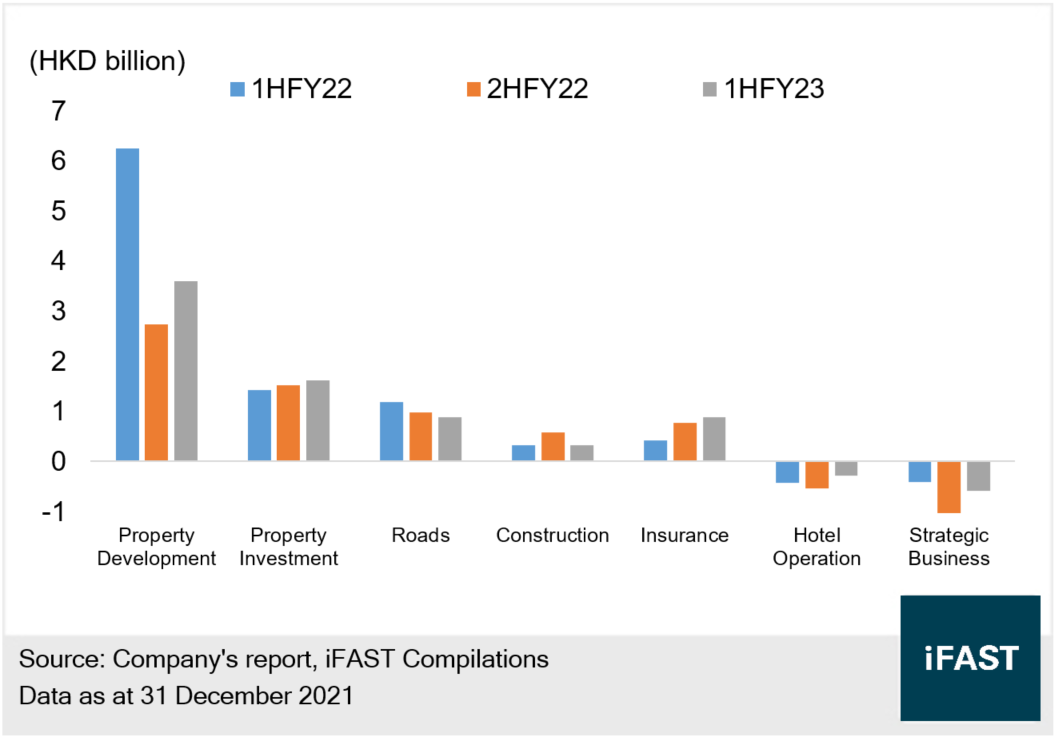
As previously mentioned, one of the Group's growth drivers is an increase in rental revenues and management fees from K11 investment properties. Indeed, in the first half of FY2023, the Group's segment profit from property investment was HKD 1.62 billion, up 5.9% from the previous half year. This demonstrates a good operating performance.
The Group continued to dispose some non-core assets, narrowing the operating losses of the hotel operations and strategic businesses. The insurance business also saw a slight increase. However, its road and construction segments reported a 10.2% and 44.3% decline in profit respectively compared to the previous half year. Overall, the Group's operating performance was fair.
The Group is Determined To Deleverage and Emphasized No Requirement of a Rights Issue
The Group stated that it would regard deleveraging as its main operating objective, with a view to gradually reducing its net gearing ratio (calculated as treating perpetual debts as equity) from the current 47% to around 40%. It also emphasized that it would not consider share placements or rights issuance to replenish the funds. We believe this is to address the market's concern that many equity investors have lost their confidence after the unexpected rights issue by Link REIT.
The Group also launched a package of deleveraging plans, including (1) capital expenditure optimisation, (2) disposal of non-core assets, (3) dividend reset, (4) treasury management and (5) corporate actions. So, how feasible are these plans? (See Table 1)
Table 1: The Group’s Deleverage Plans and Bondsupermart Commentaries
|
Plan Details | Bondsupermart Commentary |
|
Capital Expenditure Optimisation |
|
|
|
Disposal of Non-core Assets |
|
|
|
Dividend Reset |
|
|
|
Treasury Management |
|
|
|
Corporate Actions |
|
|
|
Source: Company Presentation, iFAST Compilations Data as of 23 February 2023 | ||
Overall, while some plans such as the disposals of non-core assets and treasury management might be difficult to achieve, most plans are quite feasible. These should gradually reduce the Group's leverage level. If most of these plans are implemented as expected, it would also show an improvement in the Group’s corporate governance, which will have a positive effect on its operating and credit performances.
Solid Financial Position with Manageable Credit Risk
About the credit profile, as of the end of 2022, the Group’s total debt was HKD 239.1 billion, a decrease of around 2.2% from the end of June 2022. The Group's adjusted gearing ratio increased to 80%, due to a drop in cash and total equity, instead of an increase in total debt.
The Group refinanced all of its loans matured before the end of June 2023, with an undrawn credit facility of about HKD 35 billion. It has sufficient liquidity to meet short-term expenses and debts. It is in a solid financial position.
Table 2: The Group’s Main Credit Indicators
| Dec 21 | Jun 22 | Dec 22 | |
| Total Asset (HKD billion) | 627.1 | 635.9 | 621.9 |
| Total Debt (HKD billion)* | 227.2 | 240.9 | 239.1 |
| Total Cash (HKD billion) | 52.4 | 62.2 | 56.7 |
| Adjusted Net Gearing Ratio (%)* | 68% | 74% | 80% |
| Cash To Short-term Debt (times) | 0.9 | 1.2 | 1.3 |
| Average Cost of Borrowings (%) | 2.50% | 2.50% | 3.80% |
| Short-term Debt To Total Debt (%)* | 25% | 21% | 19% |
| Fixed Rate Debt to Total Debt* | 41% | 39% | 43% |
| *Include
Perpetual Debt Source: Company Presentation, iFAST Compilations Data as of 31 December 2022 |
|||
It is highlighted that the Group's leverage level is higher than that of other Hong Kong developers. It is therefore more exposed to the upward pressure on the cost of borrowings under the rate hike cycle. The average cost of borrowings increases from 2.5% to 3.8%. 57% of the total debt is in floating rates (most of this kind of debt belong to the bank loan). It would inevitably have to refinance the fixed rate debt at higher rates. Thus, the interest expense would continue to rise.
The Group estimated its average cost of borrowings will be 4.4%. The rate of increase is much slower than that of USD benchmark rate or HKD Base Rate through the Discount Window. This reflects that the Group already proactively manages the cost of borrowings and interest rate risk. The related risk should be manageable.
The Group's long-term growth drivers are the massive agriculture land and the gradual completion of K11 investment properties, coupled with resilient property sales on the mainland and management's plans to deleverage. Even if the Group chooses not to offer rights issue, it is confident that the Group would withstand the challenges.
Together with the credit indicators, we believe the credit risk is manageable. The short- to medium-term default risk remains low.
Investors Could Consider 2027 USD Bond with Yield To Maturity of Around 6.1%
The current New World 2027 USD bond "NWDEVL 5.875% 16JUN2027 CORP (USD)" is relatively attractive with a yield to maturity of around 6.1%. Investors could also choose a bond with the suitable maturity date according to your financial goals (see Table 3).
Table 3: New World’s Non-perpetual Bonds
| Bond Name | Currency | Years To Maturity | Ask Price (Investor Buys) | Yield To Maturity |
| NWDEVL 5.250% 19MAR2024 CORP (HKD) |
HKD | 1 | 101.9 | 4.1% |
| NWDEVL 5.875% 16JUN2027 CORP (USD) |
USD | 4.2 | 100.2 | 6.1% |
| NWDEVL 3.800% 21MAY2029 CORP (HKD) |
HKD | 6.2 | 93.2 | 5.8% |
| NWDEVL 4.500% 19MAY2030 CORP (USD) |
USD | 7.2 | 88.5 | 7.1% |
| NWDEVL 3.750% 14JAN2031 CORP (USD) |
USD | 7.8 | 82.7 | 6.9% |
| Source: Bondsupermart Data as of 24 March 2023 |
||||
For perpetual bonds (Table 4), these bonds are more sensitive to credit quality and interest rates. Therefore, they are more volatile in terms of the price than fixed tenor bonds. From the yield perspective, their current yield (coupon / bond price) is about 6% to 6.5%, which is not attractive.
If bond prices fall significantly and the current yield on these sustainable bonds draws up to 9% or more, we believe that investors might consider these sustainable bonds with caution. Yet investors need to pay attention to the terms, next call date, yield to call, reset rate, etc., and probably estimate the probability of call on the next call date and risk of coupon suspension.
Table 4: New World’s Perpetual Bonds
| Bond Name | Currency | Next Call Date | Ask Price (Investor Buys) | Yield To Call | Current Yield |
| NWDEVL 5.250% PERPETUAL CORP (USD) |
USD | March 2026 | 89.1 | 8.7% | 6.0% |
| NWDEVL 6.150% PERPETUAL CORP (USD) |
USD | March 2025 | 95.3 | 8.5% | 6.6% |
| NWDEVL 4.800% PERPETUAL CORP (USD) |
USD | September 2023 | 65.2 | 149.2% | 7.4% |
| NWDEVL 4.125% PERPETUAL CORP (USD) |
USD | March 2028 | 77.2 | 9.0% | 5.4% |
| NWDEVL 6.250% Perpetual Corp (USD) |
USD | March 2024 | 80.7 | 32.6% | 7.9% |
| Source: Bondsupermart Data as of 24 March 2023 |
|||||
Related Risk
Under the rate hike cycle, New World's interest expenses would increase, which will affect the Group’s profitability. It might also affect Hong Kong people's desire to purchase residential properties. It may require price reductions for promotions or accept a lower sell-through rate.
Besides, theoretically, an increase in the interest rate would put a certain degree of downward pressure on Hong Kong property prices. This could affect the Group’s profit margin of property sales.
The deleverage plans suggested by the management have a certain degree of execution risks. These might not be as effective in reducing debt levels as expected.
The major debt of New World is bank loans. If the renewal or refinancing of bank loans is affected by some systemic risks in financial systems or industry risks, its liquidity will be suppressed.
Conclusion
New World’s sales performance was robust, but the operating performance was fair. The Group determined to deleverage and launched a series of deleveraging plans, such as capital expenditure optimisation, disposal of non-core assets, dividend reset, treasury management and corporate actions.
The Group’s financial position was solid. Overall, the credit risk was manageable. The short- to medium-term default risk remained low. Without a rights issue, the Group could still hold on.
Investors could consider its 2027 USD bond, with yield to maturity of around 6.1%.
Declaration: For specific disclosure, at the time of publication of this report, IFPL (via its connected and associated entities) and the analyst who produced this report hold a NIL position in the abovementioned securities.
Our podcast series, Yield Hunters, is available on Spotify, iTunes Podcasts and Google Podcasts. We share our thoughts on new bond issues and hold discussions on
the fixed income space. Listen to our latest episode below and follow us!