Highlights:
- GLP’s growth momentum remains strong. Its revenues are highly visible. The fundamental remains robust. As an alternative asset manager, the Group has several advantages. The overall investment properties are of high quality.
- GLP’s dry powder is still at an excellent level. It has strong abilities in capital raising and asset liquidation. Its leverage level does not change much, with a solid bank loan refinancing ability. It is more likely to execute the asset disposals, where the proceeds could be used for operations and debt repayment.
- It is possible that GLP will be downgraded, but this should have little impact on its credit profile. The Group has a strong short- to medium-term solvency. Investors could take advantage of opportunities for excess return. The potential total return of the 2025 bond is up to 51%.
This article focuses on GLP's 1H2023 results. Regarding the introduction of GLP, it can be reviewed in this article:
Idea of the Week: Global Logistics Properties (GLP)—Golden Investment Opportunity? Over 50% Return
Growth Momentum Remains Strong with Robust Fundamental
In the first half of 2023, GLP Pte (GLP) generated total revenue of around USD 1.2 billion, which increased by 34% YoY. It was driven by a 67% YoY increase in management fees. Due to a change in some accounting treatments, partial management fees, which were previously only recorded in JVs and Associates, could be recognised directly in the Group's revenue. If we exclude the related impact, the total revenue and management fees were increased by around 25% and 18% YoY respectively. The Group’s growth momentum remains strong.
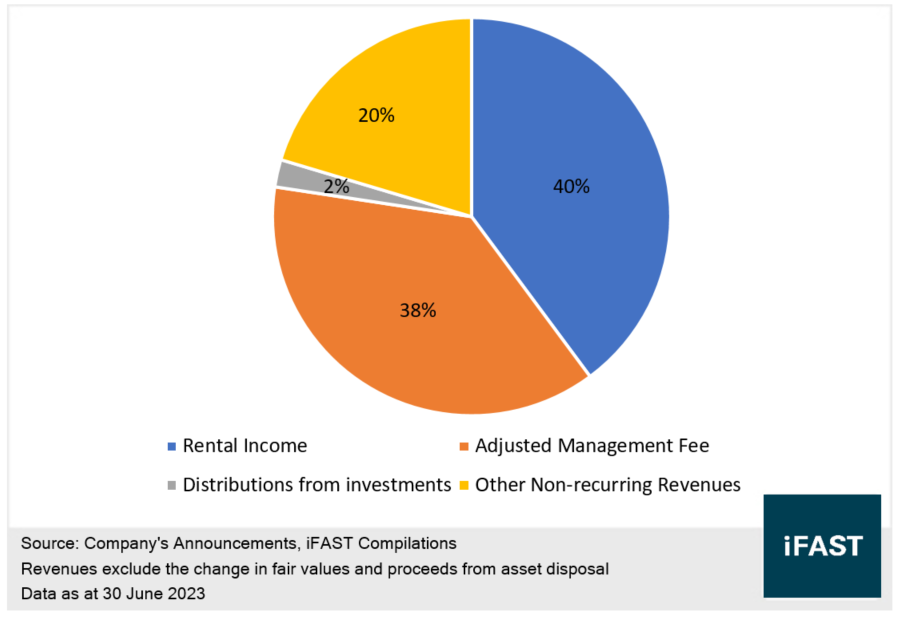
Besides, as shown in Chart 1, amongst the USD 1.2 billion revenue, around 80% revenues of GLP were recurring revenues (i.e. rental revenues and management fees). The Group’s revenues are highly visible. The fundamental remains robust.
Chart 1: GLP’s 2023 1H Revenue Breakdown
In the first half of 2023, the core EBITDA dropped by 56% YoY to USD 660 million, mainly because the Group recorded very few monetised fair value gains, representing fewer on-balance sheet assets being liquidated during the period.
As mentioned in Misconception 3 before, the monetised fair value gains belong to the recurring (regular) profit with higher volatility. Therefore, a significant decline in the core EBITDA does not mean a deterioration in GLP’s fundamentals. The management pointed out that in the second half of 2023, the Group would have more asset disposals, so the profit from the monetised fair value gains should have a significant improvement compared to the first half year.
Several Advantages of Alternative Asset Managers Together with High-quality Properties
In terms of operations, GLP's asset under management (AUM) increased slightly from USD 125 billion at the last year's end to USD 127 billion. The alternative asset managers, including GLP, have several advantages to maintaining the AUM, such as difficulty in recording fund outflows, low liquidity of alternative assets (which may be a disadvantage for holders but an advantage for asset managers), the long holding period of private equity investors (mostly five years or more) and the dry powder available for new investments. These factors explain why the Group still managed to record a small growth in the AUM despite the weakness in the Chinese real estate industry and global rate hike cycle etc.
In addition, GLP maintained a high occupancy rate of 90% for its properties (including those held directly, through JVs and Associates or funds managed by GLP), with tenant retention rising from 68% to 75%. The same property's net operating profit increased 3% YoY. The overall investment properties are of high quality.
Dry Powder still at an Excellent Level; Strong Abilities in Capital Raising and Asset Liquidation
Regarding capital raising ability, GLP’s capital raised in the first eight months was USD 3.2 billion (see Table 1), which had a certain decline compared to the second half of the last year (estimated to be around USD 5 billion and USD 6 billion). The dry powder also slightly fell to USD 13.5 billion, but is still at an excellent level, which is sufficient to gradually liquidate more than 50% of its on-balance sheet assets (investment properties and assets held for sales: around USD 21.4 billion). This provides liquidity and room for profits.
Table 1: A List of GLP’s Capital Raised
| Fund Name | Region | Capital Raised in the first eight months of 2023 |
| China Income Fund VIII | China | $356 million |
| GCP China Green Energy Fund | China | $550 million |
| CICC GLP Warehouse Logistics REIT | China | $260 million |
| China Logistics Fund III | China | $180 million |
| Hidden Hill YKC Fund | China | $27 million |
| Hidden Hill SMA | China | $413 million |
| GLP J-REIT | Japan | $212 million |
| Japan Income Fund | Japan | $151 million |
| GLP Capital Partners V | The U.S. | $268 million |
| IndoSpace Logistics Parks IV | India | $351 million |
| European Income Partners III | Europe | $33 million |
| Others | / | $400 million |
| Total | $3.2 billion | |
| Sources:
Company’s Presentation, Company’s Announcement, iFAST Compilations Data as of 31 August 2023 |
||
In early October, GLP raised about USD 250 million for its China value-added strategies. The fund will purchase around USD 500 million onshore assets from the Group (implying that the fund will be leveraged in two times). This demonstrated its strong ability to raise capital and to liquidate assets.
GLP is in discussions with a number of insurance companies, including providing seed funding together to establish new funds that will acquire assets from the Group. This allows the Group to realise its “asset-light strategy”, increase the dry powder and reduce the Group’s leverage level.
Not Much Change in Leverage Level; Solid Bank Loan Refinancing Ability
GLP's leverage level did not change much. As shown in Table 2, the Group's net debt / total investment and net gearing ratios were 49% and 68% respectively, which were close to the levels at the end of the previous year.
However, due to the decline in core EBITDA, GLP's net debt/core EBITDA rose to 9.8 times and its interest coverage ratio dropped to 2.1 times. Both of them deteriorated to a certain extent. Nevertheless, with the significant asset disposals in the second half of the year and next year, it is expected that the monetised fair value gains will substantially. These two ratios will be improved significantly as a result.
Table 2: GLP’s Credit Indicators
| (USD billion) | Dec 21 | Dec 22 | Jun 23 |
| Total Debt (Including Perpetual Debt) | 13.5 | 18.1 | 18.3* |
| Total Cash | 2.1 | 2.6 | 2.5 |
| Net Debt | 11.5 | 15.6 | 15.9* |
| Total Investments (Property and Equity Investments) | 33.1 | 32.2 | 32.6 |
| Net Debt / Total Investment (%) | 35% | 48% | 49%* |
| Net Gearing Ratio (%) | 50% | 66% | 68%* |
| Net Debt / Core EBITDA | 3.7x | 6.4x | 9.8x* |
| Interest Coverage Ratio (times) | 5.3x | 3.9x | 2.1x |
| Average Cost of Borrowings | 4.5% | 4.5% | 4.9% |
| Sources:
Company’s Announcement, iFAST Compilations Data as of 30 June 2023 *Total debt was estimated value |
|||
About the bank loans, during the conference call, GLP emphasised that no bank withdraws its credit lines. The bank loan refinancing ability remains solid. We believe that this is due to the Group's good operating performance, sizable recurring revenues, its large number of investment properties and equity investments that can be pledged as collaterals and its good track record of cooperation with banks. These factors prevented banks from withdrawing their credit facilities during this tough period.
More Likely To Execute Asset Disposals; Proceeds from Disposals could be used for Operations and Debt Repayment
It is noted that these property investments and equity investments have actual cash flows and investment returns. Their liquidity will be much higher than the properties under development. GLP could sell them to its managed funds or third parties. Given that the Group has a large amount of dry powder, and it is the asset manager of the funds, this ensures that the Group has control and visibility over the transaction. It is more likely that the asset disposals could be executed.
Amongst these, GLP has properties held for sale of around USD 6.1 billion, which are expected to be gradually sold to its managed funds for cash. If the transactions are sold at book value, the Group will receive about USD 2.3 billion in cash proceeds after deducting liabilities classified as held for sale. Some of the transactions are expected to be completed before the end of the year. The Group expects that the consideration of these assets will be close to their book value. This will replenish the Group’s liquidity.
Besides, GLP already made good progress in the deal with China Logistics Group. The Group offers a basket of onshore portfolios in China amounted to USD 7 billion. This substantial disposal is expected to be closed before the end of the year or early next year. We estimate the potential size of the transaction to be around USD 5 billion, with an expected cash inflows of at least USD 2.5 billion after deducting the related liabilities. The proceeds are expected to be used in deleverage and liquidity enhancement.
GLP expects to liquidate over USD 10 billion in 2023. Excluding the completion part, the Group should dispose at least USD 6.6 billion assets. The deals are sizable with good progresses, which is positive to the credit performance.
These series of asset disposals can allow GLP to reduce its leverage (as the Group will need to repay its project loans after the sale) and lower the proportion of China’s assets. These also generate cash inflows of around USD 4 billion to USD 5 billion, which can be used in bond repurchase or bond repayment directly.
On a side note, the regulatory policies on Chinese real estate, such as regulatory pre-sale proceed requirements and the three red lines, are not relevant to GLP. Thus, the proceeds from the asset disposals and the cash on book can be used directly for operations and debt repayment.
Possible to be Downgraded but Little Impact on its Credit Profile
The issuer credit ratings of GLP Pte and GLP China Holdings are both BBB- (S&P / Fitch). The deterioration in the credit metrics (especially those related to earnings) might trigger the Group’s downgrade. The rating agencies S&P and Fitch each have their unique ways of calculating indicators such as EBITDA, interest coverage ratio and leverage. Their rating reports show that they might downgrade the Group if the interest coverage ratios calculated by them are below a certain level.
According to this earnings result, we believe that GLP is already on the threshold of being downgraded. Whether the Group will actually be downgraded to non-investment grade depends on whether the rating agencies are willing to give the Group time, as factors other than interest coverage ratio (including the progress of asset disposals, estimated forward leverage, etc.) will affect the rating outcome.
If GLP is really downgraded to non-investment grade, there could be another round of sell-off (especially the downgrade by S&P). However, this should have little impact on its credit profile, as it already lost the ability to refinance with bond issuance. It is unlikely that the Group will include penalty clauses associated with downgrades on its existing loans. Investors need not be too worried about the downgrade risk.
Strong Short- to Medium-term Solvency; Investors could Take Advantage of Opportunities for Excess Return
Taking reference to GLP’s bond maturity profile (see Chart 2), its onshore and offshore bonds (including perpetual bonds) amounted to around USD 5.8 billion. Amongst these, the bond principals due on 2024 are USD 2.1 billion, close to the current cash level of the Group (around USD 2.2 billion, if deducting the onshore bonds being repaid in the past three months). The repayment pressure is not high.
Chart 2: GLP’s Onshore and Offshore Bonds Maturity Profile
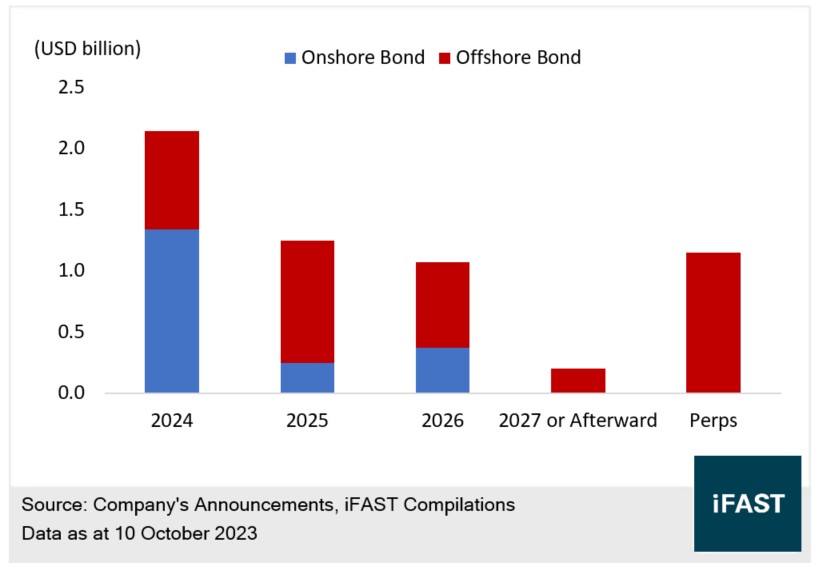
Over the medium- to long-term, GLP would sell its assets in exchange for liquidity to repurchase or repay the bonds. As mentioned above, the cash proceeds from the ongoing transaction could be up to USD 4 to 5 billion. These proceeds are enough to repay the bonds due in 2025 and 2026, or even call the two perpetual bonds in May 2026 and June 2027 respectively.
Table 3: GLP’s Bonds due in or before 2025
|
Bond Name |
Issuer |
Currency |
Tenor (years) |
Ask Price (Investors Buy) |
Yield To Maturity |
Potential Return |
| GLPSP 3.875% 04JUN2025 CORP (USD) | GLP Pte |
USD |
1.6 |
69.6 |
29.8% |
51% |
| GLPCHI 4.974% 26FEB2024 CORP (USD) | GLP China Holdings |
USD |
0.4 |
91.3 |
32.4% |
11% |
|
GLP China Holdings |
RMB |
0.7 |
79.9 |
41.2% |
28% |
|
|
Source: Bondsupermart Data as of 11 October 2023 |
||||||
With respect to perpetual bonds, their prices fell to below $40, pushing the net current yield to 12% or above (see Table 4), which is attractive. However, investors need to be aware that the risk of perpetual bonds is significantly higher, with a larger price movement and a subordinated nature.
If GLP unfortunately defaults or even goes into liquidation, perpetual bond investors would be at a disadvantage at the claims level. The recovery value could be low.
Surely, if GLP is successfully passing through this down cycle, the potential return of perps (coupon and capital gain) should be higher than those of fixed-tenor bonds.
Table 4: GLP’s Perpetual Bonds
|
Bond Name |
Currency |
Next Call Date |
Ask Price (Investors Buy) |
Yield To Call |
Current Yield |
|
GLPSP 4.500% Perpetual Corp (USD) |
USD |
17 May 2026 |
36.5 |
57.2% |
12.3% |
| GLPSP 4.600% Perpetual Corp (USD) | USD |
29 June 2027 |
36.5 |
40.5% |
12.6% |
|
Source: Bondsupermart Data as of 11 October 2023 |
|||||
Related Risks
As mentioned in the above, GLP’s credit rating is marginally investment grade. Once the rating agency downgrades it to non-investment grade, banks could tighten its credit lines. This could increase its liquidity pressure and default risk.
The slowdown in China’s economic growth and depression in the Chinese real estate industry might lead to a series of spillover effects. This could affect the capital raised and dry powder
The Group’s offshore bond yields rose to over 29%, which makes it almost impossible to issue bonds in the offshore markets (excluding the Japan market). This implies that the Group has to seek other financing channels and dispose of some assets for the repayment of debts. These methods have a certain degree of execution risk. If they fail, the Group’s chance of default will increase.
Conclusion
Global Logistics Properties (GLP)’s growth momentum remains strong. Its revenues are highly visible. The fundamental remains robust. As an alternative asset manager, the Group has several advantages. The overall investment properties are of high quality.
GLP’s dry powder is still at an excellent level. It has strong abilities in capital raising and asset liquidation. Its leverage level does not change much, with a solid bank loan refinancing ability. It is more likely to execute the asset disposals, where the proceeds could be used for operations and debt repayment.
It is possible that the Group will be downgraded, but this should have little impact on its credit profile. The Group has a strong short- to medium-term solvency. Investors could take advantage of opportunities for excess return. The potential total return of the 2025 bond is up to 51%.
Declaration: For specific disclosure, at the time of publication of this report, IFPL (via its connected and associated entities) holds a NIL position in the abovementioned securities. The analyst who produced this report holds positions in GLPSP 4.500% Perpetual Corp (USD).
Our podcast series, Yield Hunters, is available on Spotify, iTunes Podcasts and Google Podcasts. We share our thoughts on new bond issues and hold discussions on the fixed income space. Listen to our latest episode below and follow us!