Highlights:
- GLP has a resilient business model, with multiple advantages and lower operational risk.
- The Group has diamond-level shareholder base, which is beneficial to the Group's development. The Group’s debt level is not high, with massive property and equity investments. The Group has Dry Powder from its managed funds and equity financing opportunities, which could enhance the Group’s liquidity.
- The Group has strong solvency in the short- to medium-term. Investors could take advantage of this opportunity. The potential total return of the 2025 bond is up to 58%.
Chart 1: GLP’s Group Structure
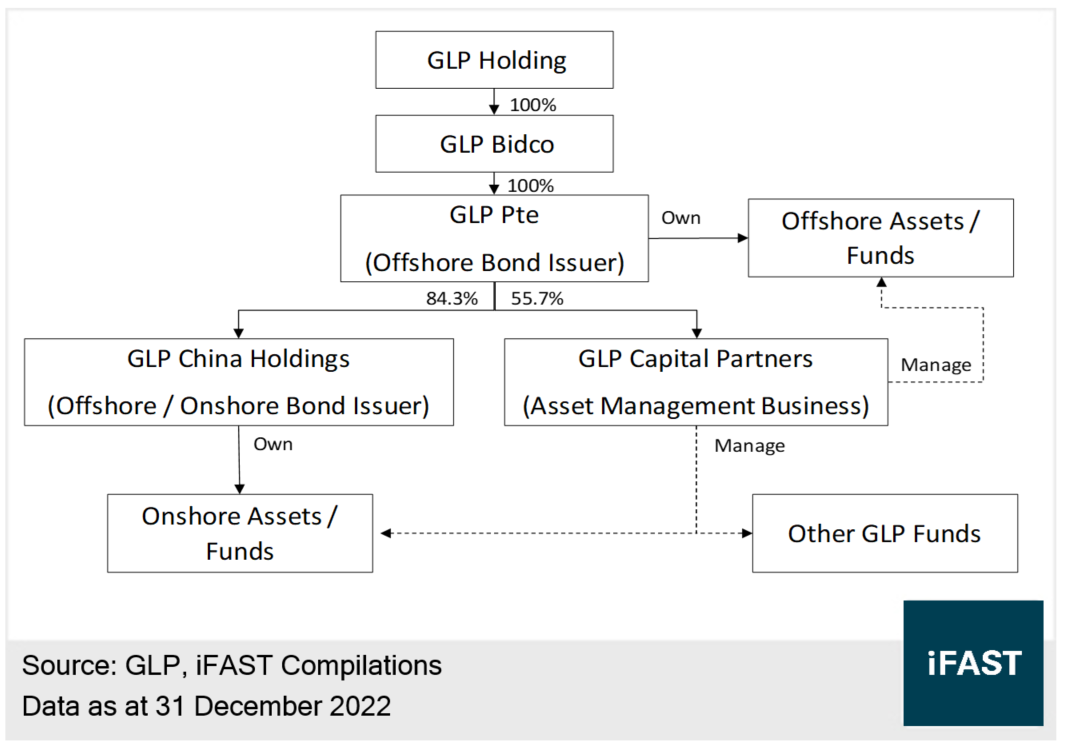
(Remark: "GLP" or "The Group" in this article refers to GLP Pte and its subsidiaries)
Global Logistics Properties (GLP) has many investment properties in China. Investors would compare the GLP bonds to Wanda bonds, and consider GLP bonds to be one of the Chinese real estate bonds.
Recently, there has been a spate of negative news for Wanda, such as seeking loan extension, no progress on the listing of Zhuhai Wanda Commercial Management Group, up to RMB 30 billion repurchase in equity to be repaid by the end of the year and massive layoffs. Together with the weak macro data in China, these led to a massive sell-off of Chinese real estate bonds (including GLP bonds).
We believe that the market is biased and misunderstood about GLP. This article explains why we are bullish on GLP's bond performance and address some misconceptions about GLP.
Advantage 1: Resilient Business Model
GLP has a resilient business model (Chart 2), with multiple advantages:
- The assets related to the Group’s development segment can be easily exited, by selling to related parties (JVs and associates or REITs and funds managed by the Group). The assets can even be securitized once the cash flows of assets are stabilized. The Group’s fund management scale could be enlarged, with better selling prices of the assets.
- The Group has two types of sustainable revenues: rental revenues and management fee. These have higher visibility and stronger cash flows.
- The Group can raise capital through its managed funds or REITs, allowing the Group to sell the assets to its managed funds over time and effectively recycle the capital.
- The major assets owned or the funds managed by the Group are logistics assets. They have a strong demand. By the end of 2022, the occupancy rate of its self-owned and managed logistics assets reached 92% and the tenant retention rate increased to 68%, reflecting the strong operating performance of its logistics assets.
Chart 2: GLP’s Business Model
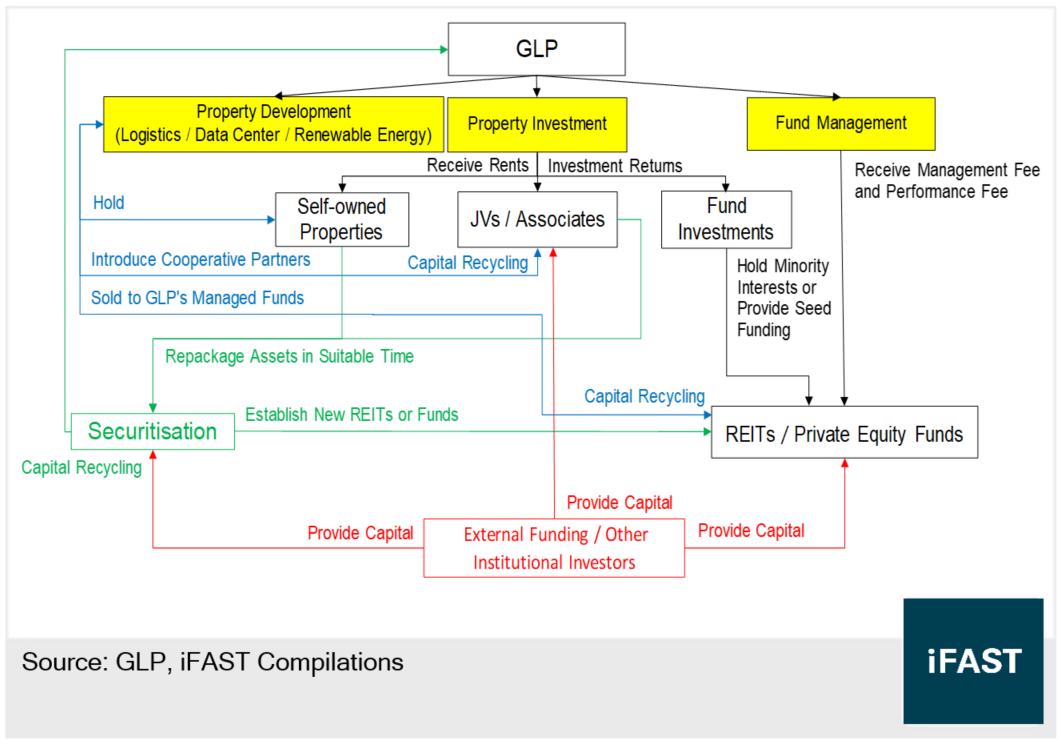
(Note: GLP's business model will be mentioned again below, which directly affects the results of the analysis. Readers should take the time to understand Chart 2 first.)
Advantage 2: Diversified Regions
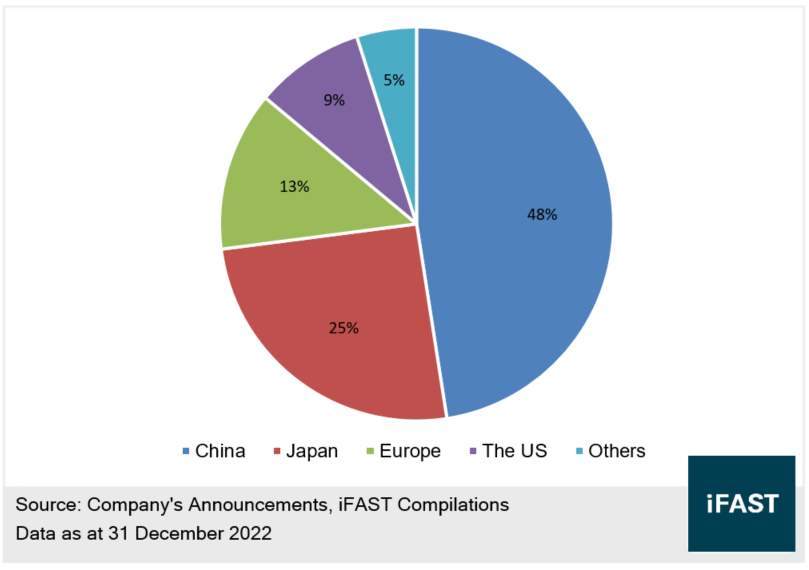
GLP has USD 122 billion of assets under management (including its own properties, associates and joint ventures and funds managed by the Group), with 48% in China (Figure 3) and the rest in Japan, Europe and the US etc. It is sufficiently diversified in terms of regions.
If we refer to the management fee (2022: USD 560 million), the China part only accounts for 38% while the non-China portion accounts for 62%. This reaches a similar conclusion. The regional risk is effectively diversified.
Chart 3: GLP’s Assets under Management Breakdown by Region
Advantage 3: A Gorgeous Lineup of Shareholders
GLP has a diamond-level shareholder base (Table 1). The shareholder structure remained unchanged after GLP was privatized by a Chinese consortium in 2018. Existing GLP’s shareholders include SMG Fund, which was founded by GLP's current CEO, Mr. Zhi Ming Mei, China Vanke and Bank of China, which have a background of state-owned enterprises or central enterprises, and two large private equity funds with excellent track records – Hillhouse Capital and Hopu Fund, whose investors include well-known foreign investment institutions such as Yale University Endowment Fund, Temasek and Goldman Sachs. Such the shareholders are not ordinary investors.
Table 1: GLP’s Shareholder Structure
| Shareholder Name | Shareholding in GLP | Background |
| Spring Hill Fund | 21% | Founded and controlled by current CEO, Mr. Zhi Ming Mei |
| China Vanke | 21% | The largest Chinese real estate developer, with SOE background |
| Hillhouse Capital | 21% | A large Asian Private Equity fund; Investors include Yale University Endowment Fund |
| Hopu Fund | 21% | A large Asian Private Equity fund; Investors include Temasek and Goldman Sachs |
| Bank of China | 16% | A large bank in China, with central enterprise background |
| Source:
Company’s Announcements, iFAST Compilations Data as of 17 May 2023 |
||
The diversified shareholder background is beneficial to the Group's development. For example, the Group could negotiate refinancing with banks in better terms. It is easier to access to counterparties when disposing assets of its self-owned properties or funds. Once the Group is in distress, these shareholders might also rescue the Group (such as share placement or shareholder’s loans).
Advantage 4: Debt Level Not High, with Massive Property and Equity Investments
About the operating and credit metrics (see Table 2), the 2022 result showed a certain degree of deterioration, with core EBITDA falling 21% YoY to USD 2.44 billion, an increase trend in the leverage indicators and interest coverage dropped to 3.9 times.
However, GLP’s debt level was not high. The net debt to total investment and net gearing ratio were 48% and 66% respectively. The average cost of borrowings was low at 4.5%. The Group also had properties and equity investments up to USD 32.2 billion. These assets have actual cash flows and investment returns. Their liquidity will be much higher than the properties under development.
Table 2: GLP’s Main Operating and Credit Metrics
| 2021 | 2022 | |
| Core EBITDA (USD billion) | 3.09 | 2.44 |
| Net Debt (including perpetual debts) (USD billion) | 11.48 | 15.56 |
| Total Investments (Property and Equity Investments) (USD billion) | 33.06 | 32.23 |
| Net Debt / Total Investments (%) | 35% | 48% |
| Net Gearing Ratio (%) | 50% | 66% |
| Net Debt / Core EBITDA (times) | 3.7x | 6.6x |
| Cash Interest Coverage Ratio (times) | 5.3x | 3.9x |
| Average Cost of Borrowings (%) | 4.5% | 4.5% |
| Source: Company’s Announcements, iFAST Compilations Data as of 31 December 2022 | ||
Advantage 5: Dry Powder of the GLP’s Managed Funds and Equity Financing Opportunities
The current GLP’s managed funds have dry powder up to USD 14 billion. These dry powder provide strong liquidity, allowing the Group to dispose of the self-owned properties to its managed funds.
Besides, the Group has two listed platforms for equity financing, such as GLP J-REIT (Stock Code: 3281.JP) and CICC GLP Warehouse Logistics REIT (Stock Code: 508056.CH), with a market capitalisation of around USD 5.11 billion and USD 950 million. Through equity financing, these REITs could gradually buy the assets from the Group, which could recycle the capital.
In recent months, GLP J-REIT plans to raise about JPY 30.9 billion in a share placement to purchase four warehousing logistics assets from GLP for a total consideration of JPY 58.2 billion (USD 420 million). GLP J-REIT has a clear asset purchase plan over the next few years, with a pipeline up to JPY 1 trillion (Amongst these, GLP J-REIT has preferential negotiation rights on assets of JPY 120 billion). CICC GLP Warehouse Logistics REIT intends to raise capital of around RMB 1.8 billion (USD 250 million) to purchase the GLP China’s three units of warehousing logistics assets.
In addition, GLP Capital Partners (GCP), which engaged in the asset management business of GLP, received external investment during the previous year. The Group issued RMB 1.1 billion of equity instruments to third parties related to GCP’s shares, indirectly replenished the Group’s liquidity.
Misconception 1: Consider GLP as Chinese Real Estate Developer
GLP's business model is very different from that of Chinese real estate developers. Besides property development, the Group has a large scale property investment and fund management. Upon completion of the property development projects, some of them are held by the Group to receive rents, and potentially securitise the assets in a suitable time. Some of them are sold to JVs / associates or the GLP’s managed funds to generate profits. The Group subsequently manages the assets and earns the management and performance fees. The business model is obviously much more robust than that of Chinese real estate developers, with a lower operational risk.
China accounts for over 60% of the Group's revenue and assets. The Group seems to be a Chinese company in terms of the proportion. But this is due to the Group's successful implementation of its asset-light strategy (The Group puts the assets in JVs / associates or GLP’s managed REITs or private funds, without directly holding the assets.) in other regions (Japan, Europe, the US, India etc.).
Under the consolidated basis of accounting, most of the non-China revenues and profits are placed in management fee, profits from JVs / associates and one-time profits. Due to the asset-light strategy, the proportion of assets is significantly reduced. However, in China, businesses are still dominated by the asset-heavy strategy. Most of the businesses (including the rental revenues) are presented on a consolidated basis. It seems to have most of the revenues and assets coming from China on the book.
In fact, as mentioned in "Advantage 2" above, if we consider China based on the asset under management breakdown or management fees, the proportion of China would be less than 50%. Rather than being a Chinese company or Chinese real estate developer, we should say that GLP is a leading Asian alternative asset manager and investor.
Misconception 2: Under the Tight Liquidity Situation, GLP needs to Sell Assets at a Deep Discount
In fact, when GLP sells the assets, most of the buyers are related parties (GLP’s JVs / associates or managed funds). Therefore, GLP rarely need to sell assets at a deep discount, resulting in a certain degree of transfer of benefits for the Group.
For example, GLP China's 2022 development margin is 21%, which is higher than the average profit margin for Chinese real estate developers (around 5% - 10%). Apparently, the asset disposal prices are more decent.
The Group can securitize some of its self-owned properties. In general, at the time of listing, the valuation level will be better. The Group does not need to sell its assets at a deep discount. It has a number of ways to effectively liquidate its assets.
Misconception 3: Exclude Monetised Fair Value Gains when Calculating Recurring Profits
Many analytical reports deducted GLP’s monetised fair value gains from core EBITDA to reach the “adjusted EBITDA” number. They interpreted this number as recurring profits. This would significantly understate the Group's actual profit level.
Monetised fair value gains appear to be one-off gains. Nevertheless, given the Group's business model, it is normal that the Group disposes the assets and realise the gains from investment properties, assets held for sales and investment in JVs / associates on a regular basis. Thus, these monetised fair value gains should not be regarded as one-off gains, but rather as the recurring profit with higher volatility.
This is similar to the development projects of Hong Kong property developers. While the development profits are highly volatile, when calculating their core profit, we should not exclude all development profits and then just consider the profits of non-development business.
Strong Short- to Medium-term Solvency; Investors could Take Advantage of Buy Opportunities
GLP Pte’s credit rating is BBB- (S&P / Fitch), which belongs to the investment grade level. GLP China Holdings also has the same rating.
As shown in Chart 4, GLP’s onshore and offshore bonds (including perpetual bonds) amounted to USD 6.22 billion. Amongst these, the bond principals due on or before 2024 are USD 2.61 billion, which is close to the current cash level of the Group. It implies the Group should have enough liquidity to handle the bonds due on or before 2024. The repayment pressure is not high.
Chart 4: GLP’s Onshore and Offshore Bonds Maturity Profile
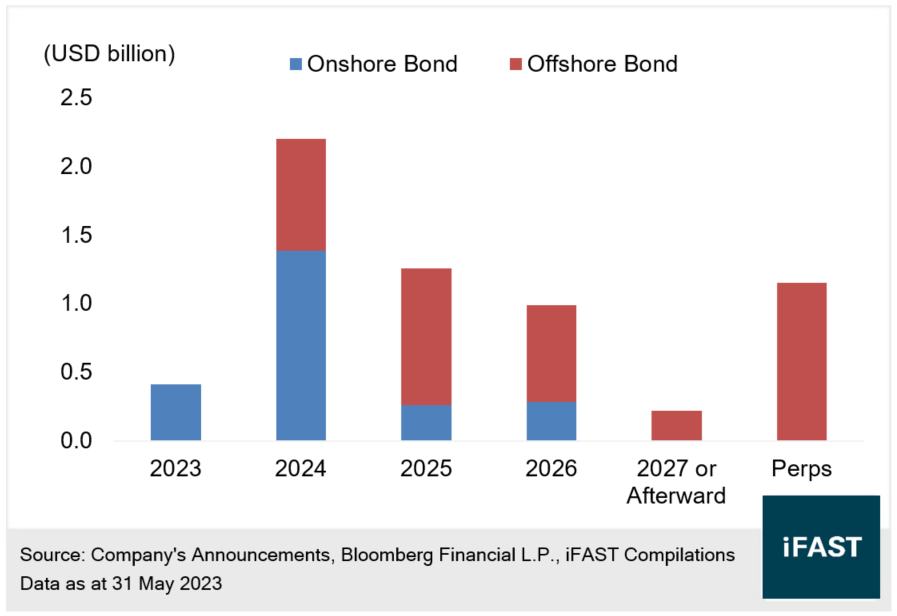
Subsequently, the Group should liquidate some assets (property and equity investments: around USD 32.2 billion) and collect some receivables from its parent company, GLP Bidco (involving approximately USD 5.4 billion), to free up liquidity for debt repayment. The bonds due in 2025 are USD 1.26 billion, which is trivial compared to the value of investment properties, equity investments and receivables. The Group clearly has a strong position to repay the debts.
As for bank and other loans (around USD 8.8 billion), we believe that the Group has little difficulty in refinancing these loans, since the Group have recurring revenues from the investment properties and fund management business, and the Group has many ways to cash out its development or investment projects. Overall, the Group's solvency in the short- to medium-term is strong.
Investors could take advantage of this golden investment opportunity. The bonds, issued by GLP or GLP China and matured on or before 2025, are yielding over 20% (see Table 4). The potential total return of the 2025 bond is up to 58%.
Table 4: GLP’s Bonds due in or before 2025
| Bond Name | Issuer | Currency | Tenor (years) |
Ask Price (Investors Buy) |
YTM | Potential Total Return |
| GLPSP 3.875% 04JUN2025 CORP (USD) |
GLP Pte | USD | 2.0 | 67.7 | 26.7% | 58% |
| GLPCHI 4.974% 26FEB2024 CORP (USD) |
GLP China | USD | 0.7 | 88.0 | 25.1% | 17% |
| GLPCHI 4.000% 02Jul2024 Corp (CNH) |
GLP China | CNH | 1.0 | 80.1 | 28.1% | 29% |
| Source:
Bondsupermart Data as of 2 June 2023 |
||||||
With respect to perpetual bonds, their prices fell to below $40, pushing the current yield to above 12% (Table 5), which is attractive. However, investors need to be aware that the risk of perpetual bonds is significantly higher, with a larger price movement and a subordinated nature. If GLP unfortunately defaults or even goes into liquidation, perpetual bond investors would be at a disadvantage at the claims level. The recovery value could be low, or even close to zero.
Table 5: GLP’s Perpetual Bonds
| Bond Name | Currency | Next Call Date | Ask Price (Investors Buy) |
YTC | Current Yield |
| GLPSP 4.500% Perpetual Corp (USD) |
USD | 17 May 2026 | 36.2 | 50.7% | 12.3% |
| GLPSP 4.600% Perpetual Corp (USD) |
USD | 29 June 2027 | 35.1 | 38.9% | 13.0% |
| Source:
Bondsupermart Data as of 2 June 2023 |
|||||
Related Risk
GLP Pte’s credit rating is marginally investment grade. Once the rating agency downgrades it to non-investment grade, some bank loan covenants could be triggered. Banks might require GLP to immediately repay these loans, which would increase its liquidity pressure and default risk.
The Group has more book profits and non-cash expenses. The earnings of its JVs and associates can fluctuate from year to year. Moreover, the Group did not disclose detailed information of funds under its management or the investment companies, nor did it state its property transactions within the period. Hence, solely analysing the financial data of GLP Pte and GLP China might not effectively reflect the actual operation.
The Group’s sources of revenue appear to be diversified but they are in fact interrelated. If the logistics property market is under pressure, its rental revenues, investments and fund management will also face a certain degree of revenue decline or valuation loss.
The Group’s offshore bond yields rose to over 20%, implying difficulty in issuing bonds in the offshore market. The Group has to seek other financing channels and dispose of some assets for the repayment of debts. These methods have a certain degree of execution risk. If they fail, the Group’s chance of default will increase.
Conclusion
GLP has a resilient business model, with multiple advantages and lower operational risk.
The Group has a diamond-level shareholder base, which is beneficial to the Group's development. The Group’s debt level is not high, with massive property and equity investments. The Group has dry Powder from its managed funds and equity financing opportunities, which could enhance the Group’s liquidity.
The
Group has strong solvency in the short to medium term. Investors could take
advantage of this opportunity. The potential total return of the 2025 bond is
up to 58%.
Declaration: For specific disclosure, at the time of publication of this report, IFPL (via its connected and associated entities) holds a NIL position in the abovementioned securities. The analyst who produced this report holds positions in GLPSP 4.500% Perpetual Corp (USD).
Our podcast series, Yield Hunters, is available on Spotify, iTunes Podcasts and Google Podcasts. We share our thoughts on new bond issues and hold discussions on the fixed income space. Listen to our latest episode below and follow us!