Receive first-hand news on the latest bond issues, credit updates and special events when you join us on our Telegram channel at https://t.me/bondsupermart!
Highlights:
- Shinhan Financial Group delivered decent track records, with both net interest income and net interest margin rising over the past few years due to positive impacts from the rate-hiking cycle. Non-bank segments are advancing at a faster pace, becoming a key growth driver in the future.
- The Group's capital adequacy proffers ample buffers over the regulatory requirement, and the banking sector posts a below-average non-performing loan ratio with decent asset quality. However, the credit card sector is a weak point in the Group's overall performance and may continue to be under pressure in the near term.
- The AUD Bond due in 2028 is yielding around 6.2%, which is much higher than most investment-grade bank bonds. Investors interested in Korea-based corporate bonds or looking for an allocation to AUD assets may consider this bond.
We recently introduced you to several Korean financial companies, including Mirae Asset and Korea Investment Securities, which have issued bonds that typically yield 0.5% to 1% more than financial bonds elsewhere, making them attractive under the current environment. Shinhan Financial Group (Shinhan Financial) is one of them, with its AUD bonds due in 2028 currently yielding around 6.2%, which is higher than many investment-grade bank bonds.
Company Background
Founded in 1982, Shinhan Financial is listed on both the Korea Stock Exchange and the New York Stock Exchange under the stock code 055550.KRX and SHG.US, respectively, with a current market capitalization of approximately KRW 19.6 trillion.
Shinhan Financial is a large comprehensive financial conglomerate in South Korea, with its core business covering two segments: banking and credit cards. Shinhan Bank, a wholly-owned subsidiary of the Group, is one of the "Big Four" banks in Korea and ranks first in terms of total assets and third in terms of net profit (Table 1). Shinhan Card, a wholly-owned subsidiary of the Group, is the largest credit card company in Korea, with a market share of approximately 22% by the end of 2022. In addition, Shinhan Financial's business scope includes securities, life insurance, and leasing.
Table 1: Assets and Profits of the “Big Four” Banks in Korea
|
Total Asset (Trillion KRW) |
1H2023’s Net Profit (Trillion KRW) |
|
|
Shinhan Bank |
611.5 |
1.7 |
|
Hana Bank |
590.0 |
1.8 |
|
Kookmin Bank |
524.5 |
1.9 |
|
Woori Bank |
518.0 |
1.5 |
|
Source: Company reports, iFAST Compilations Data as of 30 June 2023 |
||
The Banking Sector Remains Stable with Rising Net Interest Margin, But the Credit Card Sector Performed Poorly
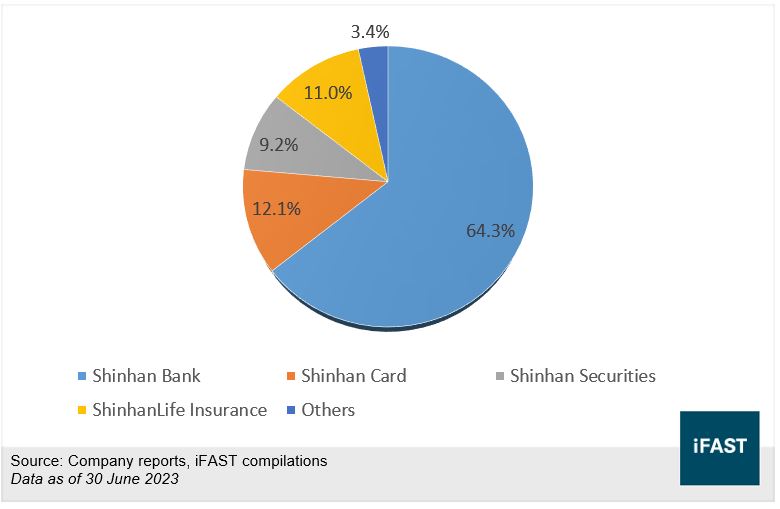
Looking at the revenue in 1H2023 (Chart 1), banking is the largest source of income, accounting for 60% of total revenue.
Chart 1: Shinhan Group’s Revenue Breakdown
 In
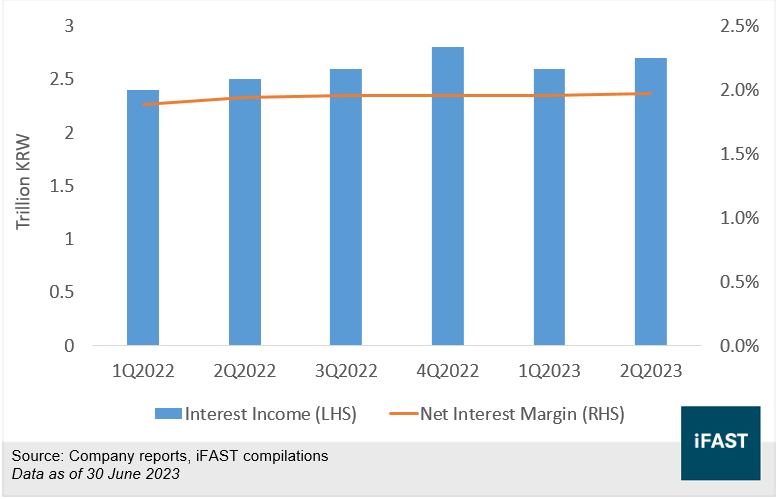
general, the interest hike cycle is favourable to banks' interest income. The
Central Bank of Korea hiked the interest rate seven consecutive times in 2022,
pushing the terminal rate to a high of 3.25%. This led to a continued benefit
for the Group's banking business. We see that the net interest margin (NIM)
rose by 1.89% in 1Q2022 to 1.97% in 2Q2023, while the high interest-rate
environment depresses the demand for credit, coupled with the down cycle of the
semiconductor industry, which is one of the backbone of Korea's economy,
resulting in a contraction on loan volume and quarterly interest income
remaining at KRW 2.4 to 2.8 trillion over the past few quarters. On the other
hand, the rate-hiking cycle has pronounced downside pressure on non-interest income, with a
loss in non-operating profit. Finally, the net profit of the banking sector
amounted to KRW 1.7 trillion, almost flat compared to 1H2022, and the overall
performance was still rather stable.
In
general, the interest hike cycle is favourable to banks' interest income. The
Central Bank of Korea hiked the interest rate seven consecutive times in 2022,
pushing the terminal rate to a high of 3.25%. This led to a continued benefit
for the Group's banking business. We see that the net interest margin (NIM)
rose by 1.89% in 1Q2022 to 1.97% in 2Q2023, while the high interest-rate
environment depresses the demand for credit, coupled with the down cycle of the
semiconductor industry, which is one of the backbone of Korea's economy,
resulting in a contraction on loan volume and quarterly interest income
remaining at KRW 2.4 to 2.8 trillion over the past few quarters. On the other
hand, the rate-hiking cycle has pronounced downside pressure on non-interest income, with a
loss in non-operating profit. Finally, the net profit of the banking sector
amounted to KRW 1.7 trillion, almost flat compared to 1H2022, and the overall
performance was still rather stable.
Chart 2: Results of the Banking Sector
 In the
credit card business, the increase in interest rates on credit cards is usually
much steeper than the increase in the policy rate, prompting consumers to
reduce their credit card borrowings. We note that the credit card loan of
Shinhan Card reached KRW 4.6 trillion ending 30 June 2023, a decrease of
roughly 19% from end-2022. Meanwhile, the delinquency rate and bad debt rate
Shinhan Credit faced increased at varying degrees, leading to a 44.3%
year-on-year surge in credit loss impairment and net profit of KRW 317.0
billion in 1H2023, down by 23.2% YoY, leaving room for improvement in its operating
performance.
In the
credit card business, the increase in interest rates on credit cards is usually
much steeper than the increase in the policy rate, prompting consumers to
reduce their credit card borrowings. We note that the credit card loan of
Shinhan Card reached KRW 4.6 trillion ending 30 June 2023, a decrease of
roughly 19% from end-2022. Meanwhile, the delinquency rate and bad debt rate
Shinhan Credit faced increased at varying degrees, leading to a 44.3%
year-on-year surge in credit loss impairment and net profit of KRW 317.0
billion in 1H2023, down by 23.2% YoY, leaving room for improvement in its operating
performance.
Non-bank Segments Maintain a Fast Pace of Development
The Group's banking and credit card businesses are relatively mature, meaning that the potential for further growth is relatively modest. Therefore, it started to shift its business focus to non-banking businesses, such as securities and life insurance. Among them, Shinhan Life Insurance's Annual Premium Equivalent grew by 32.4% year-on-year to KRW 438.0 billion in 1H2023, driving net profit up by 27.9% to KRW 241.9 billion, making it the third-largest source of income. In addition, Shinhan Securities also performed well, with revenue rising by 27.9% to KRW 241.9 billion. Given the imminent ending of the rate-hiking cycle in Korea and the recovering stock market of Korea (KOSPI), which rallied by 15% in 2023. It is believed that with the improvement in market sentiment and the increasingly active trading in the stock market, Shinhan Securities is expected to maintain its rapid growth.
Overall, Shinhan Financial’s net profit for the first half of 2023 totaled KRW 2.6 trillion, a dip of 2.1% from one year ago, mainly due to the suppressed performance of the credit card sector. However, the non-banking sectors post desirable results and are poised to become a key growth driver in the future, and we still have a positive view of its long-term development.
Asset Quality of Banking Sector Looks Decent, But Bad Debt of Credit Card Business Hits a High Level
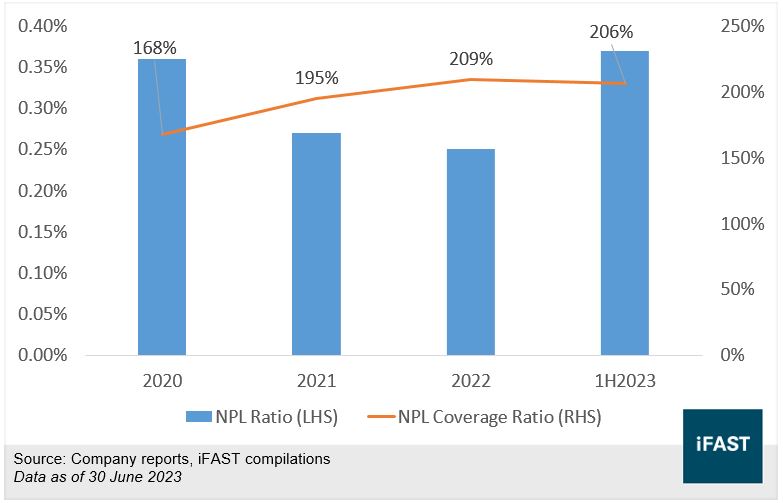
In terms of asset quality, owing to the robust capability of credit risk management, the non-performing loan ratio stood at 0.3% ending 30 June 2023 and is managed to remain below 0.4%. Meanwhile, the NPL coverage ratio reached 206%, hinting at a solid capacity to absorb credit loss.
Chart 3: Asset Quality of Banking Sector
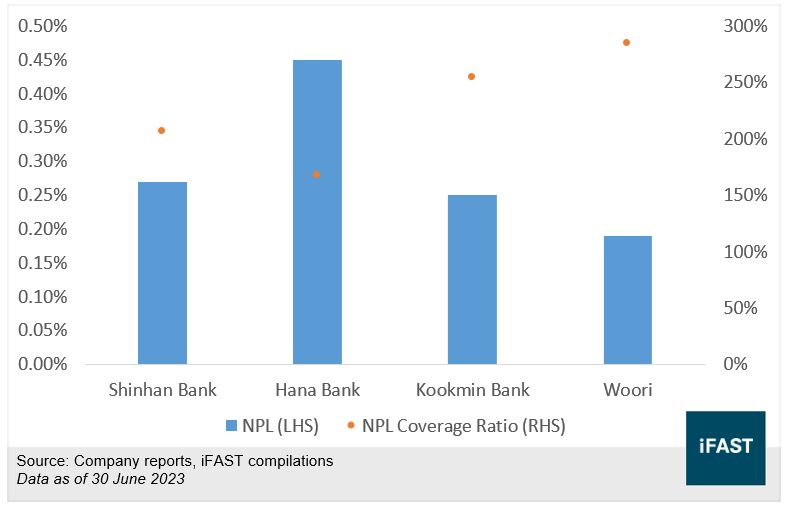
 In comparison to "Big Four"
banks in Korea, as of 30 June 2023, Shinhan Bank's NPL ratio is below that of
Hana Bank, but higher than that of Woori Bank and Kookmin Bank, and similar to
the provision coverage ratio, which is better than that of Hana bank, but not
as good as that of Kookmin bank and Woori Bank, suggesting that the overall
asset quality of Shinhan bank is at the average of “Big Four” banks.
In comparison to "Big Four"
banks in Korea, as of 30 June 2023, Shinhan Bank's NPL ratio is below that of
Hana Bank, but higher than that of Woori Bank and Kookmin Bank, and similar to
the provision coverage ratio, which is better than that of Hana bank, but not
as good as that of Kookmin bank and Woori Bank, suggesting that the overall
asset quality of Shinhan bank is at the average of “Big Four” banks.
Chart 4: Comparison of “Big Four” Banks’ NPL Figures
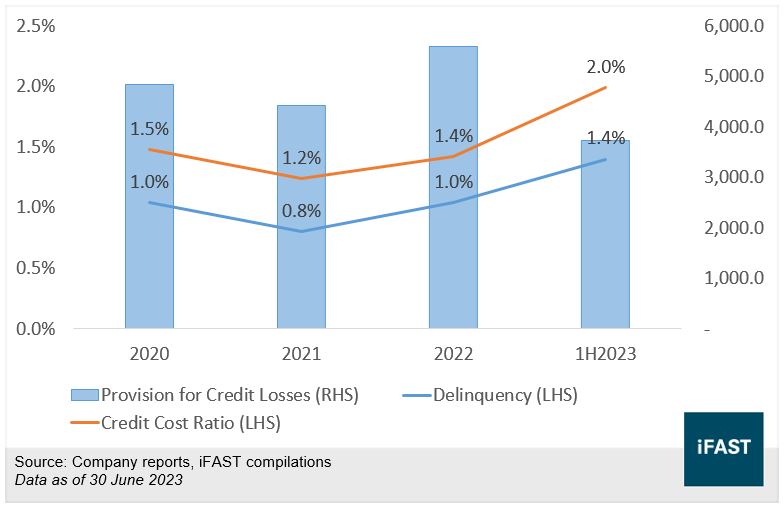
 As for the credit card sector, as
mentioned above, the rate-hiking cycle pushed up the delinquency rate and bad
debt rate to varying degrees. Chart 5 shows that the delinquency rate and
credit loss ratio (Credit loss impairment/total credit card loan) in 1H2023
reached 1.4% and 2.0%, respectively, which are considerably higher than in
previous years. Moreover, 1H2023’s provision for credit losses already hit KRW 372
billion, and the full-year figure is expected to be significantly higher than
that of 2022.
As for the credit card sector, as
mentioned above, the rate-hiking cycle pushed up the delinquency rate and bad
debt rate to varying degrees. Chart 5 shows that the delinquency rate and
credit loss ratio (Credit loss impairment/total credit card loan) in 1H2023
reached 1.4% and 2.0%, respectively, which are considerably higher than in
previous years. Moreover, 1H2023’s provision for credit losses already hit KRW 372
billion, and the full-year figure is expected to be significantly higher than
that of 2022.
Chart 5: Credit Quality of Credit Card
 On a
consolidated basis, high bad debts in the credit card segment resulted in the
Group's total credit loss provisioning nearing KRW 1 trillion in 1H2023, a
year-on-year surge of about 67.8%. The credit loss ratio also rose 22 basis
points to 0.57%. However, it should be noted that despite the decline in asset
quality of the credit card sector, the performance of the banking segment was
stable and the overall credit metrics of the Group remain manageable.
On a
consolidated basis, high bad debts in the credit card segment resulted in the
Group's total credit loss provisioning nearing KRW 1 trillion in 1H2023, a
year-on-year surge of about 67.8%. The credit loss ratio also rose 22 basis
points to 0.57%. However, it should be noted that despite the decline in asset
quality of the credit card sector, the performance of the banking segment was
stable and the overall credit metrics of the Group remain manageable.
Capital Looks Rich with Further Room for Improvement
As of 30 June 2023, the Group's CET1 ratio and capital adequacy ratio stood at 13.0% and 16.0%, respectively, offering respective buffers of 250 bps and 200 bps over the regulatory requirement, indicating that the Group is well capitalized with robust capability to withstand risk. When compared to the other three banks of the "Big Four" in Korea, their CET1 ratio averaged roughly 13%, signaling that the Group's capital adequacy is at an average level.
Table 2: Capital Adequacy Ratio of Shinhan Financial
|
2021 |
2022 |
1H2023 |
Minimum Regulatory Requirement |
|
|
CET1 Ratio |
13.1% |
12.8% |
13.0% |
10.5% |
|
Capital Adequacy Ratio |
16.2% |
16.1% |
16.0% |
14.0% |
|
Source: Company reports, iFAST Compilations Data as of 30 June 2023 |
||||
It's noteworthy that the CET1 ratio for banks in Europe and Hong Kong are generally over 14%, e.g., 14.7% and 14% for HSBC and Standard Chartered Bank respectively as of June 2023, and even as high as 16.8% for the Bank of East Asia, which indicates the low capital adequacy ratios of commercial banks in Korea. The reason behind this is mainly due to the fact that the regulatory requirement of Korea is not that high, as no mechanism for extra cushion such as Countercyclical Capital Buffer (CCyB) has been introduced, resulting in a weaker risk-resistance ability than developed markets. Financial Services Commission, the financial regulatory of Korea, has realized the importance of ascending regulatory requirements and plans to impose 1% CCyB, which will be tacked to common equity tier 1 capitals starting from May 2024. Following the adjustment of regulatory requirements, the Group's buffers are not too ample, and we expect that it will likely replenish capital in the near term through the issues of Additional Tier 1, etc. We thus believe that the Group's ability to withstand risk in the future would be further strengthened.
Liquidity Meets Regulatory Requirements but There Is Room for Improvement.
Unlike most countries’ minimum liquidity coverage ratio of 100%, the Financial Services Commission reduced the requirement to 92.5% during the outbreak of the pandemic and revised it slightly to 95% in the second half of 2023 to preserve the stability of the domestic financial system. As of 30 June 2023, the Group’s liquidity coverage ratio stood at 97.9%, marginally higher than the regulatory requirement.
We believe that one of the key factors behind the Group's tight liquidity is the high ratio of loan-to-deposit, which was 92.5% as of 30 June 2023, meaning that the amount of loans lent out and deposits received are very close to each other, and the pressure on the bank to make payment is significant. Even though the loan-to-deposit ratio is still within the regulatory requirement of 100%, there is much room for the Group to trim down the ratio, taking into account the average of around 80% in other regions.
All in all, the credit metrics of the Group meet the regulatory requirements, and the overall credit profile remains good, in line with its issuer credit ratings of A+/A (S&P/Fitch), although there is still some room for improvement, given the relatively lenient regulatory requirements in Korea.
Investors Can Consider a 2028 AUD Bond with a Current Yield to Maturity of 6.2%
Investment-wise, three bonds issued by subsidiaries of Shinhan Financial are available on our platform, two issued by Shinhan Bank and one issued by Shinhan Card. Please refer to the table below for more details:
Table 3: Comparison of Shinhan’s Bonds
|
Bond |
Issuer |
Bond Credit Rating |
Years to Maturity |
Ask Price |
YTM |
|
SHINCA 2.500% 27Jan2027 Corp (USD) |
Shinhan Card |
N.R |
3.0 |
92.7 |
5.2% |
|
SHNHAN 4.500% 12Apr2028 Corp (USD) |
Shinhan Bank |
A+/A (S&P/Fitch) |
4.2 |
99.5 |
4.6% |
|
SHNHAN 5.000% 30Aug2028 Corp (AUD) |
Shinhan Bank |
BBB+/BBB+ (S&P/Fitch) |
4.6 |
95.1 |
6.2% |
|
Source: Bondsupermart Data as of 5 February 2024 |
|||||
The 2027 USD bond issued by Shinhan Card is yielding around 5.2% with an investment horizon of approximately 3 years, and the bond due in 2028 issued by Shinhan Bank proffers a yield to maturity of 4.6% and 80 bps spread over treasury yield, which is not attractive in terms of absolute return, although it is consistent with the average level among A-rated bonds.
The credit rating of the AUD bonds due in 2028 is BBB+/BBB+ (S&P/Fitch), which is two notches lower than the issuer's credit rating. This is because the bond is a Tier 2 bond, and considering the fact that the Group is well-capitalized with stable operation, the possibility of triggering a write-down to absorb loss is very unlikely, not to mention the fact that Tier 2 has a higher seniority over Tier 1 capital. We thus believe that the difference in investment risk between Tier 2 and senior bonds is modest. The bond is currently yielding around 6.2%, offering a significantly higher rate of return than senior bonds and Tier 2 bonds of other banks, we believe that investors interested in Korea-based corporate bonds or looking for an allocation to AUD assets may consider this bond.
Corporate Risk
Investors should be mindful of the following risks. Firstly, Tier 2 bond is embedded with the TLAC feature, which may result in a full or partial loss under some situations.
Secondly, the Group's credit card business is currently underperforming. If the high interest-rate environment in Korea continues for a longer time, the credit loss ratio may rise further in the future, affecting the overall asset quality.
Conclusion
Shinhan Financial Group delivered decent track records, with both net interest income and net interest margin rising over the past few years due to positive impacts from the rate-hiking cycle. Non-bank segments are advancing at a faster pace, becoming a key growth driver in the future.
The Group's capital adequacy proffers ample buffers over the regulatory requirement, and the banking sector posts a below-average non-performing loan ratio with decent asset quality. However, the credit card sector is a weak point in the Group's overall performance and may continue to be under pressure in the near term.
The AUD Bond due in 2028 is yielding around 6.2%, which is much higher than most investment-grade bank bonds. Investors interested in Korea-based corporate bonds or looking for an allocation to AUD assets may consider this bond.
Declaration: For specific disclosure, at the time of publication of this report, IFPL (via its connected and associated entities) and the analyst who produced this report hold a NIL position in the abovementioned securities.
Our podcast series, Yield Hunters, is available on Spotify, iTunes Podcasts and Google Podcasts. We share our thoughts on new bond issues and hold discussions on the fixed income space. Listen to our latest episode below and follow us!