Receive first-hand news on the latest bond issues, credit updates and special events when you join us on our Telegram channel at https://t.me/bondsupermart!
- Olam reported a - 69% YoY decline in PATMI due to a surge in net finance costs. However, core segments remain strong operationally. Olam’s Revenue and EBIT grew 16% YoY and 9% YoY respectively, with ofi and Olam Agri recording robust EBIT growth.
- Olam’s credit profile remain stable since our previous update. Liquidity remains strong and greatly mitigates any near-term liquidity risk. Debt metrics have worsened against FY23, but have stabilised in 2H24.
- Olam has announced that it will sell a 44.6% stake in Olam Agri to the Saudi Agricultural and Livestock Investment Company (Tranche 1), raising estimated cash proceeds of S$ 2.4B. Olam’s remaining 19.99% stake in Olam Agri will be sold over the next three years after the completion of Tranche 1.
- For OLAMSP 4.000% 24Feb2026 Corp (SGD), the sale of Olam Agri is unlikely to impact its redemption upon maturity. For OLGPSP 5.375% Perpetual Corp (SGD), the sale represents a potential loss in the Group’s cashflows and claims to assets but is balanced out by a higher likelihood to call.
- We like and continue to recommend OLAMSP 4.000% 24Feb2026 Corp (SGD). The bond is trading at an attractive yield of around 4.16%, one of the higher-yielding short-term SGD bonds.
Profits weighed down by higher finance costs and one-off charges…
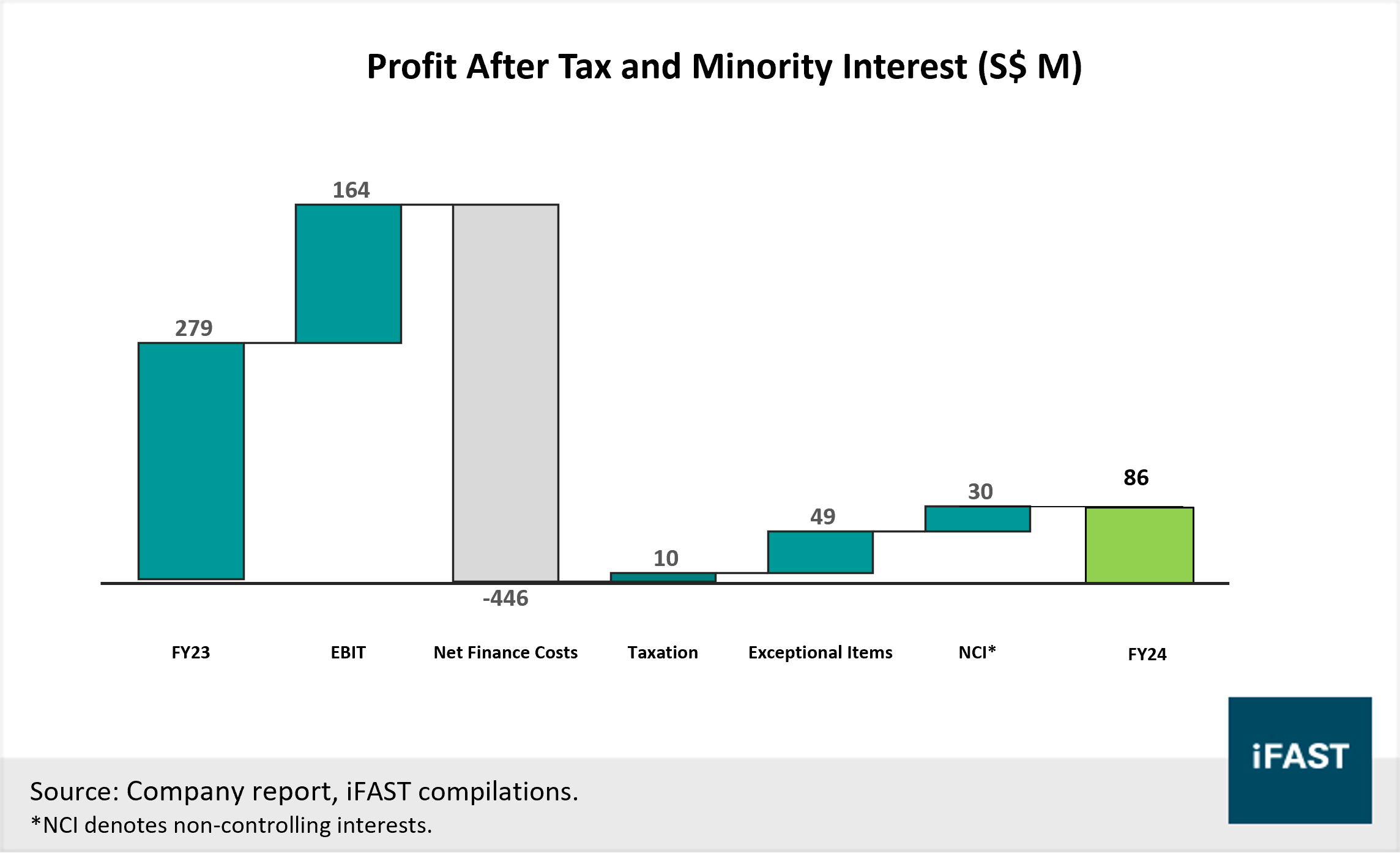
For the twelve months ended 31 December 2024 (“FY24”), Olam’s profit after tax and minority interest (“PATMI”) fell -69.0% YoY to S$86.4M in FY24 (FY23: S$278.7M) (Chart 1), dragged down by a S$ 445.7M increase in net finance costs and net exceptional losses of S$129.9 million (mainly one-off charges). In particular, net finance costs surged in 2H24 due to greater debt utilisation as a result of an increase in working capital requirements after commodity prices rose. Excluding the exceptional losses, operational PATMI recorded a smaller decline of -52.8% to S$216.3M in FY24 (FY23: S$458.1M).
Despite a moderation in profits, we think Olam remains resilient operationally and expects the drag from finance costs to ease as average interest rates peak. The Group expects steady growth from ofi, guiding for low to mid-single digit total volume growth and high single-digit adjusted EBIT growth over the medium term. We expect Olam Agri to maintain its strong revenue contribution for most of 2025 – til the sale of 44.58% stake to Saudi Agricultural and Livestock Investment Company (“SALIC”) which should be completed in late 4Q25.
Chart 1: PATMI fell in FY24 due to higher net finance costs
… but Olam’s core segments remain strong
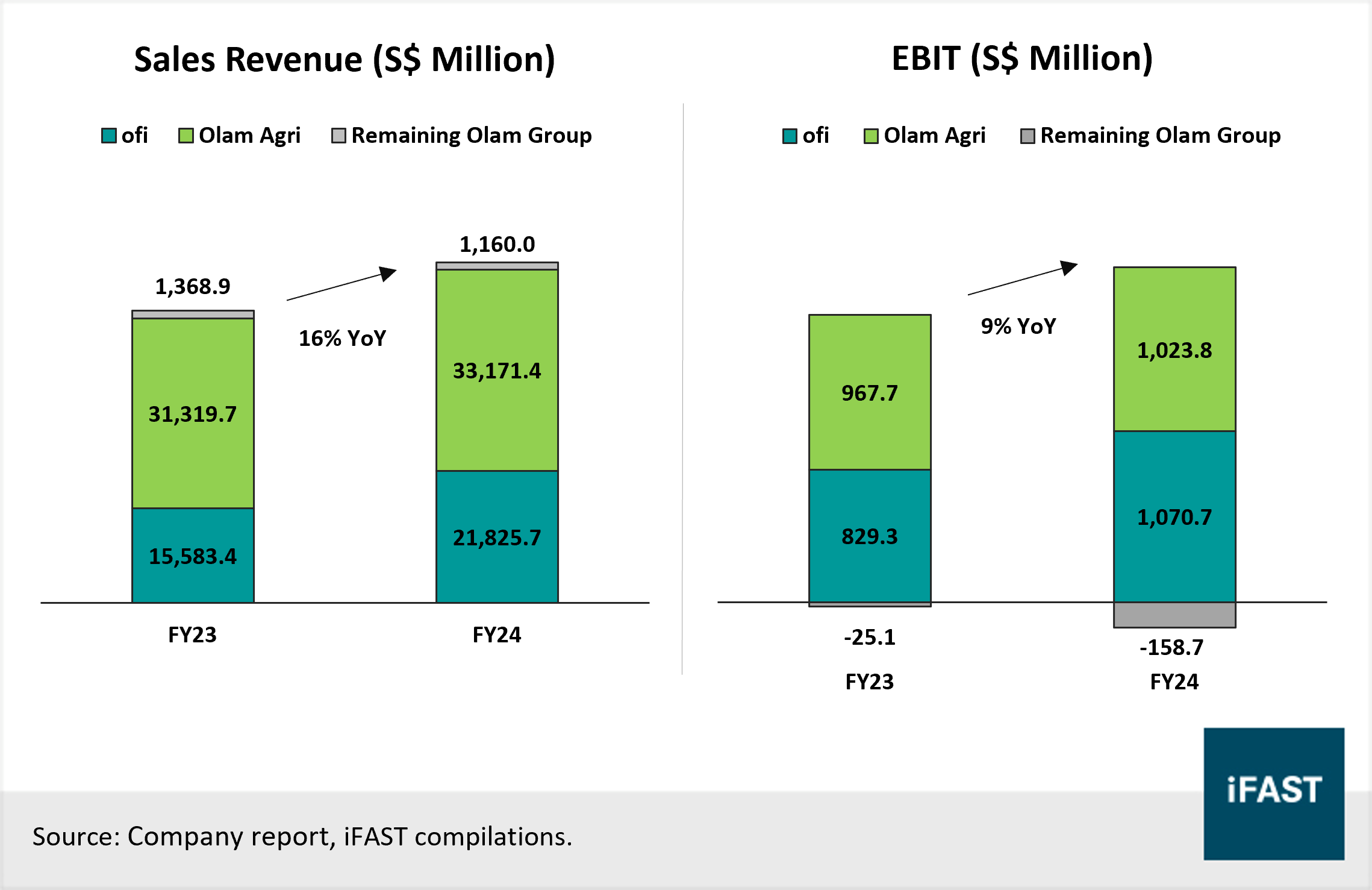
Despite the decline in PATMI, Olam reported a 16.3% year-over-year (“YoY”) increase in group revenue to S$56.2B (FY23: S$ 48.3 B) and a 12.5% YoY increase in volume to 49.6M MT in FY24 (FY23: 44.1M MT). EBIT – Olam’s key operational metric – grew 9.2% YoY to S$ 1.9B (FY23: S$ 1.8B), helped by improved performance from both Olam Agri and Olam Food Ingredients (“ofi”), as we expected after solid growth in 1H24 (Chart 2).
Ofi recorded a 29.1% YoY growth in EBIT to S$ 1.1B (FY23: S$ 829.3M) and was the major contributor to the Group’s EBIT. This was driven by its ingredients & solutions sub-segment, which benefited from elevated prices for cocoa, dairy, and spices. Meanwhile, Olam Agri recorded a milder 5.8% YoY growth in EBIT to S$ 1.0B (FY23: S$ 967.7M). Its Food & Feed – Processing & Value-added segment was the primary EBIT contributor due to successes across its flour and pasta, edible oils, and integrated feed & protein business. The remaining Olam Group incurred a wider EBIT loss of -S$158.7M in FY24 (FY23: -S$ 25.1M), dragged down by non-cash foreign exchange revaluation losses.
Chart 2: Sales revenue and EBIT recorded robust growth in FY24
Debt levels have risen but ratios have largely remained resilient
As expected from 1H24 financial results, Olam’s debt levels have increased due to higher working capital needs. Total debt for Olam (including lease liabilities) rose by S$ 0.7B to S$ 23.1B in FY24 (1H24: S$22.4B). As highlighted above, this was due to higher working capital requirements given higher commodity prices. We do not see this as a lingering issue given that swings in working capital requirement are rather common across commodity-trading businesses. In fact, working capital requirements have started to ease in 2H24, as previously guided by management, which should reduce the need for related debt utilisation.
Given higher debt levels, ratios have deteriorated relative to FY23 but have generally maintained resilient relative to 1H24 (Table 1). Treating the perpetual securities (“perps”) as debt, Olam’s adjusted net debt to EBITDA was estimated to be 7.6x in FY24, relatively unchanged from 1H24 (1H24: 7.6x and FY23: 5.3x) while the adjusted EBITDA interest coverage ratio (incl. perp. distribution) saw a slight moderation to 1.5x in FY24 (1H24: 1.7x and FY23: 1.9x).
Meanwhile, the reported net gearing ratio was 2.8x in FY24 (1H24: 2.6x and FY23: 1.7x). This was higher than the internal target of less than 2.0x and relatively high amongst SGD issuers, in our opinion. That said, we are not overly concerned given Olam’s other liquid assets like readily marketable inventories (“RMI”) and secured receivables (which can be liquidated within 90 days without a reduction in sales price or margin). Including these assets, the reported adjusted net gearing ratio falls back below 1.0x, to 0.7x in FY24 (1H24: 1.0x and FY23: 0.6x).
Table 1: Debt metrics deteriorated versus a year ago, but has stabilised over the past 6 months
|
Metrics
|
Dec '23
|
Jun '24
|
Dec '24
|
|
Net debt
to EBITDA (x)
|
5.1
|
7.3
|
7.3
|
|
Adj. net
debt to EBITDA (x) (incl. perps)
|
5.3
|
7.6
|
7.6
|
|
Reported net gearing (X)
|
1.7
|
2.6
|
2.8
|
|
Reported
adj. net gearing (incl. RMI and secured recievables) (X)
|
0.6
|
1.0
|
0.7
|
|
EBITDA interest
coverage (X)
|
1.93
|
1.71
|
1.53
|
|
Adj.
EBITDA interest coverage (incl. perps dist.) (X)
|
1.88
|
1.69
|
1.50
|
|
Source:
Company report, iFAST estimates, iFAST compilations. Data as of 31 Dec 2024
|
Strong total available liquidity which sufficiently covers debt obligations
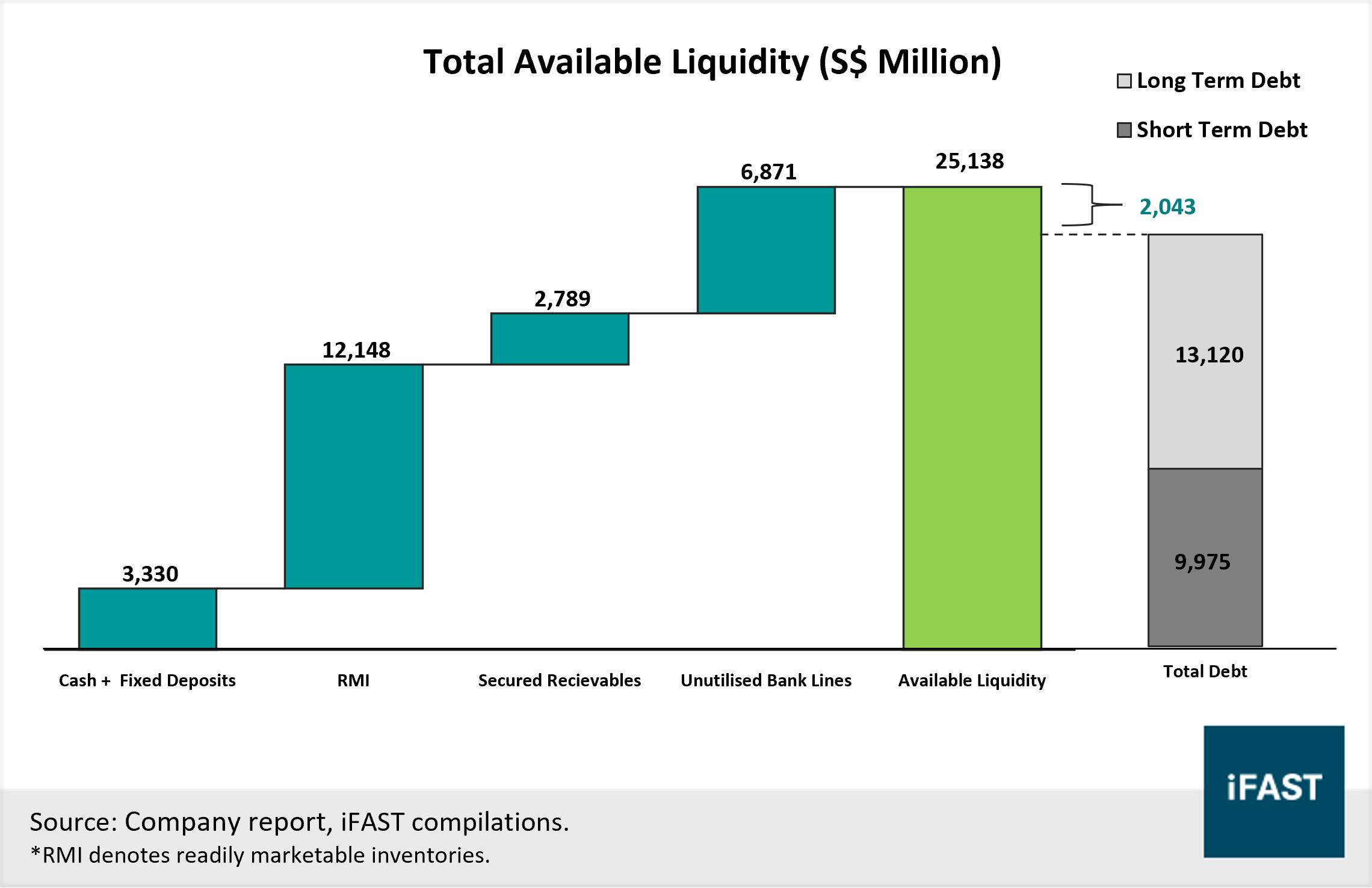
Olam recorded a cash balance of S$ 3.3B in FY24, a slight decline from 1H24 (1H24: S$ 3.5B and FY23: S$3.6B). Including S$12.1B of readily marketable inventories, S$2.8M of secured receivables, and S$ 6.9M of unutilised bank lines, the Group has a total available liquidity of S$ 25.1B (Chart 3). This is more than sufficient to cover total debt (including lease liabilities) of S$ 23.1B in FY24, leaving a healthy S$2.0B of liquidity headroom for the Group (Chart 3).
Excluding readily marketable inventories and secured receivables, Olam’s short-term debt of S$ 9.9B is well covered even by the total S$10.2B from cash and unutilised bank lines, pointing to little near-term liquidity risk. Furthermore, the Group is also expecting S$ 2.4B of sale proceeds to be unlocked from the selling of 44.57% stake in Olam Agri (sale of tranche 1 to complete in 4Q25, explained below). We see this as an additional liquidity buffer with management expressing the potential to allocate part of the proceeds for debt repayment and improving the balance sheet of both ofi and Olam Group.
Chart 3: Total liquidity remains strong, sufficient to cover both total debt
Sale of Olam Agri to SALIC
On 24 February, Olam announced that it will sell a 44.6% stake in Olam Agri for SGD 2.4B to the Saudi Agricultural and Livestock Investment Company (“SALIC”) (Tranche 1). SALIC is expected to own a controlling 80.01% stake after the sale of Tranche 1 is completed. The sale is subjected to the approval of shareholders as well as regulators and is estimated to be completed in 4Q24.
Upon completion, i) Olam has a put option to sell its remaining 19.99% stake in Olam Agri to SALIC (Tranche 2) which is exercisable on the third anniversary of completion of Tranche 1, and ii) SALIC will have a call option to buy the 19.99% stake in Olam Agri on or before the third anniversary of completion of Tranche 1.
Olam is expected to raise an estimated total gross cash proceeds of S$ 3.4B from the sale of both tranches, with S$ 2.4B alone from Tranche 1. Management has highlighted that the proceeds may be used for debt repayment, right-sizing the capital structure of Olam Group and ofi, as well as for a potential one-time special dividend distribution. This will depend on the Group's future earnings, cash flows, capital and financial requirements, as well as general business conditions.
Bond recommendations – Olam’s 2026 bond continues to look attractive
Table 1: Olam’s fixed rate and perpetual bonds
|
Bond Name
|
Issuer
|
Maturity Date / Call Date
|
Bond Price
|
Years to Maturity / Call date
|
Yield to Maturity / Next Call (%)
|
|
OLGPSP 5.375% Perpetual Corp (SGD)
|
Olam Group Limited
|
18 July 2026
|
99.50
|
- / 1.35
|
- / 5.76
|
|
OLAMSP 4.000% 24Feb2026 Corp (SGD)
|
Olam International Limited
|
24 Feb 2026
|
99.850
|
0.96 / -
|
4.16 / -
|
|
Source: Bloomberg Finance L.P.,
Bondsupermart, iFAST compilations. Data as of 10 Mar 2025
|
Overall, we maintain our view (from our previous update) that Olam’s credit profile remains stable. The Group continues to maintain a strong liquidity profile which mitigates any near-term liquidity risk. Debt metrics have worsened 1H24, due to debt utilisation for higher working capital requirements, but have stabilised in 2H24. While the sale of Olam Agri will lower the Group’s revenue and cashflow over the long-term, we think the large proceeds will provide a short-term balance sheet boost over the next 1 - 3 years (where the sale of Tranche 1 and 2 are expected to complete).
For investors, we continue to recommend OLAMSP 4.000% 24Feb2026 Corp (SGD), particularly for those looking for short-term SGD bonds. We find the bond attractively priced at an indicative ask yield to maturity of 4.16%, which is one of the higher-yielding short-term SGD bonds. The bond is issued by Olam International Limited, under ofi, which has demonstrated strong EBITDA growth in FY24. Management has also guided for high single-digit adjusted total EBIT growth in the medium term. We see little risk for OLAMSP 4.000% 24Feb2026 Corp (SGD), which is maturing less than a year, as the $10.2B from cash and unutilised bank lines sufficiently covers all short-term debt.
The sale of Olam Agri is also unlikely to impact the redemption of OLAMSP 4.000% 24Feb2026 Corp (SGD) upon maturity. First, we believe the earnings growth of ofi (the issuer) should remain resilient while its growth direction unaffected by the sale, despite a loss in cashflow on a group level. Second, the proceeds from Tranche 1 can serve as an additional liquidity buffer to Olam’s already decent liquidity profile. The S$ 2.4B proceeds alone can comfortably cover the S$ 250k principal and two remaining coupon payouts upon maturity. Third, Olam’s 2026 bonds are expected to mature in just two months after the completion of Tranche 1 in 4Q25 (management expects this to be in December).
We also maintain our preference for OLAMSP 4.000% 24Feb2026 Corp (SGD) over OLGPSP 5.375% Perpetual Corp (SGD), considering the structural subordination and greater cashflow uncertainties faced by the latter as the perpetual security (“perp”) was issued by Olam Group Limited, the ultimate parent (holding company) of Olam Agri and ofi. In particular, the sale of Olam Agri and a potential IPO of ofi (which management still plans to pursue) will represent a significant loss of cashflow and claims to asset on a Group level.
That said, for perp holders of OLGPSP 5.375% Perpetual Corp (SGD), the potential loss in cashflow and claims to asset from the sale of Olam Agri is balanced out by a higher likelihood to call (on 18 July 2026), in our opinion. We think there is a likelihood that management will use part of the proceeds from Tranche 1 to retire the perp and right-size Olam Group’s balance sheet. Further incentive to call may come from the perp's wide reset spread of 6.807% and a reset rate of around 9.0% (if un-called), based on current expectations of forward rates.
For investors who are considering the perp with the expectation of a call, we think the 5.76% yield to call of OLGPSP 5.375% Perpetual Corp (SGD) looks attractive relative to many SGD perps with similar call dates. This is largely due to Olam’s higher leverage and the above risks, in our view. Nonetheless, investors have to be cautious of non-call risks when investing in perps. For OLGPSP 5.375% Perpetual Corp (SGD) in particular, a non-call would expose perp holders to 1) uncertainties such as a drop in cashflow after the sale of Olam Agri and potential IPO of ofi, 2) major loss to claims in assets of Olam Agri and ofi, and 3) potential exit or sale of stake from Temasek holdings, major shareholder of Olam Group (which may affect the perceived status of a Temasek-linked bond).
Declaration: For specific disclosure, at the time of publication of this report, IFPL (via its connected and associated entities) holds a position in OLAMSP 4.000% 24Feb2026 Corp (SGD) and OLGPSP 5.375% Perpetual Corp (SGD) and the analyst who produced this report holds a NIL position in the abovementioned securities.
Our podcast series, Yield Hunters, is available on Spotify, iTunes Podcasts and Google Podcasts. We share our thoughts on new bond issues and hold discussions on the fixed income space. Listen to our latest episode below and follow us!