Highlights:
- Under China's property sales slump, Seazen is still able to generate monthly contracted sales of RMB 20 billion. Comparing with its peers, it has a relatively sufficient land bank, with a low land acquisition cost. The rental income and management fees from shopping malls should still remain a rapid growth.
- The Group’s traditional credit indicators worsened, but its off-balanced sheet debt indicators were decent. The Group’s rights issue has been oversubscribed, reflecting its fairly good financing ability. Additionally, spinning off its shopping malls and listing them as a REIT and disposal of its commercial property management business could be solutions to provide more liquidity.
- The bonds are still attractive. Moderately aggressive investors could consider them. Its 2023 bond is available on Bond Express, with a yield to maturity of 30.9%.
Seazen Group Limited (“the Group”) was founded in 1996. It is a large property developer in China, mainly engaging in property development, commercial real estate investment, property management and entertainment businesses. The Group has been listed on HKEX (Stock Code: 1030.HK) since 2012, with a current market capitalization of HKD 37.9 billion.
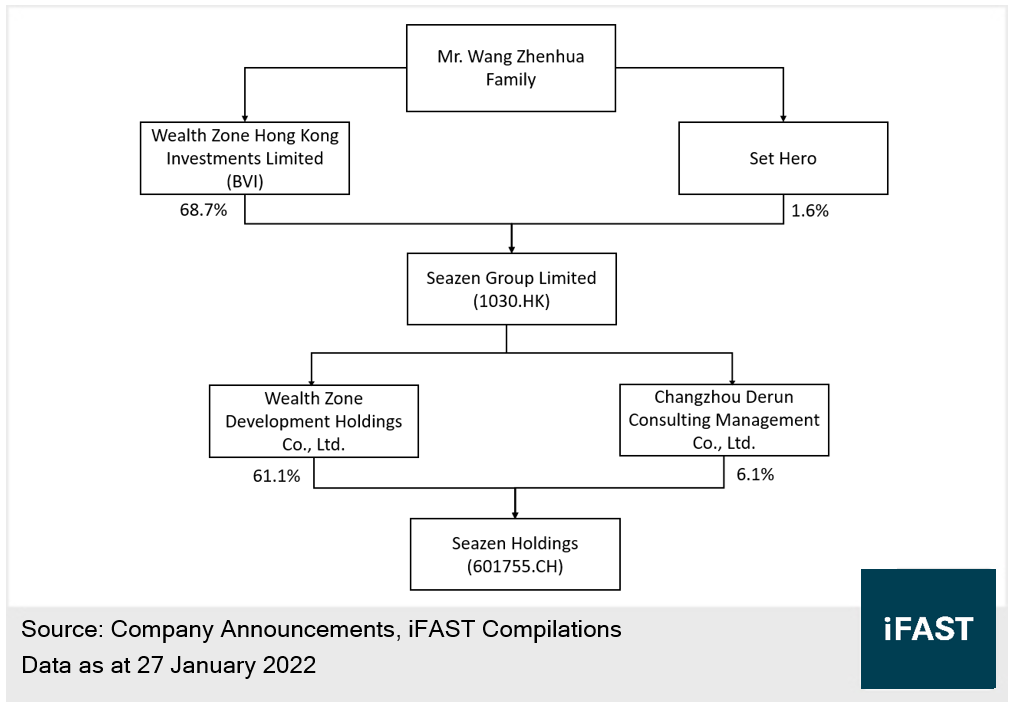
The Group’s related property businesses mainly operate through Seazen Holdings Co. (“Seazen Holdings”). The Group holds a 67.2% stake in Seazen Holdings. Seazen Holdings was listed on Shanghai Stock Exchange (Stock Code: 601155.CH), with a current market capitalization of RMB 77.2 billion.
Chart 1: Seazen’s Simplified Organization Chart
Still Able to Generate 20 billion Monthly Contracted Sales under China's Property Sales Slump
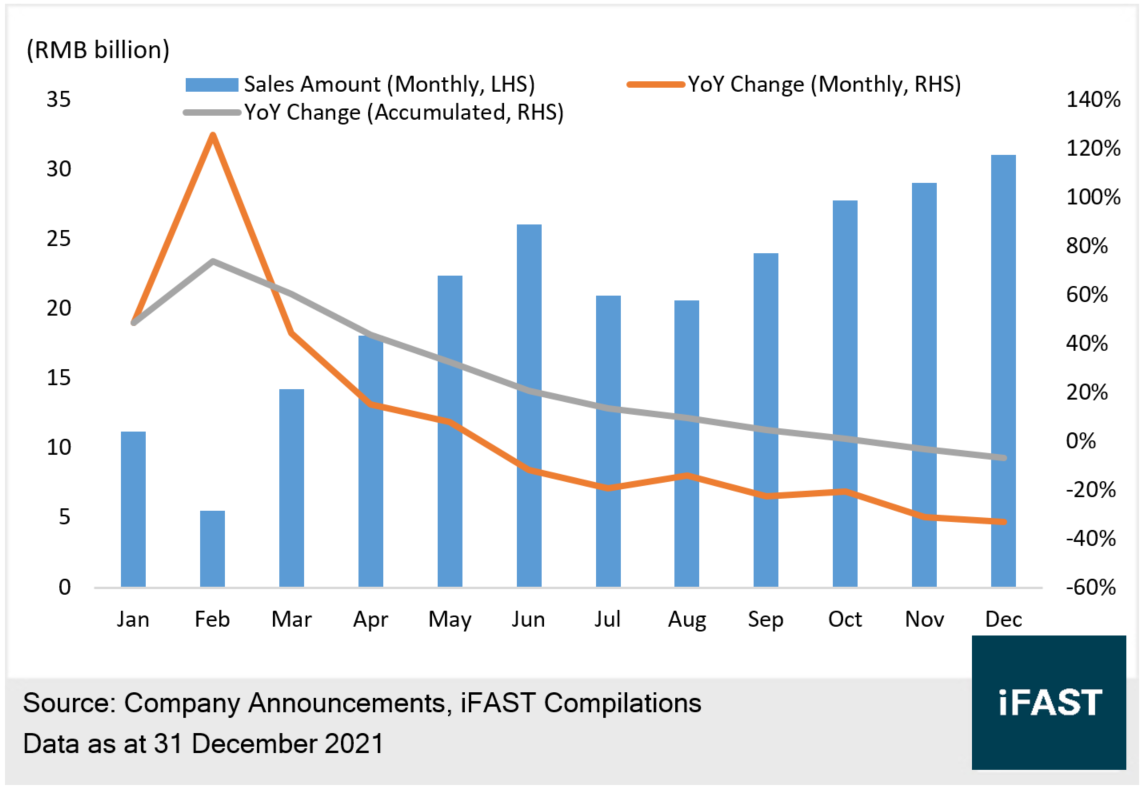
In 2021, the Group’s total contracted sales was RMB 233.8 billion, which decreased by 7% YoY. The decline rate was slightly higher than its peers, owing to a 7% YoY decrease in its average selling price (to RMB 9,928 per sq. meter). The contracted saleable area was around 23,550 thousand sq. meters, remaining roughly flat YoY.
As shown in Table 2, despite the China’s property sales slump from September to December, the Group was still able to monthly contracted sales of 20 billion. In these few months, the YoY decline rates ranged from 20% to 33%, which were lower than its peers. In 2022, it is expected to remain a sales scale of over RMB 200 billion.
Chart 2: Seazen Group Limited’s Sales Figures in 2021
The Group has a Relatively Sufficient Land Bank, with a Low Land Acquisition Cost
The Group’s overall land acquisition cost in 2021 was around RMB 45.0 billion, including RMB 40.4 billion in the first half of the year and RMB 4.6 billion in the second half of the year. The land acquisition of the Group was significantly reduced in the second half of last year, most likely due to tightening regulations on pre-sale proceeds requirement and financing channels.
As at the end of June 2021, the Group’s land bank was around 149.92 million sq. meters (Table 1). Its land bank to sales ratio was as high as 6.9 times, outperforming the peers’ average of 4.4 times. This would be sufficient for the Group’s development projects in the coming five to six years. Thus, even without acquiring new land banks, the Group would still be able to maintain its sales scale in the short-to-medium term. Besides, its average land acquisition cost was as low as RMB 2,700 per sq. meter, which is much lower than its peers. The low land acquisition cost gives the Group relatively high flexibility in property pricing.
Table 1: Seazen Group Limited’s Land Acquisition Cost
2021 1H | 2020 | 2019 | |
Land Bank (million sq. meter) | 149.92 | 142.88 | 123.59 |
Average Land Acquisition Cost (RMB per sq. meter) | 2,674 | 2,615 | 2,503 |
Land Bank to Sales (times) (by area) | 6.9 | 6.1 | 5.1 |
Source: Company Reports, iFAST Compilations Data as at 30 June 2021 | |||
Rental Income and Management Fees from Shopping Malls should still remain a Rapid Growth
Over the past few years, the sales growth of Seazen was not as good as its peers. However, the Group adopts a “two-wheeled drive: residential + commercial” business model, which means while the Group develops residential projects, it will also choose to build new shopping malls nearby. This business model not only brings retail, dining and entertainment but also people flows to the district. This could increase the homebuyer’s confidences, as well as brining a growing recurring revenues for the Group.
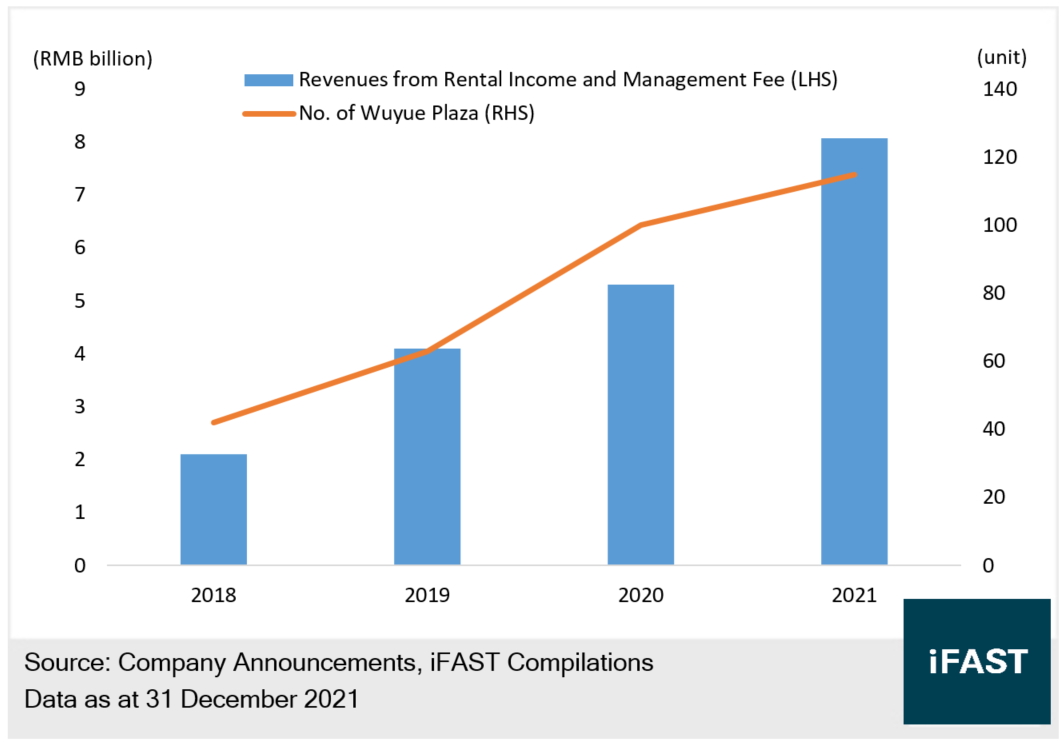
Seazen has expanded rapidly through the shopping malls under the “Wuyue Plaza” brand. As of the end of December 2021, the Group has 115 Wuyue Plaza complexes in total. Last year, the revenues from rental and management fees surged 52% to RMB 8.07 billion. With more competition on shopping malls, newly open shopping malls recognizing full year revenues and an upward adjustment in basic rental income driven by the economic recovery. Therefore, we believe that the Group’s revenues from rental and management fees would continue to grow rapidly.
Chart 3: The Group’s Revenues from Rental and Management Fees
Listing Shopping Malls as a REIT and Disposal of its Commercial Property Management Business Could Be Solutions to Provide More Liquidity
It is worth highlighting that the Group proposes to split off its commercial properties located in Yangtze River Delta and provincial capitals into a REIT, which is named Seazen Asset Management Pte. Ltd. It will raise capital and be listed on Singapore Stock Exchange. If this succeeds, it would greatly enhance the liquidity of the company and for other projects. The company could gradually sell its commercial properties to the REIT as a new financing option. Upon the completion of the proposed spin-off, the Group’s subsidiary, Seazen Holdings, will own around 51% to 55% stake in the REIT.
In addition, Seazen Holdings is still the provider of most commercial property management services of Wuyue Plaza. Taking references from the transaction between the Group and S-Enjoy Services on February 2021, the Group could sell its commercial property management business to S-Enjoy Services, in exchange for one-time cash flow. As most developers are facing liquidity strain, this might become one of the best solutions for them to acquire more liquidity.
Traditional Credit Indicators Worsened, but Off-balanced Sheet Debt Indicators were Still Decent
The financial statement of Seazen Holdings is consolidated into Seazen Group Limited. There are no significant differences between their financial statements (their differences in revenues, assets and liabilities are only 1%). As such, Seazen Holdings’ statement could reflect the Group’s financial situation.
Seazen Holdings has disclosed partial of its financial data in the third quarter of 2021. Taking reference to it, as of the end of September 2021, the Group is a “yellow light” developer under the three red lines requirements. Its net gearing ratio and cash to short-term debts were 69.0% and 1.38 times. Both of them worsened. Its adjusted liabilities to assets ratio was 75.4%, which was still higher than the requirement of below 70% under the three red lines requirements. Its credit profile is fair. Nevertheless, its cost of borrowing went down to 6.5% in the first half of 2021, showing an improving financing ability.
Table 2: Seazen’s Traditional Credit Indicators
2021 3Q* | 2021 1H | 2020 | 2019 | Three Red Lines Requirement | |
Adjusted Liabilities to Assets Ratio (%) | 75.4%* | 76.9% | 76.2% | 78.6% | < 70% |
Net Gearing Ratio (%) | 69.0%* | 65.2% | 50.7% | 38.5% | < 100% |
Cash To Short-term Debt (times) | 1.38* | 1.89 | 2.02 | 1.60 | > 1.0 times |
Total Debt (RMB billion) | 105.6* | 115.2 | 105.4 | 88.1 | / |
Total Cash (RMB billion) | 42.8* | 57.1 | 63.4 | 65.6 | / |
Cost of Borrowing (%) | / | 6.5% | 6.8% | 7.2% | / |
*Data from the Group’s subsidiary, Seazen Holdings (Stock Code: 601155.CH); other data from Seazen Group Limited (Stock Code: 1030.HK) Sources: Company’s Report, Bloomberg Finance L.P., iFAST Compilations Data as at 30 September 2021 | |||||
Besides, as shown in Table 3, the Group’s off-balance-sheet debt indicators were decent. Its high contracted liabilities to attributable contracted sales was 114%, it also achieved a high single-digit in returns on JVs and associates (9%), reflecting that the Group is less likely to use JVs and associates to hide its debts on the project subsidiary level.
However, its subsidiary, Seazen Holdings, has a minority interest to total equity of 42%, which implies that the Group has a relatively high number of partnered development projects. This might increase the risk of being unable to transmit the funds to the group level for the purpose of repayment.
Table 3: Seazen’s Off-balanced Sheet Debt Indicators
2021 1H | |
Difference between Consolidated Ratios | 0% |
Contracted Liabilities / Attributable Contracted Sales | 114% |
Return on JVs and Associates | 9% |
Minority Interests / Total Equity* | 42%* |
*Data from the Group’s subsidiary, Seazen Holdings (Stock Code: 601155.CH); other data from Seazen Group Limited (Stock Code: 1030.HK) Sources: Company’s Report, iFAST Compilations Data as at 30 September 2021 | |
Oversubscription in the Group’s Rights Issue shows its Fairly Good Financing Ability
In January 2022, the Group has launched a rights issue on the basis of one rights share for every twenty-one existing shares, the subscription price was HKD 5.3 per share. Ultimately, it successfully issued 290 million new shares and raised around HKD 1.57 billion. 60% of the proceeds would be used for acquiring the land in Sichuan Province and Hubei Province, while 40% of the proceeds would be used for the repayment for its USD 100 million offshore debts.
It is highlighted that the group’s rights issue was oversubscribed. The Group got 341 million shares subscription, accounting for around 115% of the maximum limit of the rights issue. Besides, the controlling shareholder, Wealth Zone Hong Kong Investment Limited, also applied for extra subscription. This showed the Group’s fairly good financing ability, as well as the controlling shareholder’s confidence in the Group’s future development.
We believe that using the rights issue to inject liquidity into the Group is reasonable, as it could ensure the Group’s to have enough capital to swim upstream under the unfavourable market condition. At the beginning of February, the Group’s subsidiary, Seazen Holdings, announced that it would redeem its USD 200 million bond due March 2022 earlier. This demonstrates the Group has conviction in its cash flow management.
The Bonds are Attractive; Moderately Aggressive Investors Can Consider them
Dragged by the default wave, sales decline and tightening policies, the Group’s credit quality worsened. The Group’s bonds are therefore dropped to around USD 67 to 90 (except the bond due on March 2022). Yet, its bond prices are considered resilient compared to other non-SOE backed developers.
In January, it was reported that the Chinese government is going to ease the regulation on the pre-sales proceeds requirement, together with relaxed measures in the policy side. As such, the Group would be one of the main beneficiaries.
The Group has a large sales scale and massive land bank advantages. Its “two-wheeled drive” business model has established sales advantages and growing recurring revenues. Moreover, it has a relatively strong financing ability, together with its probable less off-balance-sheet debts, we believe that its credit profit is much better than other BB grade peers. Therefore, the bonds are attractive. Moderately aggressive investors can consider them, while conservative investors can remain a wait-and-see attitude to wait for the industry starting to recover from the downturn.
As shown in Table 4, Seazen’s USD bonds could be classified into two types, namely the “FUTLAN bonds”, which are issued or guaranteed by Seazen Group Limited, and “FTLNHD bonds”, which are issued or guaranteed by Seazen Group Limited or Seazen Holdings. Currently, we believe there are no huge differences in the bonds in terms of the priority of debt payments. Investors can assume that their credit qualities are almost the same.
One of the Group’s bonds, FUTLAN 6.150% 15APR2023 CORP (USD), is now available on Bond Express. It has a yield to maturity of 30.9%. Investors could enter the market at a lower cost, so as to diversify their portfolio, limit the transaction size to control the investment risk.
Table 4: Seazen’s USD Bonds
Bond Name | Issuer | Guarantor(s) | Years to Maturity | Ask Price (Investor Buys) | YTM |
FTLNHD 7.500% 20MAR2022 CORP (USD) | New Metro Global | Seazen Holdings | 0.1 | 100.3 | -0.2% |
FTLNHD 6.500% 20MAY2022 CORP (USD) | New Metro Global | Seazen Holdings | 0.2 | 89.7 | 59.6% |
FUTLAN 6.450% 11JUN2022 CORP (USD) | Seazen Group Limited | Subsidiaries | 0.3 | 86.2 | 67.3% |
FTLNHD 5.000% 08AUG2022 CORP (USD) | New Metro Global | Seazen Holdings | 0.5 | 87.6 | 37.8% |
FUTLAN 4.250% 22SEP2022 CORP (USD) | Future Diamond Limited | Seazen Group Limited Seazen Resources Capital Group | 0.6 | 84.0 | 38.3% |
FUTLAN 6.150% 15APR2023 CORP (USD) (Bond Express Member) | Seazen Group Limited | Subsidiaries | 1.2 | 78.5 | 30.9% |
FTLNHD 6.800% 05AUG2023 CORP (USD) | New Metro Global | Seazen Group Limited | 1.5 | 78.1 | 26.9% |
FUTLAN 6.000% 12AUG2024 CORP (USD) | Seazen Group Limited | Subsidiaries | 2.5 | 67.9 | 25.0% |
FUTLAN 4.450% 13JUL2025 CORP (USD) | Seazen Group Limited | Subsidiaries | 3.4 | 67.3 | 18.2% |
FTLNHD 4.625% 15OCT2025 CORP (USD) | New Metro Global | Seazen Holdings | 3.7 | 69.8 | 16.8% |
FTLNHD 4.500% 02MAY2026 CORP (USD) | New Metro Global | Seazen Group Limited | 4.2 | 68.9 | 15.5% |
Source: BSM Data as at 11 February 2022 | |||||
Related Risks
The regulations on the real estate sector are still relatively tight in most cities, and currently, there is no additional detail on the possible loosening regulatory pre-sales proceeds. Besides, due to the weak market sentiment, there might be a further decline in property sales, which might drag down its cash flows.
It may be difficult for Seazen to issue new bonds on the public market. Given that its bonds are traded at over 15% yield, its refinancing risk will be relatively high.
Taking reference from Fujian Yango Group and Yango Group’s case, to a certain extent, the parent company or subsidiary’s solvency would be different when they encounter a liquidity crisis. Seazen’s corporate structure is complicated, which might result in a lower repayment priority of debt for some bonds.
Conclusion
Under China's property sales slump, Seazen is still able to generate monthly contracted sales of RMB 20 billion. Comparing with its peers, it has a relatively sufficient land bank, with a low land acquisition cost. The rental income and management fees from shopping malls should still remain a rapid growth.
The Group’s traditional credit indicators worsened, but its off-balanced sheet debt indicators were decent. The Group’s rights issue has been oversubscribed, reflecting its fairly good financing ability. Additionally, spinning off its shopping malls and listing them as a REIT and disposal of its commercial property management business could be solutions to provide more liquidity.
The bonds are still attractive. Moderately aggressive investors could consider them. Its 2023 bond is available on Bond Express, with a yield to maturity of 30.9%.
Declaration: For specific disclosure, at the time of publication of this report, IFPL (via its connected and associated entities) holds positions in FUTLAN 6.150% 15Apr2023 Corp (USD), and the analyst who produced this report holds a NIL position in the abovementioned securities.
Our podcast series, Yield Hunters, is available on Spotify, iTunes Podcasts and Google Podcasts. We share our thoughts on new bond issues and hold discussions on the fixed income space. Listen to our latest episode below and follow us!