Receive first-hand news on the latest bond issues, credit updates and special events when you join us on our Telegram channel at https://t.me/bondsupermart!
Highlights:
- Dragged down by the sluggish Chinese property market, the government's fiscal revenue from land sales dropped significantly, leading to the fiscal strain of many local governments.
- Local governments are exposed to increasing debt repayment risk due to the tightened refinancing from the Local government financing vehicle (LGFV).
- The central government will likely introduce more loose real estate policies to stabilize local government revenues.
What is Land Finance?
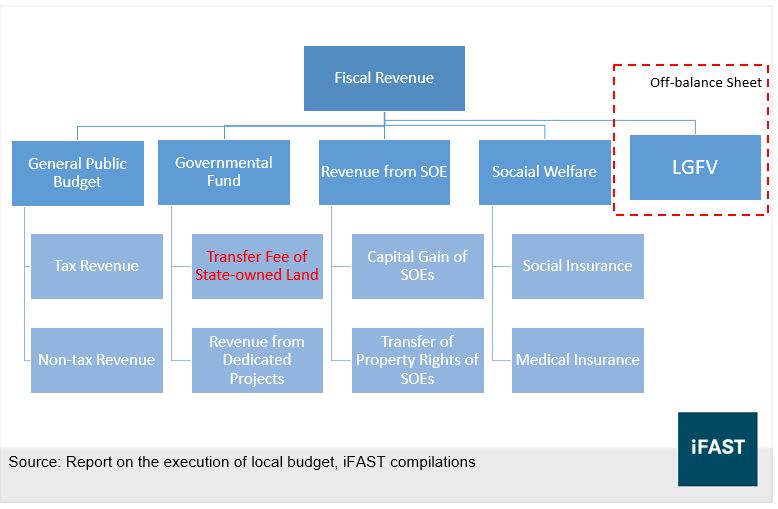
Before answering the question, let's briefly look at the sources of the Chinese local government's fiscal revenue. As shown in the chart below, local governments generate revenue from four categories: general public budget, governmental fund revenue, revenue from SOE, as well as social welfare fund revenue. In addition, to be precise, funds raised by LGFV could be looked as at a source of fiscal revenue, such as the issue of Chengtou bonds (also known as urban construction development bonds).
Chart 1: Local Government’s Fiscal Revenue
 In terms of fiscal revenue breakdown, the general public budget,
and governmental fund revenue are the main sources of fiscal revenue, with the
two together accounting for roughly 90% of total revenue. Specifically, the general
public budget is primarily consisted of taxation, while the vast majority of
governmental fund revenue comes from transfer fees of state-owned land, which
is also known as land sales.
In terms of fiscal revenue breakdown, the general public budget,
and governmental fund revenue are the main sources of fiscal revenue, with the
two together accounting for roughly 90% of total revenue. Specifically, the general
public budget is primarily consisted of taxation, while the vast majority of
governmental fund revenue comes from transfer fees of state-owned land, which
is also known as land sales.
After the Tax-sharing Reform of China in 1994, the central government owns over 60% of the right of the tax levy, resulting in an imbalanced fiscal spending and deficit for local governments. To supplement the fiscal revenue, state-owned land gradually became an irreplaceable asset for local governments, which benefit from land transfer fees and related taxation, such as real estate developers' business tax and land value-added tax. Land sales constitute a vital role in local government's fiscal revenue, particularly for less developed regions.
In short, land finance is the revenue generated by local governments from land sales and further development. At a deeper level. land finance is equivalent to the real estate economy, as local governments commercialise state-owned land and bloom the real estate industry, which plays a very important role in China's economic development.
Land Sales Slumped with High Dependency on Land Finance
It is well known that most Chinese non-SOE developers face a liquidity dilemma over the past two years and have had to cut down their land spending as a result. Especially in 2022 (Chart 2), the top 100 developer's land acquisition spending plunged by 48.9% from one year ago.
Chart
2: Land Spending by Top 100 Developers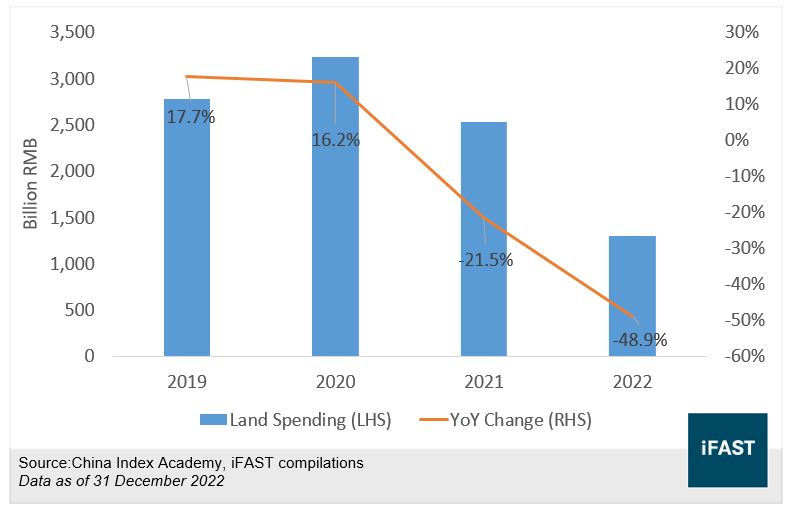 So, how serious is the impact on the local government's land
finance amid the downturn of the property market? We summarised and compiled
the data of land sales and financial metrics of four municipalities and 27
provincial capital cities in China in Table 1. It is important to note that the
reason why we selected the provincial capital cities as samples is because they
usually are the most advanced region of the province in terms of economy. It
suggests that if the economic data of provincial capital cities are weak, the
remaining low-tier cities may face worse conditions. The results below depict
that apart from a few cities such as Shanghai, Hangzhou, Nanchang, and Guiyang,
the rest of the cities witnessed a large drop in land sales in 2022, and over
70% slump was recorded by some cities, including Harbin, Changchun, and
Shenyang.
So, how serious is the impact on the local government's land
finance amid the downturn of the property market? We summarised and compiled
the data of land sales and financial metrics of four municipalities and 27
provincial capital cities in China in Table 1. It is important to note that the
reason why we selected the provincial capital cities as samples is because they
usually are the most advanced region of the province in terms of economy. It
suggests that if the economic data of provincial capital cities are weak, the
remaining low-tier cities may face worse conditions. The results below depict
that apart from a few cities such as Shanghai, Hangzhou, Nanchang, and Guiyang,
the rest of the cities witnessed a large drop in land sales in 2022, and over
70% slump was recorded by some cities, including Harbin, Changchun, and
Shenyang.
The decline in land sales resulted in a dropping fiscal revenue for local government, as at the end of 2022, all cities listed in the table above reported a below 100% fiscal self-sufficient rate, translating into a fiscal deficit. We note that the self-sufficiency rate for Chongqing, Harbin, and Nanning was less than 50%, and the financial stress is quite significant. As a matter of fact, the rising financial pressure could be seen from the trend of a wage reduction for civil servants in many cities since the second half of 2022, and in some cities the pay cut even exceeds 30%. In addition to civil servants, teachers, and doctors also are involved in the trend of wage reduction.
Looking into the dependency on land finance, we selected data from 2021 for reference, given that the sharp decline in land sales in 2022 distorted the reliability of the data. We find that the dependency on land finance for most developed regions is relatively lower, such as Beijing and Shanghai, where the dependencies are around 30%. This is due to the sound economic structure and high urbanisation, local governments 'main sources of revenue are from taxation and capital gain of SOEs, and the importance of land finance is not that high. On the contrary, the dependency on land finance is usually higher for less developed regions, such as Guiyang, where the dependency is greater than 60%, suggesting an obvious financial vulnerability. It also implies that these cities are susceptible to the real estate market. When the land acquisition market turns weak, the likelihood of financial inability for local governments is raising correspondingly. To wrap up the points above, we can see that cities having fiscal difficulties, such as Kunming and Guiyang, either experienced a substantial drop in land sales or have a very high dependency on land finance.
All in all, the depressed real estate market leads to a significant decline in land sales for most cities in China and then weakens their financial situation. Cities with high dependency on land finance might face a more pronounced blow amid the real estate market hardship. Given that the land acquisition market remains silent, with the land spending for Top 100 developers falling by 13.1% YoY for the first four months of this year, we believe that the storm over the financial difficulties for local governments is still underway, and we do not rule out the possibility that a growing number of cities will undergo the fiscal troubles.
Table 1: Land Finance and Financial Metrics for Provincial Cities in China
|
Land Sales (Billion RMB) |
Financial Metrics |
||||
|
2021 |
2022 |
Change |
Fiscal Self-sufficient Rate |
Dependency on Land Finance (2021) |
|
|
Beijing |
254.2 |
210.1 |
-17.3% |
79.9% |
30.8% |
|
Shanghai |
352.8 |
379.9 |
7.7% |
81.0% |
31.7% |
|
Tianjin |
108.7 |
37.9 |
-65.1% |
67.1% |
37.1% |
|
Chongqing |
204.4 |
156.2 |
-23.6% |
43.0% |
49.3% |
|
Nanjing |
229.1 |
139.3 |
-39.2% |
85.2% |
59.5% |
|
Wuhan |
176.1 |
114.3 |
-35.1% |
67.6% |
53.9% |
|
Hangzhou |
229.4 |
291.7 |
27.1% |
96.4% |
48.3% |
|
Guangzhou |
226.5 |
153.5 |
-32.3% |
59.1% |
54.6% |
|
Chengdu |
198.0 |
195.7 |
-1.2% |
70.7% |
53.5% |
|
Xi'an |
116.9 |
105.9 |
-9.5% |
53.0% |
40.7% |
|
Zhengzhou |
77.4 |
33.0 |
-57.3% |
78.0% |
40.6% |
|
Harbin |
22.7 |
4.3 |
-81.0% |
24.6% |
46.4% |
|
Changchun |
66.7 |
15.2 |
-77.2% |
47.1% |
51.9% |
|
Shenyang |
48.4 |
11.2 |
-76.8% |
68.0% |
40.4% |
|
Shijiazhuang |
35.3 |
31.6 |
-10.3% |
56.8% |
35.0% |
|
Jinan |
81.3 |
41.9 |
-48.5% |
79.4% |
46.9% |
|
Taiyuan |
23.7 |
13.9 |
-41.3% |
61.1% |
35.8% |
|
Fuzhou |
92.0 |
60.2 |
-34.5% |
69.9% |
55.1% |
|
Nanchang* |
23.5 |
37.8 |
60.8% |
59.4% |
32.6% |
|
Kunming |
41.8 |
12.4 |
-70.4% |
58.5% |
37.8% |
|
Guiyang |
73.3 |
77.7 |
6.0% |
55.4% |
63.2% |
|
Lhasa* |
2.5 |
1.8 |
-29.5% |
13.0% |
19.2% |
|
Xining |
14.9 |
4.8 |
-68.2% |
38.9% |
49.2% |
|
Lanzhou |
20.3 |
16.0 |
-20.9% |
45.7% |
42.3% |
|
Yinchuan |
8.2 |
2.1 |
-74.2% |
52.5% |
32.5% |
|
Hohot* |
13.0 |
5.5 |
-57.3% |
54.9% |
36.2% |
|
Urumqi * |
22.5 |
11.0 |
-51.3% |
69.1% |
37.3% |
|
Changsha* |
124.6 |
106.5 |
-14.5% |
77.6% |
51.2% |
|
Hefei |
83.2 |
119.0 |
43.0% |
65.6% |
49.6% |
|
Nanning |
52.2 |
21.2 |
-59.4% |
46.8% |
57.1% |
|
Haikou* |
12.0 |
19.2 |
60.7% |
61.6% |
36.5% |
|
Sources: Local government websites, Enterprise Risk Alert, Bloomberg, iFAST Compilations *Land sales data missing, replaced by governmental fund revenue Data as of 31 December 2022 |
|||||
Note: 1. Fiscal Self-sufficient Rate= fiscal revenue/fiscal expenditure. Below 1 means a fiscal deficit.
2. Dependency on land finance= Land sales/ (general public budget+ land sales). It measures the proportion of revenue from land sales over the total fiscal revenue, the greater the figure, the higher the dependency.
Dropping Fiscal Revenue and Increasing Payment Pressure from Chengtou Bond, Credit Risk Goes Up for Local Governments
As mentioned above, funds raised by LGFV are also the sources of local government revenue. Amid a downturn in land finance, LGFVs are supposed to be in theory more critical.
However, the reality is far from the expectation. On one hand, given the increasingly stringent regulatory policies on Chengtou bonds, the issue amount saw a 16% YoY decrease, and the net refinancing amount even plunged by 53%. On the other hand, owing to increasing credit events since the second half of 2022, the capital market is becoming more conservative towards less developed areas, such as Guizhou, Yunnan as well as Inner Mongolia, resulting in a larger decline in the Chengtou bond issue. As they also have a high dependency on land finance, multiple negative factors together accelerated the deterioration of the financial situation for local governments and increased credit risk.
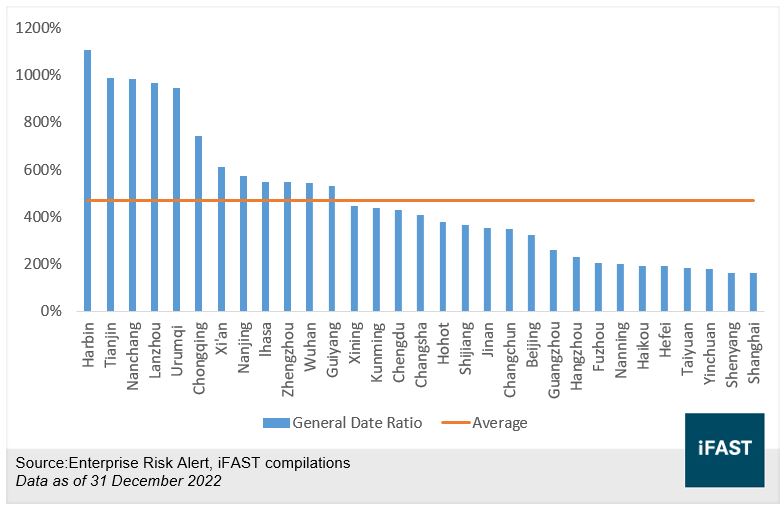
In general, the credit risk of local governments could be measured by the general debt ratio, which equals (total outstanding government debt + debt of LGFV)/ (general public budget + governmental fund revenue+ transfer payment from central or higher-level government). The higher the general debt ratio, the higher the debt repayment pressure and risk. Chart 3 illustrates that Harbin, Tianjin, and Nanchang carry an extremely high ratio of approximately 1000%, Shanghai, a well-develop region, has the lowest debt ratio of 163%. The debt ratio for these cities in our sample averaged 470%, which is quite staggering. In other words, the average debt obligation is around five times bigger than the fiscal revenue. Given the continued contraction of land finance, the general debt ratio is expected to rise further.
Chart 3: General Debt Ratio for Provincial Cities in China
A New Round of Easing Policies Is Around the Corner?
It is also worth noting that local governments not only commercialise the land but also capitalise on it. Before land sales, local governments usually raise funds from banks or financial institutions for land demolition, residential resettlement, and so on. In a sense, the interests of local governments, real estate developers, and financial institutions are highly tied together and gradually form a complex relationship in which both prosperity and loss are shared. It suggests that both local governments and financial institutions would be brought down when the real estate market steps into recession.
So what kind of measures can be taken to alleviate the financial stress of local governments? There are several ways. Firstly, the government could raise the deficit rate. However, according to "Report on The Execution of the Central and Local Budgets for 2022 and the Draft Central and Local Budgets for 2023" announced by the Ministry of Finance, the overall deficit rate will be uplifted by 0.2 percentage points to 3% for 2023, but the incremental part comes from central government, and local government's deficit amount is still limited to RMB 510 billion, which is the same as last year, reflecting the central government's opposition to the expansion of local governments' balance sheet. Secondly, the financial tension could be alleviated if LGFVs raise more funds, but the central government is now strictly controlling the Chengtou bond of local governments and giving priority to hidden debt reduction, making it less feasible.
Finally, we firmly believe that land finance is still the most powerful way. Yet, as mentioned earlier, most non-SOE developers are facing a liquidity crunch and have no capability for land purchase. Therefore, the most important action for relieving land finance is to authentically recover the real estate market. Land finance would pick up as long as the liquidity of developers and market sentiment improve. Even with easing policies such as "the 16 Measures" and "the Third Arrows" at the end of last year, the central government attempted to rescue the real estate market on the premise of "housing is for living, not for speculation". However, the house buyers' confidence remains weak, and the recovery of the real estate market is not as good as the market expected. Worse still, the statistical data, including real estate investment and newly-constructed areas signals a larger downtrend since April this year. In particular, considering the downward pressure on China's economy, the continued weakness of consumption and investment data, and even the possibility of deflation, the importance of the real estate industry, which is the backbone of China's economy, cannot be overstated, we thus believe that the necessity for the central government to impose more easing real estate policies is rising.
However, objectively speaking, the current policies for real estate are already very loose, and the mortgage rates in many cities are lower than the market lending rate, leaving limited room for further easing of policy. What kind of "weapons" could be taken out from "the arsenal" is undoubtedly a big challenge for the government.