Since the Linked Exchange Rate System was introduced, HKD interest rates have closely tracked USD rates. In early May 2025, strong capital inflows from the equity market and IPO subscriptions pushed HKD demand sharply higher, testing the strong-side Convertibility Undertaking at 7.75. The HKMA sold HKD and bought USD to defend the peg, injecting roughly HK$129 billion of liquidity in a single operation. The Aggregate Balance surged past HK$170 billion. The resulting liquidity glut drove the 1-month HIBOR from over 4% down to near zero (see Chart 1).
Chart 1: 1 Month HIBOR V.S 1 Month UST Yield
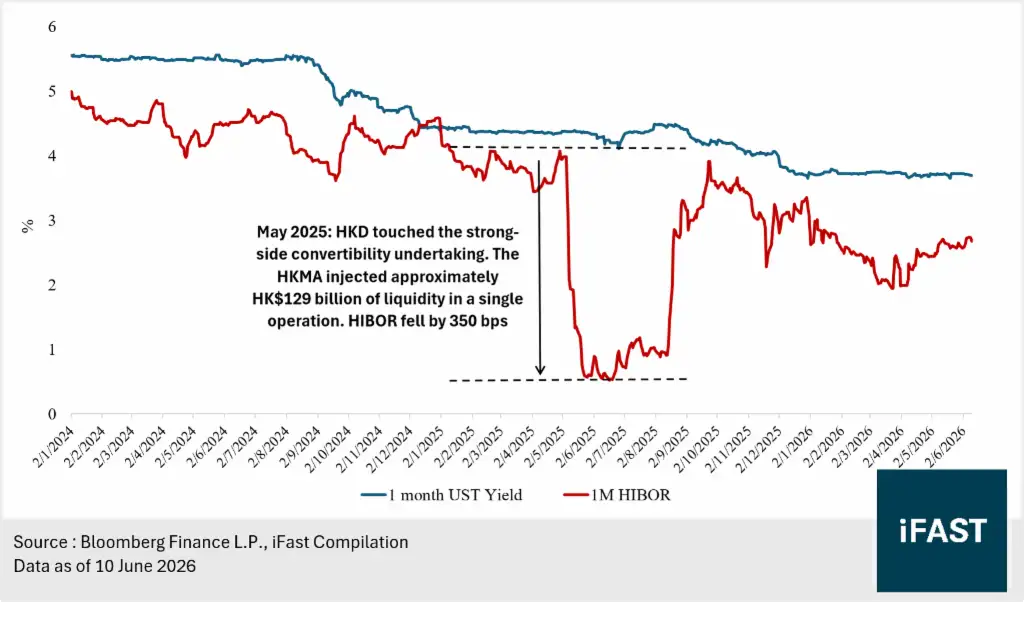
This near-zero HKD rate created an interest differential of more than 300 basis points versus the USD, triggering large-scale carry trades. Investors borrowed cheap HKD to fund higher-yielding USD assets, causing capital to flow back into USD, weakening the HKD and pushing it toward the weak side of the band. When the HKD hit the weak-side Convertibility Undertaking at 7.85, the HKMA bought HKD and sold USD to support the peg while withdrawing liquidity from the banking system. HIBOR began to normalise and converge with USD rates. The trend continued into 2026: the 1-month HIBOR recovered from around 2.0% in March to a high of approximately 2.68% in June. Seasonal cash needs from interim dividends and banks’ half-year settlements are expected to lift HIBOR further into the 3–4% range over the coming months.
Why Allocate to HKD Bonds Now?
For investors who hold HKD and have ongoing HKD funding needs, we see the current environment as an attractive entry point for HKD bonds. Rates have rebounded from the near-zero levels of 2025, and new-issue yields have been repriced to more compelling levels. Investors still sitting on idle cash or low-yielding current accounts can immediately lift returns by moving into high-quality HKD bonds.
Although the market expects HIBOR to rise further, the prevailing yield already far exceeds the near-zero return on idle HKD and provides a solid hedge against reinvestment risk. Investors concerned about higher rates can choose shorter tenors to retain flexibility. The HKD bond universe is dominated by supranational issuers, top-tier banks and high-quality corporates, offering strong credit profiles and reasonable liquidity. Under the Linked Exchange Rate System, FX risk is moderate, and shorter durations help limit price volatility. Overall, these bonds suit investors seeking reliable income and resilient total returns.
Bond Investment — Selected HKD Names on FSM Global
The platform currently offers several HKD bonds issued by corporates, the Hong Kong government and its wholly owned statutory bodies. The following names stand out, with issuer ratings up to AA+ (S&P) and yields to maturity between 3.5% and 4.2%.
Henderson Land Development — HENLND 3.950% 04Jun2033 Corp (HKD)
YTM: 4.23% | Rating: N.R / N.R (S&P / Fitch)
Henderson Land reported stable 2025 results. Total revenue reached HK$25.74billion. Net profit declined 10.4% YoY to HK$6.5 billion, mainly due to the high base from 2024’s one-off government land-resumption gain of HK$4.8 billion. Excluding non-recurring items, core operations remained resilient. Property leasing income edged down 3.4% to HK$6.8 billion, with operating margin holding at 70.5% and average occupancy at 93%. The flagship “The Henderson” achieved 90% occupancy, while Phase 1 of “Central Yards” exceeded 70% and secured premium tenants including Jane Street; rental income is ramping up. Property development revenue rose 16.8% to HK$14.6 billion, but operating profit fell 67.3% to HK$1.6 billion due to the high base and mainland project losses. Given the small scale of mainland operations and solid local presales, we expect profitability to normalise gradually, supported by stabilising property prices and the stamp-duty waiver.
As of end-2025, net debt fell 11% YoY to HK$60.2 billion and net gearing eased to 18.7% (excluding Lee Shau Kee family trust borrowings). Cash and cash equivalents rose 24% to HK$22.2 billion, with interest coverage at 3.0x. In July 2025 the group issued HK$8 billion of convertible bonds to deleverage and manage refinancing risk. The key credit strength remains the Lee family trust’s HK$80.6 billion of perpetual-style funding, providing a substantial capital buffer. With a large land bank (40.5 million sq ft agricultural land) and stable rental income, overall credit risk is manageable.
Standard Chartered — STANLN 3.996% 28May2030 Corp (HKD)
YTM: 3.88% | Rating: BBB+ / A (S&P / Fitch)
Standard Chartered delivered operating income of US$20.9 billion in 2025 (+6% YoY). Net interest income rose only 1% to US$11.2 billion as NIM narrowed slightly from 2.06% to 2.03%. Q1 2026 net interest income also grew 1% YoY to US$2.9 billion, showing resilience. Income growth was driven by higher client activity and net fund inflows. Non-interest income rose 13% to US$9.7 billion, with double-digit gains across Wealth Management, Global Banking and Global Markets. Momentum continued into Q1 2026, with non-interest income up 16% to US$3.03 billion, led by 32% growth in Wealth Management and record net inflows of US$18 billion. The “Fit for Growth” programme kept operating expenses (ex-one-offs) up just 4% in 2025 and 1% in Q1 2026. Net profit therefore rose 26% to US$5.1 billion in 2025 and another 24% to US$1.7 billion in Q1 2026.
Asset quality stayed stable, with NPL ratio around 1.95%. Middle East exposure is approximately 6% of group assets, of which over 90% is Global Banking and more than 75% investment-grade. Management overlay provisions were increased in Q1 2026, but overall credit risk remains manageable. CET1 ratio stood at 13.4% at end-March 2026, well above the 10.3% regulatory minimum and inside the 13–14% target range. Liquidity metrics are strong: LCR 157%, NSFR 138%, both comfortably above 100%. Loan-to-deposit ratio was around 51%, indicating low wholesale funding reliance.
Hong Kong Government — GBHK 3.990% 06Mar2045 Govt (HKD)
YTM: 3.87% | Rating: AA+ / AA- (S&P / Fitch)
The 2025/26 fiscal outturn significantly beat expectations. Total revenue was revised to HK$658.4 billion (+17.8% YoY), turning the original budgeted HK$67 billion consolidated deficit into an HK$11.2 billion surplus and ending four straight years of deficits. Tax revenue exceeded 62% of total; stamp duty beat budget by 47% to HK$99.5 billion on strong equity turnover, while profits tax exceeded budget by 8.7% to HK$209 billion. Even stripping out net bond issuance, the underlying deficit narrowed 51% YoY and the operating account recorded a HK$51.3 billion surplus. For 2026/27, Fitch forecasts 3.5% GDP growth, 6–8% tax revenue growth and only 2.6% expenditure growth, pointing to a further consolidated surplus of HK$22.1 billion.
Credit quality is underpinned by fiscal reserves, the Exchange Fund and low debt. Fiscal reserves rose 1.5% to HK$665.5 billion (≈20% of GDP) at end-March 2026 and are expected to approach HK$700 billion. Total government debt was HK$407.2 billion (debt-to-GDP ≈14%). Reserves comfortably cover total debt. Exchange Fund assets reached HK$4,354 billion with a backing ratio of 111.4%, well above the 100% statutory floor. Although the borrowing ceiling has been raised to HK$900 billion and annual issuance of HK$160–220 billion is planned for the next five years, proceeds are earmarked mainly for refinancing and infrastructure rather than recurrent spending, signalling continued fiscal prudence.
Hong Kong Airport Authority — HKAA 4.250% 14Jan2035 Qsov (HKD)
YTM: 3.53% | Rating: AA+ / N.R (S&P / Fitch)
In the first half of FY2025/26 (ended September 2025), total revenue rose 13% YoY to HK$8.8 billion on recovering air traffic; EBITDA held at HK$3.7 billion. Profit, however, fell 18% to HK$1.28 billion as Three-Runway System expansion interest ceased to be fully capitalised and finance costs jumped from HK$80 million to HK$570 million, compounded by higher depreciation. In April 2025 HKAA acquired a 35% stake in Zhuhai Airport Group for RMB 4.3 billion to expand its Greater Bay Area footprint.
Credit strengths rest on full government ownership, the monopoly position of Hong Kong International Airport and stable cash generation (operating cash inflow HK$3.42 billion in H1). Debt has risen with the expansion: total debt HK$144.1 billion at end-September 2025, net debt HK$115.1 billion after HK$29 billion cash. The MTN programme limit was increased from US$8 billion to US$20 billion, signalling further issuance needs. Liquidity remains adequate, supported by cash plus newly signed undrawn revolving facilities of HK$17.5 billion and RMB 2 billion. Maturities are well spread to 2062. Repayment capacity is solid given government backing and monopoly cash flows, but investors should monitor rising debt and finance costs during the peak expansion phase.
Hong Kong Mortgage Corporation — HKMTGC 3.450% 17Oct2029 Qsov (HKD)
YTM: 3.56% | Rating: AA+ / N.R (S&P / Fitch)
HKMC’s 2025 results reflected a clear business shift. The traditional mortgage portfolio contracted from HK$95.5 billion to HK$78.6 billion, while the annuity business expanded rapidly; annuity premiums doubled to HK$9 billion on promotional incentives and became the new growth driver. The group posted a net loss of HK$109 million (2024: HK$418 million), largely accounting-driven: new annuity policies require immediate expensing of acquisition costs, and lower discount rates after 2025 rate cuts created a HK$1.5 billion non-cash insurance finance expense. Embedded value of the new policies rose to HK$24.4 billion, with present value of expected future profits HK$2.9 billion. Adjusted profit nearly doubled YoY to HK$1.5 billion, helped by Exchange Fund deposit income, property-market recovery on reverse mortgages and USD asset gains.
Credit is anchored by ongoing government capital support. Cumulative injections from 2021 to November 2025 totalled HK$20 billion (HK$12.5 billion in the first 11 months of 2025 alone), lifting total equity from HK$38.9 billion to HK$51.2 billion. An HK$80 billion government revolving credit facility provides further liquidity backup. Operating cash inflow reached HK$34.6 billion in 2025 (2024: HK$9.6 billion). Total debt at year-end was HK$155.2 billion; after cash/short-term funds of HK$64.5 billion and HK$72.4 billion highly liquid Exchange Fund deposits, net debt was only HK$18 billion. Capital adequacy ratio stood at 18.1%. With sustained government backing and stable operating cash flows, default risk remains low.
West Kowloon Cultural District Authority — WEKCDA 3.050% 10Mar2031 Qsov (HKD)
YTM: 3.80% | Rating: N.R / N.R (S&P / Fitch)
In 2024/25 (ended March 2025) the West Kowloon cultural district recorded 15 million visits, ranking among Hong Kong’s top ten overnight tourist attractions for the second consecutive year. Over 60% of visitors to M+ and the Hong Kong Palace Museum came from overseas and mainland China; cumulative visits exceeded 8.4 million and 3 million respectively. Revenue, however, fell 17.9% to HK$870 million due to the absence of one-off non-recurring income (Arts Development Fund, sponsorships). Expenditure stayed flat at HK$1.64 billion, widening the deficit to HK$1.48 billion. The government’s relaxation of financial rules to allow sale of the Area 2 residential project, together with efforts to commercialise cultural IP, should gradually strengthen the revenue base and financial sustainability.
Credit support derives from full government ownership and the prime harbour-front site’s long-term development potential. Total debt at end-March 2025 was only HK$1.25 billion (drawn portion of a HK$5 billion sustainability-linked loan), while cash stood at HK$4.3 billion, placing the Authority in a net-cash position. Credit concerns therefore centre not on leverage but on the recurring development-phase deficit gradually eroding cash (2024: HK$6.2 billion). The Area 2 residential sale will provide financing and medium- to long-term revenue, helping close the gap. With government backing, high-value land and low debt, default risk is contained, but financial sustainability ultimately depends on timely property monetisation and income commercialisation progress.
It is worth noting that the bonds issued by WEKCDA are among the few issued by statutory bodies that are wholly owned by the Hong Kong Government and are not listed on the Hong Kong Stock Exchange. This means that non-professional investors can also invest in these bonds, with a relatively low entry barrier.
Table 1: HKD Bond List
| Bond Name | Issuer | Tenor (Years) | Investor buy Price | YTM | Bond Credit Rating (S&P / Fitch) | HKEX Listed ? |
| HENLND 3.950% 04Jun2033 Corp (HKD) | Henderson Land MTN Limited | 6.95 | 98.57 | 4.23% | N.R / N.R | Yes |
| STANLN 3.996% 28May2030 Corp (HKD) | Standard Chartered PLC | 3.93 | 100.21 | 3.88% | BBB+ / A | No |
| GBHK 3.990% 06Mar2045 Govt (HKD) | Hong Kong Government | 18.71 | 101.15 | 3.99% | AA+ / AA- | Yes |
| HKAA 4.250% 14Jan2035 Qsov (HKD) | Airport Authority Hong Kong | 8.56 | 105.08 | 3.53% | AA+ / N.R | Yes |
| HKMTGC 3.450% 17Oct2029 Qsov (HKD) | The Hong Kong Mortgage Corporation Limited | 3.30 | 99.98 | 3.56% | AA+ / N.R | Yes |
| WEKCDA 3.050% 10Mar2031 Qsov (HKD) | West Kowloon Cultural District Authority | 4.71 | 96.54 | 3.80% | N.R / N.R | No |
Source: iFAST Data as of 24 June 2026 |
||||||
Declaration: For specific disclosure, at the time of publication of this report, IFPL (via its connected and associated entities) holds NIL positions. The analyst who produced this report hold NIL positions in the abovementioned securities. This research report was prepared with the assistance of artificial intelligence (AI) tools. iFAST Financial Pte Ltd does not rely exclusively on AI for content generation; the content of this report – including all investment theses, ratings, price targets and conclusions – has been independently reviewed and verified by the research analyst(s) to ensure accuracy and professional integrity.
RISK DISCLOSURE STATEMENTS FOR BONDS
Key risks of investing in bond
|
Key risks of investing in high-yield bonds
|
| Bonds with special features Some bonds may contain special features and risks that warrant special attention. These include bonds:
|
Remarks
|