(The following information is for reference only and the details are subject to the original announcement.)
Exchange Offer Proposal
On 3 April, Central China Real Estate (“Central China” hereafter) proposed an exchange offer to extend the maturity dates of some bonds, by exchanging the old bonds with the new bonds. This offer seeks to improve the company’s debt structure, strengthen the balance sheet and manage cash flows. The details are as follows:
Table 1: Exchange Offer Summary
| Old Bond Name | Outstanding Amount of Old Bond | New Bond’s Maturity Date | New Bond’s Coupon Rate | Amortization Schedule (Corresponding Principal to Be Redeemed) | New Bond's Coupon Payment Date |
| CENCHI 7.250% 24Apr2023 Corp (USD) | USD 300 million | 28 April 2025 | 7.25% | 28 May 2023 (5% of par value) 28 April 2024 (2.5% of par value) 28 January 2025 (20% of par value) | 28 April and 28 October |
| CENCHI 7.650% 27Aug2023 Corp (USD) | USD 400 million | 27 August 2025 | 7.65% | 28 August 2023 (3% of par value) 28 April 2024 (2.5% of par value) 28 January 2025 (22% of par value) | 27 February and 27 August |
| CENCHI 7.900% 07Nov2023 Corp (USD) | USD 197.3 million | 7 November 2025 | 7.90% | 28 November 2023 (3% of par value) 28 April 2024 (2.5% of par value) 28 January 2025 (22% of par value) | 28 May and 28 November (The last coupon will be distributed on 7 November) |
| Source: Company’s Announcement, Bond Offering Circular, iFAST Compilations Data as at 3 April 2023 | |||||
- The minimum denomination of the new bonds is USD 150,000.
- The minimum acceptance amount is 90% of the outstanding amount of each of the three bonds.
- The accrued interest of the old bonds will be paid together with the first coupon payment of the new bonds in the first payment date.
- If this tender offer is approved by the bondholders, those who accept the offer would have the following compensations:
- A principal amount which is equivalent to 100% of the bond par value (plus the accrued interest)
- An incentive fee which is equivalent to 0.5% of the bond’s par value
- Any accrued interest (only applicable for holders of CENCHI 7.250% 24Apr2023 Corp (USD))
- The offer includes bond amortisation schedules. The company will redeem partial principal in three rounds on the dates mentioned in Table 1.
- The bonds will exempt the default events or cross-default events related to the 2023 old bonds.
The exchange offer will expire at 4pm on 18 April (London time). If the proposal is passed, the new bonds will be distributed on or around 28 April, and listed on SGX on or around 2 May.
A Consent Solicitation to Amend the Default Clauses of Other Bonds
In addition, the Group proposed a consent solicitation for the remaining bonds. The Group seeks bondholders’ approval for amending the clauses of the bonds “ CENCHI 7.750% 24May2024 Corp (USD)”, “CENCHI 7.250% 16Jul2024 Corp (USD)” and “CENCHI 7.250% 13Aug2024 Corp (USD)” and “CENCHI 7.500% 14Jul2025 Corp (USD)”, which include:
- Exempting the default events or cross-default events related to the 2023 old bonds
- Amending other related changes and making other updates.
If the proposal is accepted by the majority of bondholders (the law definition is over 50% of the holders) and successfully passed, the Group will offer a consent fee which is equivalent to 0.25% of the bond’s par value to the eligible bondholders who vote in favour before the deadline (18 April).
Latest Financials of Central China
Recently, Central China announced its 2022 annual results, revealing its tight liquidity situation. As shown in Table 2, the company's net gearing ratio rose to as high as 580% at the end of 2022 due to a significant decline in total equity. The company's cash to short-term debt and unrestricted cash to short-term debt ratios fell to 0.34 times and 0.15 times respectively. The short-term liquidity is under pressure.
Table 2: Central China’s Main Credit Indicators
|
Dec 21 |
Dec 22 |
|
|
Total Debt (RMB billion) |
21.9 |
23.7 |
|
Non-restricted Cash |
5.9 |
1.9 |
|
Restricted Cash (Including Regulatory Pre-sales Proceeds) (RMB billion) |
3.9 |
2.5 |
|
Adjusted Liabilities to Assets (%) |
86.4% |
96.2% |
|
Net Gearing Ratio (%) |
95% |
580% |
|
Cash to Short-term Debt (times) |
1.46x |
0.34x |
|
Non-restricted Cash to Short-term Debt (times) |
0.87x |
0.15x |
|
Source: Company’s Announcement, iFAST Compilations Data as at 31 December 2022 |
||
What is even more worrying is that the company recorded an operating cash outflow of RMB 1.36 billion during 2022. Even excluding the land purchase of several hundred million RMB at the beginning of the previous year, its operating cash flow is still negative, which means that the company cannot rely solely on property sales to meet its daily operating expenses and the related current payables.
If the sales does not catch up significantly, or if the company has to sell the properties at a large discount, even if extra time is allowed, the liquidity will still be gradually depleted. There is little chance of a turnaround in the short term.
However, a state-owned enterprise in Henan Province has already taken a stake in Central China in the middle of last year. The SOE has become Central China’s second-largest shareholder. Coupled with the government’s introduction of the “16-Point Plan” to assist the financing of Chinese real estate developers, we believe that Central China will be one of the largest beneficiaries.
In fact, the company has been provided with credit facilities of $45 billion by a number of banks. This at least ensures that the financing ability is strong, and should be able to make some payments and interests on the debt. It does not fall into a serious default situation.
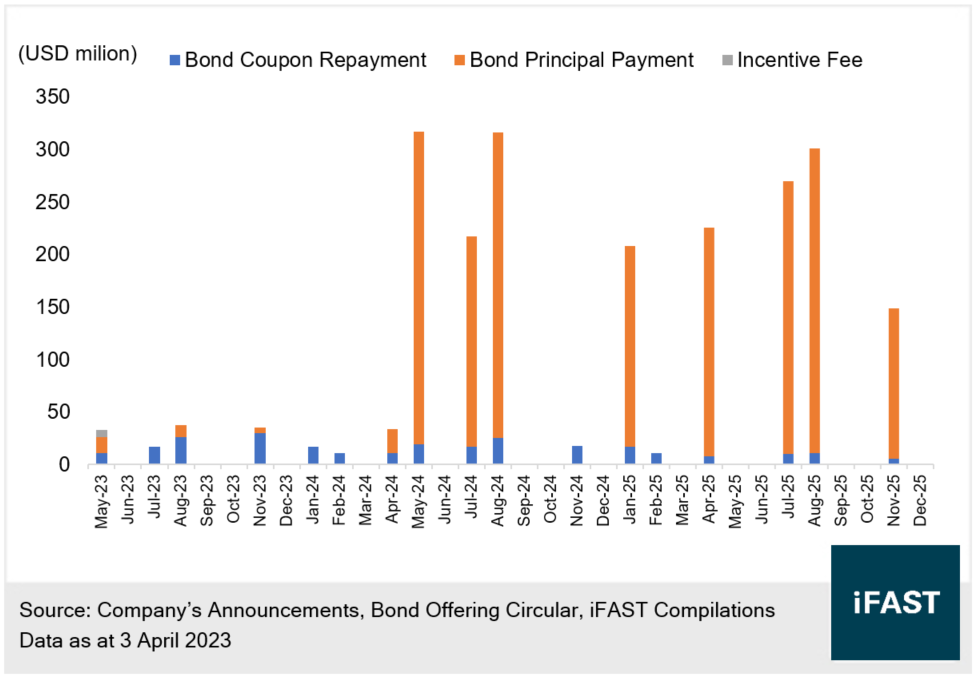
We consolidated the repayments related to Central China’s USD bonds in the next few years (Chart 1). Central China is required to pay a total of about RMB 1.27 billion (about USD 168 million) in the coming year (May 2023 to April 2024), with an average monthly cash outflow of about RMB 110 million. Based on the current contracted sales of around RMB 2.0 billion to RMB 2.5 billion per month, this should be barely enough to cover these expenses.
In order to repay the three USD bonds due in the coming year, the company will need to generate at least RMB 5 billion in monthly contracted sales and make significant progress in disposing assets or financing, so that it does not need to extend the USD bonds again.
Chart 1: Central China’s USD Bond Repayment Schedule (Assuming all holders agree with the exchange offer)
Short Commentaries on Operation and Exchange Offer Proposal
Central China’s exchange offer proposal is close to KWG Group’s and Powerlong Real Estate’s, which all are committed to repay some upfront cash fees. Central China offers an upfront fee of around 7% to 9% of the bond’s par value (0.5% incentive fee + 3% to 5% principal repayment + 3.5% to 4% accrued interest), showing certain sincerity.
However, it is still difficult to reach the minimum acceptance amount (90% or above). If the proposal is not approved, it is expected that the company would not be able to repay its upcoming USD bonds and enter into a default and debt restructuring stage. Investors will face greater uncertainty.
Benefiting from its SOE background and industry policies, from the operation level, we believe that Central China is still able to make USD coupon payments and repay the first two tranches of principal on USD bonds. If this is the case, investors will receive an amount equivalent to around 18% of the bond’s par value (the sum of principal repayment, coupon and incentive fee) within 1.5 years. The received amount is close to the current price. Therefore, investors might consider holding the bond and accepting this exchange offer.
Declaration: For specific disclosure, at the time of publication of this report, IFPL (via its connected and associated entities) and the analyst who produced this report hold a NIL position in the abovementioned securities.
Our podcast series, Yield Hunters, is available on Spotify, iTunes Podcasts and Google Podcasts. We share our thoughts on new bond issues and hold discussions on the fixed income space. Listen to our latest episode below and follow us!