Central China Real Estate is one of the largest property developers in Henan, China.
Henan has a high urbanisation rate potential compared to the national average.
The developer has enough liquidity to cover its short term bond obligations.
We think that the spin-off of the management company is positive for the CENCHI 6.875% 08Aug2022 Corp (USD) and CENCHI 7.250% 24Apr2023 Corp (USD).
Bond prices of longer-term senior USD notes for Central China Real Estate Limited (“Central China Real Estate”) have declined in tandem with the company’s lacklustre contracted sales. The group is also proposing to spin-off Central China Management Company Limited (“CCMC”), which will list on the Hong Kong Stock Exchange very soon.
Following the spin-off of its subsidiary, Central China Real Estate will not retain any interest in CCMC. The final price for the initial public offering (“IPO”) will be priced in between a range of HKD 2.40 per share and HKD 3.20 per share. Accordingly, the market capitalisation of CCMC will be valued between HKD 7.91 billion and HKD 10.55 billion.
Figure 1: Group market cap and bid prices for CENCHI 7.500% 14Jul2025 Corp (USD)
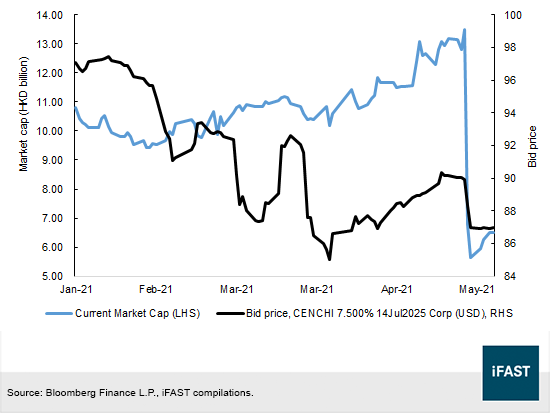
As a reflection of the spin-off on an ex-entitlement basis, the market cap of Central China Real Estate had dropped materially from HKD 13.50 billion on 12 May 2021 to HKD 6.79 billion on 13 May 2021. Concurrently, bid prices of the CENCHI 7.500% 14Jul2025 Corp (USD) (which are Central China Real Estate’s longest dated USD notes) had dropped from 89.94 to 86.91 in a matter of days (Figure 1).
Proceeds from the initial public offering will be used to expand CCMC’s presence in Greater Central China, acquisitions, information technology infrastructure and other general working capital purposes. Based on an offer price of HKD 2.80 per share (being the mid-point of the pricing range), the completed transaction will provide about HKD 852.6m to CCMC and is credit positive for bondholders.
About Central China Real Estate
The group is one of the leading real estate players in Henan, China. As per its 2020 presentation, the group’s market share, which includes light asset contributions, was about 10.8% as at the end of 2020. The company also has a market leading position in 14 out of the 18 prefectural cities in Henan.
Central China Real Estate’s land bank is approximately 54.11m square metres (“sqm”) of gross floor area (“GFA”). Attributable GFA amounts to 40.29m sqm and this will propel the group to continuing real estate development activities for another 4 to 5 years. Nearly 60.3% of its land is under development while the remaining 39.7% is held for future development.
Of the 243 projects on hand, 240 of the group’s projects are located in Henan while 3 projects are based in Hainan. Most of developer’s exposure are in Zhengzhou, as well as other Tier 3 and Tier 4 cities. The average acquisition cost of its land bank was RMB 1,289 per sqm, and this was much lower than the developer’s average selling price of RMB 7,683 per sqm. Properties still fetch a price premium as the average selling property price in Henan was about RMB 6,641 per sqm during 2020.
In addition to residential development, Central China Real Estate also recognizes revenue from hotel operations. Some of its notable hotels include the Le Meridien Zhengzhou and Pullman Kaifeng Jianye. All nine hotels have 1,758 rooms in total with an average occupancy rate of 49% in 2020. Meanwhile, average revenue per available room fell 20% to RMB 207 last year.
Mr. Wu Po Sum, the chairman and founder of the group, owns 69.1% of Central China Real Estate through Joy Bright Investments. After the drop in market cap on 13 May 2021, the company announced that Mr. Wu and/or Joy Bright Investments will increase their shares by up to HKD 100m within the following six months.
Financial results
Group revenue increased by 40.8% during 2020 to RMB 43.30 billion. During the first half of the year (“1H20”), group revenue declined to RMB 13.02 billion but staged a sharp rebound in 2H20 to RMB 30.29 billion. According to the company, the amount of revenue that will be recognised over the next 12 to 36 months, stemming from progressives sales of properties under development and project management services will amount to RMB 76.50 billion.
Nonetheless, future revenue growth is likely to be capped by weak contracted sales in the past few months. In the four months till April 2021 (“April YTD”), Central China Real Estate sold a lot less real estate compared to the corresponding period a year ago. Contracted sales of heavy assets added to RMB 13.97 billion in the first four months of this year, and that is down 13.1% in 2019 (Figure 2).
Figure 2: Contracted sales of heavy sales
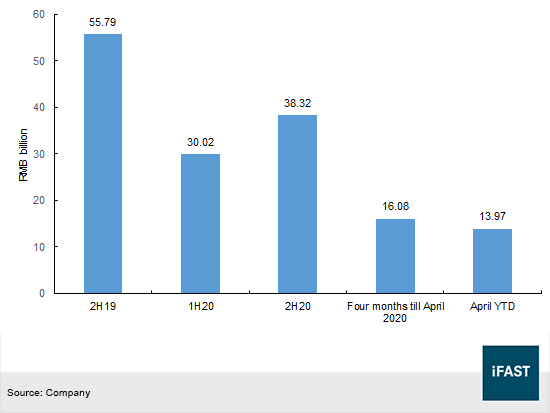
This year, the group has a contracted sales target of RMB 80.0 billion, up 17.1% from its achievement of RMB 68.3 billion in 2020. Central China Real Estate guided that 60% of the sales will come from Tier 3 and Tier 4 cities, and 18% will come from Zhengzhou. However, selling activity has been sluggish and contracted sales in 2H20, 1H20 and April YTD have yet to reach their 2H19 highs (Figure 2).
The company made a lower profit of RMB 2.10 billion in 2020 (2019: RMB 2.42 billion) on the back of substantially higher finance costs from RMB 395m to RMB 1.27 billion. The jump in finance costs was primarily driven by higher bank loan interest of RMB 2.64 billion (2019: RMB 2.24 billion), and RMB 667m of net charges connected to the fair value of its derivatives.
That being said, our adjusted EBIT estimate or adjusted earnings before interest and taxes estimate increased from ~RMB 5.44 billion in 2019 to ~RMB 6.03 billion in 2020. This is equivalent to ~2.3 times the amount of interest expense in 2020. Although the company’s interest servicing ability of ~2.3x is at a comfortable level, the multiple is down slightly from ~2.4x in 2019.
Net cash generated from operating activities increased from RMB 551m in 2019 to RMB 4.77 billion but operating profit before changes in working capital fell slightly from RMB 4.48 billion in 2019 to RMB 4.37 billion in 2020. With RMB 1.37 billion used for investing activities, and RMB 3.21 billion used for financing activities, cash and cash equivalents dropped slightly to RMB 22.62 billion in 2020 (2019: RMB 22.71 billion).
Credit position as at December 2020
Central China Real Estate has a sufficient amount of liquidity to cover its current borrowings with RMB 22.62 billion of unrestricted cash and RMB 15.26 billion of short-term debt. Total borrowings remained around RMB 31.30 billion in 2020, but RMB 6.50 billion of this amount is secured by assets and may be refinanced. Furthermore, the group may access its RMB 22.6 billion of undrawn banking facility as at 31 Dec 2020 for debt repayments.
There were approximately RMB 7.20 billion of offshore senior notes due in 2021, but the group has paid down the USD 300m CENCHI 8.750% 23Jan2021 Corp (USD), USD 300m CENCHI 6.875% 10Feb2021 Corp (USD) and USD 400m CENCHI 6.500% 05Mar2021 Corp (USD) that were due early this year.
Part of this was refinanced through the issuance of the USD 260m CENCHI 7.500% 14Jul2025 Corp (USD) in January 2021. The company may issue new bonds to refinance the USD 400m CENCHI 6.750% 08Nov2021 Corp (USD) due in November, or use existing cash to redeem the notes.
Gearing measures were lower in 2020 but they remain manageable in our view. Net debt to total equity ratio decreased to 56.8% (2019: 64.2%), while total debt to capitalisation fell slightly to 68.2% in 2020 (2019: 71.4%). However, current assets are about 1.11x that of current liabilities, and this is a drop from 1.12x in 2019. At the same time, the average debt maturity increased to 2.14 years in 2020 from 2.02 years in 2019. The group also incurred a higher funding cost of 7.4% (2019: 7.3%).
Bond recommendations
In view of its adequate liquidity profile, we recommend investing in the CENCHI 6.875% 08Aug2022 Corp (USD) and CENCHI 7.250% 24Apr2023 Corp (USD), which are offering a decent yield along the CENCHI curve (Figure 3). We think that the notes’ respective yields-to-maturity (“YTM”) of 7.40% and 9.25% offer a good return to investors.
Figure 3: Central China Real Estate offshore bonds
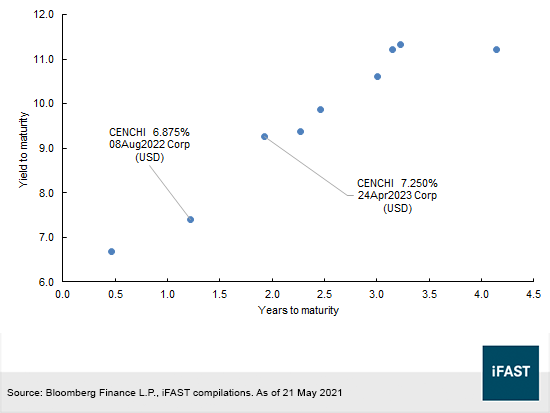
The CENCHI 6.875% 2022’s are callable at 102 after 8 Aug 2021, and this is still a distance from its offer price of 99.63 (21 May 2021). Furthermore, the notes are also redeemable at 106.875 in the event of an equity offering, and bondholders have the right to sell their holdings back to the issuer at 101 in a Change of Control event. In our view, we do not think that the issuer will call back the 2022 USD notes considering its current price and large capital commitments.
Likewise, the CENCHI 7.25% 2023’s have similar Change of Control conditions and are redeemable at 107.25 if the company launches an equity offering. However, the issuer has the option of redeeming the notes at 103.625 any time and this would make the CENCHI 7.25% 2023’s less compelling compared to the CENCHI 6.875% 2022’s. Nonetheless, the probability of a call event is quite low as the notes are trading at around 98.00 (representing a few percentage points from its call price).
On a separate note, investors may be keen to know that Moody’s Investors Service assigned a credit rating of ‘B1’ to the CENCHI 7.25% 2023’s on 15 Apr 2019. They were also rated ‘BB-‘ by Fitch Ratings on 3 May 2019. CENCHI 6.875% 2022’s were rated ‘B1’ by Moody’s on a 1 Aug 2019 and ‘BB’ by Fitch Ratings on 13 Aug 2019. Central China Real Estate has issuer ratings of “Ba3”, “B+”, and “BB-“ with stable outlooks from Moody’s, S&P, and Fitch respectively.
Figure 4: G-spreads of CENCHI offshore notes
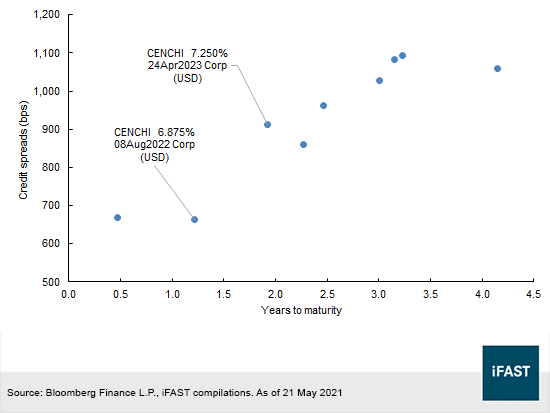
We think that the valuations of the notes are also attractive given that the CENCHI 6.875% 2022’s and CENCHI 7.25% 2023’s have credit spreads of 663 basis points (“bps”) and 912bps over US Treasuries (“G-spreads”). In particular, the 2023 notes stand out for its decent spread pickup among USD notes as seen in Figure 4.
As a final note and in light of its market leading position in Henan, comfortable liquidity position and good earnings visibility, we think that the CENCHI bonds are a good option for USD high yield alternatives among Chinese real estate issues. China’s home prices are increasing amidst the pandemic and while it does pressure the government to impose more cooling measures on the property market, national housing policies will likely promote a stable and healthy development of the real estate market. Residential property assets in certain areas will be in demand and this is good for property developers.
Declaration:
For specific disclosure, at the time of publication of this report, IFPL (via its connected and associated entities) and the analyst who produced this report hold a NIL position in the abovementioned securities.
Our podcast series, Yield Hunters, is available on Spotify and iTunes Podcasts and Google Podcasts. We share our thoughts on new bond issues and hold discussions on the fixed income space. Listen to our latest episode below and follow us!