Introduction
MNRB (Malaysian National Reinsurance Berhad) is a provider of reinsurance and retakaful, as well as two takaful (Islamic system of insurance) operators.
The group has 5 business segments, comprising of reinsurance, retakaful, general takaful, family takaful, and investment holding and others.
MNRB to divest takaful units to Bank Rakyat
Fresh off the press is the news that MNRB has entered into an implementation agreement (IA) with a unit of Bank Rakyat, to divest its two takaful subsidiaries to Bank Rakyat for RM1.64 billion in cash. The IA sets out the framework for the parties to pursue regulatory approval from Bank Negara Malaysia and other relevant authorities.
We opine the divestment serves two purposes, namely
1) to focus on its core reinsurance and retakaful operations and
2) to fund the approximately USD100.69 mil acquisition of the remaining 80% equity interest in Labuan Reinsurance.
MNRB already holds a 20% stake in Labuan RE, which effectively making Labuan Reinsurance a wholly owned subsidiary upon completion. The acquisition is meant to further build the group’s presence in international reinsurance market, which Labuan RE is already a participant in Lloyd’s market, providing access to a broader and more specialised underwriting opportunities.
The acquisition is expected to complete in 4Q26, subject to regulatory and shareholders’ approvals.
Table 1: Expected changes in MNRB business division
|
|
In (Investment) |
Out (Divestment) |
|
1) Reinsurance |
+ 80% stakes in Labuan Re |
- General takaful |
The numbers make sense
From a number perspective, divesting insurance divisions and doubling down on reinsurance divisions make sense.
With the divestment, the group could indeed lose up to 48% of its total revenue and 21% of its profit after tax, using FY26 numbers.
However, the potential acquisition on the other hand will allow MNRB to record the full earnings from Labuan RE, which in FY26 has yielded RM33.1 million PAT for the group (as a 20% associate). Following full acquisition, that will be an approximately additional RM132.4 million in profit after tax.
That would have more than offset the PAT garnered from the two to be disposed insurance divisions (total of RM108.8 million PAT in FY26), which have a lower net profit margin due to aggressive competition in Malaysia B2C insurance.
Following the restructuring, MNRB’s business model will consolidate into just reinsurance business rather than a combination of reinsurance and takaful businesses.
Continue to be supported by BNM as a national reinsurer
As a national reinsurer, MNRB continue to be benefited from two enforcements made by Bank Negara Malaysia (BNM), namely voluntary cession (VC) scheme and compulsory cession (CC). It is viewed as a national mandate, reaffirming Malaysian Re's role in supporting the local economy and reducing the outflow of reinsurance premiums to overseas markets.
CC scheme requires all local general insurers to cede 2.5% of their business to MNRB, while VC is a framework where the group receive automatic cessions as well as automatic participation in domestic facultative and treaty reinsurance. These have provided premium stability to the group.
The two schemes are subject to BNM’s approval every 3 years, with the current schemes scheduled to end on 31 December 2027.
Continue to possess healthy ratios
Pre-acquisition, for the reinsurance business, the group’s portfolio is equally split between local (50%) and overseas (50%), controlling the risk locally while diversifying to different countries including India, China, Thailand, Cambodia, Philippines, Japan, Indonesia and South Korea.
Looking at combined ratios (total claims plus expenses as a proportion of premiums earned), Malaysian Re has recorded a combined ratio of 74.20% for FY26, better than the 78.10% seen in FY25. A combined ratio well below 100% means MNRB generates a strong underwriting profit, even before accounting for investment income.
Interestingly, takaful units (to be disposed) in general have had a bigger combined ratio, as seen in the table, further supporting the stance for MNRB to refocus back on reinsurance operations.
Table 2: Combined ratio
|
|
FY25 |
FY26 |
|
Malaysian Re |
78.10% |
74.20% |
|
Takaful IKHLAS Family |
123.90% |
70.80% |
|
Takaful IKHLAS General |
90.70% |
90.10% |
|
Source: MNRB, iFAST compilations. Data as of 31 March 2026. |
||
As for interest coverage ratio, FY26 figure remains robust at 22.5 times, improving from 16.7 times in FY25, indicating ample capacity to service interest obligations.
In terms of debt servicing ability, the proposed divestment (RM1.64 billion) and acquisition (USD100.69 mil = approx. RM412 mil) are expected to result in net cash inflow of around RM1.2 billion.
This comfortably exceeds the group’s borrowings of RM670 million, even before considering any additional debt that may arise following Labuan Re’s transition into a wholly owned subsidiary. Meanwhile, debt to equity also edged down to 17.2% (FY25: 18.0%).
Importantly, MNRB and its key subsidiaries continue to maintain capital adequacy ratios above the regulatory minimum of 130% as at end-December 2025, providing additional buffer to support financial resilience.
Conservative investment asset mix
In terms of investment mix, the group continue to have a rather conservative portfolio, with 63% allocated to fixed income and 24% to deposits, leaving only 8% to equity and the other 5% to other instruments. The group has a history of being conservative, with steady and predictable income as priority, while the larger part of highly liquid instruments enables the group to cover for claims.
Chart 1: MNRB’s investment asset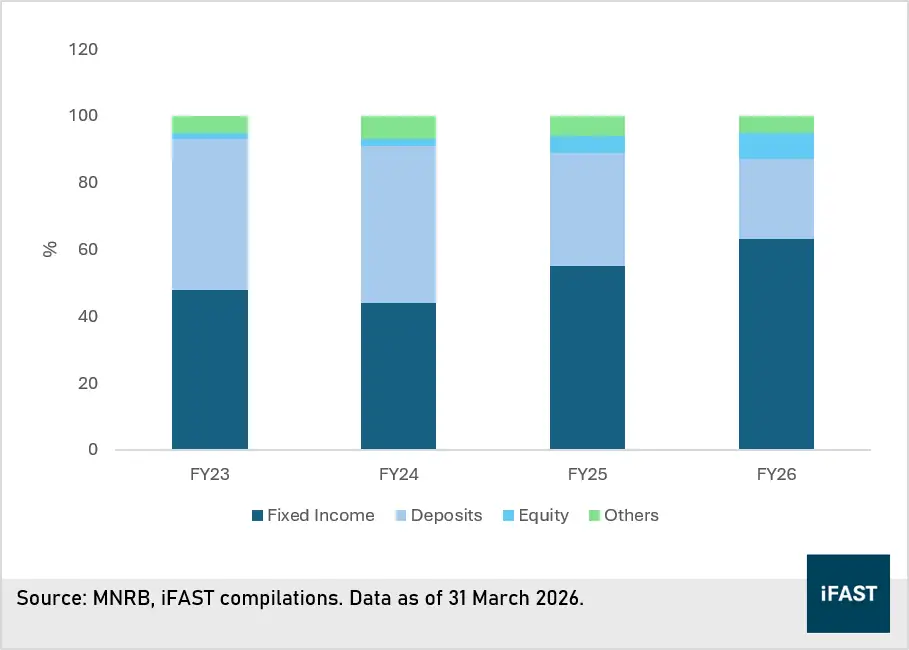
Conclusion
We remain positive on MNRB's credit profile and view the proposed divestment as a strategic initiative to streamline its operations and sharpen its focus on its core reinsurance and retakaful businesses, which have consistently delivered stronger underwriting performance, as reflected in their superior combined ratios.
In addition, we believe the likelihood of MNRB exercising the call options on both MNRBMK 5.210% 26Oct2032 Corp (MYR) and MNRBMK 4.460% 22Mar2034 Corp (MYR) is high, given that both instruments qualify as Tier 2 regulatory capital. Under Bank Negara Malaysia's Risk-Based Capital (RBC) Framework for Insurers, Tier 2 subordinated debt is subject to a straight-line regulatory capital amortisation of 20% per annum during its final five years before maturity. As a result, these sukuks become progressively less capital-efficient if they remain outstanding beyond their first call dates, providing a strong economic incentive for MNRB to redeem them. The group also has the requisite fund to make for a redemption.
Accordingly, we recommend existing bondholders to maintain their positions. However, for investors seeking new exposure, we believe the current yields on MNRB's sukuks offer limited upside. Instead, we prefer alternatives such as SIBSAB 5.600% 01Mar2030 Corp (MYR), which currently yield to maturity of approximately 5.2% and present a more attractive risk-return profile.
Table 3: MNRB’s bond on platform (subject to liquidity)
|
Outstanding bond |
Years to next call/Years to maturity |
Bond Price |
Yield to worst |
|
|
200 mil |
1Y2M/6Y2M |
102.15 |
3.% |
|
|
420 mil |
2Y7M/7Y7M |
102.49 |
3.45% |
|
|
Source: Bondsupermart, iFAST compilations. Data as of 6 August 2026. |
||||