With the resurgence of recent coronavirus cases and the spectre of low tourist arrivals, Changi Airport Group (“CAG”) is raising capital through its first medium term note offering. The issuer has announced a 10-year SGD bond at an initial price guidance (“IPG”) of 2.00%.
Other airport operators such as the Airport Authority in Hong Kong have also recently issued debt. For example, the HKAA 1.625% 04Feb2031 Qsov (USD) was issued in February 2021, at a coupon rate of 1.625%. Both the issuer and the bonds are rated AA+ by S&P Ratings.
About the bond
CAG is launching 10-year unsecured SGD notes that priced under its SGD 2 billion multicurrency medium term note programme. Proceeds of the bonds will be used for general corporate and working capital purposes. Moody’s Investors Service is expected to assign Aaa - the highest investment grade ratings to the bonds. Meanwhile, Changi Airport Group (Singapore) Pte. Ltd. is rated Aaa by Moody’s with a stable outlook.
Under the terms of the offering, the issuer has the right to redeem the bonds for taxation reasons. Noteholders have the option of selling the bond back to the issuer at par in a Put Option Event - where no member of the Group holds a valid airport licence from the Civil Aviation Authority of Singapore (“CAAS”) under the CAAS Act to operate any part of Changi Airport.
About CAG
As a wholly-owned subsidiary of the Minister of Finance, Changi Airport Group is the owner and operator of Changi Airport - an award winning airport and widely recognised as one of the best air hubs in the world. Changi Airport was also one of the busiest airports as it welcomed 62.9m passengers and handled 1.97m tonnes of cargo in the financial year ended 31 Mar 20 (“FY2020”).
Having started operations in 1981, Changi Airport has witnessed a robust growth in passenger traffic over the years. It has four airport terminals and is in the midst of building a fifth terminal as part of the Changi East Project. However due to Covid-19, Terminal 5 has paused construction for at least two years.
In 2014, CAG formed a joint venture with CapitaLand Limited to operate Jewel Changi Airport, a large shopping and entertainment complex within Changi Airport with aviation connectivity and hospitality options for visitors. Its dome shape design structure and iconic 40 meter indoor waterfall had received many rave reviews when it first opened in 2019.
CAG also manages operations at Seletar Airport on a cost-recovery basis where CAAS reimburses CAG for the cost of running the small airport. Seletar Airport mainly services business travellers as it runs private and commercial flights, as well as provide maintenance and repair works for aircrafts.
As the owner of Seletar Airport, CAAS has granted CAG the licence to operate Seletar Airport under Section 36 of the CAAS Act from 1 Jul 2009 to 31 Mar 2042. Nonetheless, financial results from Seletar Airport are not material to Changi Airport Group.
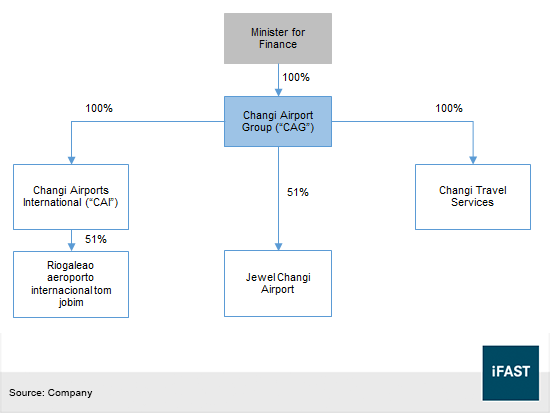
Furthermore, CAG is a consultant, manager and investor of aviation assets through Changi Airport International Pte. Ltd. (“CAI”). CAI has a 51% stake in Concessionaria Aeroporto Rio de Janeiro S.A. (“CARJ”), the operator of the Tom Jobim International Airport in Rio de Janeiro, Brazil. CARJ has a 25-year agreement for the expansion and maintenance of the Brazilian airport starting from 2014.
Changi Travel Services Pte Ltd (“CTS”) is the other wholly-owned subsidiary of CAG. CTS provides solutions for travellers such as Changi Recommends, which is a portal offering travel deals and products for visitors. These include the sale of overseas SIM cards, travel attraction promotions and Wi-Fi router rentals.
An overview of the group structure is shown in Figure 1.
Figure 1: Group structure
Revenue recognition
Group revenue is primarily recognised from regulated and non-regulated businesses. Regulated revenue represented nearly 50% of group revenue in FY2020, and is made up largely of aeronautical and security services provided to airlines and passengers. Secondly, airlines pay a fee to CAG for the use of airport facilities to land and park their passenger planes. Thirdly, CAG also receives a fee from ground handlers, and every passenger who departs or transits at Changi Airport.
On the other hand, non-regulated revenue is derived from (a) the leasing of retail space under concession arrangements, (b) office and warehouse rentals along with (c) car park fees.
Apart from regulated and non-regulated revenues, CAG also receives income from Jewel Changi Airport and Tom Jobim International Airport, both of which contributed SGD 129m and SGD 299m of revenue respectively.
FY2020 results
With regard to its recently published financial performance, total revenue at CAG increased slightly from SGD 3.04 billion in FY2019 to SGD 3.12 billion in FY2020. This was backed by strong passenger traffic during the first ten months of FY2020, although the high growth was offset by a 32.8% YoY and 70.7% YoY decline in February and March 2020. Overall in FY2020, passenger traffic at Changi Airport declined by 5.1% to 62.9m.
Table 1: Top-line performance since FY2018
|
|
FY2018 |
FY2019 |
FY2020 |
9M |
9M |
|
Revenue |
2.6 |
3.0 |
3.1 |
2.5 |
0.5 |
|
Total expenses |
1.6 |
2.1 |
2.3 |
1.7 |
1.1 |
|
EBITDA |
1.3 |
1.5 |
1.6 |
1.3 |
0.1 |
| Source: Company, iFAST estimates. Figures in SGD billion. Note: 9MFY2020 and 9MFY2021 are based on unaudited financial figures | |||||
Total cargo throughput dropped 7.5% YoY to 1.97m tonnes during FY2020 while aircraft movement declined 6.0%. Total aircraft movement in September 2020 fell to about 17% of its level in 2019. With SGD 286.2m of finance expenses and SGD 268.3m of income tax expenses, group profit after tax dropped from SGD 573.7m in FY2019 to SGD 146.3m in FY2020. Earnings before interest, taxes, depreciation and amortization (“EBITDA”) however decreased slightly from ~SGD 1.57 billion to SGD 1.43 billion in the same period.
Nevertheless, CAG’s cash position of SGD 2.42 billion was more than adequate to cover its short term borrowings of SGD 46.8m at FY2020. Group EBITDA was ~15.3 times its interest expense and this is indicative of a high interest expense servicing ability. The airport operator has a low gearing, measured as net debt over total equity at ~19.5% in FY2019 and ~22.2% in FY2020.
9MFY2021 results
Since the start of FY2021, global air traffic has declined significantly due to the pandemic as many countries have tightened border controls and imposed travel restrictions that have led to a grounding of airline fleets. Passenger traffic has dropped and the lower number of flights have resulted in a meaningful fall in revenue collected from airlines, concessionaires and other airport customers. If the number of flights and passenger traffic continue to remain low, the group may receive lower rental income from the leasing of retail spaces at the airports.
As we understand, cargo throughput and passenger movements plummeted to 60% and 0.45% of 2019 levels in April 2020. Cargo throughput recovered to 85% of 2019 levels in March 2021 but passenger movements have stayed low, at around 3% of where it was in 2019.
According to unaudited results for the 9-month period ended 31 Dec 20 (“9MFY2021”), group revenue decreased 82% YoY to SGD 0.5 billion while profit after-tax and minority interest (“PATMI”) swung from a gain of SGD 0.6 billion in 9MFY2020 to a loss of SGD 0.5 billion in 9MFY2021. After taking into account SGD 1.1 billion of expenses, EBITDA plunged by 95% to ~SGD 0.07 billion in 9MFY2021.
However, CAG’s liquidity and gearing profile continues to stay healthy. The company was in a net cash position at the end of December 2020. Cash & cash equivalents amounted to SGD 1.9 billion, and that was more than enough to cover its SGD 1.8 billion of loans & borrowings. The company also revealed that it had secured a SGD 2 billion committed revolving credit facility in April 2021. A breakdown of CAG’s borrowings is displayed in Table 2. The CAI bond due in 2021 was recently redeemed so the group does not have any loans and borrowings due within the next year.
Table 2: Loans and borrowings
|
Type of borrowing |
Borrower |
Total facility size (SGD billion) |
Outstanding amount (SGD billion) |
Maturity |
|
Term loan / committed revolving credit facility |
CAG subsidiary |
1.0 |
1.0 |
2024 |
|
Loan from non-controlling interest |
CAG subsidiary |
0.3 |
0.2 |
2024 |
|
Term loan (amortizing) |
CAG subsidiary |
0.4 |
0.3 |
2027 |
|
CAI bond (private placement) |
CAG subsidiary |
0.3 |
0.3 |
2021 |
| Source: Company, iFAST compilations | ||||
Pricing comments
With an IPG of 2.00%, the new 10-year bond by Changi Airport Group (Singapore) Pte. Ltd. (“CAGPTE”) would provide a pickup of 43 basis points (“bps”) above the current 10-year Singapore government bond yield (yield to maturity on 4 Apr 2021: 157bps), and a pickup of 20bps above the HDBSP 2.545% 04Jul2031 Qsov (SGD) at its YTM of 180bps.
Figure 2: Relative valuation of comparable long-term SGD bonds
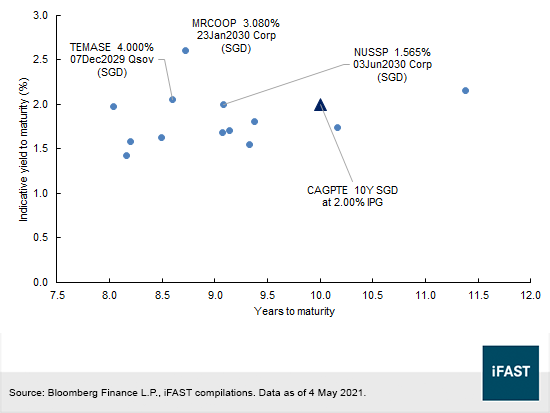
However, we think that CAGPTE’s credit spread (“G-spread”) of 43bps is less attractive compared to the TEMASE 4.000% 07Dec2029 Qsov (SGD), which is trading at a YTM of 2.05% and a G-spread of 63bps. The bond is rated Aaa/AAA by Moody’s/S&P respectively. TEMASE, or Temasek Financial I Ltd is an indirect subsidiary of Temasek Holdings. In our opinion, investors who have a shorter investment horizon are better off investing in this TEMASE bond.
Additionally, the NUSSP 1.565% 03Jun2030 Corp (SGD), also rated Aaa by Moody’s Investors Service would provide a similar yield. With a YTM of 1.99% and a 9-year tenor, the NUSSP 1.565% 2030’s would be comparatively more attractive at a G-spread of 60bps.
Investors looking for a higher yield may consider the MRCOOP 3.080% 23Jan2030 Corp (SGD). MRCOOP, or Mercatus Co-operative Ltd is a subsidiary of NTUC Enterprise Co-Operative Ltd. NTUC provides commercial support services, including healthcare, childcare, essential foods, and financial solutions to meet a social needs in Singapore. The MRCOOP 3.08% 2030’s trade at a YTM of 2.59% and a G-spread of 115bps.
All in all, we think that CAG has a very low risk of default and a healthy liquidity profile, but we think that there are better opportunities in the SGD bond market. In short, the CAGPTE bond offering is unattractively priced at its 2.00% IPG.
Declaration: For specific disclosure, at the time of publication of this report, IFPL (via its connected and associated entities) and the analyst who produced this report hold a NIL position in the abovementioned securities.
Our podcast series, Yield Hunters, is available on Spotify and iTunes Podcasts and Google Podcasts. We share our thoughts on new bond issues and hold discussions on the fixed income space. Listen to our latest episode below and follow us!