Receive first-hand news on the latest bond issues, credit updates and special events when you join us on our Telegram channel at https://t.me/bondsupermart!
From January to August 2021, total retail sales of consumer goods in China grew to RMB 28,122.4b. This represents an 18.1% increase year-on-year (“YoY”) and an 8% increase over pre-pandemic levels in the period of January to August 2019.
Retail sales in China is expected to continue increasing as China grows as the world’s second largest economy. We believe CapitaLand China Trust has a strong foothold in China to capitalise on the growing economy of China and will continue to report stellar results past the pandemic.
About CapitaLand China Trust
CapitaLand China Trust (“CLCT”) is the biggest China-focused real estate investment trust (“REIT”) in Singapore, with a market capitalization of SGD 1.91b as at 21 September 2021. The trust is traded under the ticker, AU8U on the stock exchange. Properties under CLCT’s portfolio includes both retail and business park properties totaling to a total gross floor area of approximately 1.69m square metres across 10 cities in China. 80.9% of its net property income (“NPI”) was contributed by retail properties while the remaining 19.1% was contributed by business park properties.
The REIT is managed by CapitaLand China Trust Management Limited, a wholly owned subsidiary of CapitaLand Limited. Temasek Holdings owns 52.2% of CapitaLand Limited through its wholly-owned subsidiaries as on 8 March 2021. On the other hand, CapitaLand Limited had a 51.76% interest in CapitaLand Investment on 7 July 2021.
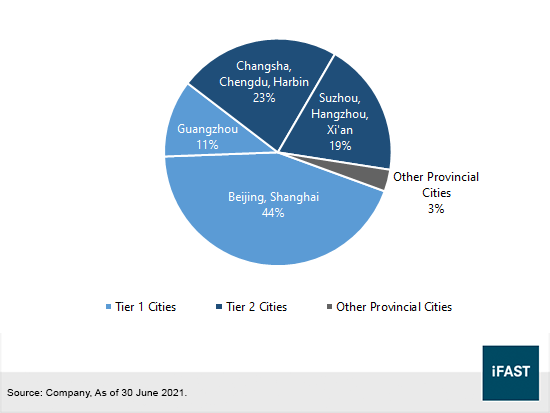
Figure 1: Portfolio geographical breakdown by 1H21 net property income
Restructuring of CapitaLand Limited
On 10 August 2021, shareholders of CapitaLand voted in favour of the Proposed Strategic Restructuring of CapitaLand and the listing of CapitaLand Investment. As a result, CapitaLand Limited trading under the ticker, C31, on the SGX was delisted on 9 September 2021. CLI (CapitaLand Investments) will be listed on the SGX in its place as CapitaLand restructures, privatising its property development business while publicly listing its investment management business as CLI on the SGX. The listing of CLI has taken effect on 17 September 2021.
Figure 2: Post-transaction structure
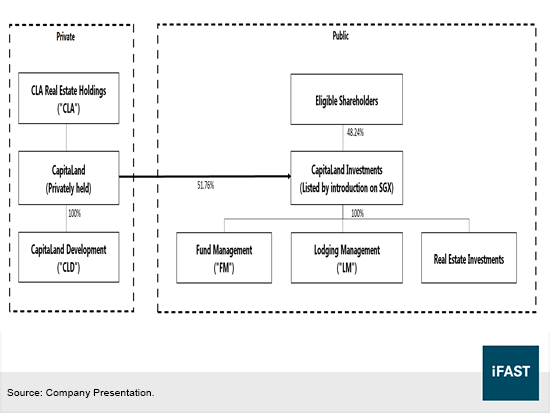
The decision to privatise its property development business was due to the capital intensive nature of the property development segment. In order to focus on asset-light and capital-efficient business, the company decided to privatise its property development segment and for CLI to further expand and scale up its asset and investment management businesses. Through the privatisation of the property development business, CLI still stands to benefit from the pipeline of projects as part of the ecosystem of CapitaLand. CLI will continue to hold stakes in CLCT under its Real Estate Investments arm as seen from Figure 2.
1H21 Financial Results
For the first half financial results ended 30 June 2021 (“1H21”), CLCT reported a 68.5% year-on-year (“YoY”) growth in gross revenue from RMB 511.0m in 1H20 to RMB 861.0m in 1H21. The company also achieved highest net property income (“NPI”) growth since listing, reporting 78.3% YoY growth to RMB 585.7m in 1H21. The stellar results were due to new contributions from its business parks portfolio and improved retail occupancy rate and retail sales and traffic.
Gross revenues for retail properties grew by 28.1% in 1H21 and were partially offset by divestments in CapitaMall Saihan and CapitaMall Minzhongleyuan. In November 2020, CLCT acquired 5 business parks in leading tier 2 cities in China. The business parks is expected to bolster CLCT’s portfolio with higher occupancy rate and also stronger rental reversion rates. This expansion into tier 2 cities in China will further diversify CLCT’s property portfolio and also geographically in China. Through the acquisition, CLCT is able to align and capitalise on China’s high economic growth.
Retail sales and traffic
CLCT has 11 retail malls across 7 cities, with majority of it located in Beijing. In 1H21, shopper traffic and tenant sales rebounded from the pandemic, with 40.7% YoY growth and 40.8% YoY growth respectively. Malls in Beijing recovered in 2Q21 from a resurgence of COVID-19 in January 2021.
Figure 3: Retail tenant breakdown by gross rental income
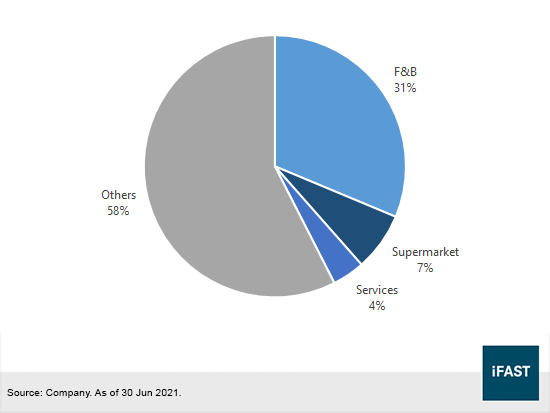
One key consideration for CLCT is its portfolio resilience. From Figure 3, 42.5% of CLCT’s retail portfolio is made up of essential retail sectors such as food and beverages, supermarket and services sectors. Food and beverage sales grew by 75% YoY in 1H21 while services sales grew by 51% YoY. Portfolio occupancy saw an upward trend increasing to 95.4% in 1H21 as compared to 93.4% in 1H20. The retail portfolio also saw position rental reversion rate of 1.8% in 1H21. We find CLCT’s retail portfolio to be resilient due to the positive rental reversions and increasing occupancy rate despite disruptions caused by COVID-19.
Business park portfolio
As mentioned above, CLCT’s business parks portion of the portfolio was acquired in late-2020 and consist of 5 properties within China’s tier 2 cities of Xi’an, Suzhou and Hangzhou. In 1H21, the business park segment reported 24% of CLCT’s gross revenue. CLCT’s business park segment saw higher occupancy rate at 94.0% and higher rental reversion of 6.7%.
Figure 4: Business park tenant breakdown by gross rental income
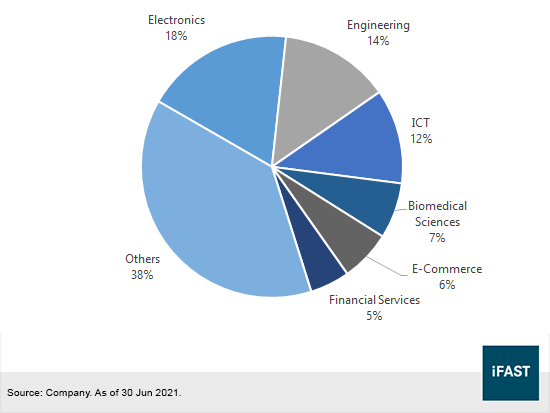
From Figure 4, 61.8% of CLCT’s business park portfolio consists of high growth emerging sectors such as Information and communications technology (“ICT”), E-Commerce and biomedical sciences. In China’s five-year plan, China plans to prioritise domestic consumption and boost investments in R&D in technology. Therefore, CLCT’s entry to business parks in tier 2 cities will be in line with China’s economic plan and positioning it to capitalize on China’s economic growth in the future. Tier 2 cities in China are also expected to grow rapidly due to the decentralisation of economic activities to tier 2 cities.
Business outlook
In China, we expect higher domestic consumption and normalisation of economic activity for the next few quarters. China’s GDP grew by 12.7% while retail sales of consumer goods grew by 23% during 1H21. China continues to rebound strongly from the impact of the coronavirus and given the high vaccination rate, we expect normalisation of economic activity to come quickly.
Beijing’s five-year plan emphasised the retail market as an area of development. Beijing’s rental index increased by 2% YoY and we expect positive rental reversions in the coming quarters.
With regard to business parks, Suzhou established the Suzhou Free Trade Zone in 2019 and this will attract and promote industrial development in the area. In Xi’an, there is a large demand for office spaces from the technology sector. Average rents for business parks spaces increased to RMB 53.4 per square meter per month in 2Q21.
In their 1H21 presentation, CLCT said that management expects a recovery of consumer demand in China as vaccination rates continue to increase. In retail, they expect a normalisation of economy to continue as social activities resume. The leasing environment is also expected to remain competitive on higher asking rents. Additionally, management expects favourable leasing demand to continue for CLCT’s business park properties.
Capital and liquidity profile
As of 1H21, CLCT had SGD 236.4m in cash and cash equivalents and total borrowings of SGD 1.72b. Total borrowings consists of offshore SGD loans, onshore RMB loans and notes under their medium-term notes programme (“MTN”). Total borrowings increased in 1H21 due to the drawdown of loans to finance the acquisition of the business parks.
Figure 5: Debt maturity profile
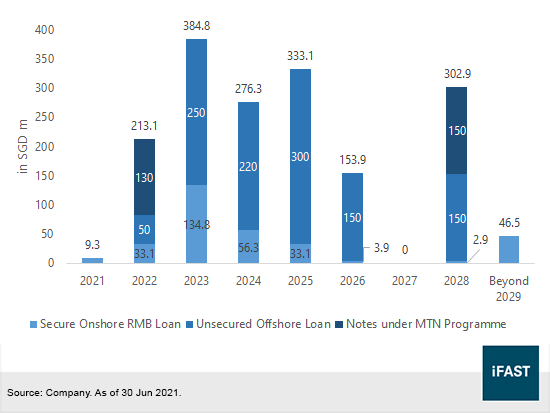
We find CLCT’s credit profile to be well managed as the company has refinanced its 2021 notes ahead of time and the company has a well spread debt maturity profile. Through the refinancing of its 2021 notes, it has extended its average term of maturity from 2.7 years to 3.8 years for 1H21. Gearing (total borrowings over deposited properties) for the company is at 35.9%, below the regulatory requirement of 50%. Interest coverage, measured by EBITDA/ interest expense on a trailing twelve month basis is high at 4.4x.
When comparing credit ratios to other SGD denominated REIT peers, we found that Mapletree North Asia Commercial Trust (“MAGIC”) has a different property portfolio from CLCT in respect to its properties in China. Only 2 out of the 13 properties are located in China, with the rest situated in Hong Kong, South Korea and Japan.
Table 1: Comparison of credit ratios of CLCT and MAGIC
|
Credit Ratios |
CLCT |
MAGIC |
|
|
Gearing ratio |
35.9% |
41.8% |
|
|
Interest Coverage Ratio |
4.4x |
4.0x |
|
| Source: Company, As of 20 Apr 2021 | |||
Nevertheless from Table 1, we can see that CLCT has better credit ratios as compared to MAGIC, with a lower gearing of 35.9% compared to 41.8% and a higher interest coverage ratio, 4.4x as compared to 4.0x.
Bond Recommendation
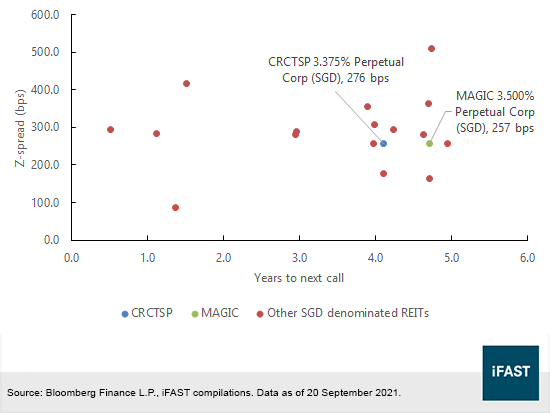
CLCT has issued 3 SGD denominated notes - CRCTSP 3.250% 04Jul2022 Corp (SGD), CRCTSP 3.375% Perpetual Corp (SGD) and CRCTSP 2.400% 29Jun2028 Corp (SGD). We will be recommending the CRCTSP 3.375% Perpetual Corp (SGD) at its indicative ask yield to next call of 3.78% with 4.1 years to call. The perpetual notes will reset on 27 October 2025 & every 5 years thereafter at the prevailing SGD 5Y Swap Offer Rate (or the Successor Rate or Alternative Reference Rate) plus the Initial Spread (2.875%).
When compared to the Z-spread with other SGD REIT perpetual notes in Figure 6, the CRCTSP 3.375% Perpetual Corp (SGD) has a z-spread of 276 bps and is relatively the same as the MAGIC 3.500% Perpetual Corp (SGD). We recommend the CRCTSP 3.375% perps over the MAGIC 3.5% perps as it has better credit ratios while also having higher yield to next call and a shorter year to call.
Figure 6: Z-spread among comparable SGD REIT perpetual notes
All in all, for investors who want to invest exclusively into China’s growing retail trade may consider CLCT for its strong foothold in China’s tier 1 and 2 cities. We find CLCT’s properties to be aligned with China’s economic development goals and is one of the attractive aspects of CLCT. It has properties in retail and business parks and we believe is poised to capitalise on China’s growing retail trade.
Declaration: For specific disclosure, at the time of publication of this report, IFPL (via its connected and associated entities) holds a NIL position and the analyst who produced this report holds a NIL position in the abovementioned securities.
Our podcast series, Yield Hunters, is available on Spotify, iTunes Podcasts and Google Podcasts. We share our thoughts on new bond issues and hold discussions on the fixed income space. Listen to our latest episode below and follow us!