In what was an eventful quarter for Credit Suisse Group AG (“Credit Suisse”), the bank saw “significant and material” losses in their prime brokerage division due to the collapse of Archegos Capital Management (“Archegos”), and losses in their supply-chain finance funds with assets of about USD 10b due to the default of Greensill Capital (“Greensill”).
Archegos defaulted on margin calls and forced their brokers to sell stocks amounting to about ~USD 30b. Analysts from JP Morgan had earlier estimated bank losses to be at about USD 10b and Credit Suisse has announced that it expects a CHF 4.4b loss from its exposure to Archegos, while pre-tax loss for the first quarter of 2021 is projected to be approximately CHF 900m. The loss is lower than what most analysts expected as the bank's operating performance helped to offset losses from the Archegos margin call.
(Read: Archegos meltdown: What happened at Bill Hwang's firm and how it is affecting global markets)
Greensill Capital
Greensill is a specialty finance firm providing supply chain financing and related services. In a typical supply chain finance model, small company suppliers are paid from banks and funds such as Greensill Capital. Suppliers are paid immediately from Greensill Capital, meaning they receive cash in less than 30 days and have shorter payment cycles.
Credit Suisse’s arm of supply-chain finance funds invested in Greensill’s loans. As soon as the fund lost its backing from asset managers, and Greensill’s insurance contracts were not renewed, Credit Suisse froze Greensill funds of about USD 10b, causing the company to default.
(Read: Greensill Capital files for Chapter 11 bankruptcy in New York)
Credit Suisse has estimated that their clients could lose up to USD 3b from these funds. However, as these funds were marketed as low-risk products and could lose about 30% of their value, Credit Suisse’ clients are reportedly threatening litigation.
(Read: Credit Suisse pegs potential Greensill fund losses at $3bn)
However, the bank may not face direct losses unless they compensate their investors. Credit Suisse may potentially recover some assets in the courts or from insurance, which may mitigate clients’ or their own losses. Thus, it is likely that Credit Suisse will not face a loss similar to that from Archegos’ default. However, the recent debacle has dealt a blow to its reputation and in the longer term, the Swiss bank may face lower revenues and manage lower assets under management (“AuM”) due to client mistrust.
Financial impact to the bank
As retained earnings make up the bulk of Common Equity Tier (“CET”) 1 capital, the losses from these two sagas will affect Credit Suisse’s capital position. The CET1 capital ratio can be used to indicate whether a bank has sufficient capital to survive in a crisis or through a series of stress tests. The CET1 capital ratio can also be used as a supplemental reference when analysing relative valuations among banks’ Additional Tier 1 (“AT1”) perpetual bonds.
Credit Suisse gave an investors update on Tuesday, 6 Apr 20201 with its expected pre-tax loss stated in the table below. In spite of the CHF 4.4b loss from Archegos, Credit Suisse expects their CET1 ratio to be at least 12% in1Q21. The other expected ratios are as follows: 1Q 2021 Tier 1 leverage ratio to be at least 5.4%, 1Q 2021 CET1 leverage ratio to be at least 3.7% and Group liquidity coverage ratio (LCR) expected to exceed 200%.
(Read: Credit Suisse trading update)
Table 1: Estimated losses and capital ratios
|
1Q21 projections |
CHF m |
|
FY20 CET1 capital |
35,351 |
|
Projected 1Q21 pre-tax loss |
~-900 |
|
Projected 1Q21 CET1 capital |
~34,451 |
|
AT1 capital |
15,841 |
|
Tier 1 capital |
51,192 |
|
Tier 2 capital |
1,234 |
|
Total eligible capital |
52,426 |
|
Risk-weighted assets |
275,576 |
|
CET1 capital ratio |
12.5% |
|
Tier 1 capital ratio |
18.2% |
|
Total capital ratio |
18.7% |
Source: Credit Suisse Pillar 3 disclosures, iFAST estimates. As of FY2020.
Relative valuations
We compare Credit Suisse against other banks that have similar CET1 ratios, along with their outstanding AT1 bonds.
Table 2: Banks with comparable CET1 ratios
|
FY20 |
CET1 Ratio (%) |
|
Julius Baer Group Ltd |
14.9 |
|
UBS Group AG |
13.8 |
|
ANZ |
11.3 |
|
Fifth Third Bancorp |
10.3 |
|
US Bancorp |
9.7 |
|
Zions Bancorp NA |
10.8 |
|
Credit Suisse Group AG |
~12.0 |
|
Banco Bilbao Vizcaya Argentaria SA |
12.2 |
|
Deutsche Bank AG |
13.6 |
|
BKS Bank AG |
11.6 |
|
Banco Comercial Portugues SA |
12.2 |
|
Source: Bloomberg Finance L.P., iFAST compilations |
|
We find that most AT1 bonds have similar or lower yields than those of Credit Suisse with a few exceptions. The three issuers that have AT1 bonds with higher yields than Credit Suisse’s are Banco Comercial Portugues SA, Sovcombank – a Russian bank that did not disclose their numbers, and BKS Bank. These banks could have inherently higher risk than Credit Suisse due to their exposures to weaker loan quality in emerging markets – which are domiciles that are less developed than Switzerland.
Credit Suisse’s bonds are also comparable to those from Deutsche Bank, although Deutsche Bank has a higher CET1 ratio. For instance, the CS 7.250% Perpetual Corp (USD) is rated BB-/BB+/Ba1 by S&P/Fitch/Moody’s while the DB 7.500% Perpetual Corp (USD) is rated BB-/BB-/B1 by S&P/Fitch/Moody’s. The difference between the two bonds is only 30 basis points (“bps”).
While Credit Suisse’s future income stream may be affected by its loss of reputation and higher compliance costs, they are also mitigating the losses by not awarding variable incentive compensation for the Executive Board, suspending its share buybacks and reducing its dividends. Credit Suisse is also prioritising to beef up its target capital ratios which is good for bondholders.
(Read: Adjusted proposals for 2021 AGM)
Figure 1: Relative valuation of designated AT1 instruments
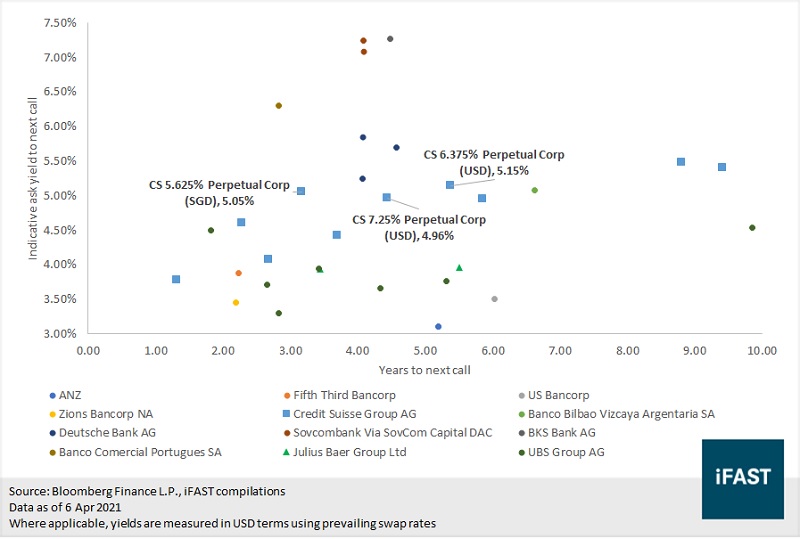
Thus, Credit Suisse AT1 bonds do look attractive after the sell-off, especially the CS 5.625% Perpetual Corp (SGD) which has an indicative ask yield-to-call (“YTC”) of 5.05% on 6 Apr 2021. Although the coupon is likely to reset to a lower rate if not called in 6 June 2024, the perpetual note is still callable thereafter on every distribution payment date. If called in June 2026, it will have an indicative ask YTC of 5.33% (or 5.52% in USD terms) which is still higher than the ask YTC of CS 7.250% Perpetual Corp (USD).
Declaration: For specific disclosure, at the time of publication of this report, IFPL (via its connected and associated entities) holds positions in UBS 5.875% Perpetual Corp (SGD) and CS 5.625% Perpetual Corp (SGD), and the analyst who produced this report holds a NIL position in the abovementioned securities.
Our podcast series, Yield Hunters, is available on Spotify and iTunes Podcasts and Google Podcasts. We share our thoughts on new bond issues and hold discussions on the fixed income space. Listen to our latest episode below and follow us!