Source: AP Images
- AT1 bonds are usually issued as a perpetual bond and are junior subordinated
- As part of the merger, all of CS’ AT1 bonds will be written-off
- CS’ Tier 2 bonds have been spared from a write-off along with senior bondholders and depositors
- We expect further repricing of AT1 bonds after this event as investors are shaken from the full write-down and fears that more financial institutions will face a similar fate to CS
- AT1 spreads are likely to widen from this event and we see higher non-call risks for AT1 bonds
What are Additional Tier 1 bonds?
Additional Tier 1 (“AT1”) bonds are bank capital securities that banks issue to contribute to the total capital required by regulators. Higher capital adequacy norms were imposed after the 2008 global financial crisis, following the collapse of several high-profile financial institutions. AT1s are issued from banks to have additional capital to absorb losses in an event of a collapse. This mitigates the need for a bailout from the regulators and instead having bondholders absorb the losses.
AT1 bonds are usually issued as a perpetual bond and are junior subordinated. AT1 bonds are classified as hybrid securities as they have both features akin to bonds and equity. The bonds do not have a maturity date and is at the sole discretion of the bank to call back the bonds on its call date. AT1 bonds are also riskier compared to typical plain-vanilla bonds due to the subordination of the bond. When there is a liquidation, AT1 bonds will be paid ahead of shareholders but below other creditors like depositors, senior and subordinated bondholders. There are also clauses embedded in AT1s like non-cumulative deferral and loss absorption features which we will explain further in the article.
The credit ratings for AT1 bonds are rated a few notches below the respective bank’s issuer ratings. This is due to the higher risk in investing in these bonds due to the respective clauses and its ‘hybrid’ nature between equity and bonds. Due to its higher risks, AT1 bonds are issued at a higher coupon in order to compensate investors for taking on more risk.
Additional Tier 1 clauses
There are three clauses that differentiates AT1 bonds to typical perpetual bonds issued by corporates.
Distribution Deferral
Often, distributions of AT1 bonds are non-cumulative in nature. In other words, the issuer can choose not to pay any distributions to perpetual bondholders, and such unpaid distributions will not accumulate and accrue interest. This is in contrast with senior bonds where the issuer is obliged to make interest payments to investors periodically, and skipping payments may be construed as a credit default event.
Distribution pusher and stopper
Distribution pusher means that if the issuer has already paid dividends to holders of securities that are ranked equal or junior to the AT1 bonds (e.g., common equity), usually within a specified look-back period (e.g., 6 – 12 months), then the issuer must pay distributions to perpetual bondholders. Likewise, the mechanics of distribution stopper work similar to that of a distribution pusher, where in the event if the issuer decides not to pay distributions to perpetual bondholders, the company shall not pay dividends in respect of its junior securities or other AT1 bonds.
Loss absorption
Typically, there are 2 types of loss absorption options: 1) Write-off or 2) Conversion, and the specific loss absorption outcome will be stated in the respective bond offering documents.
1) A write-off means that the issuer shall reduce the principal amount and cancel any unpaid distributions of the perpetual bond. A write-off can be partial or in full upon the occurrence of the trigger event. Once written-off, any principal or distributions will be extinguished and will not be restored in any circumstances, and perpetual bondholders will not be able to claim any amount that is written-off. If fully written-off, the AT1 bonds will be written down to zero and bondholders will not have any rights against the issuer for the repayment of the bond.
2) On the other hand, a conversion feature means that the perpetual bond will be converted into the underlying shares of the issuer based on a multitude of factors such as conversion ratio, purchase price and nominal value of the shares. The specific variable components and calculation methodology are usually provided in the offering-related documents, and investors should also note that the converted ordinary shares may be worth significantly less than the AT1 notes.
What may result in a trigger event?
A trigger event may be caused from a 1) contingency event or a 2) viability event. When either of these events occur, a partial or full write-off of AT1 bonds will be triggered.
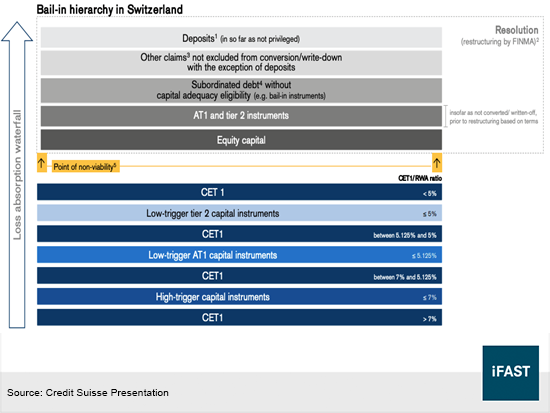
1) A contingency event may be triggered when a bank’s capital adequacy ratio falls below a certain threshold. Typically, the threshold level for AT1 bonds to be written-off is when Common Equity Tier 1 (“CET1”) ratio falls below either 5.125% or 7.00% depending on the terms of the AT1.
2) Meanwhile, a viability event is triggered when regulators deem that a write-down is necessary in order to prevent the bank from being insolvent or bankrupt. CET1 ratio do not need to fall below the CET1 threshold level for a viability event to occur. A viability event can be triggered if measures to improve a bank’s capital adequacy is deemed inadequate by regulators to prevent insolvency or bankruptcy or when a bank receives support from the public sector to boost its capital adequacy.
Risks to AT1 bonds
Loss absorption risk: Investors should still be mindful of the potential write-off/conversion risks despite the well-capitalized nature of banks. These AT1 bonds act as buffers in times of stress, and the recent example of Yes Bank (one of India’s largest private banks) writing-down its AT1 bonds before its common equity demonstrates that perpetual bondholders could be at risk of losing their capital before shareholders despite AT1s ranking superior to common equity. Seniority of perpetual bonds over equity matters during a liquidation, however, in Yes Bank’s case, it was a resolution to reconstruct the bank, not a liquidation. Hence, the seniority of AT1s over common equity did not matter, leaving many AT1 bondholders in shock following its decision to write-off its perpetual notes over its common equity. More recently, Credit Suisse saw its AT1 bonds written-off after a merger with UBS and wiped out more than CHF 16b of Credit Suisse AT1 bonds.
No guarantee of redemption on first call date: Even though most banks have a sound track record and sufficient liquidity to redeem their AT1 notes on their first call dates, we should not outright assume that they will do so. Ultimately, the decision to redeem the AT1 perpetual bonds lies in the issuer’s discretion. For example, during the pandemic, several high-profile banks such as Deutsche Bank and Lloyds Bank decided not to redeem the DB 6.250% Perpetual Corp (USD) and LLOYDS 6.375% Perpetual Corp (EUR) on their first call dates.
Notably, the banks said that the decision to not redeem their perps was mainly due to economic reasons, as it was more expensive to refinance their perpetual notes during the pandemic as a result of credit spreads widening. Following which, the DB 6.250% Perpetual Corp (USD) and LLOYDS 6.375% Perpetual Corp (EUR) were reset to a lower coupon of 4.789% and 4.947% respectively. As such, investors should also take note of the potential non-call risks of AT1 bonds, despite the historical precedence of redemption and healthy balance sheet of banks.
Which Credit Suisse bond will be written down?
On 20 Mar 23, it was announced that UBS will be merging with Credit Suisse. Credit Suisse was facing turmoil from the fallout of Silicon Valley Bank and News outlets reported that Credit Suisse’s (“CS”) largest shareholder, the Saudi National Bank, will not be increasing its stake over 10% should CS require additional capital. Saudi National Bank recently acquired a 9.88% stake in CS for CHF 1.4b. The reasons cited by Saudi National Bank’s chairman, Al Khudairy, was due to regulatory concerns as increasing their stake past 10% will incur additional regulatory requirements.
As markets were still recovering from the fallout of SVB, shares of CS plunged. CS shares fell by almost 28% from the news. In order to shore up confidence in the Swiss Banking sector, the Swiss Financial Market Supervisory Authority (“FINMA”) and Swiss National Bank (“SNB”) put out a statement to assure markets that there are “there are no indications of a direct risk of contagion for Swiss institutions due to the current turmoil in the US banking market.” SNB will also provide CS with liquidity if required. CS exercised its option to draw CHF 50b through a covered loan facility and short-term liquidity facility which will be collateralised by high quality assets.
Despite the help from FINMA and SNB, Credit Suisse saw great outflows of client funds and in order to protect the confidence of the Swiss Banking sector and Credit Suisse, FINMA decided it was best for UBS to merge with Credit Suisse. As part of the merger, all of CS’ AT1 bonds will be written-off. The reasons cited by FINMA was due to the combined entity will become a much larger bank, thus higher capital buffers are required by regulation. The capital injection to CS by SNB is likely to have triggered a viability event in CS’ AT1 bonds and caused a write-off in all of CS’ AT1 bonds. The complete write-off of CS’ AT1 bonds will erase CHF 16b worth of CS AT1 bonds, making it worth zero.
Table 1: List of CS bonds available on BSM and affiliate platforms
|
Issue Name |
Issuer Name |
Currency |
Written-off? |
|
CS 7.500% Perpetual Corp (USD) |
Credit Suisse Group AG |
USD |
Yes |
|
CS 7.500% Perpetual Corp (USD) |
Credit Suisse Group AG |
USD |
Yes |
|
CS 5.625% Perpetual Corp (SGD)* |
Credit Suisse Group AG |
SGD |
Yes |
|
CS 6.250% Perpetual Corp (USD) |
Credit Suisse Group AG |
USD |
Yes |
|
CS 7.250% Perpetual Corp (USD) |
Credit Suisse Group AG |
USD |
Yes |
|
CS 6.375% Perpetual Corp (USD) |
Credit Suisse Group AG |
USD |
Yes |
|
CS 5.250% Perpetual Corp (USD) |
Credit Suisse Group AG |
USD |
Yes |
|
CS 9.750% Perpetual Corp (USD) |
Credit Suisse Group AG |
USD |
Yes |
|
CS 5.100% Perpetual Corp (USD) |
Credit Suisse Group AG |
USD |
Yes |
|
CS 6.500% 08Aug2023 Corp (USD) |
Credit Suisse AG |
USD |
No |
|
CS 2.750% 08Aug2025 Corp (GBP) |
Credit Suisse Group AG |
GBP |
No |
|
CS 5.000% 09Jul2027 Corp (USD) |
Credit Suisse AG of New York |
USD |
No |
|
CS 7.000% 30Sep2027 Corp (GBP) |
Credit Suisse Group AG |
GBP |
No |
|
CS 7.500% 15Feb2028 Corp (USD) |
Credit Suisse AG of New York |
USD |
No |
|
CS 2.250% 09Jun2028 Corp (GBP) |
Credit Suisse Group AG |
GBP |
No |
|
Source: Bondsupermart. iFAST Compilations *Available on Bond Express |
|||
What about Credit Suisse’s Tier 2 bonds?
At this point, the CS Tier 2 bonds have been spared from a potential write-off for now. Although Tier 2 bonds have bail-in properties such as loss absorption features, only the CS AT1s were written-off. Senior bondholders and depositors are safe from any write-off and is expected to be transferred to UBS when the merger is completed. We would like to caution that details of the deal have not yet been finalised and Tier 2 bonds will be the next set of bail-in capital that the bank will use to absorb further loses (Chart 1).
Chart 1: Hierarchy of creditors for bail-in
AT1s moving forward
The full write-off of CS’ AT1 bonds was an unprecedented move by FINMA. Not because the bonds were fully written-off but it was the first time bondholders took losses ahead of shareholders. UBS offered CHF 3b to acquire CS, representing CHF 0.76 per share to CS’ shareholders. This was the first time bondholders took losses ahead of equity shareholders. Although AT1 bondholders are subordinated in nature, it still sits above equity shareholders in the priority of payments.
Moving forward, this will shake the AT1 bond market. We expect further repricing of AT1 bonds after this event as investors are shaken from the full write-down and fears that more financial institutions will face a similar fate. New issuances of AT1 bonds will likely be priced at a higher coupon in order to draw interest from investors. This may cause banks to rethink their funding plans as it will be too costly for banks to issue at such a high coupon. We see heightened risks in investing in AT1 bonds due to the weak market sentiment within the banking sector. AT1 spreads are likely to widen from this event. It will not be economical for banks to refinance AT1 bonds when spreads widen. It is likely we see further non-calls from banks on their AT1s. Due to its complexities, we urge investors to understand the risks and clauses before investing in AT1 bonds.
Declaration: For specific disclosure, at the time of publication of this report, IFPL (via its connected and associated entities) holds a NIL position and the analyst who produced this report holds a NIL position in the abovementioned securities.
Our podcast series, Yield Hunters, is available on Spotify, iTunes Podcasts and Google Podcasts. We share our thoughts on new bond issues and hold discussions on the fixed income space. Listen to our latest episode below and follow us!