Key Points
- In 1H2026, Emirates NBD’s earnings profile remained resilient, with total operating income growing by 16%, supported by strong loan growth and robust customer activity.
- Despite ongoing geopolitical tensions, the bank’s balance sheet remains solid. Key Basel III regulatory ratios, including CET1 and LCR, remain well above the respective regulatory requirements.
- Asset quality has also shown a slight improvement, with the NPL ratio declining to 2.1% in 1H2026, from 2.4% in FY2025.
- We maintain a positive stance and recommend that investors consider EBIUH 5.913% 18Jun2035 Corp (AUD) and EBIUH 6.100% 21Feb2033 Corp (AUD), which offer yields of approximately 6.06% and 5.95%, respectively.
- For investors seeking USD-denominated exposure, EBIUH 6.250% Perpetual Corp (USD) may also be of interest, offering a yield of around 5.93%, approximately 145bps above the 7-year UST. Among fixed-tenor bonds, EBIUH 4.529% 13Jan2031 Corp (USD) and EBIUH 4.195% 13Jan2029 Corp (USD) could be considered as alternatives, offering yields of approximately 5.06% and 4.81%, respectively.
(In this article, the data and figures are presented for 1H2026, with comparisons made on a YoY basis.)
Previous article update:
First AT1 Issuance in the Middle East Since the Conflict – Confidence Remains Strong at Emirates NBD
Earnings profile continues to grow steadily despite ongoing geopolitical tensions
- Emirates NBD continued to benefit from strong balance sheet growth and robust customer activity in 1H2026, with net interest income increasing by an impressive 13% YoY and non-funded income — income generated from sources other than interest income — rising by 25%. As a result, total operating income grew by 16%.
- Impairment allowances increased to AED1,407 million in 1H2026, compared with a net impairment reversal of AED278 million in 1H2025. The swing from a net impairment credit of AED278 million in 1H2025 to a net impairment charge of AED1,407 million in 1H2026 was primarily driven by the absence of exceptional recoveries recorded in 1H2025, which benefited from outsized recoveries on legacy problem loans, as well as prudent provisioning across DenizBank and Emirates NBD amid continued loan book expansion.
- Net interest margin (NIM) declined slightly to 3.25%, reflecting the impact of rate cuts in 2025 and competitive pricing for deposits. Nevertheless, 1H2026 NIM remained within the bank’s guidance range of 3.1%–3.3%.
- Overall, the earnings profile remained resilient, with Emirates NBD’s profit before tax increased by 5% YoY to AED16,247 million.
Table 1: Profitability indicators (AED million)
|
2022 |
2023 |
2024 |
2025 |
1H2025 |
1H2026 |
|
|
Net interest income |
23,222 |
30,080 |
32,396 |
35,502 |
13,396 |
15,181 |
|
Non-interest income |
9,285 |
12,948 |
11,738 |
13,817 |
7,106 |
8,858 |
|
Total Operating Income |
32,507 |
43,028 |
44,134 |
49,319 |
23,938 |
27,885 |
|
Profit before tax |
14,974 |
23,655 |
27,141 |
29,838 |
15,443 |
16,247 |
|
Net interest margin % (NIM) |
3.43% |
3.95% |
3.64% |
3.46% |
3.47% |
3.25% |
Source: Company Reports, iFAST Compilations. Data as of 30 June 2026.
All operating segments recorded higher operating income in 1H2026.
Table 2: Operating segments (AED million)
|
1H26 |
Change (YoY) |
|
|
Corporate and Institutional banking |
5,363 |
17% |
|
Retail banking and Wealth Management |
10,491 |
9% |
|
Global Markets and Treasury |
1,393 |
12% |
|
DenizBank |
7,780 |
22% |
|
RBL Bank^ |
141 |
- |
|
Others |
2,717 |
28% |
^ RBL Bank was only incorporated into the group’s financial statements in 1H2026.
Source: Company Reports, iFAST Compilations. Data as of 30 June 2026.
Balance sheet remains resilient following the acquisition of RBL Bank, one of India’s leading banks
- From a credit perspective, Emirates NBD’s balance sheet remains strong. Total assets reached a record high of more than AED1.3 trillion, up from AED1.16 trillion in FY2025, primarily driven by an 18% expansion in the loan book to AED746.4 billion, compared with AED632.8 billion in FY2025.
- Despite the rapid balance sheet expansion, asset quality improved, with the NPL ratio declining to 2.1% from 2.4% in FY2025. This improvement was driven by a combination of factors, including i) the denominator effect, as gross lending expanded by 18%, and ii) strong recoveries and repayments from previously impaired exposures.
- The bank also maintained a solid loan-loss coverage ratio of 152%, indicating sufficient provision coverage against impaired loans at this juncture. Nevertheless, AED 13.41 billion of exposures were transferred from Stage 1 to Stage 2 (1HFY2025: AED 10.91 billion). While this represents an increase, the amount remains relatively modest at approximately 1.7% of total loan exposure and is therefore not considered significant.
- Despite the ongoing geopolitical tensions, we expect the NPL ratio to remain manageable within the 2.0%–2.5% range, supported by the policy measures introduced by the CBUAE to strengthen the resilience of the banking system across the Middle East (Table 3).
Table 3: Measures introduced by UAE Central Bank
|
Pillar |
Measures |
Impact on UAE Banks |
|
I. Monetary Policy |
Enhanced access to reserve balances (up to 30% of cash requirements). |
Provides immediate liquidity to banks to manage potential capital outflows or funding volatility caused by regional conflict. |
|
II. Liquidity Relief |
Temporary easing of LCR and NSFR ratios. |
Allows banks to maintain lower levels of high-quality liquid assets, freeing up capital to support private sector lending. |
|
III. Capital Buffers |
Release of CCyB and CCB. |
Reduces the regulatory capital burden, allowing banks to absorb losses through their "rainy day" buffers without breaching minimum requirements. |
|
IV. Credit Risk |
Loan Classification Flexibility. |
Prevents an immediate surge in Stage 3 (NPL) classifications by allowing banks to offer temporary relief to viable borrowers affected by the geopolitical situation. |
|
V. Lending Mandate |
Continued Financing Expectation. |
Ensures credit remains available to the national economy, preventing a pro-cyclical credit squeeze during times of uncertainty. |
- Meanwhile, key Basel III regulatory ratios, including the CET1 ratio and Liquidity Coverage Ratio (LCR), stood at 13.6% and 135%, respectively, compared with 14.4% and 152% in FY2025. Despite the decline, both ratios remain comfortably above the regulatory requirements of 11% and 100%, respectively.
- The decline in these ratios was mainly attributable to Emirates NBD’s acquisition of a 60% stake in RBL Bank, one of India’s leading listed private-sector banks, which added approximately AED60 billion in risk-weighted assets (RWAs) to the bank’s balance sheet. In addition, the decline in the LCR was partly driven by the cash outflow required to fund the acquisition, which amounted to approximately US$2.75 billion.
- Overall, Emirates NBD’s credit profile remains solid at this juncture. While the acquisition of RBL Bank has placed some pressure on key capital and liquidity ratios, the bank continues to generate capital organically through retained earnings. As a result, we expect the CET1 ratio to recover towards the 14% level in 2026.
Well-diversified loan portfolio
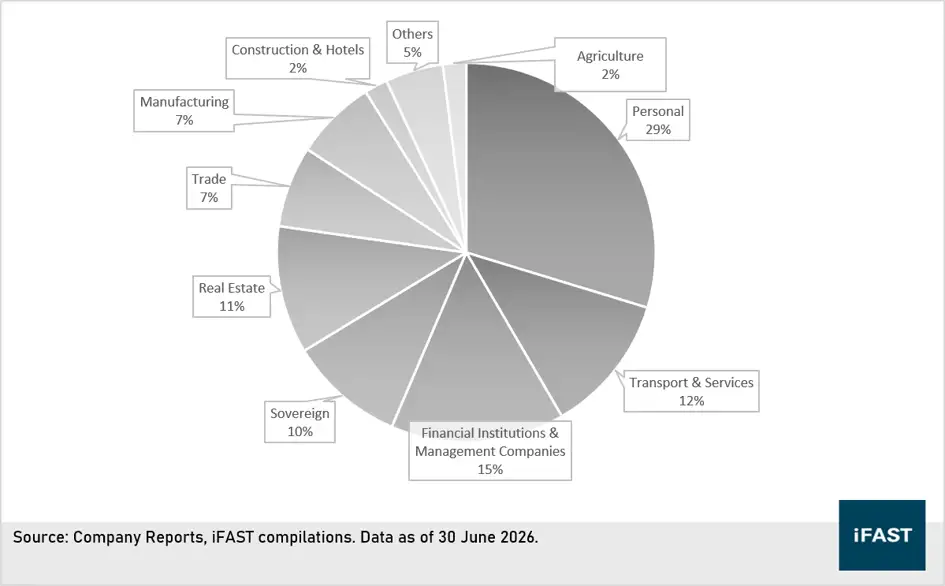
- Emirates NBD’s loan portfolio remains well diversified across multiple sectors and geographies. Coupled with improving asset quality and a solid liquidity position, we believe the bank is well positioned to absorb any potential deterioration in credit quality or increase in delinquencies arising from heightened geopolitical tensions in the Middle East.
Chart 1: Loan Portfolio by sector
Our View
There has been no material change since our previous update in May. We continue to maintain our positive stance on Emirates NBD despite the higher migration of loans to Stage 2 in 1H2026. We opine that the bank’s credit profile remains solid, while its strong liquidity position remains supportive. This view is notwithstanding the strategic stake held by the Government of Dubai.
Hence, we recommend that investors consider the following issuances:
From a yield perspective, investors may consider EBIUH 5.913% 18Jun2035 Corp (AUD) and EBIUH 6.100% 21Feb2033 Corp (AUD), which offer yields of approximately 6.06% and 5.95%, respectively.
Table 4: Recommended Bonds (AUD)
|
Bonds |
Years to Maturity |
Yield to Maturity |
Credit Rating (Fitch) |
Min / Sub investment amount |
|
8Y10M |
6.06% |
A+ |
AUD10,000 /10,000 |
|
|
6Y6M |
5.95% |
A+ |
AUD10,000 /10,000 |
|
|
3Y6M |
5.75% |
A+ |
AUD10,000 /10,000 |
Source: BSM, iFAST Compilations. Data as of 17 August 2026.
For investors with a preference for US dollar-denominated bonds, EBIUH 6.250% Perpetual Corp (USD)* may also be of interest, offering a yield of around 5.93%, approximately 180bps above the 7-year UST. For investors seeking fixed-tenor bonds, EBIUH 4.529% 13Jan2031 Corp (USD) may be considered, offering a yield of around 5.06%. For shorter-duration exposure, EBIUH 4.195% 13Jan2029 Corp (USD), yielding at 4.81%, may also be worth considering.
* Investors should be mindful of the risks associated with AT1 perpetual instruments, including: (i) loss absorption, (ii) non-call risk, and (iii) coupon deferral.
Table 5: Recommended Bonds (USD)
|
Bonds |
Years to Maturity |
Yield to Maturity |
Credit Rating (Fitch) |
Min / Sub investment amount |
|
EBIUH 6.250% Perpetual Corp (USD) |
5Y9M (Years to next call) |
5.93% area (Yield to next call) |
A+ (Issuer Credit Rating) |
USD200,000 / 1,000 |
|
4Y5M |
5.06% |
A+ |
USD200,000 / 1,000 |
|
|
2Y5M |
4.81% |
A+ |
USD200,000 / 1,000 |
Declaration: For specific disclosure, at the time of publication of this report, IFPL (via its connected and associated entities) holds a position in EBIUH 3.670% 13Jul2028 Corp (CNH) and the analyst who produced this report hold a NIL position in the abovementioned securities.