- In FY25, Emirates NBD’s total income grew by 12%, mainly due to stronger loan growth and higher non-funded income (credit cards, wealth management, etc.).
- The bank’s credit profile remains solid, with a CET1 ratio of 14.4% and a liquidity coverage ratio (LCR) of 152%, both well above the regulatory minimum. With this, we believe ENBD has the ability to withstand economic downturns.
- Asset quality has seen material improvement, with the NPL ratio falling to 2.4%, primarily driven by higher write-backs and recoveries.
- Investors should be mindful of key risks, including geopolitical tensions and hyperinflation in Turkey.
- Considering that spillover effects from the Middle East conflict have pushed yields higher, ENBD’s bonds now appear more attractive. Investors may consider its AUD issuances
Emirates NBD (ENBD) is the largest bank in Dubai, the second largest in the United Arab Emirates (UAE), and the fourth largest in the Gulf Cooperation Council (GCC) by total assets. The bank serves over 9.4 million active customers across 13 countries and has one of the strongest retail banking franchises in the UAE.
ENBD plays a vital role in the UAE’s financial system and is designated as a domestic systemically important bank (D-SIB). The bank is majority-owned by the Government of Dubai and related entities (55.8%), with the remaining shares held by the public, including institutional and retail investors.
ENBD is listed on the Dubai Financial Market (DFM), with a market capitalisation of approximately AED 175 billion (c. USD 47.65 billion) as at 7 April 2026.
Financial performance recorded double-digit growth in FY25
In FY25, ENBD recorded double-digit growth of 12% YoY in total income, primarily driven by stronger net interest income (NII), which rose by 10% YoY to AED 35,502 million, supported by robust asset growth. This offset the impact of a lower interest rate environment. Non-funded income (NFI) also increased by 18% YoY to AED 13,817 million, underpinned by resilient growth across business segments and a diversified product offering.
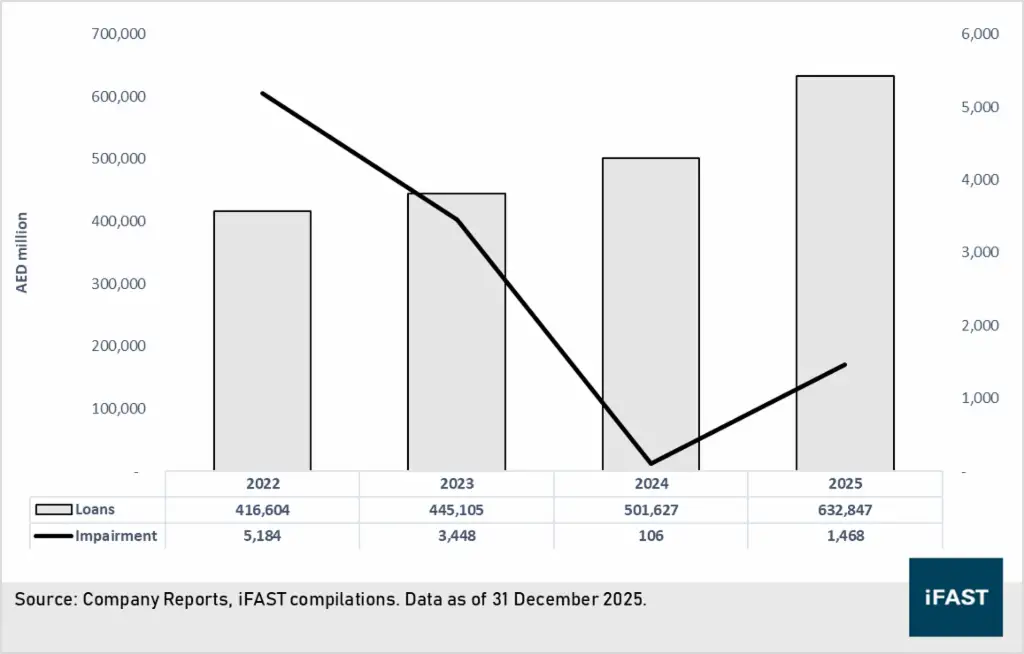
Impairment allowances rose to AED 1,468 million, compared with AED 106 million in FY24. We do not view this as a red flag; rather, it reflects a normalisation following the significant recoveries recorded in 2024, which had resulted in unusually low impairment charges. Furthermore, the increase in impairment is reasonable given the bank’s expanding loan book, with total gross loans rising by 24% to AED 658 billion.
Chart 1: Impairment allowances (AED million)
Overall, despite higher impairment charges, profit before tax (PBT) increased by 10% YoY to AED 29,838 million, demonstrating the bank’s underlying earnings resilience.
Chart 2: Profitability indicators (AED million)
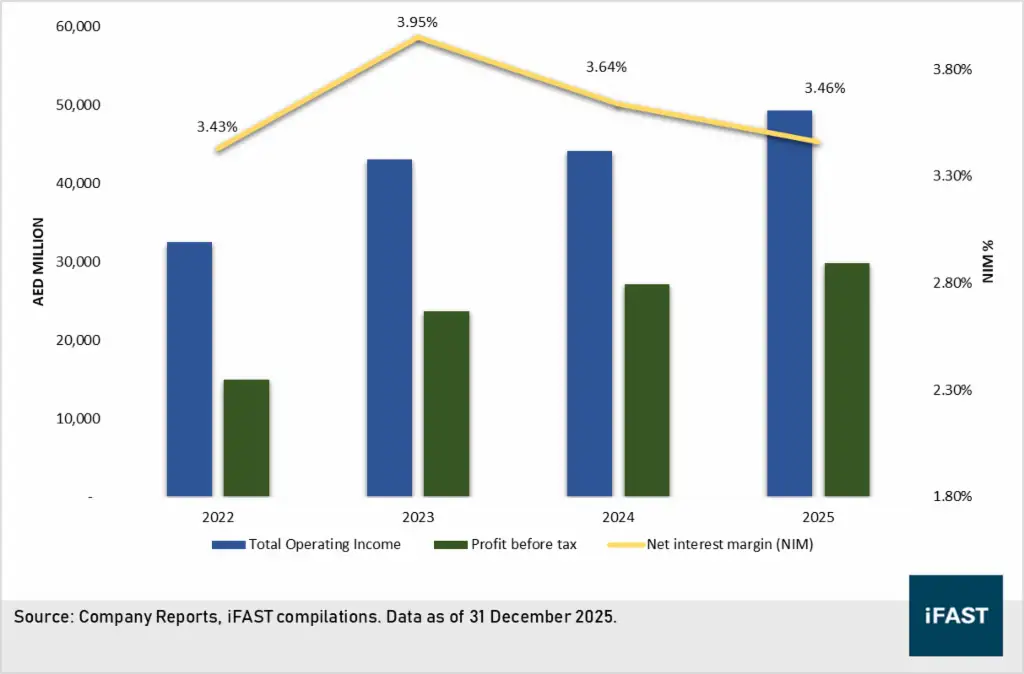
Looking ahead, amid the escalating US–Iran conflict and its potential spillover effects on global interest rate dynamics—where a shift towards rate hikes may occur instead of the previously anticipated easing cycle. Also, given that UAE dirham (AED) is pegged to the USD, the Central Bank of the UAE is very likely to mirror FED’s decision to maintain monetary stability. With this, we expect ENBD to maintain a relatively stable net interest margin (NIM) through 2026.
Credit fundamentals remain robust
At this juncture, ENBD’s overall credit profile remains resilient. The bank maintains a solid capital and liquidity position, with a liquidity coverage ratio (LCR) of 152% and a CET1 ratio of 14.4%, both well above regulatory minimum requirements.
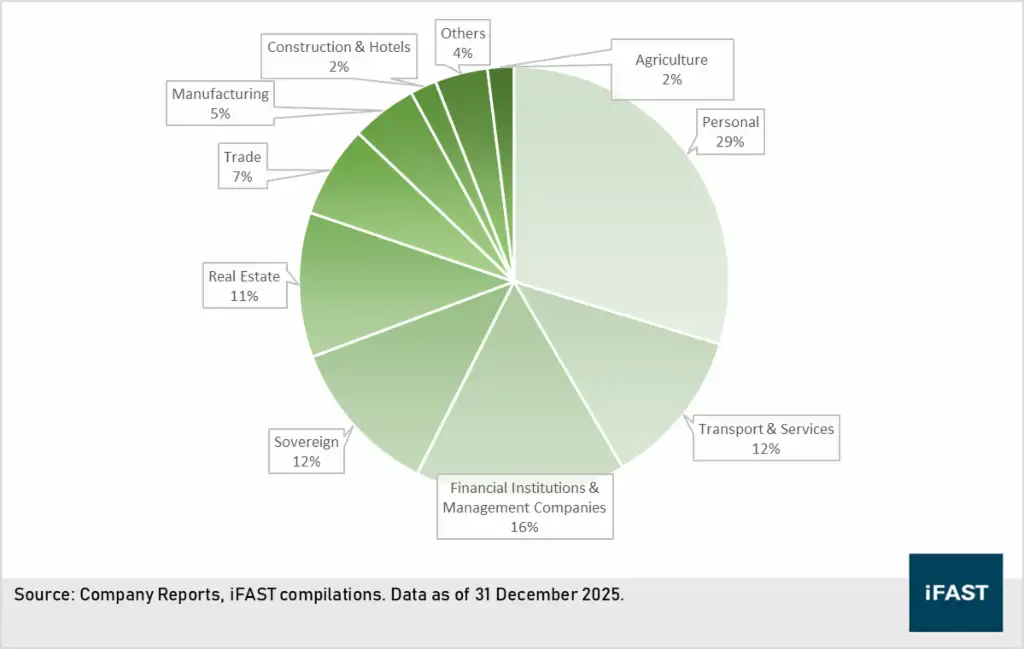
Asset quality has improved materially, as reflected in the lower NPL ratio of 2.4% (FY24: 3.3%), primarily driven by higher write-backs and recoveries. The bank’s loan portfolio is well diversified across various sectors, positioning the group to absorb potential delinquency spikes arising from the Middle East conflict.
Chart 3: Loans by sector (%)
In addition, the bank’s coverage ratio remains very strong at 160%, indicating a substantial buffer against impaired loans.
Table 1: Credit metrics
|
|
2022 |
2023 |
2024 |
2025 |
|
NPL ratio |
6.00% |
4.60% |
3.30% |
2.40% |
|
Coverage ratio |
145% |
163% |
156% |
160% |
Source: Company Reports, iFAST Compilations. Data as of 31 Dec 2025.
Considering the potential spillover effects of the escalating Middle East conflict, we expect higher impairment charges in 2026, as banks may front-load provisions as a prudent measure to brace for potential impacts.
Several measures have been introduced by the Central Bank of the UAE
Following the US-Iran conflict, the Central Bank of the UAE introduced a range of measures to support banks across the Middle East and maintain financial stability amid global uncertainties, including:
Table 2: Measures introduced by UAE Central Bank
|
Pillar |
Measures |
Impact on UAE Banks |
|
I. Monetary Policy |
Enhanced access to reserve balances (up to 30% of cash requirements). |
Provides immediate liquidity to banks to manage potential capital outflows or funding volatility caused by regional conflict. |
|
II. Liquidity Relief |
Temporary easing of LCR and NSFR ratios. |
Allows banks to maintain lower levels of high-quality liquid assets, freeing up capital to support private sector lending. |
|
III. Capital Buffers |
Release of Countercyclical Capital Buffer (CCyB) and Capital Conversion Buffer (CCB). |
Reduces the regulatory capital burden, allowing banks to absorb losses through their "rainy day" buffers without breaching minimum requirements. |
|
IV. Credit Risk |
Loan Classification Flexibility. |
Prevents an immediate surge in Stage 3 (NPL) classifications by allowing banks to offer temporary relief to viable borrowers affected by the geopolitical situation. |
|
V. Lending Mandate |
Continued Financing Expectation. |
Ensures credit remains available to the national economy, preventing a pro-cyclical credit squeeze during times of uncertainty. |
Source: CBUAE, iFAST Compilations. Data as of 18 March 2026.
Well-spread maturity profile
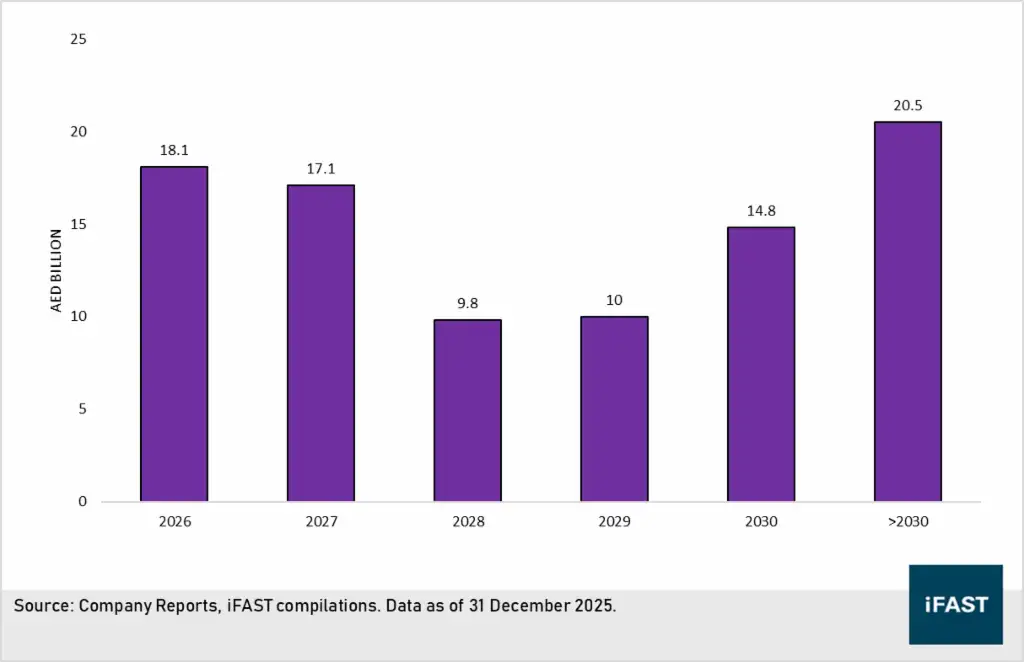
Emirates NBD’s maturity profile is well spread over the next few years. With the bank’s strong deposit base and the current encumbered cash of about AED16.8 billion, we believe the bank has the ability to meet its debt obligations in the coming years.
Chart 4: Debt Maturity Profile
Key Risks
Geopolitical risk in the middle east: The escalating geopolitical tensions in the Middle East could potentially impact the bank’s operations, given its significant exposure within the region.
Exposure to Hyperinflation in Turkey: Emirates NBD acquired DenizBank, a Turkey-based bank, with the intention of expanding its reach beyond the Gulf region. Given the hyperinflation in Turkey, with the Consumer Price Index (CPI) rising by 30.87 % YoY in Mar 2026, this may potentially result in a higher default rate in the region, subsequently impacting the profitability of the Turkish operations. Nonetheless, we believe this is manageable as the DenizBank accounts for only around 11% of the group profit before tax.
Currency Movement Volatility: The bank’s operations are not limited to the UAE. Currency fluctuations may potentially reduce profitability when foreign earnings are translated back to AED, the bank’s reporting currency.
Confidence in the UAE’s banking sector remains intact
On 2 April 2026, ENBD successfully secured US$2.25 billion in financing, comprising a US$1.75 billion five-year sustainability-linked syndicated term loan and a US$500 million five-year Islamic financing facility. The sustainability-linked loan was initially launched at US$1 billion but was significantly oversubscribed and subsequently upsized to US$1.75 billion.
This strong demand, despite escalating tensions in the Middle East, underscores continued investor confidence and reinforces the bank’s standing in international loan markets.
Get nod to become majority owner of RBL Bank
On 2 April 2026, India’s central bank approved Emirates NBD’s proposal to acquire a majority stake in RBL Bank, subject to a maximum foreign ownership limit of 74%.
RBL Bank is one of India’s fastest-growing private sector banks, serving over 15.11 million customers through a network of 580 branches. The consideration for the acquisition is approximately INR 268.53 billion (US$3.05 billion), to be executed via a preferential share issuance.
If the transaction is successfully completed, ENBD could enhance its revenue base through exposure to India’s fast-growing financial sector—particularly strong growth in retail lending, SME credit, and corporate banking—and further strengthen its strategic positioning within the India–Middle East–Europe Economic Corridor.
Our view
ENBD’s overall profitability and balance sheet remain solid at this juncture. However, following the escalation of tensions in the Middle East (US–Iran conflict), ENBD’s bond prices have declined significantly, as securities in the region have come under broad sell-off pressure.
After factoring in the potential impact of the conflict, we expect ENBD to face weaker earnings and some balance sheet pressure in 2026, primarily due to higher impairments and an increase in non-performing loans.
That said, we view the recent sell-off as an opportunity to consider ENBD bonds, as the price decline has led to more attractive yields. Despite the challenging environment, we believe ENBD bonds remain investable for several reasons:
i) ENBD plays a vital role in the UAE banking sector;
ii) The bank maintains ample liquidity buffers (LCR: 152%) to withstand economic downturns; and
iii)Confidence in the UAE banking sector remains resilient;
iv) Active support from the UAE central bank (as illustrated in Table 2).
We advocate investors may consider EBIUH 3.050% 26Feb2030 Corp (AUD), yielding at approximately 5.9% (~120bps yield pickup vs 5-year Australian government bond yield)
Investors who prefer longer duration may consider EBIUH 5.913% 18Jun2035 Corp (AUD) and EBIUH 6.100% 21Feb2033 Corp (AUD) - yield pickup is about 150bps (vs 10-year AGB) and 110bps (vs 7-year AGB) respectively.
Table 3: Recommended bonds
|
Bonds |
Years to Maturity |
Yield to Maturity |
Credit Rating (Fitch) |
Min / Sub investment amount |
|
9.2Y |
6.5% area |
A+ |
AUD10,000 /10,000 |
|
|
3.9Y |
5.9% area |
A+ |
AUD10,000 /10,000 |
|
|
6.9Y |
5.95% area |
A+ |
AUD10,000 /10,000 |
|
|
4.8Y |
4.82% area |
A+ |
USD200,000 /1,000 |
|
|
2.8Y |
4.56% area |
A+ |
USD200,000 /1,000 |
Source: BSM, iFAST Compilations. Data as of 7 April 2026.
Declaration: For specific disclosure, at the time of publication of this report, IFPL (via its connected and associated entities) holds EBIUH 3.500% 28May2026 Corp (CNH) and EBIUH 3.670% 13Jul2028 Corp (CNH) and the analyst who produced this report hold a NIL position in the abovementioned securities.