Highlights:
- Cocoa bean prices declined sharply, driven by expectations of improved weather conditions and a recovery in consumer demand.
- In FY2026, JB Cocoa’s revenue declined by 16.4% YoY, reflecting lower shipment volumes and cautious consumer demand. Nevertheless, we do not view this as a sign of weaker business performance, as the decline was primarily attributable to the normalisation of cocoa bean prices. Net profit margin improved significantly to 5.8%, compared with 1.4% in FY2025.
- Credit metrics remain healthy, with the net gearing ratio standing at 0.80x and the Interest Coverage Ratio improving to 5.62x. The Group’s liquidity position remains sufficient to support its debt obligations.
- Overall, we maintain a positive view on JB Cocoa, supported by (i) its cost pass-through model, (ii) longstanding partnerships with major global chocolate players, and (iii) its healthy earnings profile and balance sheet position. Accordingly, investors may consider its November 2027 and November 2029 issuances, which are currently yielding 4.96% and 5.29%, respectively.
JB Cocoa is a premium cocoa ingredient brand under JB Foods Limited (SGX: BEW). The group’s principal activities comprise of the production and sales of cocoa ingredients, i.e.: cocoa mass, cocoa butter and cocoa powder. As of today, it is one of the world’s leading producers of cocoa ingredients.
In the past two years, we have provided regular updates on JB Cocoa’s credit profile. The company has been able to remain profitable despite the significant surge in cocoa bean prices, as it adopts a cost-pass-through model, where additional costs incurred are passed on to its customers.
Cocoa bean prices have now normalised to below $4,000/MT. In this article, we will examine the impact of the sharp decline in cocoa prices on JB Cocoa, and whether one of the world’s largest cocoa grinders has been adversely affected by the fall in bean pricesCocoa Industry - Outlook
As shown in the chart below, the cocoa industry is experiencing a price correction and normalisation after the 2024 peak, with cocoa bean prices declining to approximately $3,862.99/MT as of 10 June 2026. This reflects a combination of factors, including softer demand following elevated cocoa bean prices, as well as improved weather conditions and stronger harvests after the supply shortages.
Taking into consideration the normalisation of cocoa bean prices and the better harvests expected in 2026, the market is expecting a slight rebound in cocoa bean grinding capacity (a proxy for cocoa demand), as cocoa remains a key ingredient in the food and beverage industry.
Against this backdrop, we view the environment as broadly supportive for JB Cocoa. While the company may register lower absolute sales figures, we believe margins could remain stable, as lower cocoa bean prices are beneficial to its bottom-line performance (e.g. administrative costs, finance costs, etc.).
Chart 1: World ocoa Grindings and Cocoa Bean Price (000’ MT and USD/MT) as of 10 June 2026 (*cocoa crop year – 1 October to 30 September)
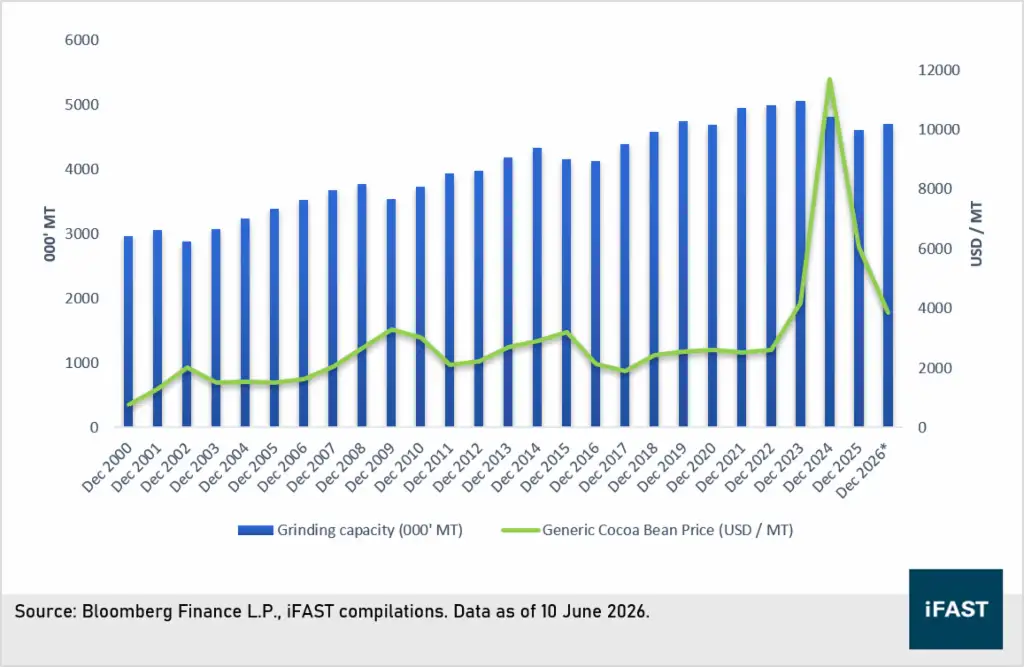
*Market forecast on the grinding capacity in 2026 cocoa crop year (01 Oct 2025 – 30 September 2026)
Financials
JB Cocoa recorded lower revenue of USD1,385.75 million, representing a decrease of approximately 16.4% YoY, partly due to lower shipment volumes and softer demand coupled with the normalisation of cocoa bean prices.
During the financial year, JB Cocoa recognised inventory write-downs to net realisable value (“NRV”) amounting to USD 79.3 million, in accordance with applicable international accounting standards and in response to sudden shifts in the global commodities market.
The Group continued to be affected by losses on foreign exchange contracts denominated in GBP and EUR of USD 2.7 million, driven by volatility in the US dollar.
Additionally, administrative expenses increased significantly by 59.6% to USD 25.9 million, mainly due to higher employee-related costs and performance-based incentives, broadly in line with the Group’s financial performance.
Nevertheless, supported by ongoing cost optimisation initiatives, higher contractual margins, and stronger hedging gains, EBITDA improved to USD139.75 million
Overall, despite lower sales volumes and higher administrative expenses, JB Cocoa’s bottom-line performance remains solid, with net profit margin at 5.8% compared to 1.4% in FY2025.
Looking ahead, we expect absolute sales figures to moderate given the normalisation in cocoa bean prices. However, net margins are expected to remain intact.
Table 1: Profitability indicators (USD million, unless otherwise stated)
|
FY2022
|
FY2023
|
FY2025 (15 months ) |
FY2026
|
|
|
Revenue |
509.63 |
595.79 |
1657.46 |
1,385.75 |
|
Cost of sales |
-461.48 |
-555.46 |
-1553.20 |
-1,214.94 |
|
EBITDA |
33.70 |
24.78 |
76.92 |
139.75 |
|
Profit before tax |
16.70 |
1.90 |
23.13 |
107.05 |
|
Net margin (%) |
3.3% |
0.3% |
1.4% |
5.8% |
Source: Company’s Reports, iFAST Compilations. Data as of 31 March 2026.
Credit highlights
Despite the highly volatile cocoa bean price, JB Cocoa has continued to demonstrate a stable credit profile. The net gearing ratio decreased marginally to 0.79x, compared to 0.8x in FY2025. The majority of its debt comprises trade bills (64%), which is typical for JB Cocoa given the nature of its business, followed by Sukuk issuance (27%) and term loans (9%).
Supported by stronger EBITDA performance, Total Debt/EBITDA improved to 1.93x (FY25: 2.56x). In addition, the interest coverage ratio also strengthened to 5.62x.
From a liquidity perspective, the group has actively increased its cash reserves, with cash levels now sufficient to cover short-term debt obligations (excluding trade lines). In addition, short-term debt obligations are further supported by its holdings of marketable assets.
Although the group recorded an operating cash outflow of USD25.1 million, this is not viewed as a concern, as such cash flow volatility is typical for a cocoa grinder business.
Other than that, there is one thing worth paying attention to is the maturity profile of the group’s Sukuk. Two tranches are due to mature in March 2027 and November 2027, with outstanding amounts of MYR100 million and MYR105 million (approximately USD25 million and USD26 million) respectively. However, we believe this is not a significant concern, as JB Cocoa’s EBITDA generation and cash reserves remain supportive to these upcoming repayments.
To summarise, the group’s gearing position remains broadly stable with a slight improvement, while its liquidity position remains solid. Credit risk remains well under control despite the elevated debt level, as we expect the group to gradually pare down debt following the normalisation of cocoa bean prices.
Table 2: Credit metrics (USD million)
|
|
2022 |
2023 |
2025 |
FY2026 |
|
Short-term Debt (excluding trade lines) |
19.8 |
4.0 |
44.1 |
42.3 |
|
Long-term Debt (excluding trade lines) |
18.8 |
41.7 |
88.6 |
54.2 |
|
Total Debt (excluding trade lines) |
38.5 |
45.7 |
132.7 |
96.5 |
|
- Trade lines |
138.3 |
225.4 |
64.3 |
173.3 |
|
Cash and bank balances |
21.6 |
26.3 |
36.7 |
48.4 |
|
Current ratio |
1.35 |
1.18 |
1.21 |
1.31 |
|
Operating cash flow |
49.2 |
-41.1 |
147.9 |
-25.1 |
|
Net gearing ratio (x) |
0.87 |
1.38 |
0.80 |
0.79 |
|
Total Debt / EBITDA (times)* |
5.25 |
10.94 |
2.56 |
1.93 |
|
Interest Coverage Ratio (times) |
5.05 |
1.60 |
2.19 |
5.62 |
Source: Company’s Reports, iFAST Compilations. Data as of 31 March 2026.
Key risks
Prolonged supply chain disruptions: If supply chain disruptions arising from adverse weather conditions persist for an extended period, this may adversely affect the group’s financial performance and credit metrics.
Fluctuation in cocoa bean prices and foreign exchange risks: Highly volatile bean prices environment and foreign exchange movements may impact the group’s financials negatively.
Our view
Generally, JB Cocoa’s outlook remains positive, largely underpinned by its cost pass-through model and longstanding partnerships with major players in the chocolate industry. Furthermore, the Group continues to benefit from a strong earnings profile and a healthy balance sheet. As mentioned, cocoa bean prices have eased from their peak levels, which should ultimately benefit cocoa grinders such as JB Cocoa by alleviating working capital pressures.
We are of the view that JB Cocoa, along with other cocoa grinders, may report lower revenue and cost of sales as cocoa bean prices normalise, given their cost-pass-through business model. However, margins are expected to remain intact and could potentially improve.
Overall, we believe the group’s credit risk remains well under control, supported by its strong earnings generation and solid liquidity position, which continue to provide adequate support for its debt servicing and repayment obligations.
Investors may consider its existing issuance, JBCOCO 5.800% 12Nov2027 Corp (MYR) and JBCOCO 5.950% 13Nov2029 Corp (MYR), yielding at4.96% and 5.29% respectively.
Table 3: Recommended bonds
|
Bonds |
Years to Maturity |
Yield to Maturity |
|
5M |
4.21% |
|
|
9M |
4.64% |
|
|
1Y5M |
4.96% |
|
|
3Y5M |
5.29% |
Source: BSM, iFAST Compilations. Data as of 16 June 2026.
Declaration: For specific disclosure, at the time of publication of this report, IFPL (via its connected and associated entities) and the analyst who produced this report hold a NIL position in the abovementioned securities.