What are STRIPS?
Treasury STRIPS (Separate Trading of Registered Interest and Principal of Securities) are securities that have been ‘stripped’ apart from traditional Treasury securities (including notes, bonds, and TIPS [Treasury Inflation-Protected Securities]). Essentially, each Treasury can be stripped apart into its respective principal and interest components (referred to as Principal STRIP and Interest STRIP respectively). For example, if we have a Treasury bond with 10 years remaining to maturity and coupons paid semi-annually (twice a year), this bond can be stripped into (i) one Principal STRIP due in 10 years; and (ii) 20 interest STRIPS every six months over the next 10 years (totalling 21 STRIPS).
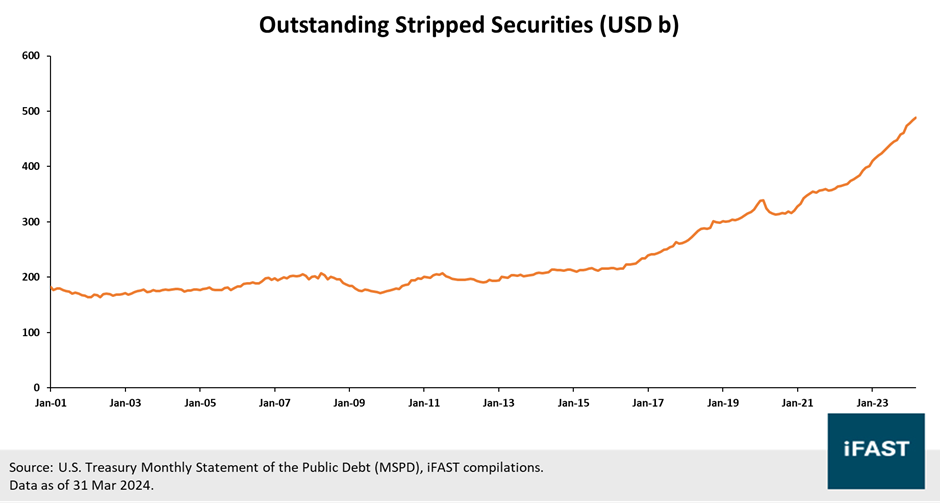
STRIPS demand has remained robust over the past few months, with the outstanding amount of stripped securities (monthly) generally seeing an increasing trend (Chart 1). In recent times, some of the largest monthly increases in the amount of STRIPS have come with growing expectations of rate cuts (e.g. Oct 2023: +$10.3b / Dec 2023: +$13.4b); similarly, the largest decreases in the amount of STRIPS have come with expectations of rate hikes (e.g. Mar 2020: -$15.1b). We attribute this trend to its status as a pure duration play (see section below).
Chart 1: Amount of STRIPS outstanding has increased over time
What should you know about STRIPS?
1. STRIPs can have different prices/yields from unstripped Treasuries
Each STRIP trades separately and independently in the secondary market. An unstripped Treasury, its constituent Principal STRIP, and its constituent Interest STRIPS (which will have different maturity dates in 6-month intervals) will all have different identifiers (e.g. ISIN), and more importantly, will have their own market price and yield.
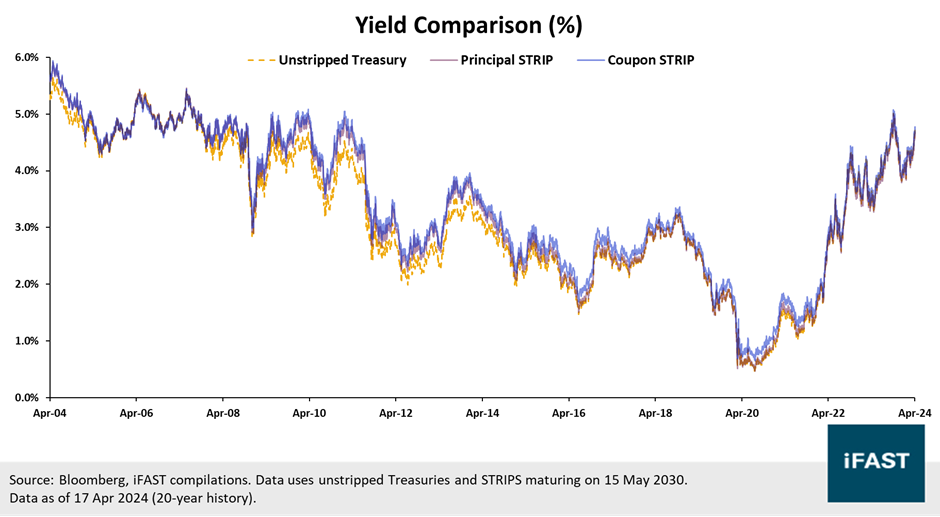
Nonetheless, considering their essentially identical risk and maturity profiles, we expect their yields to closely track each other . We illustrate this using an example of securities maturing on 15 May 2030, where their yields have moved in tandem over a long time horizon (Chart 2). As of 17 April 2024, the unstripped Treasury trades at a yield of 4.63% while the Principal STRIP trades at a yield of 4.60%. Minor differences in yields are unsurprising and expected depending on varying supply-demand conditions, though large yield differentials will likely be arbitraged out over the longer term.
Chart 2: Yields track each other very closely
2. STRIPS are generally longer in duration
Comparing a Principal STRIP with its corresponding unstripped Treasury, the Principal STRIP will generally have a higher duration despite having the same maturity. This is because of the zero-coupon nature of Principal STRIPS (compared to unstripped Treasuries which typically have non-zero coupons). For instance, looking at long-end unstripped Treasuries and STRIPS maturing on 15 Nov 2052, we find that there is a significant difference in modified duration: 15.9y vs 28.5y (data as of 17 Apr).
Therefore, in a falling-rates environment, Principal STRIPS will likely see a larger extent of price appreciation compared to its comparable unstripped Treasury (and vice versa for a rising-rates environment). Our two points below use the same examples of securities maturing on 15 Nov 2052.
- Chart 3 shows the historical price movements of these securities since 2023. It is clear that Principal STRIPS generally see larger and more volatile price movements compared to their unstripped counterparts – almost double in percentage terms.
- Chart 4 shows the results of our rates-sensitivity analysis, where we calculate indicative price movements of these securities if yields were to move by varying amounts. Once again, the estimated price movements are almost double for STRIPS compared to their unstripped counterparts.
Chart 3: STRIPS have historically seen much more volatile price movements
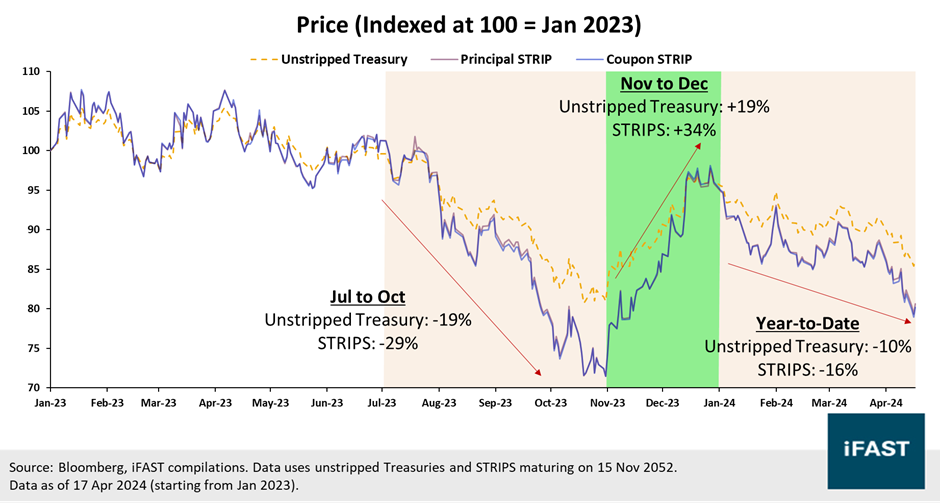
Chart 4: Sensitivity analysis - estimated price changes for changes in yield

3. No regular coupons, only a single principal repayment
Each STRIP comes with just a single payoff on its respective maturity date at par value, with no regular coupon payments up till the maturity date. This is different from most other Treasury securities which typically come with semi-annual coupon payments. This may help to reduce the reinvestment uncertainty associated with non-zero-coupon bonds, where investors have to think about how to re-invest their regular coupon payments every 6 months.
4. Risks are similar to that of Treasuries
The ‘stripping’ process is conducted by dealers (typically financial institutions) on the Commercial Book Entry System (CBES). However, in our view, STRIPS are considered to be backed by the full faith and credit of the US Government, which has issuer ratings of AA+ by S&P and Fitch, and Aaa by Moody’s. Hence, the default risk of STRIPS is very similar to that of their underlying unstripped Treasury, and we would currently classify STRIPS as a fairly low-risk investment.
5. Minimum investment amount is the same for STRIPS and Treasuries
Accredited (and institutional) investors into STRIPS can purchase them in USD 100 denominations with a minimum outlay of USD 1,000 – these amounts are the same for investors purchasing unstripped Treasuries. Retail (non-accredited) investors are subject to a regulatory minimum of SGD 200k for their transaction, once again the same as investments in unstripped Treasuries.
Potential investors can check their eligibility for an ‘Accredited Investor’ status, as the significantly lower minimum outlay provides them much more flexibility in their investments.
Who are STRIPS suitable for?
We compare the newly-onboarded SP ZERO 15Feb2054 Govt (USD) to other long-dated Treasuries on our platform maturing in 2050 and beyond (Table 1). Some features typical to STRIPS (highlighted above) are immediately apparent, including the significantly higher duration and zero coupons.
We think STRIPS (compared to unstripped Treasuries) are best suited to investors who think rate cuts will materialise soon, and are looking to STRIPS as a pure duration play. Investors who wish to gain exposure to US Treasuries (i) without worrying about reinvestment of coupons; and/or (ii) without the need for a significant cash outlay may also consider STRIPS. For investors using STRIPS as a duration play, we caution that STRIPS’ higher duration also likely results in heightened price volatilities relative to standard Treasuries.
With that being said, our Research Team has articulated a broader preference for shorter-duration bonds, given the prospect of a higher-for-longer interest rates environment – investors should be extra mindful of the embedded duration risks.
Table 1: List of long-dated Treasuries and STRIPS
| Bond Name | Maturity Date (Years to Maturity) |
Ask Price | Yield to Maturity (%) | Modified Duration (years) |
| SP ZERO 15Feb2054 Govt (USD) |
15 Feb 2054 (29.8) |
26.390 | 4.52% | 29.2 |
| T 1.250% 15May2050 Govt (USD) |
15 May 2050 (26.1) |
47.940 | 4.75% | 19.4 |
| T 1.625% 15Nov2050 Govt (USD) |
15 Nov 2050 (26.6) |
53.053 | 4.76% | 18.7 |
| T 3.000% 15Aug2052 Govt (USD) |
15 Aug 2052 (28.3) |
73.139 | 4.73% | 17.0 |
| T 4.000% 15Nov2052 Govt (USD) |
15 Nov 2052 (28.6) |
88.890 | 4.71% | 15.9 |
| T 4.125% 15Aug2053 Govt (USD) |
15 Aug 2053 (29.3) |
89.999 | 4.76% | 16.1 |
| T 4.750% 15Nov2053 Govt (USD) |
15 Nov 2053 (29.6) |
100.976 | 4.67% | 15.6 |
| Source: Bloomberg, Bondsupermart, iFAST compilations. Data as of 17 Apr 2024. | ||||
Declaration: For specific disclosure, at the time of publication of this report, IFPL (via its connected and associated entities) and the analyst who produced this report hold an NIL position in the abovementioned securities.
Our podcast series, Yield Hunters, is available on Spotify, iTunes Podcasts and Google Podcasts. We share our thoughts on new bond issues and hold discussions on the fixed income space. Listen to our latest episode below and follow us!