Introduction
DRB-HICOM Berhad (DRB) is a Malaysian conglomerate with businesses spanning across automobile sales and manufacturing, postal services, banking, and aviation, to name a few. DRB-HICOM is listed on the Kuala Lumpur Stock Exchange with a market capitalization of RM 4.56 billion as of 2nd of December 2019[1]. DRB-HICOM’s major shareholder is Malaysia’s 12th richest man valued at USD 1.9 billion[2], Tan Sri Syed Mokhtar, who holds a 55.92% shareholding via Etika Strategi Sdn Bhd[3]. Other notable shareholders include the Employees Provident Fund at 6.97%, Lembaga Tabung Haji at 2.59%, and CIMB Group Holdings at 2.13%[4].
Industry analysis: automotive sector
Proton’s turnaround: now Malaysia’s second best-selling brand
In 2017, DRB decided to sell a stake in its subsidiary, Proton Holdings, to China’s carmaker Geely, with the partnership involving exchanges of design and technologies, among others. The partnership has started to bear fruits as Proton (and by extension, DRB) begins to reap the rewards of the aforementioned technology and design transfer, which manifested in the hot-selling Proton X70 SUV model.
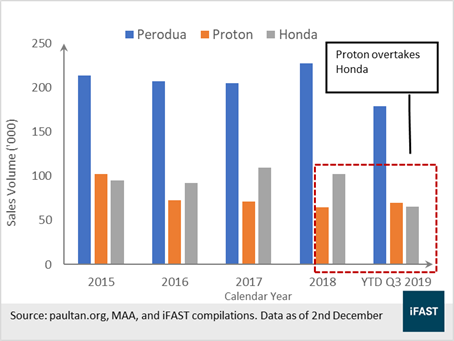
The strong response has contributed to a 42.02% YoY increase in Proton’s total sales volume for the third quarter of calendar year 2019, registering a total of 69,920 sales[5]. Corresponding to Proton’s strong performance, Proton now has been lifted to the country’s second best-selling car brand with a total market share of 15.78%, moving past the previous second best-selling brand Honda (14.70%).
The graph below highlights the automotive sector’s trend in car sales.
Figure 1: Top 3 best-selling car brands in Malaysia
Softer loan demand; higher loan approval rate
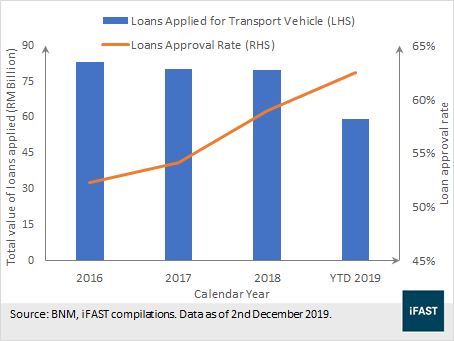
Automobile loan data is consistent with the change in sales mix, with consumer preference shifting towards Proton’s cheaper array of vehicles. The total value of loans applied for transport vehicle has been dropping since 2016, while the loan approval rate over the same period of time has been increasing. Given that hire-purchase lending rules have remained largely unchanged (and assuming buyers credit remains the same), the automotive loan data seems to suggest there is a trend of buyers favoring cheaper Proton vehicles.
Figure 2: Automotive loan data (loan applied vs loan approved)
Credit Analysis
In evaluating DRB’s credit profile, we have benchmarked DRB’s credit against automotive players in Malaysia namely Oriental Holdings Berhad, UMW Holdings Berhad, and Tan Chong Motor Holdings Berhad. This would give a more holistic view of how the credits of the automotive players in Malaysia stack against each other based on their respective latest financial data, which in the case of DRB-HICOM is as of the quarter ended 30th September 2019.
Profitability
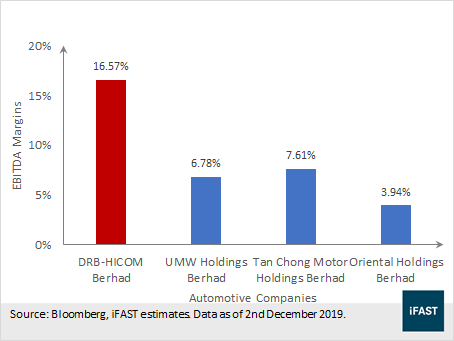
It should come as no surprise that DRB’s change in fortune coincided with Proton’s upswing. Proton’s increase in sales volume helped push revenue from DRB’s automotive segment up by 25.87% YoY in the latest quarter ended 30th September 2019. This has significantly improved DRB’s EBITDA margin to a healthy 16.57%, making the company the only listed automotive player in Malaysia to post double-digit margins.
Figure 3: EBITDA margins of major automotive companies
Gearing
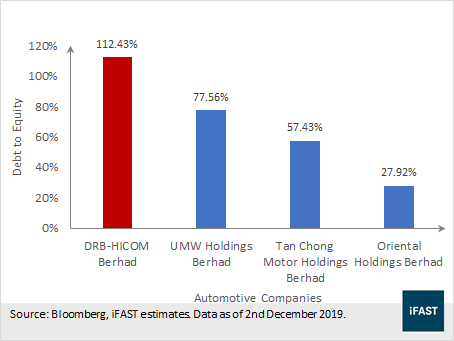
To evaluate the indebtedness of the automotive players, we have looked at their debt over equity. In addition to that, while perpetual securities are treated as equity under accounting rules, we have adjusted the perpetuals as debt as they are interest-bearing and therefore should be taken into account as debt, in our view, to fairly evaluate the indebtedness of the respective companies. Besides that, we have excluded financials attributable to Bank Muamalat from DRB’s balance sheet to provide fairer comparison.[6]
Relative to the other automotive players, DRB’s debt-to-equity ratio is far higher at 112.43%. With the new RM 1.5 billion issuance of sukuk, the gearing of DRB is expected to remain at similar levels as proceeds raised are expected to be used for repaying debt issued under the existing RM 1.8 billion sukuk programme.
Figure 4: Debt-to-equity ratios of major automotive players
Interest coverage
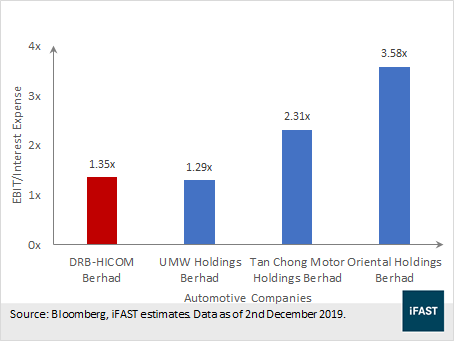
Given DRB’s highly leveraged position, it should come as no surprise that DRB’s interest cover is the lowest among its peers at 1.35 times of EBIT over interest expense (inclusive of its distribution to perpetual sukuk holders). While the interest cover does appear thin, improvements in the profit margins of DRB on the back of Proton’s success has steadily increased DRB’s interest cover from 0.92 times in FY 2018, a trend we foresee to continue.
Figure 5: EBIT over interest expense of major automotive players
Valuation and recommendation
Under the fresh sukuk programme, DRB has raised debt totaling RM 1.5 billion from issuances across the 3-year, 5-year, 7-year, and 10-year maturities. Given the lack of comparables in the market, we have used the BNM A+ curve across the respective tenures to evaluate relative pricing.
Figure 6: Yields to maturity of the DRB bonds vs the BNM A+ curve
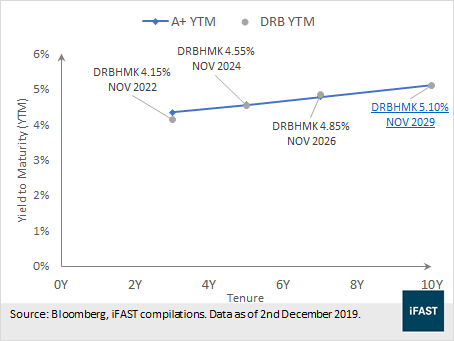
The graph above suggests that the respective DRB bonds are fairly priced relative to their A+ rating band (as rated by local rating agency, MARC). Overall, we are positive on all the new DRB bonds, with a preference towards the longer end of the curve i.e. the 10-year DRB bond, as it offers the most attractive spread (+167 basis points over the 10Y MGS).
Despite DRB’s aggressively geared balance sheet, we believe that DRB should be able to service its debt as Proton’s improved profitability should drive DRB’s earnings and therefore add more room to its interest-servicing ability. Furthermore, DRB’s strong shareholder base suggests the likely availability of financial support in times of need.
Table 1: the new DRB bonds
|
Bond |
Yield to Maturity |
Credit Opinion |
|
DRBHMK 4.15% NOV 2022 |
4.15% |
Fairly valued |
|
DRBHMK 4.55% NOV 2024 |
4.55% |
Fairly valued |
|
DRBHMK 4.85% NOV 2026 |
4.85% |
Fairly valued |
|
5.10% |
Fairly valued |
|
|
Source: Joint lead managers (Maybank, RHB). Data as of 29 November 2019. |
||
Declaration: For specific
disclosure, at the time of publication of this report, IFC (via its connected
and associated entities) does not have any position in the securities mentioned
in the report. The analyst who produced this report holds a NIL quantity in the
securities mentioned in the report.