About First REIT
- Listed on the Singapore Exchange since 2006 with a market cap of S$795m (as of 30 Aug 19), First REIT is Singapore’s first healthcare REIT that has a focus on the healthcare sector.
- First REIT’s portfolio consists of twenty properties valued at S$1.35 billion at the end of June, located in Indonesia (16 properties), Singapore (3), and South Korea (1). The REIT’s hospital assets in Indonesia are operated by PT Siloam International Hospitals Tbk (“Siloam”), a listed subsidiary of PT Lippo Karawaci Tbk (“LK”). As disclosed in First REIT’s 2018 annual report, LK, Siloam and their subsidiaries contributed around 83.6% of the REIT’s rental income.
- The REIT Manager, Bowsprit Capital Corporation Limited, is owned by OUE Lippo Healthcare Limited (40%) and its parent, OUE Limited (60%). OUE Limited has approximately 18.3% deemed ownership stake in First REIT (as at 30 Jun 19). The REIT sponsor and former parent of the REIT Manager, LK, holds 10.5% interest in the REIT.
Stable operating performance in 1H19
First REIT’s operating performance in the six months ended June (“1H19”) was largely stable, as its rental and other income stayed unchanged at S$57.6m (1H18: S$57.6m). Property operating expenses rose from S$0.7m in the previous corresponding period to S$1.3m in 1H19. As a result, we saw a slight dip (-1.0% YoY) in net property income to S$56.4m (1H18: S$56.9m).
The increase in property expenses were mainly incurred at First REIT’s Sarang Hospital and Indonesia properties. According to management’s explanation at a recent investor meeting we attended, the underperformance of Sarang Hospital was expected to persist for the foreseeable future. The tenant at the property had not been paying the full contractual rental, which to our understanding was unrealistically high relative to what the tenant could expect to earn from operating the hospital.
First REIT had refrained from pushing too hard for rental recovery from the South Korean tenant, in fear of being left with an idle hospital without an operator. Nonetheless, management stressed that Sarang Hospital constituted only a small part of their portfolio. The property contributed USD0.5m of annual rental, or less than 1% of First REIT’s rental income in 2018.
Meanwhile, other expenses dropped to S$0.5m (1H18: S$1.7m) primarily due to lower unrealized exchange losses on the REIT’s USD loan. This is offset by the net fair value losses on interest rate swap contracts of S$0.5m (1H18: gains of S$0.2m). Overall, First REIT’s profit before tax was stable at S$40.2m for the first six months of 2019 (1H18: S$40.2m).
Credit metrics remained healthy
First REIT’s cash flow from operating activities jumped 34.9% YoY to S$54.7m in 1H19 (1H18: S$40.6m), following the collection of trade and other receivables from rental receipts and VAT refunds from Indonesia’s tax authority for previous years’ acquisitions. After paying S$34.0m (1H18: S$31.5m) in distributions to unitholders and S$10.3m (1H18: S$11.1m) in interest expense including perpetual distributions, the REIT applied most of the cash flow surplus toward debt repayment.
Consequently, total borrowings (before transaction costs) fell from S$503.0m to S$492.8m in the six months ended June, and reported gearing ratio (total debt over total assets) improved correspondingly from 35.0% to 34.5%. Assuming the S$60m FIRTSP 5.680% Perpetual Corp (SGD) as debt, we find First REIT’s adjusted gearing ratio at 38.7% (4Q18: 39.1%), which is still a healthy level.
Finance costs were slightly lower at S$10.1m in 1H19 (1H18: S$10.2m), which translated to a robust interest coverage ratio (EBIT/finance costs) of 5.0x (1H18: 4.9x). Including the S$1.69m reserved for distribution to perpetual bondholders (1H18: S$1.69m), we find the REIT’s adjusted interest coverage at 4.3x (1H18: 4.2x).
Gearing is likely to rise from asset enhancement initiatives and acquisitions
We note that First REIT has committed to a S$63m payment for its asset enhancement initiative (“AEI”) for Siloam Hospitals Surabaya (“SHS”). In December 2015, the trust entered into an asset swap deal with a LK subsidiary, which essentially comprised the swapping of the existing SHS for a new SHS that is part of a mixed development on the adjacent land. Pursuant to the transaction, First REIT will receive S$27.5m for its sale of the existing hospital, and pay S$90.0m for the new SHS.
First REIT has paid S$27.0m of the acquisition price, with the remaining S$63.0m to be paid presumably when the trust takes possession of the new SHS, which is expected to take place in the second half of 2020. Assuming the balance (minus the divestment proceeds of S$27.5m) is fully funded by debt, we estimate First REIT’s gearing and adjusted gearing ratios to rise to approximately 36% and 40% respectively.
In addition to AEIs, management has guided that they will continue to look for acquisition opportunities from third parties or its sponsors LK and OUE Lippo Healthcare Limited. Given the significant uncertainty from expiry of LK master leases in December 2021, which we will discuss in more detail below, we think First REIT will be aggressive in acquiring new income sources to plug the gap, diversify its revenue base, and hold up growth.
We understand from management that they intend to keep reported gearing below 38% on a long-term basis, although they have also indicated their willingness to go above 40% temporarily if the situation calls for it. Furthermore, the Monetary Authority of Singapore (“MAS”) announced recently that it was considering to raise the current leverage limit of 45% for Singapore REITs.
First REIT is likely to take advantage of the higher debt headroom if the proposed regulatory changes go through. Nonetheless, management noted that they were mindful of the risks posed by the lease expiries in 2021, which might put downward pressure on the REIT’s portfolio valuation and push gearing higher. Weighing the above considerations, we think there is a high chance that First REIT will lever up to buy new properties in the near-to-medium term, although we expect it to fund acquisitions with a combination of debt and equity to keep leverage manageable.
No maturing debt until 2021
In the first half of 2019, First REIT repaid S$10m of borrowings and refinanced another S$100m term loan facility due in May. As a result, the trust has no refinancing needs until 2021 (see Figure 1). Weighted average debt maturity was lengthened to 2.51 years as at 30 Jun 19 (4Q18: 2.36 years). Although the REIT’s weighted average cost of borrowing rose to 4.1% per annum (4Q18: 3.8% p.a.), its ratio of fixed-rate debt over total debt improved to 60.2% (4Q18: 59.0%) over the same period.
Figure 1: First REIT’s debt maturity profile as at 30 Jun 19
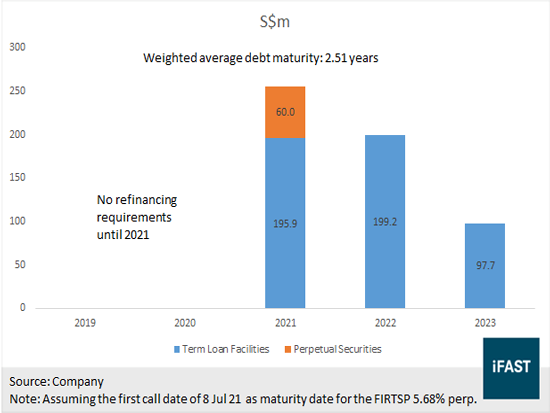
Although First REIT’s refinancing risk is minimal, we think the trust has limited financial flexibility for the foreseeable future. Firstly, First REIT has already mortgaged most of its investment properties for loans, with just three unencumbered properties—Sarang Hospital, SHS, and Siloam Hospitals Yogyakarta—that aggregated to S$61.6m or less than 5% of its portfolio. The trust also does not have any committed revolving credit facilities in place.
All of First REIT’s S$492.8m of borrowings are secured debt, which as a proportion of its property portfolio will translate to a loan-to-value ratio of roughly 37%. While that suggests the REIT should be able to raise additional secured borrowings if needed, its financial flexibility is constrained by factors discussed in the earlier section, i.e. its capital expenditure requirements for AEIs and acquisitions, the expiry of LK master leases in 2021, and the leverage limit imposed by MAS.
Revenue concentration and looming master lease expiries constrain credit profile
Since its inception, First REIT has been heavily reliant on LK for its earnings. The sponsor, Siloam (51% owned by LK), and their subsidiaries contributed 83.6% of the REIT’s revenue in 2018.
In addition, rentals paid by Siloam, the healthcare provider operating all of First REIT’s hospitals in Indonesia, are heavily subsidized by LK. We understand from management that Siloam is paying only around 20% of rental income received by the REIT, with the rest of the rents being topped up by LK as the master lessee. We see this arrangement as equivalent to income support from LK to both Siloam and First REIT.
The side effects of revenue concentration and sponsor rental support are starting to surface as the first batch of LK master leases approach their expiry date. In 2021, five of the REIT’s lease contacts, constituting 22% of its portfolio’s gross floor area (“GFA”), will be up for renewal (see Figure 2). Except for Sarang Hospital, four of the other expiring contracts are master lease agreements with LK and its subsidiaries—Siloam Hospitals Lippo Village, Siloam Hospitals Kebon Jeruk, SHS, and Imperial Aryaduta Hotel & Country Club.
Figure 2: First REIT’s lease expiry profile
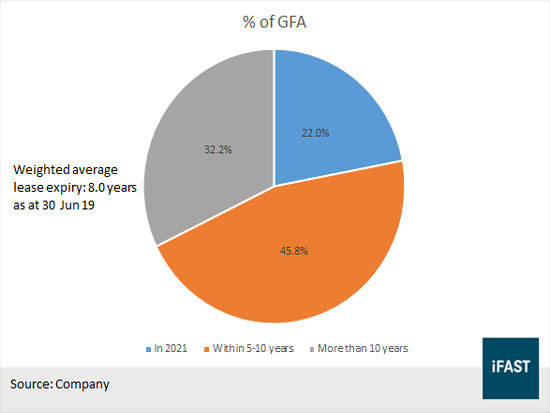
We estimate that the five master leases contributed about S$31m in 2018, or 27% of First REIT’s rental income last year. According to management, rental subsidies from the sponsor comprised around 70% of the income derived from LK master leases expiring in 2021, and as mentioned earlier, the third-party tenant at Sarang Hospital hadn’t been able to meet its full rental expense from operating earnings.
We also heard from management that rents received by the REIT for its Indonesian hospitals would make up around half of the operators’ EBITDA. Our survey of Bloomberg data on the operating results of healthcare providers in Southeast Asia suggests that a more reasonable ratio of rental expense over EBITDA would be in the region of 10-30%. Finally, the SHS asset swap deal described earlier involves a new master lease agreement with LK at a higher base rent of S$8.1m per annum, once First REIT takes possession of the new SHS.
Taking into account the above considerations, we estimate that between 5% and 15% of First REIT’s rental income could be at risk come 2021. Given First REIT’s healthy balance sheet and interest coverage, even a poor outcome from the master lease expiries is unlikely to threaten its financial viability. However, we think the 2021 leases will be a major overhang on the trust’s security prices until it provides more clarity on the situation.
The management acknowledged that renewal negotiations for the 2021 LK master leases will be a challenge, given the unique characteristics of the properties such as the services offered and property structure. Although management held on to the view that current rentals were not too expensive as compared to prevailing market rates, they had been forthright to admit that, at this juncture, they were unsure how things would eventually turn out.
High extension risk on the FIRTSP 5.68% perp
At its indicative ask price of 92.107 (as at 30 Aug 19), First REIT’s FIRTSP 5.680% Perpetual Corp (SGD) is offering a yield to worst/perpetuity of 5.95%. The yield to call is 10.46%, representing a spread of 888bps above SGD swaps, which clearly tells us that the market is not expecting the REIT to redeem its perp on the first call date of 8 Jul 21.
In July 2021, the coupon rate on the FIRTSP 5.68% perp will reset to the sum of the prevailing five-year SGD swap offer rate plus the initial spread of 392.5bps. Comparing the current credit spread attributed to the perp with its initial spread, it is safe to say that if there is no improvement in First REIT’s credit profile—or at least the market’s perception of it—between now and July 2021, it would be much cheaper for the REIT to leave the perp outstanding than to refinance it with a new bullet bond or perp.
Indeed, that was what management had indicated during our recent meeting with them. We were told that if things stay as they are and the market environment remains similar to now, there is a high chance they would extend the FIRTSP 5.68% perp beyond July 2021.
Assuming similar market conditions and issuer’s credit profile, and given management’s early indication of a likely non-call, the market is prone to price the FIRSTSP 5.68% perp increasingly on a perpetuity basis as we approach July 2021. In that scenario, we think bond prices could fall to 74-83 cents on the dollar to reflect a yield to perpetuity (6.6-7.4%) that is more comparable with First REIT’s dividend yield on equity (8.6% as at 30 Aug 19).
Of course, refinancing economics is not the only driver of call decisions. First REIT will also have to consider the significant reputational cost of extending a perp beyond its first call date. Besides, a lot of things can certainly change within two years. Last but not least, because of their regulatory leverage limit, REITs have a higher incentive to redeem perps on first call so that they can continue to tap the perpetual bond market—perps are a valuable tool for them to sidestep the gearing cap.
From that perspective, current prices of the FIRTSP 5.68% perp provide decent potential upside from the perp being called in July 2021. But even then, we think the risk-reward ratio of First REIT’s perp pales in comparison to the perps of its sister REIT, Lippo Malls Indonesia Retail Trust (“LMIRT”).
We think LMIRT’s LMRTSP 7.000% Perpetual Corp (SGD) (ask YTW: 7.51%) and LMRTSP 6.600% Perpetual Corp (SGD) (ask YTW: 7.61%) carry lower extension risk. Although LMIRT’s reported gearing and adjusted gearing ratios are higher at 35.2% and 47.9% respectively (both as at 30 Jun 19), the REIT has greater financial flexibility in our view, given its fully unencumbered property portfolio and continued access to the bond market, having issued the LMRTSP 7.250% 19Jun2024 Corp (USD) in June.
LMIRT also has a much lower revenue concentration in the Lippo group of companies—revenue from related-party tenants accounted for 24.5% of its revenue in 1H19. Unlike First REIT, which presumably has the 2021 expiration of sponsor master leases as its absolute top business priority, LMIRT has lesser pressure to undertake acquisitions or diversify its earnings. That gives LMIRT more room to plan for the refinancing of the two LMIRT perps to ensure continued access to the perpetual bond market. Finally, even assuming a non-call event, the two LMRTSP perps offer better value and lower downside risk, as their yields to perpetuity are closer to LMIRT’s twelve-month equity dividend yield of 8.43% (as at 30 Aug 19).
Declaration:
For specific disclosure, at the time of publication of this report, iFAST Financial Pte Ltd (via its connected and associated entities) has a principal position in LMRTSP 6.600% Perpetual Corp (SGD). The analyst who produced this report holds a NIL position in the abovementioned securities.