- PT Lippo Karawaci Tbk and Siloam International Hospitals Tbk ran into troubles generating revenue last year, leaving First REIT in a lurch with almost S$200m of debt expiring this year
- First REIT is aiming to restructure its master lease agreements with them to give them a lifeline and in hopes of extending its own credit facilities
- The MLAs reduce the rental income by about 40% for First REIT but renew the leases for a longer period of time. Together with vaccinations, they should reduce the chances of default for PLKR and Siloam
- However, unitholders have to pass the resolution in an EGM on 19 Jan first
- First REIT's perps look interesting at the price region of 60+ although it will most likely not be called this year
In the final week of 2020, First REIT announced that OCBC and CIMB Bank have extended credit facilities of up to S$260m. This will help to refinance most of FIRT’s 2018 secured loan facilities, including S$196.6m expiring this year.
However, the loan facilities are not without clauses. First REIT’s 2018 secured loan facilities total to S$400m. The astute reader will notice that there is a sizable gap of S$140m, of which OCBC and CIMB Bank have imposed a condition where First REIT has to undertake an equity fund raising exercise to fill this gap.
First REIT will undertake a rights issue where First REIT Management Ltd. and OUE Lippo Healthcare Ltd. (“OUELH”) will accept, subscribe and pay in full for its respective total provisional allotments of the Rights Units. Furthermore, OUE will procure its direct wholly-owned subsidiary, Clifford Development Pte. Ltd., to subscribe and pay in full any excess Rights Units. Thus, the S$140m is a given if First REIT carries out the rights issue.
That is not all. In our previous credit update (see article “First REIT: Credit Update 30 Jul 20”), we pointed out that First REIT’s revenue mainly comes from PT Lippo Karawaci Tbk (“LPKR”). PT Siloam International Hospitals Tbk (“Siloam”), a listed subsidiary of LK, operates all of First REIT’s healthcare properties in Indonesia, while LK acts as the master lessee for most of these properties. In 2019, LK and its subsidiaries, including Siloam, contributed 83.3% of First REIT’s rental income.
Under the current Master Lease Agreements (“MLAs”), rental collection from LKPR could be highly challenging given the current financial circumstances faced by the tenant and may lead to dire consequences for First REIT and its investors. In addition, the REIT will see 24% of its gross floor area (“GFA”) expiring in 2021. Thus, First REIT intends to restructure LPKR’s MLAS to secure future revenue. This gives visibility over First REIT’s valuations and cashflow, allowing unitholders to evaluate First REIT, which is important for its rights issue exercise.
On 19 Jan 2021, unitholders will be voting in the Extraordinary General Meeting (“EGM”) to pass the 2 resolutions – 1. the proposed LPKR MLAS restructuring, and 2. the proposed waiver by unitholders other than Clifford Development Pte. Ltd. (“CDPL”) and its concert parties of their rights to receive a general offer for their units from CDPL pursuant to Rule 14 of the Takeover Code.
If you are a unitholder, it makes the most sense to approve the two resolutions. If resolution 1 is not passed, the rights issue cannot take place. If only resolution 1 is passed, First REIT has to arrange for the rights issue to be underwritten in order for the rights issue to proceed, which may be quite some trouble to go through. Finally, if the rights issue does not proceed, then First REIT will face a very high liquidity risk as the S$196.6m of debt is expiring in March, against a S$17.8m of cash at hand as at 30 Jun 20.
What will the new MLAs be?
In our previous articles, we noted that the current MLAS are unsustainable for Siloam with LPKR subsidising most of their rents. COVID-19 also resulted in revenues in some hospitals reducing by half and the impact may even be significant and structural over the medium term. The proposed MLAS aims to resolve that and removes the impact of SGDIDR fluctuations too.
Table 1
Overview of key terms
|
S$ million |
Current (FY19) |
Proposed |
|
|
LPKR Hospitals and MPU Hospitals |
Base rent |
80.9 (LPKR hospitals) |
50.9 (LPKR hospitals) |
|
Base rent escalation |
2x of Singapore's CPI increase for the preceding calendar year (capped at 2%) |
4.5% annually |
|
|
Variable/Performance based rent |
2.9 (LPKR) |
8.0% of preceding FY hospital gross operating revenue |
|
|
Total rent payable |
Base + variable |
Higher of base or performance based rent (asset by asset basis) |
|
|
Tenure |
15 years + 15 years with mutual agreement/at the option of lessees |
15 years + 15 years with mutual agreement |
|
|
Currency |
SGD |
IDR |
|
|
Security deposits |
6 months |
8 months |
|
|
Source: Company's presentation dated 28 Dec
20 |
|||
The proposed MLAS alleviate LPKR’s burden by reducing the base rent of about 40 – 50% but it will increase at a much faster rate as compared to the current MLAS. Furthermore, the variable rent only consisted of a small proportion of the total rent in the current MLAS. Changing it to performance-based rent allows First REIT to receive more income in bumper years. However, it will take some years for rental income to return to current MLAs levels.
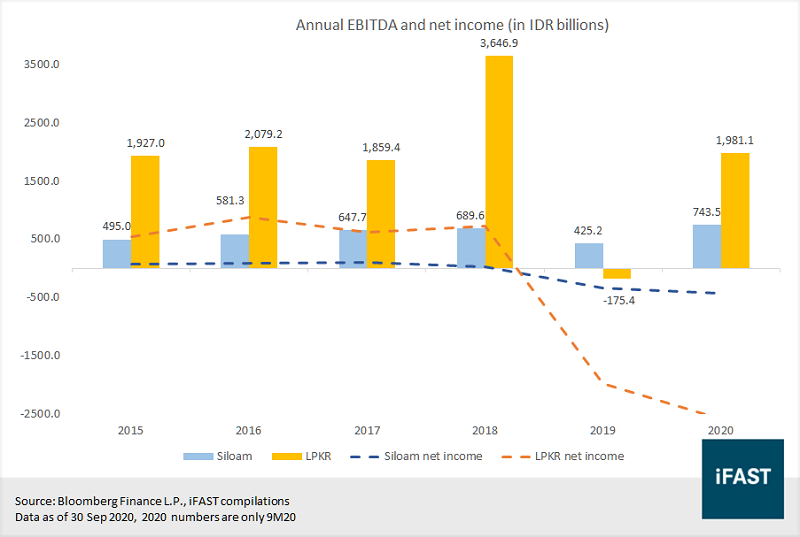
The below figure shows EBITDA figures for Siloam and LPKR. Note that new accounting policies were in effect from 2020, which moved rental expenses to interest expenses, thus EBITDA from 2020 onwards do not include rental expenses. The current MLA would have taken a huge chunk of Siloam’s and LPKR’s earnings. However, LPKR received subsidies of S$32.9m (~IDR 881bn) in 2020, and in LPKR’s 3Q20 presentation slides, they reported that Siloam only paid IDR 93b of rent to LPKR for 9M20, which should only be a fraction of what they usually pay.
The subsidies would improve their net income but net income still fell for Siloam and LPKR in 9M20. Although Siloam and LPKR still have positive cash balance of IDR 702.3b and IDR 3717b in 3Q20 respectively, they would be lower if not for the subsidies. Without restructuring, it may be only a matter of time before their cash balances would be depleted.
Figure 1
Net income and EBITDA for Siloam and LPKR
With lower rental income, dividend pay-outs have to fall. The below table shows the pro forma financial effects of the restructuring and the rights issue for First REIT.
Table 2
Pro forma financial effects for FY19
|
S$ million |
FY19 |
Pro forma FY19 |
|
Rental and other income |
115.3 |
77.6 |
|
Net property and other income |
112.9 |
75.1 |
|
Leverage ratio |
34.50% |
33.90% |
|
Adjusted interest coverage ratio (x) |
4.30 |
3.65 |
|
DPU (cents) |
8.60 |
2.59 |
|
Source: Company presentation slides, FY19 financial statement, iFAST estimates |
||
As the debt is transferred to equity, leverage ratio will be reduced. Adjusted interest coverage ratio (EBIT/financing costs, including perps interest) decreases to 3.65X due to the fall in revenue. However, their revenue will be more volatile in the future as First REIT will bear currency risk after the restructuring. Unitholders will take the brunt of the impact with much lower dividends in the future and has already suffered significant capital loss.
What about the First REIT perp?
At the end of 1H20, First REIT only holds S$17.8m in cash and cash equivalents. The FIRTSP 5.680% Perpetual Corp (SGD) has an outstanding amount of S$60m. Obviously, First REIT cannot call the perps without issuing new debt, and it is unlikely that they can do it now. Furthermore, the perp will reset to a lower rate of about 4.4% which will most probably be lower than the coupon rate which they will/can refinance at.
At a call date of 8 Jul 2024 and an indicative ask price of 63, investors will still face a sizable yield to call of 20.96%. The dividend yield for the stock based on indicative issue price of S$0.20 and theoretical ex-rights price of S$0.31 is 13.0% and 8.5% respectively. Comparing to the dividend yield, the perp’s price also seem decent now with a yield to maturity of about 8%.
Furthermore, the longer it takes for First REIT to call back the perp, the more difficult it will be for them to issue new bonds/perps considering the reputational risk they may face. In an interview with Business Times, First REIT’s management also stated they “plan to take on unsecured debt and tap the bond market to raise funds in future, as part of its funding source diversification plans.”
Per the management’s intention, the FIRTSP 5.680% Perpetual Corp (SGD) has to be called eventually so that they can continue to tap the bond market at the cost of manageable interest expense. At current prices, future unsecured debt might have to be issued at 7-8% coupon rates. Assuming an issue size of S$100m, we expect the adjusted interest coverage ratio in 1H20 will fall to 2.8x.
Although the credit ratios of First REIT do not look terrible on paper, investors will probably wait for the dust to clear at the Indonesian front before they have appetite for new First REIT bonds. Looking at Siloam’s and LPKR’s earnings, they seemed to have navigated through the storm as seen by the rebound in 3Q20. For LPKR, their net income was affected by the unrealized loss of IDR 1.1 trillion.
Table 3
Income for Siloam and LPKR for 2020 quarters
|
IDR billions |
Net income |
EBITDA |
||
|
Dates |
Siloam |
LPKR |
Siloam |
LPKR |
|
31/3/2020 |
16.195 |
-2115.53 |
303.464 |
1516.634 |
|
30/6/2020 |
-146.237 |
864.481 |
81.589 |
-220.85 |
|
30/9/2020 |
81.247 |
-1089.44 |
358.408 |
685.425 |
|
Source: Bloomberg Finance L.P.,
iFAST compilations |
||||
As occupancy rates and revenue have a high possibility to rebound, and together with lower rental expenses, Siloam and LPKR should have a strong tendency to improve their income this year. These would be positive for First REIT too.
Which is better – the bond or stock?
If the refinancing succeeds, the next major debt repayment (excluding the perps) would be the 2019 credit loan facility of S$100m expiring in 2022. Thus, it is likely that the next refinancing efforts would be focused on this loan facility rather than the perps. However, as explained above, First REIT should call their perp as soon as possible if they want to tap into the bonds market. If First REIT calls their perps within 3 years (Jan 2024), investors will still receive a yield to call of 21.4%. Comparing it to its stock, the stock has to appreciate by 13% annually if its dividend yield is at 10.5% to match the perps’ returns. Chances of that happening do not seem to be high.
Furthermore, in the worst-case scenario where First REIT defaults, bondholders will still get a higher share if the REIT liquidates its holdings. If the unitholders do not pass the resolution to restructure the MLAs, First REIT has to refinance S$196.6m of debt. There will probably not be enough demand for new bonds as First REIT is highly encumbered. First REIT probably has to raise more funds through its rights issue, which OUE will have to fund. This subsequently means that its equity will lose even more value, which is more detrimental towards unitholders. Thus, unitholders should be more incentivised to pass the resolutions, which should improve the perps’ prices too.
As it is in the unitholders’ interest to pass the resolutions, we also believe that the perps are attractive at its current pricing. It may even be more opportune for investors to invest in the FIRTSP 5.680% Perpetual Corp (SGD) before the EGM convenes on 19 Jan.
Declaration: For specific disclosure, at the time of publication of this report, IFPL (via its connected and associated entities) and the analyst who produced this report hold a NIL position in the abovementioned securities.
Our podcast series, Yield Hunters, is available on Spotify and iTunes Podcasts and Google Podcasts. We share our thoughts on new bond issues and hold discussions on the fixed income space. Listen to our latest episode below and follow us!