Key Points
- TIME dotCom’s business model remains relatively stable, supported by a subscription-based revenue model with a high proportion of recurring income (~95%).
- For Q1FY2026, revenue and profit before tax increased by 6% YoY and 9.1% YoY respectively, driven primarily by stronger customer subscriptions and growth in connectivity services.
- The Group has consistently maintained a strong credit profile and a net cash position since FY2014, with a net debt-to-equity ratio of 0.01x and a healthy interest coverage ratio of 20.71x.
- Given its resilient financial profile, investors may consider TIME’s new issuances, offering approximately 3.79% for the 5-year tranche and 3.92% for the 7-year tranche.
TIME dotCom Berhad ("TIME") is Malaysia's leading independent telecommunications and digital infrastructure provider, offering fibre broadband, enterprise connectivity, data centre, and cloud services across retail, enterprise, and wholesale customer segments.
The company was originally incorporated in 1996 as TIME Telecommunications Holdings Berhad (TIME Telecom). It officially changed its name to TIME dotCom Berhad in January 2000, prior to its listing on the Main Market of Bursa Malaysia (KLSE: TIMECOM / 5031) on 12 March 2001.
As of 14 July 2026, Employees Provident Fund remains as the largest shareholder with 17.32% stakes, followed by 10.09% stakes held by Rahim Afzal Bin Abdul (Executive Vice Chairman).
Why people like Time Dotcom?
TIME dotCom stands out because it offers pure fiber internet with equal speed in both directions. While most broadband providers give you fast download speeds but slow upload speeds, TIME delivers symmetrical speeds where your upload speed fully matches your download speed. In contrast, asymmetrical speeds (offered by most competitors) provide fast download speeds but drastically reduce upload capacity.
Example:
-TIME (Symmetrical): A 500 Mbps plan gives you 500 Mbps download / 500 Mbps upload.
-Competitor (Asymmetrical): A 500 Mbps plan gives you 500 Mbps download / only 100 Mbps upload
In addition, TIME offers a far more competitive internet package compared to rival providers. For instance, while a standard 300 Mbps plan typically costs around RM130 per month with competitors, TIME provides users with double the bandwidth—a 600 Mbps plan—for that exact same price point
About Time dotCom
TIME’s product offering can be segregated into 4 different products, namely Data, Cloud, Voice and Other Solutions.
Table 1: Products offered by TIME
|
Product |
Description |
% of Revenue |
|
Data |
Fibre-based connectivity — home broadband, enterprise data links, and wholesale bandwidth sold over TIME's terrestrial and subsea cable network |
~2% |
|
Cloud |
Private and multicloud infrastructure services, delivered mainly through subsidiary AVM Cloud |
~90% |
|
Voice |
Traditional fixed-line voice services, a legacy/secondary business in structural decline |
~1% |
|
Other Solutions |
Renewable energy — solar power and EV charging infrastructure |
~6% |
Source: Company Reports, iFAST Compilations. Data as of 31 March 2026.
Given TIME's business model, which focuses on broadband and fibre connectivity services, approximately 95% of its revenue is recurring in nature.The reason behind is mainly because the broadband and fibre connectivity services are on a contractual basis (usually 12,24,36 months), providing the group with an earning visibility.
In addition, the durability of TIME's revenue is further supported by its ownership of an extensive terrestrial fibre network and equity stakes in four international subsea cable systems (UNITY, FASTER, APG and AAE-1). Besides TIME, Telekom Malaysia (TM) is the only other telecommunications provider in Malaysia with its own nationwide fibre network infrastructure.
This creates a significant barrier to entry, as replicating such an extensive network requires substantial capital investment, lengthy deployment timelines and regulatory approvals. As a result, we believe TIME's infrastructure assets provide a durable competitive advantage and strengthen the sustainability of its earnings over the long term
Financial highlights
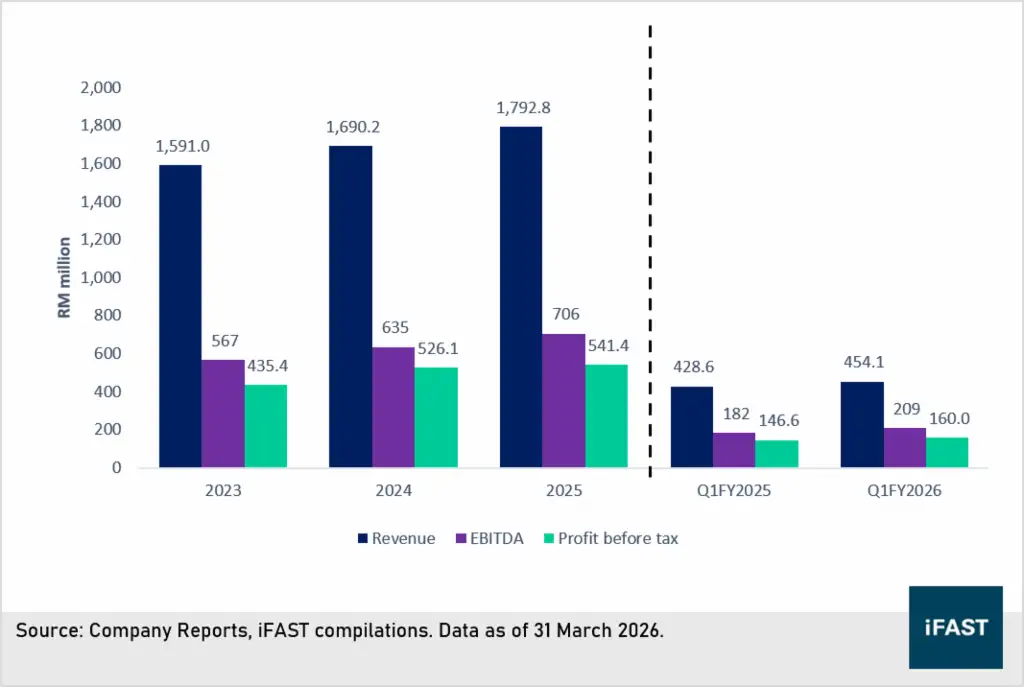
As illustrated in Chart 1, both revenue and earnings have recorded steady growth since FY2023. The positive momentum continued into FY2026, supported by sustained demand for data and connectivity services. In Q1 FY2026, the group reported revenue of RM454.1 million, representing a 6.0% YoY increase compared with the corresponding period in FY2025.
The group's cost structure has also remained largely stable, with operating expenses increasing gradually and at a manageable pace in line with business expansion. As a result, EBITDA margins have remained healthy, ranging between 36% and 46% since FY2023.
Overall, profit before tax rose to approximately RM160 million in Q1 FY2026, an increase of 9.1% YoY, reflecting the group's resilient earnings profile and continued operating efficiency.
Chart 1: Profitability indicators (RM’000)
Prudent balance sheet structure; robust liquidity position
TIME has maintained a conservative capital structure over the years, with minimal borrowings and a net cash position since 2014. Consequently, its net debt-to-equity ratio has consistently remained negative, reflecting its net cash position, while its interest coverage ratio stood at a healthy 20.7x as of Q1 FY2026, mainly supported by resilient earnings generation and a low debt obligation.
That said, the group's cash balance declined significantly from RM1.5 billion to RM253.3 million in Q1 FY2026. The higher cash level in 2023 was mainly because of the deployment of proceeds from the divestment of its stake in AIMS Data Centre to DigitalBridge Group, which generated approximately RM2 billion in gross proceeds.
A substantial portion of these proceeds was returned to shareholders through special dividend payments in 2024 and 2025. This was primarily aimed at optimising the balance sheet and boosting shareholder returns (ROE), rather than retaining excess cash in low-yielding bank deposits. The remainder was utilised to support the Group’s ongoing capital expenditure, particularly the continued expansion of its fibre network.
If we look at the group's borrowings, they increased significantly to RM281.9 million in 1QFY2026. Management explained that the additional borrowings were part of its balance sheet optimisation strategy and were used to finance capital expenditure (CAPEX) and working capital requirements. Rather than relying solely on its cash reserves, the Group is adopting a more efficient capital structure by utilising low-cost debt to fund its expansion. We also believe that raising debt is ‘cheaper’ than equity, as shareholders typically expect higher returns through sustained growth and larger dividend payouts.
Most importantly, following the increase in borrowings, the ratio stood at only 0.1x, suggesting that the Group remains conservatively leveraged and still has substantial borrowing capacity to support future growth. Management has indicated a long-term target of maintaining a net debt-to-EBITDA ratio of 1.0x to 1.5x.
Despite the reduction in cash balances, TIME's credit profile remains firmly supported by its net cash position, strong liquidity and prudent financial management. As such, we believe the group's credit risk remains very low.
Table 1: Credit Metrics (RM’000)
|
2023 |
2024 |
2025 |
Q1FY2026 |
|
|
Cash and bank balances |
1,535,041 |
1,237,360 |
475,925 |
253,250 |
|
Current borrowings |
10,913 |
958 |
2,874 |
281,916 |
|
Non-Current borrowings |
- |
2,874 |
- |
- |
|
Net Debt-to-Equity ratio |
-0.37 |
-0.31 |
-0.15 |
0.01 |
|
Interest coverage ratio (x) |
17.14 |
18.36 |
20.73 |
20.71 |
|
Operating cash flow |
767,899 |
628,775 |
793,048 |
166,258 |
|
Free cash flow |
417,274 |
318,385 |
430,351 |
77,417 |
Source: Company Reports, iFAST Compilations. Data as of 31 March 2026.
Key Risk
Technology Obsolescence: As a network service provider, TIME faces the ongoing risk of technology obsolescence, requiring continuous investment in network infrastructure to upgrade critical assets, expand coverage, and maintain its competitive position. Although the company currently generates sufficient operating and free cash flow to fund these investments, a substantial increase in CAPEX requirements could lead to higher borrowings and increased leverage.
Rising Competitive Pressure: Other telecommunications providers, such as Maxis and CelcomDigi, are increasingly offering 5G fixed wireless access (FWA) broadband as an alternative to fibre broadband. This could potentially erode TIME's market share if these operators are able to offer more compelling value-for-money packages.
Nevertheless, we believe 5G FWA is unlikely to be a direct substitute for fibre broadband over the long term, as fibre continues to offer superior speed, lower latency, greater bandwidth capacity, and more consistent performance, particularly for data-intensive applications.
Our view
Overall, TIME dotCom maintains a strong earnings and credit profile, underpinned by its stable business model, resilient cash flow generation, and a high proportion of recurring revenue (~95%). Its competitive internet plans and service quality support customer stickiness, resulting in a lower risk of subscriber churn to other network providers.
In view of these factors, investors may consider TIME’s new issuances as follows:
Table 2: Recommended bonds*
|
Bonds |
Yield |
Credit Rating |
|
Time dotCom 5 years |
~3.79% |
AA1 (RAM) |
|
Time dotCom 7 years |
~3.92% |
AA1 (RAM) |
*Availability and liquidity are subject to prevailing market conditions.
Declaration: For specific disclosure, at the time of publication of this report, IFPL (via its connected and associated entities) and the analyst who produced this report holds a NIL position in the abovementioned securities.