Key Points
- GCB’s profit before tax (PBT) surged 139% YoY to RM455.5 million in 1H2026, despite a 46% YoY decline in revenue, largely reflecting lower finance costs as a result of lower cocoa bean prices.
- The lower cocoa bean price environment has eased working-capital and borrowing requirements, with GCB’s net debt-to-equity ratio improving significantly to 93% as at 1H2026, from 135% at FY2025.
- GCB’s credit quality remains sound despite its relatively low cash position against short-term obligations. This is not a major concern as most of the short-term debt comprises self-liquidating trade financing, which is repaid as cocoa beans are processed and sold.
- We maintain a positive view on GCB’s credit profile. Existing investors can continue to hold. For new investors, we prefer the 2030 bonds, which offer a yield of around 5.04%, given their longer maturity and attractive yield.
Overview
Guan Chong Berhad (GCB) is a Malaysian public-listed company principally engaged in the manufacturing and trading of cocoa-derived food ingredients. The company was incorporated in Malaysia on 22 March 2004 and listed on the Main Market of Bursa Malaysia Securities Berhad on 8 April 2005.
GCB's core business is processing cocoa beans into cocoa-based ingredients, including cocoa mass, cocoa butter, cocoa cake and cocoa powder. These ingredients are widely used by food and beverage manufacturers, particularly in chocolate, confectionery, bakery products and beverages.
GCB is now one of the largest cocoa grinders in the world and plays a key role in the global cocoa industry. GCB had recently announced its latest results (Q2/1H2026), in the latest results, Guan Chong delivered a strong bottom-line performance despite a decline in revenue — a pattern shared by other cocoa grinders such as JB Cocoa this year, for broadly similar reasons (falling bean costs boosting grinding margins even as top-line revenue tracks lower selling prices).
Outlook - Cocoa Bean Industry
As shown in Chart 1 below, cocoa bean prices have been normalising since their 2024 peak, falling to around USD5,150/MT as of 30 June 2026. This reflects a combination of factors: softer demand following the earlier price spike , together with improved weather conditions and stronger harvests in West Africa, which have eased the previous supply shortage.
That said, we think this correction may not run much further, and prices could turn choppy or even see renewed upward pressure. A very strong El Niño weather pattern is already under way and is expected to peak around Q4 2026 — the US National Oceanic and Atmospheric Administration (NOAA) has put the odds of it reaching “very strong” intensity at over 90%, with some forecasters suggesting it could rank among the strongest events in the modern record (potentially surpassing every El Niño observed since formal records began in 1950).
El Niño events typically bring drier, more erratic weather to West Africa, which supplies roughly 60–70% of the world’s cocoa — so a severe event could hurt the region’s upcoming harvest and put renewed upward pressure on bean prices.
Given this, we think it is likely that cocoa grinders such as Guan Chong, JB Cocoa and others will need to keep their borrowing levels elevated in order to fund higher bean purchases, which would weigh on margins. That said, because grinders largely pass bean costs through to their customers, we believe day-to-day operations should hold up reasonably well even if profitability comes under some pressure.
Chart 1: World cocoa grindings and cocoa bean price ('000 MT and USD/MT), as at 30 June 2026
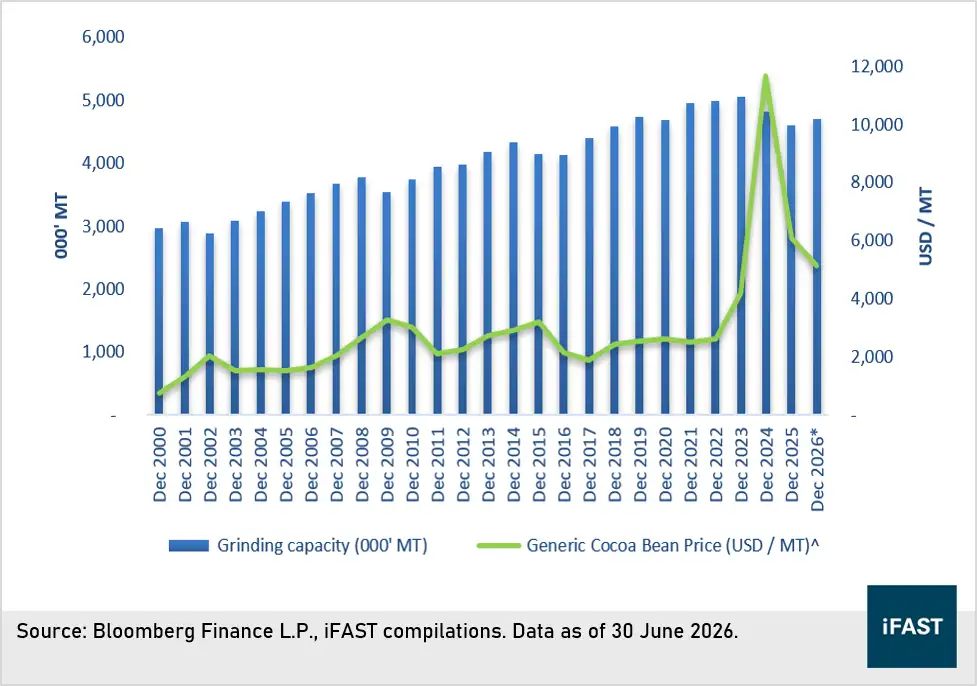
*Market forecast for grinding capacity in the 2026 cocoa crop year (1 October 2025 – 30 September 2026). ^Price as at 30 June 2026.
Financials - Margins Widen Despite Revenue Decline
In line with the sharp fall in cocoa bean prices from their peak of around USD12,000/MT, GCB's revenue fell 46% YoY to RM4,424.9 million in 1H2026.
Lower bean prices also eased the group's finance costs, which fell to RM109.8 million from RM181.4 million in 1H2025 — a reminder that cheaper beans reduce the amount of working-capital financing GCB needs, and therefore its interest bill as well.
Overall, profit before tax jumped 139% to RM455.5 million, from RM190.5 million in 1H2025, despite the fall in revenue. This was mainly driven by effective management of raw material purchases and cocoa ingredient sales positions: GCB managed to procure beans at lower cost while selling at prices that had not yet fully adjusted downward, which widened its margin.
Looking ahead, we expect GCB to maintain its margin levels despite the potential impact of El Niño on cocoa bean prices, as the company has experienced similar cost pressures in 2024 and demonstrated its ability to pass on higher input costs to clients.
Table 1: Profitability indicators (RM million, unless otherwise stated)
|
2021 |
2022 |
2023 |
2024 |
2025 |
1H2025 |
1H2026 |
|
|
Revenue |
3,923.3 |
4,419.8 |
5,320.8 |
10,442.5 |
14,924.0 |
8,192.2 |
4,424.9 |
|
Operating profit |
229.2 |
244.2 |
284.4 |
796.0 |
630.0 |
370.5 |
567.6 |
|
Profit before income tax (PBT) |
196.8 |
188.1 |
139.1 |
513.8 |
293.4 |
190.5 |
455.5 |
|
PBT margin (% - TTM) |
5.0% |
4.3% |
2.6% |
4.9% |
2.0% |
3.5% |
5.0% |
Source: Company reports, iFAST compilations. Data as at 30 June 2026.
Credit Profile: Gearing Improves as Bean Prices Fall
GCB's credit profile held up well and even improved slightly in 1H2026. Total borrowings fell 22% YoY to RM2,500 million, from RM3,187 million as at 31 December 2025 (FY2025) — bringing the net debt-to-equity ratio down sharply to 93%.
As Table 2 shows, GCB's borrowing levels swing around quite a bit from year to year, and most of its debt is short-term. That is largely because around 58% of total debt is made up of trade loans, which are used to finance bean procurement. Strip these out, and short-term debt excluding trade loans comes to a much smaller RM89.5 million.
The interest coverage ratio, on a trailing 12-month basis, also improved slightly to 2.7x, helped by stronger 1H2026 earnings.
At this juncture, we believe GCB's credit quality remains sound, without any material deterioration. Cash on hand looks thin next to short-term obligations, but we do not see this as a red flag: this short-term debt is largely self-liquidating trade financing that gets repaid as beans are processed and sold, rather than debt GCB needs to cover out of its own cash reserves.
Table 2: Credit metrics (RM million, unless otherwise stated)
|
2021 |
2022 |
2023 |
2024 |
2025 |
1H2026 |
|
|
Short-term debt |
900.5 |
796.4 |
1,533.8 |
3,437.0 |
2,215.8 |
1,536.3 |
|
Long-term debt |
391.8 |
364.4 |
648.0 |
798.7 |
971.9 |
962.9 |
|
Inventories |
1,875.5 |
1,589.2 |
2,524.3 |
5,483.4 |
4,534.1 |
3,606.2 |
|
Trade and other receivables |
431.6 |
624.7 |
850.0 |
1,302.7 |
1,296.3 |
998.9 |
|
Cash and bank balances |
73.8 |
69.1 |
85.1 |
241.7 |
123.0 |
174.5 |
|
Net debt-to-equity ratio (%) |
91% |
67% |
120% |
188% |
135% |
93% |
|
TTM Interest coverage ratio (x) |
8.9 |
5.5 |
2.5 |
3.1 |
2.1 |
2.7 |
Source: Company reports, iFAST compilations. Data as at 30 June 2026.
Risks
Prolonged supply chain disruption: If weather-related disruption, including from El Niño persists for an extended period, this could adversely affect the group's financial performance and credit metrics.
Rollover risk on short-term financing: GCB's business model relies on continued access to short-term trade financing lines from banks. A tightening in credit conditions, or a renewed spike in bean prices that strains collateral values, could test the group's ability to roll over these facilities on similar terms.
Our view
Overall, GCB's financial performance and credit profile remain solid at this juncture, despite the lower revenue recorded in 1H2026. Cocoa bean prices are inherently volatile, driven by a mix of weather, crop disease and consumer demand. We are not overly concerned by this volatility, given GCB's cost pass-through model — where bean cost changes are largely reflected in selling prices — and its long-standing relationships with major global players such as Nestlé and Mondelez.
We therefore maintain a positive stance on Guan Chong's business and outlook. Existing investors can continue to hold. For new investors, we will recommend the 2030 bonds, yielding at 5.04% area**.
**Liquidity subject to market conditions
Table 3: Recommended bonds
|
Bond |
Years to maturity |
Yield to maturity |
Credit rating (MARC) |
|
1Y3M |
4.47% |
AA- |
|
|
3Y7M |
5.04% |
AA- |
Source: BSM, iFAST compilations. Data as of 17 September 2026.
Declaration: For specific disclosure, at the time of publication of this report, IFPL (via its connected and associated entities) and the analyst who produced this report hold a NIL position in the abovementioned securities