Sembcorp Industries Ltd (“SCI”) is proposing to issue its maiden sustainability-linked bond at a final price guidance (“FPG”) of 2.66%. The tenor of the issuance will be 10.5 years and will mature on 6 April 2032.
About the sustainability-linked notes
SCI is the guarantor of the new issue. The unsecured notes will bear a fixed-rate coupon of 2.66% with 10.5 years to maturity and is ranked senior to other bonds. The notes come with a sustainability-linked coupon step-up and states that if SCI does not meet with the note’s sustainability performance target (“SPT”), it will trigger a step-up event of +25bps on or after 1 April 2026. The SPT for the notes is to achieve a greenhouse gas (“GHG”) emissions intensity of 0.40 tCO2e/MWh or lower by 31 December 2025 and the coupon step up will be effective from the first interest payment date after the step up event has occurred.
The use of proceeds of the notes will be for general corporate purposes and to refinance the existing debt of SCI. Proceeds from a potential investment by the International Finance Corporation (“IFC”) will be used to finance or refinance SCI’s renewable energy or other sustainable projects.
IFC has obtained in-principle board approval (subject to final confirmation by its management) to purchase up to SGD 150m of the notes. Investors have to note that this investment from the IFC is subjected to final confirmation and the investment may not take place. Additionally, SCI may decide not to allocate any notes to IFC.
1H21 Financial highlights
For its half year (“1H21”) results for the financial year ended 30 June 2021, SCI reported revenues of SGD 3.29b, a 26% year-on-year (“YoY”) increase from 1H20. Earnings before interest, tax, depreciation and amortization (“EBITDA”) for the company also saw a 20% increase YoY to SGD 640m.
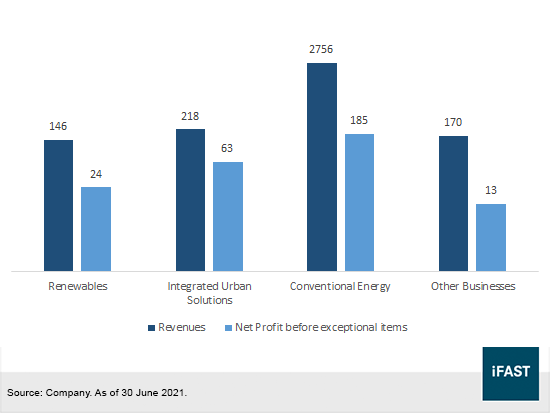
Renewables and integrated urban solutions segment make up SCI’s Sustainable Solutions arm and saw total revenues for both segments increasing by 9% YoY to SGD 364m. Net profits for Sustainable Solutions saw a 10% decline YoY to SGD 87m in 1H21 partly due to lower wind resource in India and start-up costs of solar business in Vietnam.
Figure 1: 1H21 revenues and net profit before exceptional items (in SGD m)
Key ESG KPIs
SCI aims to transform their business from conventional energy to greener renewables energy. Currently, conventional energy make up 59% of SCI’s net profit (before corporate costs and exceptional items, “core net profit”) and Sustainable Solutions making up 38% of SCI’s core net profit. SCI plans to achieve 70% of core net profit from Sustainable Solutions in FY2025 through organic growth in its Sustainable Solutions segments and recycling of assets for new sources of capital.
Through SCI’s Sustainable Financing Framework, SCI highlighted 3 key performance indicators (“KPIs”) for sustainability-linked transactions – GHG emissions intensity, absolute GHG emissions and gross installed renewable energy capacity.
For FY20, SCI recorded 0.54 tCO2e/MWh and aims to achieve 0.40 tCO2e/MWh by FY25. As mentioned above, as part of the sustainability-linked coupon step up, a step-up event will occur if SCI fails to achieve this KPI by FY25. In our view, it is likely for SCI to achieve this KPI as the company transitions into less carbon intensive renewables energy sector. Given SCI’s plan to put more emphasis and investments into their Sustainable Solutions segments, we believe SCI will be able to lower their GHG intensity down to 0.40 tCO2e/MWh.
SCI’s other KPIs include lowering of absolute GHG emissions (Scope 1 and 2 emissions) from 26.5m tCO2e to 2.7m tCO2e by FY30 and increasing gross installed renewable energy capacity from 2.6GW to 10GW by FY25. In our view, we think SCI should be able to reach these targets as it continues to grow its Sustainable Solutions segments.
Credit and liquidity
We find SCI’s credit and liquidity profile to be well managed. Total borrowings for the group is at SGD 7.72b and cash and cash equivalents of SGD 1.16b. SCI have access to various sources of funding. It has unutilised committed facilities of SGD 1.22b and unutilised borrowing facilities of SGD 4.92b. Thus, SCI is able to refinance its debts and has low refinancing risks.
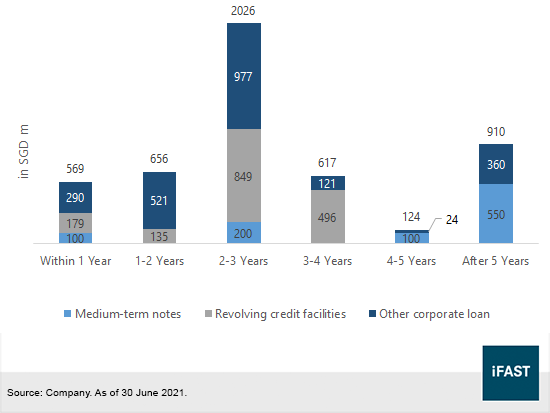
Leverage (Debt/EBITDA) for the group have decreased from 6.5x in FY20 to 6.0x in 1H21. Interest coverage ratio (EBITDA/ Interest) for the company have improved from 2.4x in FY20 to 3.0x in 1H21. From Figure 2, debt maturity profile of the company is also well spread with a weighted average term to maturity of 4.5 years.
Figure 2: Debt maturity profile
Relative valuation
One key difference between green bonds and sustainability-linked notes is that sustainability-linked notes tend to have a SPT coupon step-up in the event the SPT is not met. This allows the issuer to be more flexible with the use of proceeds as it does not need to fund certain green projects as long as the SPT is met.
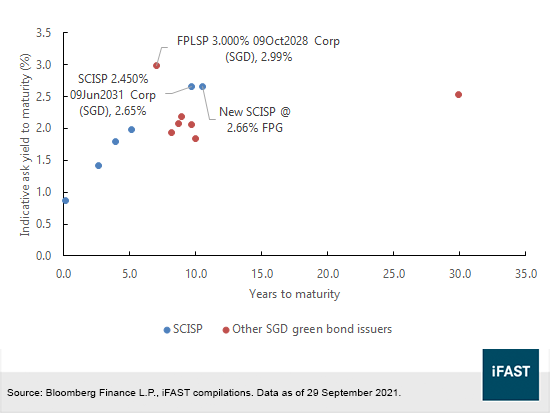
From Figure 3, comparing the new issue with other SCI issues, we do not find the new issue to be fairly priced at its FPG of 2.66%. The new notes have just 1 basis point in yield above SCISP 2.450% 09Jun2031 Corp (SGD) and has a longer year to maturity.
Comparing the new notes to other SGD green bonds, the FPLSP 3.000% 09Oct2028 Corp (SGD) has a more attractive yield as compared to the new SCI issue. Furthermore, for investors who would want to invest into green projects through bonds, investing in green bonds offers investors more transparency in knowing that the use of proceeds will be used to fund green projects by the company.
Figure 3: Relative valuation of SGD ESG bonds vs the SCISP curve
Declaration: For specific disclosure, at the time of publication of this report, IFPL (via its connected and associated entities) holds a NIL position and the analyst who produced this report holds a NIL position in the abovementioned securities.
Our podcast series, Yield Hunters, is available on Spotify, iTunes Podcasts and Google Podcasts. We share our thoughts on new bond issues and hold discussions on the fixed income space. Listen to our latest episode below and follow us!