HSBC has been in the news for almost all the wrong reasons – its role in the FinCen leaks, and being caught in the crossfire between the US and China, to name a couple. While HSBC’s stock and bond prices have recovered after Ping An revealed that it was increasing its stake in HSBC, we will examine potential implications of the ongoing developments in this article.
Ailing profits
HSBC’s profits declined in 2019 largely due to restructuring costs and goodwill impairment. While we think restructuring costs and asset disposals would be recurring themes in HSBC’s financial statements to 2022, 1H20 has been much worse due to COVID-19. Reported profit after tax declined by 69% YoY to USD 3.1 billion in 1H20 due to higher expected credit losses (“ECL”) and lower revenue. ECL increased by USD 5.7 billion to USD 6.9 billion and was estimated to continue increasing in the next two quarters.
As HSBC based their scenario analysis on countries’ GDP growth, we compared the lender’s assumptions with Bloomberg consensus forecasts to judge whether the lender’s ECL have been too conservative or not. Bloomberg consensus forecasts gloomier scenarios for the UK and Hong Kong.
Table 1: Forecast of annual GDP growth rates
|
Annual GDP growth (%) |
UK |
US |
HK |
CN |
|
Bloomberg consensus |
||||
|
2020 |
-10.0 |
-4.4 |
-7.0 |
2.1 |
|
2021 |
6.4 |
3.8 |
4.2 |
8.0 |
|
HSBC consensus |
||||
|
2020 |
-7.8 |
-5.2 |
-4.8 |
1.4 |
|
2021 |
5.9 |
4.1 |
4.2 |
8.1 |
|
Source: Bloomberg Finance L.P., HSBC's interim report 2020, iFAST compilations Data as of 30 Sep 20 |
||||
HSBC Group seems to be forecasting a reported ECL of USD 8.3 billion for 2020 based on the probabilities of their scenarios. Table 2 shows how ECL would change according to the three different scenarios laid out by the lender. With a more bearish outlook, we could potentially see ECL of about USD 3-4 billion in 2H20.
Table 2: Group ECL sensitivity results
|
Total Group ECL |
Retail USD bn |
Wholesale USD bn |
|
Reported ECL |
4.0 |
4.3 |
|
Scenarios |
|
|
|
100% consensus Central scenario |
-0.2 |
-0.5 |
|
100% consensus Downside scenario |
0.4 |
1 |
|
100% alternative Downside scenario |
1.9 |
6.8 |
|
Source: HSBC's interim report 2020 |
||
Net interest margin (“NIM”) also fell, declining by 21 basis points (bps) from 1Q20 to 1.33% in 2Q20, due to lower interest rates. We expect NIM to remain stable for the next few years since interest rates could barely go lower for developed countries, unless they proceed to move to negative interest-rate policy. Barring any one-off expenses, 2H20 net income would most likely be higher than 1H20 and 2H19, considering that 2H19 had a huge impairment of goodwill.
The bank’s common equity tier 1 (“CET1”) ratio increased from 14.7% to 15.0% in 1H20 due to the cancellation of 4Q19 dividend and the current suspension of dividends on ordinary shares, which offset the increase in risk-weighted assets.
US sanctions and Chinese threats
On 3 June 20, HSBC’s Asia-Pacific CEO Peter Wong signed a petition backing Beijing’s new national security law on Hong Kong. The action received much backlash from many, including US secretary of state Mike Pompeo and UK foreign secretary Dominic Raab. Subsequently, on 14 July 20, the Hong Kong Autonomy Act became public law in the US. Below is an excerpt from it regarding sanctions on foreign financial institutions.
SEC. 7. SANCTIONS WITH RESPECT TO FOREIGN FINANCIAL INSTITUTIONS THAT CONDUCT SIGNIFICANT TRANSACTIONS WITH FOREIGN PERSONS THAT CONTRAVENE THE OBLIGATIONS OF CHINA UNDER THE JOINT DECLARATION OR THE BASIC LAW.
(1) LOANS FROM UNITED STATES FINANCIAL INSTITUTIONS.—The United States Government may prohibit any United States financial institution from making loans or providing credits to the foreign financial institution.
(2) PROHIBITION ON DESIGNATION AS PRIMARY DEALER.—Neither the Board of Governors of the Federal Reserve System nor the Federal Reserve Bank of New York may designate, or permit the continuation of any prior designation of, the foreign financial institution as a primary dealer in United States Government debt instruments.
(3) PROHIBITION ON SERVICE AS A REPOSITORY OF GOVERNMENT FUNDS.—The foreign financial institution may not serve as agent of the United States Government or serve as repository for United States Government funds.
(4) FOREIGN EXCHANGE.—The President may, pursuant to such regulations as the President may prescribe, prohibit any transactions in foreign exchange that are subject to the jurisdiction of the United States and involve the foreign financial institution.
(5) BANKING TRANSACTIONS.—The President may, pursuant to such regulations as the President may prescribe, prohibit any transfers of credit or payments between financial institutions or by, through, or to any financial institution, to the extent that such transfers or payments are subject to the jurisdiction of the United States and involve the foreign financial institution.
To our interpretation, the sanctions could have multiple implications – point 1 in the above list could cause problems in interbank borrowing for the sanctioned foreign financial institution; point 2 and 3 could create obstacles in commercial and investment banking; and point 4 could cause problems in dollar funding.
Meanwhile, China came up with its own Unreliable Entity List, where penalties including restricting trade, investment and visas will be imposed on any company, country, group or person that appears on the list. This could cause problems in new business development for HSBC. However, given that details of the new regulation are vague at this juncture, we deem the probability of aggressive Chinese enforcement actions on possible candidates, including HSBC, to be low. For example, while Lockheed Martin is supposedly on the list, the move seems to be purely symbolic, as Lockheed Martin does not have much revenue coming from China.
For China to be moving aggressively with the list, it would mean a significant further worsening of relationship between the UK and China, as US firms should be China’s primary retaliation targets. Furthermore, HSBC’s Asia-Pacific unit seems to have bent to the will of China too. If being on the list would affect employment prospects of HSBC’s employees in Hong Kong, it could cause more resentment for Chinese authorities too, which may not be what China wants.
For the US sanctions, we believe they would be targeted more towards non-Western foreign financial institutions, i.e. Chinese financial institutions. If there is truly a sanction on HSBC, we think would be likely more symbolic rather than impactful. Still, the potential impact of sanctions, if imposed, could be huge, so we will still be monitoring the situation closely. We think an election win for Joe Biden should reduce US sanction risk, as Donald Trump is more unpredictable.
HSBC has a tightrope to tread considering that it earns the bulk of its profits from Asia but has a hefty US balance sheet and is headquartered in the UK. However, we think it is likelier that sanction threats would turn out to be manageable for the reasons mentioned above.
FinCen leaks
In the FinCen Files, HSBC reportedly filed suspicious activity reports (“SAR”) on a Ponzi scheme based in Los Angeles. Despite knowing it was a Ponzi scheme in 2014, HSBC still aided in the transactions, allowing the perpetrator to withdraw the ill-gained funds. The International Consortium of Investigative Journalists (ICIJ) also claimed that “HSBC identified suspicious transactions moving through accounts in Hong Kong of more than $1.5bn – about $900m linked to overall criminal activity”. While HSBC fulfilled its legal duty of submitting the SAR, one could say that the lender failed in its ethical duties.
In December 2012, HSBC was fined USD 1.9 billion for its role in money laundering of at least USD 881m for Mexican drug cartels. While the suspicious transactions mentioned in the preceding paragraph amounted to a sizable sum of at least USD 1.5 billion, we do not know if all of them would fall under the territory of the US Justice Department. What we do know is that chances of HSBC receiving another fine would be high.
Brexit
Brexit has been dragging for a couple of years now and HSBC had time to prepare for it since 2016. From the bank’s interim report, its “programme to manage the impact of the UK leaving the EU has now been largely completed”. Furthermore, from the transcript of HSBC’s 1H20 results call, management had already factored in the impact from Brexit on ECLs. Brexit should not be high on HSBC’s list of concerns, and similarly, for investors.
Our take
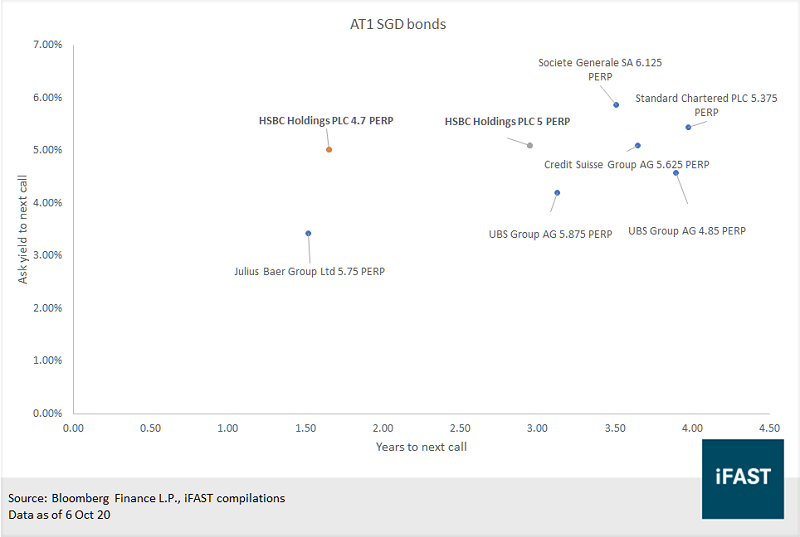
If we look across the globe, these developments are not exclusive to HSBC only. Standard Chartered shares a similar fate with HSBC, having significant profit exposure to Hong Kong and both having scrapped dividends since the pandemic broke out. Other big banks like JP Morgan also have accusations against them in the FinCen leaks. If we look at the SGD AT1 bond space, the two HSBC perpetual bonds — HSBC 4.700% Perpetual Corp (SGD) and HSBC 5.000% Perpetual Corp (SGD)— seem fairly valued after the rebound in late September, and provide decent yields compared to the other issuers.
Figure 1: Relative valuation: SGD AT1 instruments
If we look at the spreads on the AT1s of HSBC versus Standard Chartered, HSBC looks more appealing. HSBC’s spreads have been lower historically, and HSBC still has a higher credit rating than Standard Chartered currently. HSBC’s CET1 capital ratio is also higher than Standard Chartered, although its profitability seems to be in worse shape.
Figure 2: HSBC vs Standard Chartered
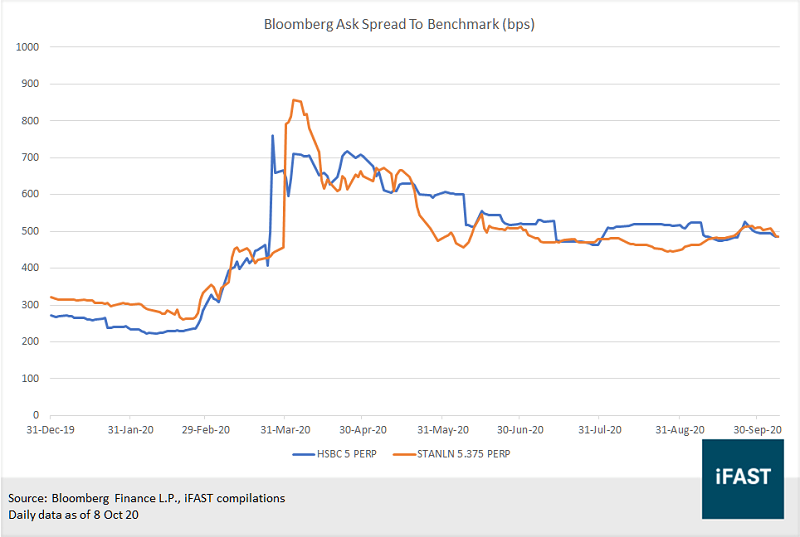
Table 3: 1H20 financial highlights
|
HSBC |
Standard Chartered |
|
|
CET 1 capital ratio (%) |
15.0 |
14.3 |
|
Total capital ratio (fully-loaded) (%) |
20.7 |
21.5 |
|
Tier 1 capital ratio (%) |
17.8 |
16.5 |
|
Return on tangible equity (%) |
3.8 |
6.0 |
|
UK leverage ratio (%) |
5.9 |
5.2 |
|
Liquidity coverage ratio (%) |
148.0 |
149.0 |
|
Credit provisions as a % of loans (in bps) |
66 |
57 |
|
Source: Bloomberg Finance L.P., Company filings, iFAST compilations |
||
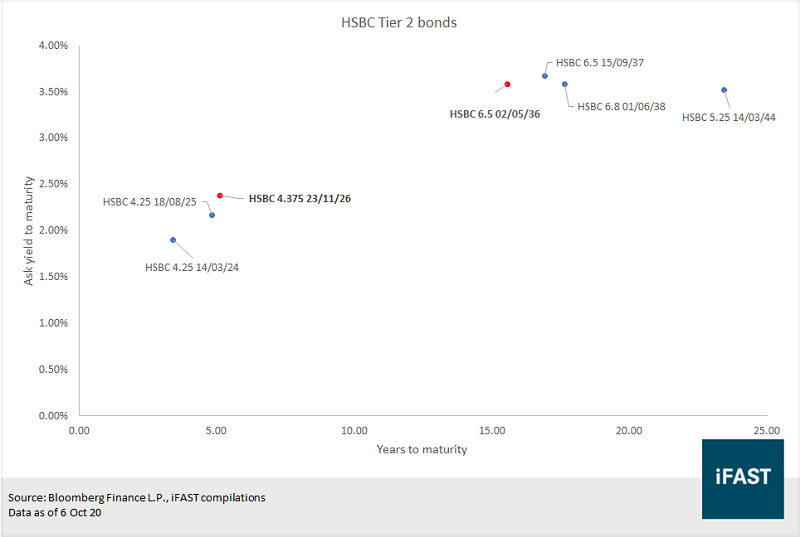
For tier 2 bonds, investors can look at HSBC 4.375% 23Nov2026 Corp (USD) and HSBC 6.500% 02May2036 Corp (USD). The longer dated bond offers a spread pick-up of about 73 bps.
Figure 3: HSBC Tier 2 bonds
In the near future,
negotiating good deals for the businesses that are looking to be sold could
boost HSBC bonds, but the lender should still continue to face profitability
woes. The biggest obstacle would still be COVID-19 and the relevant government
measures, as cases remain on the rise. Uncertainty remains, but HSBC bonds are decently
valued in our view.
References
BBC News. 2020. Fincen Files: HSBC Moved Ponzi Scheme Millions Despite Warning. [online] Available at: <https://www.bbc.com/news/uk-54225572>
Bloomberg. 2020. China Reveals Punishment For Firms On Unreliable Entity List. [online] Available at: <https://www.bloomberg.com/news/articles/2020-09-19/china-reveals-punishment-for-firms-on-unreliable-entity-list>
Chen, Q., 2020. HSBC May Have Violated Chinese Law In Meng Wanzhou’S Arrest In Canada - Global Times. [online] Globaltimes.cn. Available at: <https://www.globaltimes.cn/content/1202480.shtml>
Ministry of Commerce, People’s Republic of China. MOFCOM Order No. 4 of 2020 on Provisions on the Unreliable Entity List. Available at: < http://english.mofcom.gov.cn/article/policyrelease/questions/202009/20200903002580.shtml
US 116th Congress. H.R. 7440 – Hong Kong Autonomy Act. Available at: <https://www.congress.gov/bill/116th-congress/house-bill/7440/text>
Wilson, H. and Liu, A., 2020. HSBC, Stanchart Defy U.K. To Endorse Hong Kong Security Law. [online] Bloomberg. Available at: <https://www.bloomberg.com/news/articles/2020-06-03/u-k-banks-defy-london-to-back-beijing-on-hong-kong-security-law>
Declaration: For specific disclosure, at the time of publication of this report, IFPL (via its connected and associated entities) holds a position in HSBC 4.7% PERP Corp. The analyst who produced this report holds a NIL position in the abovementioned securities.
Our podcast series, Yield Hunters, is available on Spotify and iTunes Podcasts and Google Podcasts. We share our thoughts on new bond issues and hold discussions on the fixed income space. Listen to our latest episode below and follow us!