Receive first-hand news on the latest bond issues, credit updates and special events when you join us on our Telegram channel at https://t.me/bondsupermart!
- Straits Trading Company (“STC") continues to register strong EBITDA growth of 52.8% in FY23. Real Estate remains the key earnings driver, with a 69% YoY EBITDA growth.
- We remain positive on the business outlook for STC and expect resilient earnings in FY24 driven by real estate and stable growth in both the resources and hospitality segments.
- Credit profile for STC remains healthy given ample liquidity, sustainable cashflow, and a manageable degree of leverage.
- We recommend the STRTR 4.100% 04May2026 Corp (SGD).
Company Background
The Straits Trading Company Limited (“STC”) is a conglomerate-investment company with operations across various business segments such as resources, real estate, and hospitality. The Group reports revenue in these three operating segments. Its Real Estate segment comprises of majority stakes in property developers and real estate investment companies such as 1) Straits Development Pte. Ltd., 2) STC Property Management Sdn. Bhd., 3) Straits Real Estate Pte. Ltd. and 4) Straits Investment Management Pte. Ltd.
Besides that, the Group also owns a minority interest in 1) ESR Cayman Limited, which is APAC’s largest real estate and real assets fund manager, 2) Suntec REIT, one of the largest commercial REITs in Singapore, and 3) SDAX Financial Pte. Ltd., which is a fintech investment asset tokenizing platform.
Meanwhile, the Group’s resources segment is driven by its 52%-owned subsidiary, Malaysia Smelting Corporation (“MSC”), which is listed on both the Singapore Exchange and Bursa Malaysia. MSC is the largest independent custom tin smelter globally and is largely engaged in the upstream and downstream activities of the tin value chain through its mining, tolling and smelting businesses.
The Group’s hospitality segment is mainly driven by Far East Hospitality Holdings Pte Ltd (“FEHH”), which is a 30%-owned joint venture with Far East Orchard Limited. FEHH has a combined portfolio of close to 16,500 rooms under the management across over 90 hotels and serviced residences in nine countries.
Financial Highlights
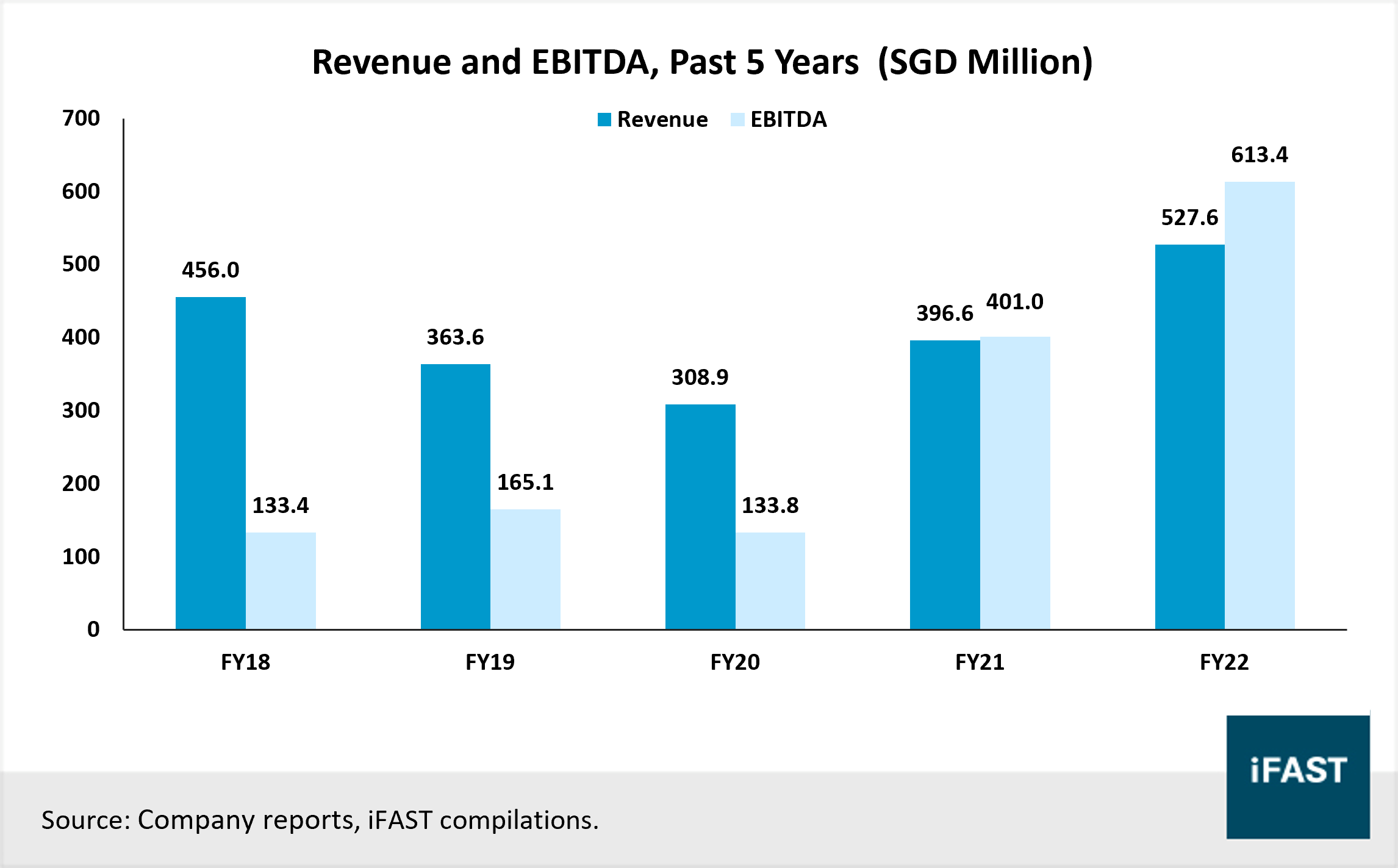
For the full year ended 31 December 2022, STC’s revenue grew 33.0% year-on-year (YoY) to S$ 527.6M (Chart 1), mainly driven by a strong performance for its real estate and resources segment. EBITDA continue to grow steadily, by 52.9% YoY to S$ 613.4M, despite greater operating expenses from costlier tin mining and smelting operations. As such, net profit after tax (attributable to shareholders) surged by 135% YoY to S$551.3M, partly helped by decent income tax credit.
Chart 1: EBITDA continue to demonstrate strong post-Covid growth
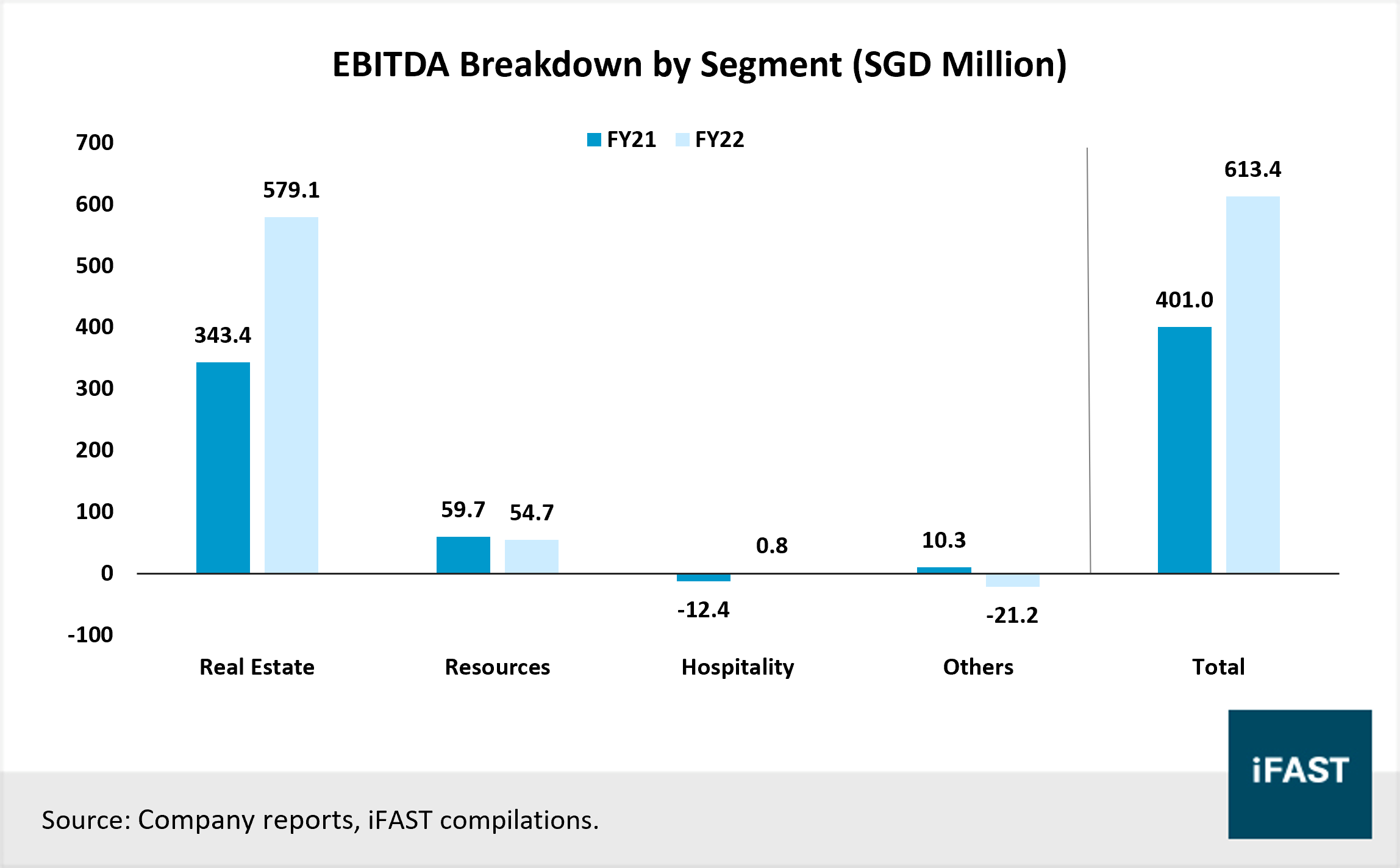
For its Resources segment, MSC’s revenue grew by 39.7% YoY to a record high of RM1,503.6 million. This was driven by higher average tin prices in Ringgit terms as well as a stronger sales volume of refined tin. However, operating costs also rose as MSC’s international tin smelting operations saw higher labour, energy, fuel, reductant, and furnace re-bricking expenses. This ate into MSC’s operating profit, leading to a -8% YoY decline in the overall resources segment’s EBITDA.
STC’s Real Estate segment managed to deliver solid performance in FY22 across its group of property developers and real estate investment companies. Collectively, the segment also reported a 69% YoY increase in EBITDA to $579.1M. The notable increase can be largely attributed to gains from a disposal of the stake in ARA Asset Management Limited which offset fair value losses from several of its investment properties due to higher capitalisation rates.
STC’s Hospitality segment reported an EBITDA of $0.8 million for FY22, up from a loss of $12.4 million During the year, demand from leisure and business rebounded with the global reopening of borders globally and support from the government. Together, this drove occupancies, room rates, and fees higher for FEHH which helped compensate for the inflation-driven operating expenses.
Chart 2: Real estate was the key earnings driver in FY22
Business Outlook
Looking ahead, we remain positive on the business outlook for STC. Earnings have been fairly resilient despite softening global economic growth and we expect this to continue in FY24 (as explained below). That said, earnings may soften if global economic growth decelerates further but STC will likely remain profitable in our view.
- Resources segment may be challenged by macro headwinds but resilient tin prices and potential cut in operating expenses helps protect profits. While Tin’s demand has fallen, we expect supply to remain tight as production in Myanmar (possible mining suspension in parts of Myanmar) and Indonesia (potential export ban of refined tin) will likely remain volatile. The International Tin Association also forecasts the metal to be in a structural deficit. Overall, we expect tighter supply to offset weak demand, supporting and keeping average prices for Tin elevated relative to pre-Covid levels. If macro headwinds escalate in 2H23 and FY24, we expect sales volume to decline but elevated Tin prices may minimise the drag on sales value.
- Furthermore, with a potential full decommission of MSC’s Butterworth plant by mid-2024, the company expects cost savings of approximately 30%. Together with subsiding inflationary pressure, we think operating expenses for MSC may decline meaningfully next year.
- Well-diversified portfolio expected to provide income stability and growth opportunities for STC’s real estate segment. High-quality acquisitions such as Australia’s newly upgraded and repositioned office properties and UK’s business park property should provide steady income as demand has been resilient. We expect income growth to come from (1) the group’s S. Korea’s logistics properties, given robust e-commerce growth and stronger warehouse demand in recent years, (2) Chong Qing and Shanghai retail malls as footfall and consumer spending is expected to recover after China reopens, and (3)the opening of Crowne Plaza Hotel, slightly later in 1Q24, in Straits City, Penang.
- The continuation of tourism rebound provides support for the Hospitality segment. We continue to expect an improvement in the tourism industry this year on the back better flight connectivity/ capacity as well as a greater number of China tourists. This should benefit FEHH’s hotel portfolio (Singapore, Australia, Austria, Denmark, Japan, Germany, Hungary, Malaysia. and New Zealand) where many are in tourist hotspots. Additionally, five new hotels (>750 rooms) are slated to open across Australia, Japan, Malaysia, and Switzerland. While the cost of operations may pick up, we remain positive that net property income should remain positive.
Credit highlights
For the full year ended 31 December 2022, total borrowings for STC grew by 33% YoY from S$ 1,046.0M (FY21) to S$ 1,390.7M (FY22). While debt value has risen, the debt profile remains decent in our view. First, the increment was largely driven by longer-term secured loans (Secured by mortgages on certain properties, assets and shares). If the Group is unable to pay off these borrowings, they are able to utilise these collateralised assets to repay the debt. As of FY22, the Group’s investment property can sufficiently cover secured debt as suggested by a secured debt-to-investment properties ratio of 58%. Second, the portion of unsecured borrowings to total borrowings is not excessive, at 56% and 58% for current and non-current borrowings respectively.
Third, short-term borrowings that are repayable within a year have declined by 61% to S$ 336.7 (FY22). We note that short-term borrowings in the current fiscal year is likely to drop further, considering the Group would likely utilise the net proceeds from its recent issuance of SGD 370m worth of secured exchangeable bonds (in 1Q) to refinance existing borrowings.
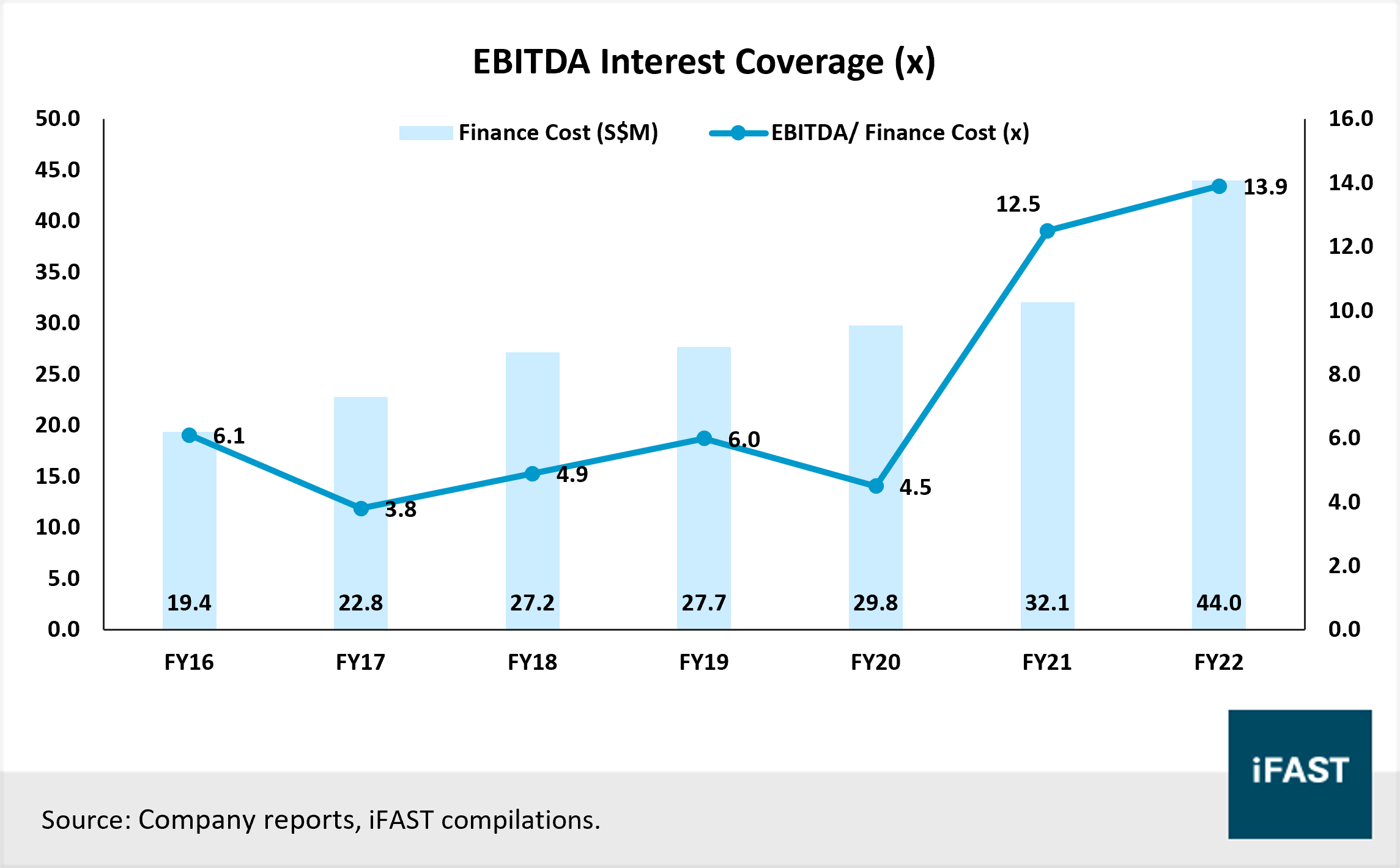
The debt ratios further affirm that the degree of leverage remains manageable. STC still maintains a decent net debt to total assets ratio at 33% (FY22), slightly higher but close to the industry average. The net gearing ratio remains healthy, at 61% which is lower than the industry average (Table 1). The Group also managed to improve its interest coverage. The EBITDA interest coverage ratio has jumped from 12.5x (FY21) to 13.9x (FY22) as EBITDA grew over 50% in FY22. The operating cash flow interest coverage ratio (before changes in working capital) is near 1.2x, around historical levels. Both ratios are either around or have exceeded the industry average.
Chart 3: STC’s EBITDA coverage ratio has improved in FY22
STC managed to strengthen its liquidity position by growing cash and short-term deposits by 78% from S$ 141.6M (FY21) to S$ 251.7M (FY22). The was driven by inflows from financing and operations. Specifically, cash flow from financing activities turned positive in FY22 after the issuance of S$170M STRTR 4.100% 04May2026 Corp (SGD) in May 2022 and S$78.3M from the issuance of shares. The improved cash position also allows the group to sufficiently cover its short-term borrowings of S$ 148.4M. Liquidity ratios are also healthy and above the industry average, with the cash and current ratio standing at 0.7X and 1.4X respectively for FY22.
STC’s management is also of the opinion that cashflow should remain sustainable. The Group has largely seen steady inflows from sources dividend from investment securities, interests received, operating cashflow (before working capital), and from the disposal of assets. We think it is worth highlighting that the operating cashflow (before working capital) has been robust and positive, averaging at S$50.1M, over the past 4 years - even during the pandemic. The Group also has a strong history of asset disposal such as the sales and divestment of its property portfolios which tend to generate large cash inflows. STC has an average disposal per annum of S$165.4M.
Overall, the credit profile for STC remains healthy given ample liquidity, sustainable cashflow, and a manageable degree of leverage. The resilient earnings outlook in FY24 (as outlined above) should also contribute to a healthy financial position in the short term.
Table 1 and 2: Credit metrics comparison for diversified property developers
|
Market Cap. (SGD Millions)
|
Net Gearing
(%)
|
Interest coverage
(x)
|
Operating Cash Flow/ Interest Expense (x)
|
Net Debt/
Total Assets (%)
|
|
Straits Trading
|
935
|
61.0
|
13.9
|
1.2
|
33.0
|
|
City Developments
|
6,103
|
76.3
|
7.6
|
1.4
|
31.8
|
|
OUE
|
881
|
43.3
|
1.9
|
1.7
|
27.3
|
|
Sinarmas Land
|
851
|
-2.1
|
3.9
|
3.9
|
-1.3
|
|
Oxley Holdings
|
532
|
198.9
|
1.3
|
0.7
|
54.3
|
|
Tuan Sing Holdings
|
371
|
83.8
|
0.6
|
0.6
|
38.6
|
|
GSH Corp.
|
345
|
92.7
|
0.5
|
0.7
|
34.8
|
|
Average
|
-
|
79.1
|
4.2
|
1.5
|
31.2
|
|
Source:
Bloomberg L.P., iFAST Compilations. Data as of 30 June 2023.
*Calculation of average excludes figures that are larger than 2
standard deviation from their respective category.
|
|
Market
Cap.
(SGD Millions)
|
Secured Debt/ Investment Properties (%)
|
Cash Ratio
|
Quick Ratio
|
Current Ratio
|
|
Straits Trading
|
935
|
57.6
|
0.7
|
0.7
|
1.4
|
|
City Developments
|
6,103
|
26.2
|
0.5
|
0.5
|
2.2
|
|
OUE
|
881
|
16.4
|
0.4
|
0.5
|
0.7
|
|
Sinarmas Land
|
851
|
105.1
|
1.3
|
1.4
|
2.7
|
|
Oxley Holdings
|
532
|
550.7
|
0.1
|
0.1
|
1.0
|
|
Tuan Sing Holdings
|
371
|
81.3
|
0.6
|
0.6
|
1.3
|
|
GSH Corp.
|
345
|
N.M.
|
0.3
|
0.3
|
2.1
|
|
Average
|
-
|
57.0
|
0.5
|
0.6
|
1.6
|
|
Source:
Bloomberg L.P., iFAST Compilations. Data as of 30 June 2023.
*Calculation of average excludes figures that are larger than 2
standard deviation from their respective category.
|
Recommendation
Comparing the fixed rate issuances by Straits Trading and its related entities (Table 3), STC’s bonds that are maturing in 2005 and 2026 look attractive given higher yield-to-maturity (“YTM”) considering the remaining years to maturity. Notably, the STRTR 3.750% 29Oct2025 Corp (SGD) is currently yielding ~4.5% with 2.33 years left to maturity, while the STRTR 4.100% 04May2026 Corp (SGD) is yielding ~4.7% with 2.85 years left to maturity.
Both STC’s 2025 and 2026 bond are attractive in our view but we prefer the latter. The 2026 bond offers almost a 20 bps for slightly longer years to maturity (0.5 years), which we see as fair. Amongst the comparable entities, OUESP 3.500% 21Sep2026 Corp (SGD) is another bond we like its given relatively higher YTM, albeit partly driven by higher credit spreads.
In sum, STC is a diversified property developer with a healthy credit profile and positive earnings outlook. We do not foresee issues for STC in meeting its debt obligations in the near-term. As such, for investors looking for option in the short to medium term and/or for a healthy diversified property developer, we recommend the STRTR 4.100% 04May2026 Corp (SGD).
Table 3: Fixed rate issuances from Straits Trading and comparable entities
Declaration: For specific disclosure, at the time of publication of this report, IFPL (via its connected and associated entities) holds positions in STRTR 3.750% 29Oct2025 Corp (SGD), STRTR 4.100% 04May2026 Corp (SGD), OUECT 3.950% 02Jun2026 Corp (SGD) and the analyst who produced this report holds a NIL position in the abovementioned securities.
Our podcast series, Yield Hunters, is available on Spotify, iTunes Podcasts and Google Podcasts. We share our thoughts on new bond issues and hold discussions on the fixed income space. Listen to our latest episode below and follow us!